
“Perseverance is not a long race; it is many short races one after the other.” — Walter Elliot
Jobs Update
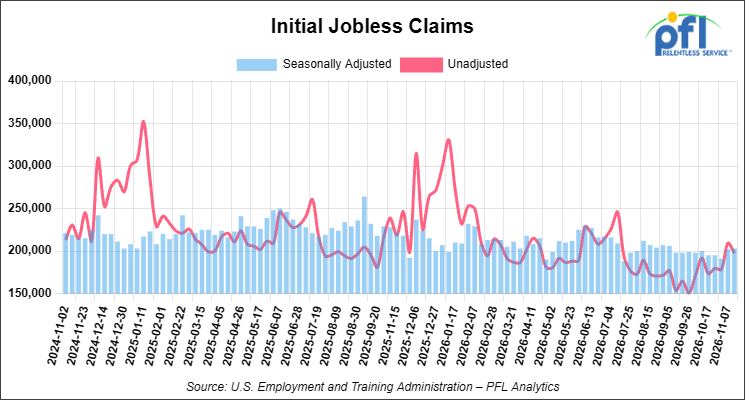
Initial jobless claims seasonally adjusted for the week ending November 14, 2026 came in at 203,000, versus the adjusted number of 202,000 people from the week prior, up 1,000 people week over week.
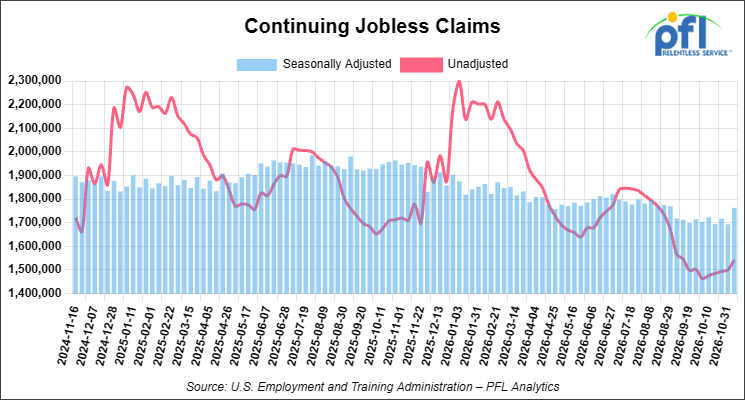
Continuing jobless claims came in at 1,763,000, versus the adjusted number of 1,693,000 people from the week prior, up 70,000 week-over-week.
Stocks closed lower on Friday of last week and lower week-over-week
The DOW closed lower on Friday of last week, down -949.73 points (-1.93%), closing out the week at 48,147.33, down -4,200.22 points week-over-week. The S&P 500 closed lower on Friday of last week, down -265.44 points (-3.70%), and closed out the week at 6,910.39, down -651.28 points week-over-week. The NASDAQ closed lower on Friday of last week, down -1261.47 points (-5.28%), and closed out the week at 22,617.73, down -2,518.54 points week-over-week.
In overnight trading, DOW futures are expected to open at 49,198 this morning, up 982 points from Friday’s close.
Crude oil closed higher on Friday of last week, but lower week-over-week
West Texas Intermediate (WTI) crude closed up $0.77 per barrel (0.93%), to close at $83.98 on Friday of last week, but down $4.58 per barrel week-over-week. Brent crude closed up $0.59 per barrel (0.64%), to close at $92.57, but down $3.27 per barrel week-over-week.
One Exchange WCS (Western Canadian Select) for December delivery settled on Friday of last week at US$22.35 below the WTI-CMA (West Texas Intermediate – Calendar Month Average). The implied value was US$58.78 per barrel.
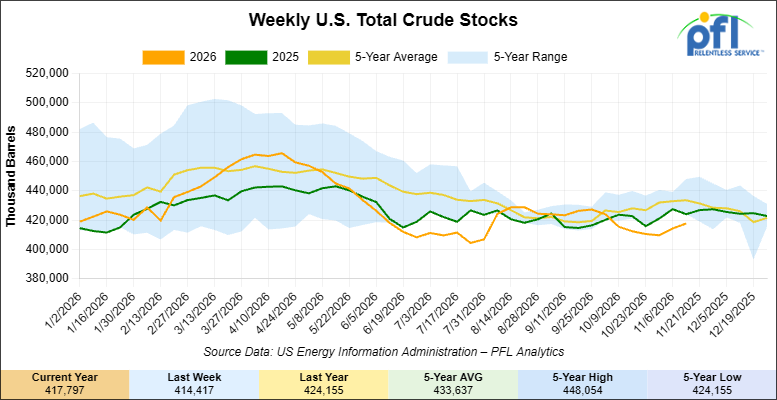
U.S. commercial crude oil inventories (excluding those in the Strategic Petroleum Reserve) increased by 3.4 million barrels week-over-week. At 417.8 million barrels, U.S. crude oil inventories are 4% below the five-year average for this time of year.
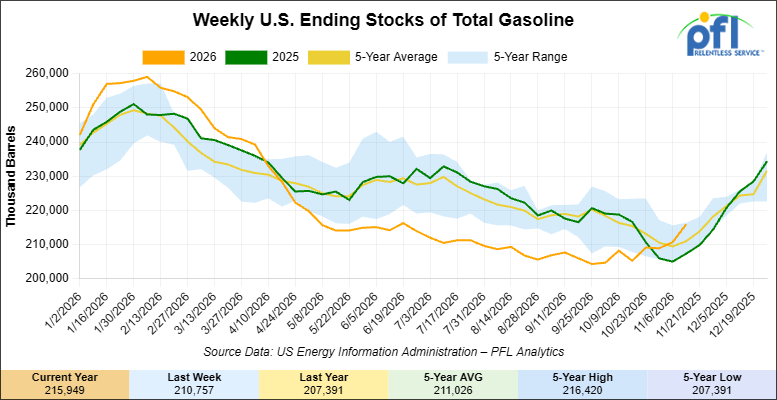
Total motor gasoline inventories increased by 5.2 million barrels week-over-week. and are 2% above the five-year average for this time of year.
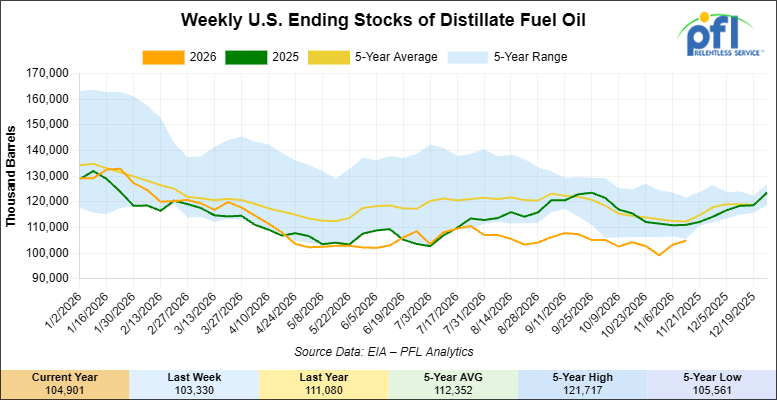
Distillate fuel inventories increased by 1.6 million barrels week-over-week. and are 7% below the five-year average for this time of year.
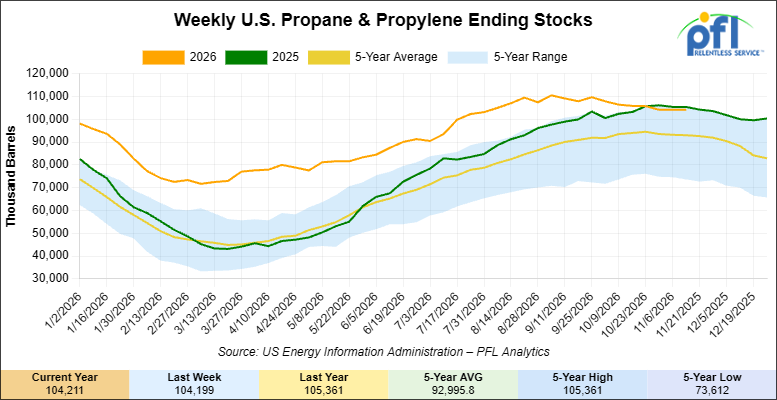
Propane/propylene inventories increased by 12,000 barrels week-over-week. and are 12% above the five-year average for this time of year.
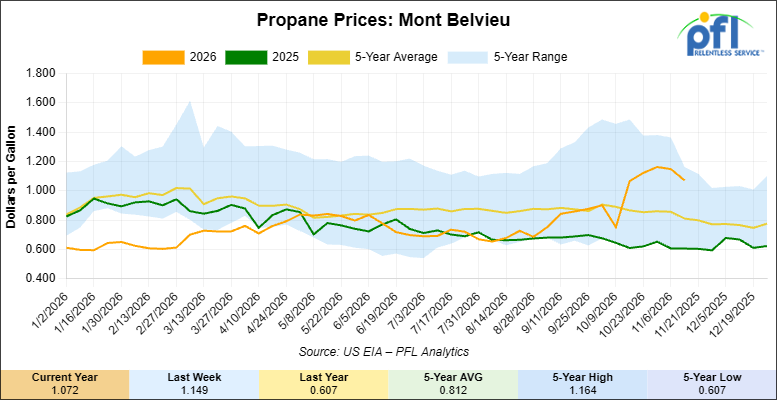
Propane prices closed at 107.2 cents per gallon on Friday of last week, down 7.7 cents per gallon week-over-week, but up 46.5 cents year-over-year.
Overall, total commercial petroleum inventories increased by 9.2 million barrels week-over-week during the week ending November 13, 2026.
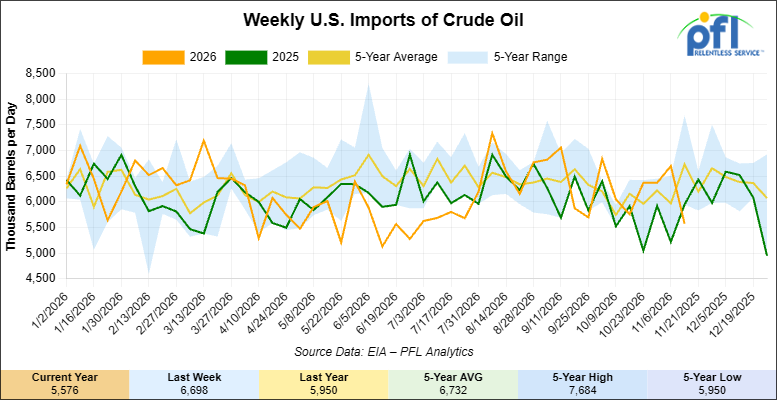
U.S. crude oil imports averaged 5.6 million barrels per day during the week ending November 13, 2026, a decrease of 1,122,000 barrels per day week-over-week. Total motor gasoline imports (including both finished gasoline and gasoline blending components) averaged 533,000 barrels per day, and distillate fuel imports averaged 133,000 barrels per day during the week ending November 13, 2026.
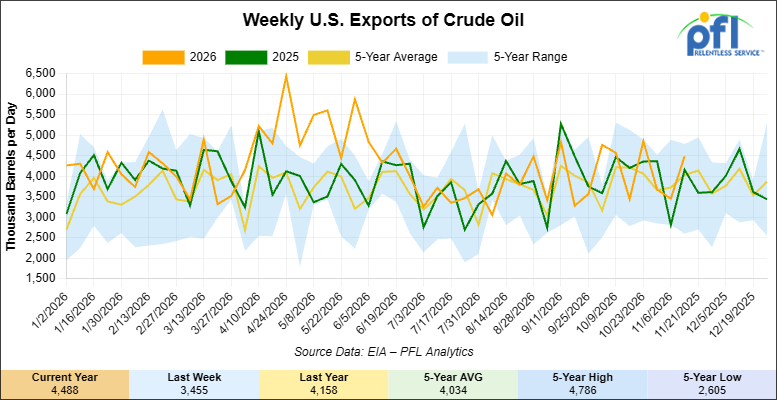
U.S. crude oil exports averaged 4.488 million barrels per day during the week ending November 13, 2026, an increase of 1.033 million barrels per day week-over-week. Over the past four weeks, crude oil exports averaged 4.118 million barrels per day.
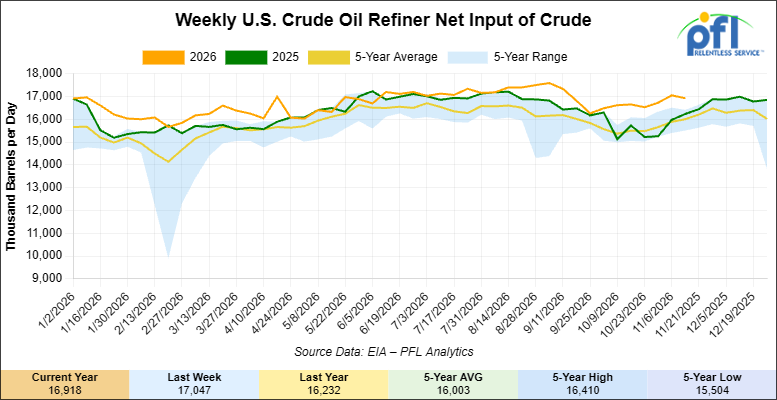
U.S. crude oil refinery inputs averaged 16.9 million barrels per day during the week ending November 13, 2026, which was 129,000 barrels per day less week-over-week.
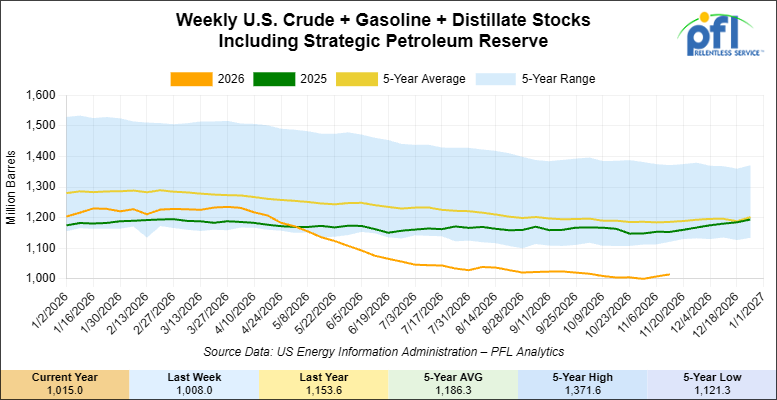
U.S. crude oil, gasoline and distillate inventories, including the Strategic Petroleum Reserve, increased by 6,969,000 barrels week-over-week to 1,015.0 million barrels for the week ending November 13, 2026. Combined stocks are 138.5 million barrels—or 12.0%—below last year and 171.3 million barrels—or 14.4%—below the five-year average. Inventories remain below the five-year seasonal range.
WTI is poised to open at $82.35 this morning, down $1.06 per barrel from Friday’s close.
North American Rail Traffic
Week Ending November 18, 2026:
Total North American weekly rail volumes were up (+8.79%) in week 47, compared with the same week last year. Total Carloads for the week ending November 18, 2026 were 335,438, up (+5.35%) compared with the same week in 2025, while weekly Intermodal volume was 368,758, up (+12.13%) year over year. 10 of the AAR’s 11 major traffic categories posted year-over-year increases. The largest decrease came from Grain (-1.72%). The largest increase was Metallic Ores and Metals (+17.43%).
In the East, CSX’s total volumes were up (+10.57%), with the largest increase coming from Motor Vehicles and Parts (+17.82%). NS’s total volumes were up (+5.78%), with the largest increase coming from Petroleum & Petroleum Products (+14.43%), while the largest decrease came from Grain (-10.12%).
In the West, BNSF’s total volumes were up (+10.45%), with the largest increase coming from Forest Products (+23.42%), while the largest decrease came from Grain (-16.56%). UP’s total volumes were up (+8.77%), with the largest increase coming from Intermodal Units (+16.26%), while the largest decrease came from Nonmetallic Minerals (-3.74%).
In Canada, CN’s total volumes were up (+9.62%), with the largest increase coming from Metallic Ores and Metals (+26.23%), while the largest decrease came from Grain (-5.26%). CPKCS’s total volumes were up (+4.67%), with the largest increase coming from Metallic Ores and Metals (+22.27%), while the largest decrease came from Coal (-12.19%).
Source Data: AAR – PFL Analytics
North American Rig Count Summary
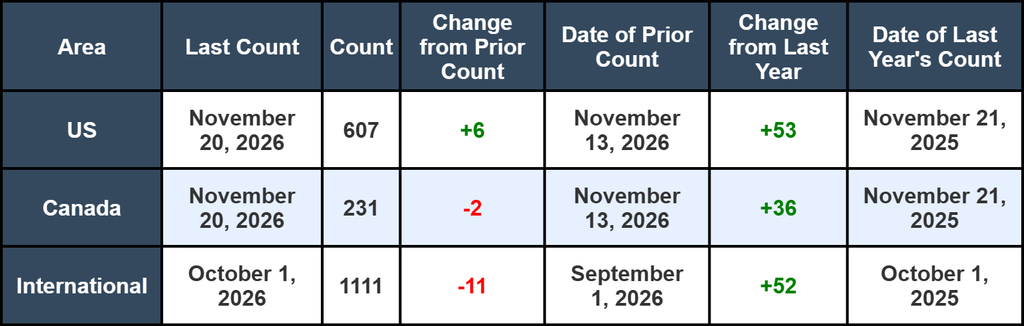
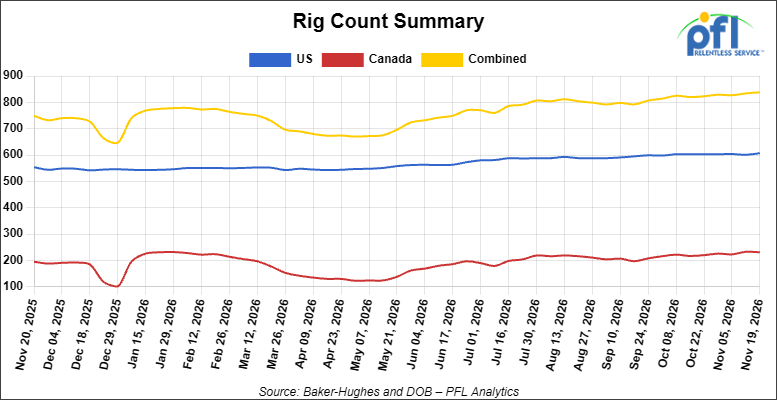
North American rig count was up by +4 rigs week-over-week. The US rig count was up by +6 rigs week-over-week, and up by +53 rigs year-over-year. The US currently has 607 active rigs. Canada’s rig count was down by -2 rigs week-over-week but up by +36 rigs year-over-year. Canada currently has 231 active rigs. Overall, year-over-year we are up by +89 rigs collectively.
We are watching a few things out there for you:
We Continue to Watch Our Strategic Petroleum Reserves
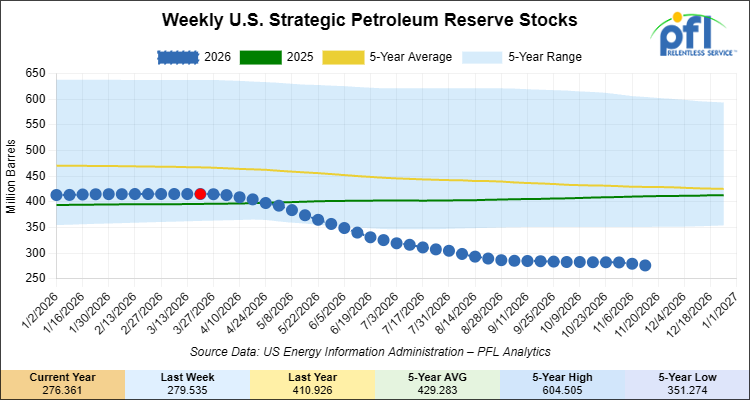
The ongoing emergency drawdown of the U.S. Strategic Petroleum Reserve (SPR) remains a major component of global efforts to offset crude oil supply disruptions stemming from the conflict involving Iran and the continued restrictions on oil shipments through the Strait of Hormuz. Since March, the Department of Energy (DOE) has awarded exchanges covering more than 133 million barrels of crude oil, with additional releases expected as part of a broader international response coordinated through the International Energy Agency (IEA).
The United States continues to execute its commitment to make available up to 172 million barrels from the SPR under the IEA’s collective plan to inject roughly 400 million barrels into global energy markets. Officials have argued that the releases are necessary to help stabilize crude supplies and limit further increases in fuel prices as refiners compete for replacement barrels amid ongoing transportation disruptions. The IEA’s coordinated action remains the largest emergency oil-stock release in the agency’s history.
Inventories in the SPR have declined to 276.361 million barrels, down from 415.442 million barrels at the start of the conflict with Iran and reaching their lowest level since October 1982. The SPR decreased by 3,174,000 barrels during the week ending November 13th (453,429 barrels per day). Since the first SPR drawdown began, the United States has withdrawn approximately 139.081 million barrels, equivalent to an average of roughly 584,374 barrels per day through the week ending November 13, 2026.
Global petroleum inventories have also tightened considerably. The IEA has reported substantial draws in commercial crude and refined-product stockpiles across major consuming nations, underscoring the strain that the conflict has placed on world energy markets. While oil flows through the Strait of Hormuz have partially recovered from their initial near-shutdown, the IEA continues to identify significant uncertainty surrounding the pace and durability of the recovery.
The Administration continues to emphasize that the current program consists primarily of exchange agreements, rather than outright sales. Under these arrangements, companies receiving crude oil today are required to return the borrowed barrels in the future along with additional volumes as a premium.
We Are Watching Plant Security
A federal grand jury in Illinois indicted Andrew M. Kozak, 41, of Chillicothe on Tuesday of last week over the bomb scare at BioUrja Renewables’ 135-million-gallon-per-year ethanol plant in Peoria. Kozak, a process trainee at the plant, is charged with transmitting a threat to destroy the facility by fire and explosive, which carries up to 10 years, and with making threatening interstate communications, which carries up to five. He pleaded not guilty and a trial date was set for January 11th. This was no hoax: bomb technicians rendered a device safe at 9:12 p.m. on Friday, November 13th, and the FBI has since confirmed it was a real explosive. Thousands of people inside a one-mile radius, reaching into East Peoria, were evacuated for 18 hours. Federal officials have not said who built or planted the device.
Law enforcement at the BioUrja Renewables ethanol plant in Peoria, November 2026.

Source: FBI, via NPR Illinois – PFL Analytics
The threat came from inside the gate, and that is the part that should bother every plant operator reading this. Prison records cited by the Chicago Sun-Times show Kozak served time in Nebraska on burglary charges, released in 2008, and the Associated Press reported a further sentence that ended in 2014. The federal backstop for vetting people at hazardous sites has been gone since Congress let the Chemical Facility Anti-Terrorism Standards program lapse on July 27th, 2023, and it has not been reauthorized. CFATS covered roughly 3,200 high-risk facilities and gave them access to terrorist watchlist screening for new hires; what remains is voluntary. Peoria is not the first device found at U.S. infrastructure this year either. In May, a grenade-type IED turned up at the Converse Reservoir, the drinking water source for Mobile, Alabama.
What does this do to insurance? So far, not much, because commercial property and energy insurance is in its softest market in years and premiums are still falling. Marsh’s global index showed commercial rates down 5% in the third quarter, the ninth straight quarterly decline, with property down 10% and the U.S. composite down 1%. Willis put North American large property rates down 14.5% in the second quarter, and its April energy review described a buyer’s market despite roughly $6.8 billion in downstream losses in 2025. One defused device will not turn a market swimming in capacity, although underwriters do give loss-affected accounts a harder look at renewal.
The inflation pressure sits on the liability side. U.S. casualty is the one major line still rising in Marsh’s numbers, and that, more than fences and cameras, is what will show up in plant operating costs. Better screening of who gets a badge is cheap next to an 18-hour shutdown and a one-mile evacuation. PFL will be watching whether Washington finally revives chemical facility vetting, and whether shippers start writing it into their own contracts.
We Continue to Watch Prince Rupert
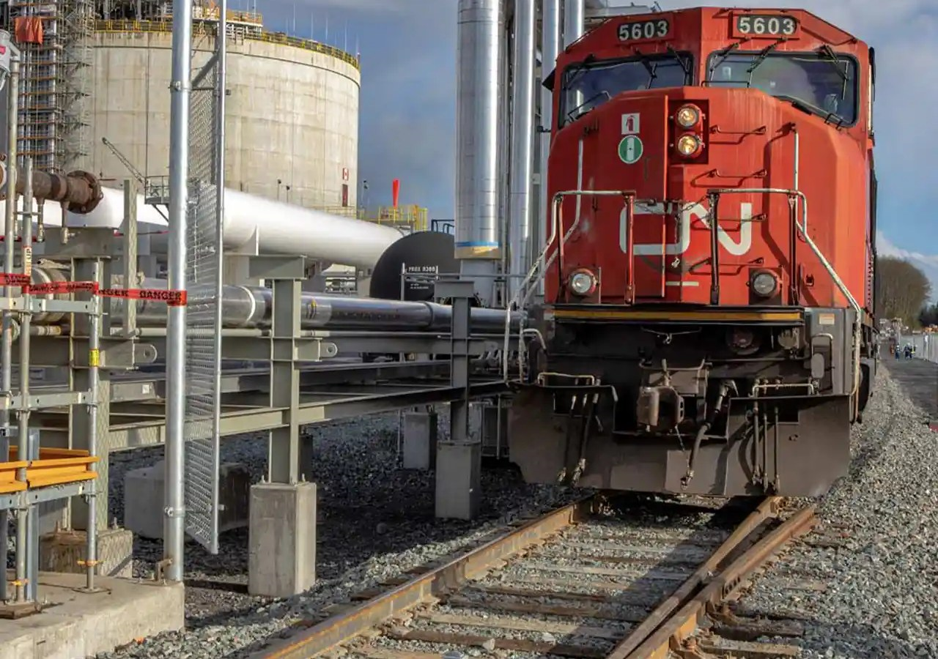
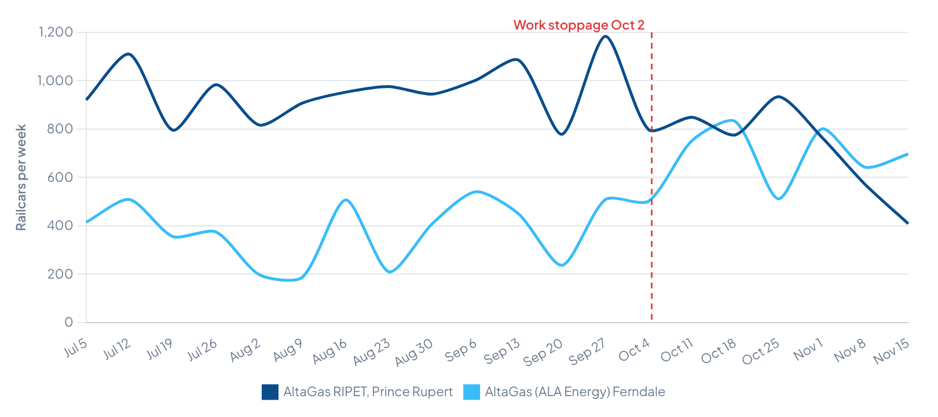
The strike by ILWU Local 523A at Trigon Pacific Terminals on Ridley Island went into its seventh week last week with the two sides still far apart: Trigon is offering $65.41 an hour over seven years and the union wants $74.41 over three. RailState counted just 409 propane tank cars into AltaGas’ Ridley Island Propane Export Terminal in the week of November 9th to the 15th, against roughly 975 a week before the strike and about 1,017 a week at the same point last year. Since the Canada Industrial Relations Board ordered Trigon to keep replacement workers off its property and rail infrastructure, AltaGas’ contractors can no longer do the switching.
A CN train at Trigon Pacific Terminals on Ridley Island, Prince Rupert.
Source: Trigon Pacific Terminals – PFL Analytics
AltaGas has started limiting its rail offtake of propane in Alberta, and estimates roughly 800,000 barrels a week cannot move to the coast, with losses of up to C$75 million across producers and midstream. Ferndale in Washington State is picking up some of the slack at about 678 cars a week, up from 397, but AltaGas’ combined car count is still 14% below pre-strike levels. Edmonton propane traded 33 cents a gallon under Conway on November 13th, the widest discount for western Canadian propane since February 2021. Western Canadian propane stocks started November at 7.36 million barrels, 14% higher than a year earlier, according to Canada Energy Regulator data.
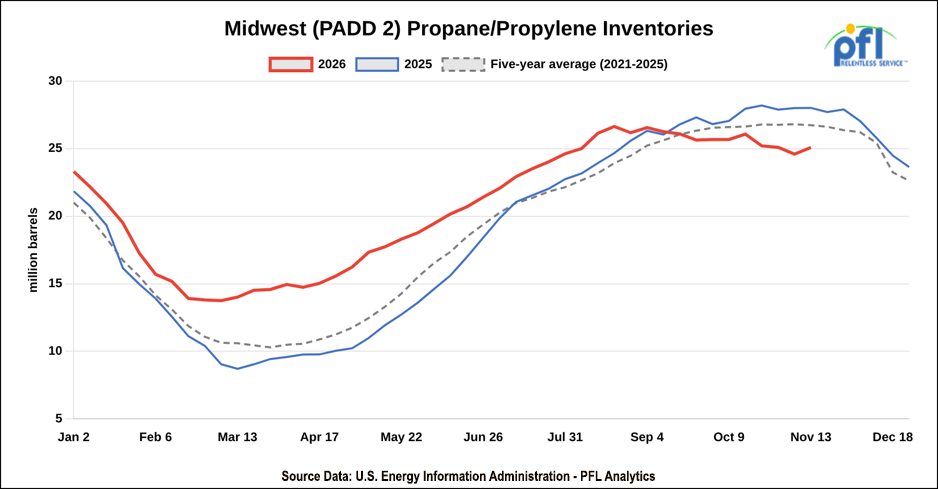
Here in the U.S. the picture is the opposite. U.S. propane stocks sat at 104.2 million barrels in the week ending November 13th, about 12% above the five-year average, but 64.3 million of that is on the Gulf Coast. Midwest stocks were 25.1 million barrels, below the five-year average of 26.7 million and 10% under a year ago, heading into heating season. RBN noted that the record storage surplus evaporated with early withdrawals in October, and that the Midwest has only just started to refill. Folks, there is cheap propane piling up in Alberta just a short Midwest train ride away. If you have pressure cars sitting or a supply problem to solve this winter, call PFL today.
We Continue to Watch Left Wing Carney
The November 15th deadline for binding Pathways agreements between Ottawa, Alberta and the five big oil sands producers came and went with no deal, and officials are now saying only that one is expected soon. This is the carbon capture project Prime Minister Carney made the condition for a West Coast pipeline: “no Pathways, no pipeline.” On Friday of last week Alberta changed its carbon capture incentive program to pay grants covering 12% of eligible capital costs during construction rather than after start-up, to line up with the federal tax credit. Company executives have signaled they are willing to take whatever time is needed to get the right deal.
Ottawa has had no trouble closing deals with itself. The Parliamentary Budget Officer reported on Tuesday of last week that new measures across Carney’s three spending plans total $331.6 billion, and about 60% of that goes to the day-to-day operations of government, not capital. The PBO also found the government spent 96% of its new fiscal room from higher-than-expected revenues on fresh commitments instead of the deficit, and that borrowing is set to reach $765 billion over five years. Do the math: 60% of $331.6 billion is roughly $199 billion for operations, about 4.5 times the C$43.7 billion estimate for the Pacific Link pipeline that still has no shipper and is waiting on Pathways.
A government that can find $331.6 billion for new spending but cannot get a signature from five oil companies has its priorities exactly where we expected them to be.
We Continue to Watch the UP NS Merger
Dozens of comments flowed into the Surface Transportation Board last week with the deadline for public and stakeholder comments due November 18. While shipper associations were the voice of most filings, a few individual shippers did submit their own remarks. Chemicals manufacturer Lubrizol told the STB that 25% of its rail traffic is captive to UP and NS and that trucking is not viable for its business. It expressed concerns over rising rates in the event of a transcontinental merger. Olin also echoed similar remarks, saying a merger between the two Class Is would place more than 60% of its originating rail volume under the control of one railroad, saying the merger erodes competition and makes them vulnerable to unilateral rate increases. We continue to watch this one as the merger plays its course through the STB. Stay tuned to PFL.
We Continue to Watch Hormuz
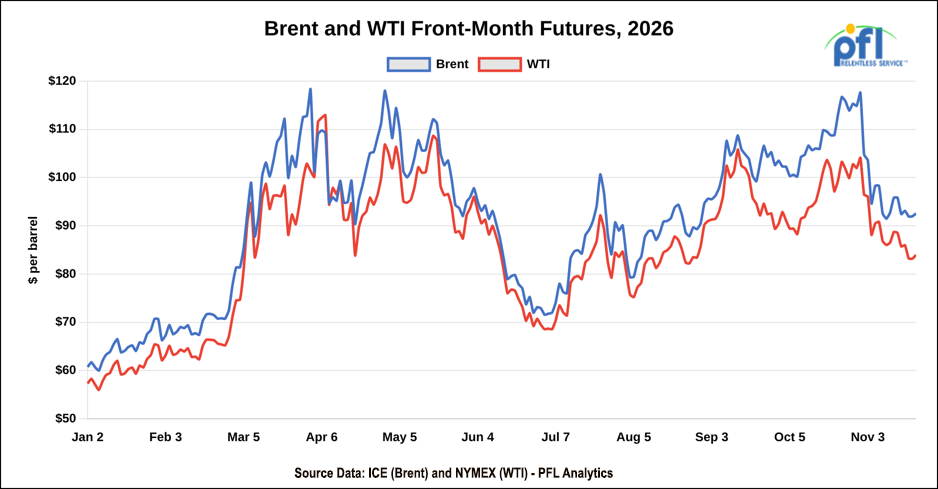
WTI settled at $83.98 on Friday of last week, down $4.58 or 5.2% on the week, and Brent closed at $92.57, down $3.27, the third straight weekly decline for both. Brent is down more than 20% in November as crude shipments through the Strait of Hormuz have returned to roughly pre-war levels. Houthi attacks on Riyadh and fresh tanker incidents were not enough to change the direction, with the IEA now seeing a surplus of about 2 million barrels per day this quarter. OPEC+ meets on November 29th to set 2027 policy.
U.S. refiners are not slowing down. Runs were 95.7% of capacity in the week ending November 13th, with crude stocks up 3.4 million barrels to 417.8 million and gasoline up 5.2 million. Distillate stocks rose 1.6 million barrels to 104.9 million, still about 7% below the five-year average for the week. The Gulf Coast sweet 3-2-1 crack averaged $41.37 a barrel from November 1st to 18th, the widest for that stretch since at least 2015, even after Gulf Coast ULSD dropped almost 38 cents a gallon on the week.
Refiners are pushing maintenance into 2027 to capture these margins, which sets up a heavier turnaround season next year. PBF has moved turnarounds at Chalmette and Toledo out of the fourth quarter, Citgo has deferred a coker turnaround at Lake Charles, and Valero says about 1.5 million barrels per day of turnarounds have been delayed worldwide. We will continue to watch this one closely!
We Continue to Watch Permitting
In last week’s report, we covered the 73-25 procedural vote. On Thursday of last week, the Senate passed the Bipartisan American Affordability and Jobs Act 62-33, the most significant energy legislation to clear the chamber since the Inflation Reduction Act. About 14 Democrats, including Leader Chuck Schumer, and independent Angus King voted yes, while Republicans Josh Hawley and Mike Rounds voted no. The bill shortens the window for legal challenges and protects federal permits once issued, which matters for pipelines and power lines alike.
Now it is the House’s turn, and the clock is short. A House vote is expected after Thanksgiving, and Republican leaders want it on the President’s desk in the lame-duck session before Democrats take control of both chambers in January. The White House has said it supports the bill. We will continue to watch this one into the House.
We Are Watching Enbridge
Enbridge’s 475,000 barrel per day North Dakota Pipeline has been shut or running at reduced rates since November 14th after organic chlorides turned up in Bakken crude arriving at Clearbrook, Minnesota. Enbridge says it will not accept contaminated crude and has given no restart timeline. At least two Midwest refiners have declared force majeure, with Reuters naming Flint Hills’ Pine Bend refinery and Marathon declaring on its North Dakota deliveries on November 19th. December Bakken at Johnson’s Corner traded $1.00 to $1.50 under CMA Nymex on November 19th, down from a $1.10 premium on November 13th and the lowest since July 16th.
Producers are trucking barrels to Dakota Access delivery points, and Energy Aspects warned that tanks are filling and trucks are scarce. The realistic volume needing a new outlet is closer to 235,000 barrels per day than the 475,000 nameplate, and Dakota Access has about 225,000 barrels per day of room. That is happening with North Dakota pumping 1.18 million barrels per day in September, a 10-month high. The Bakken unit train rate to Philadelphia rose 61 cents to $11.78 a barrel last week.
North of the border, Enbridge is rationing the Mainline harder for December. Heavy nominations at Superior are apportioned 17% and light at Kerrobert 24%, up from 16% and 19% in November. Enbridge told investors on November 6th that it expects the Mainline to stay in apportionment for the foreseeable future. December WCS at Hardisty settled at $26.60 under WTI-CMA on November 11th, after trading as wide as $31 under in the first week of the month. That is well past the $18 that crude by rail needs, with the Alberta to Gulf Coast unit train at $18.14 against a $9.86 pipeline toll to Houston.
Our read is that between a contaminated system in North Dakota and a rationed Mainline, there are more barrels looking for a way out this winter than the pipes will take. PFL is watching this one closely.
We are watching Key Economic Indicators
Industrial Output & Capacity Utilization
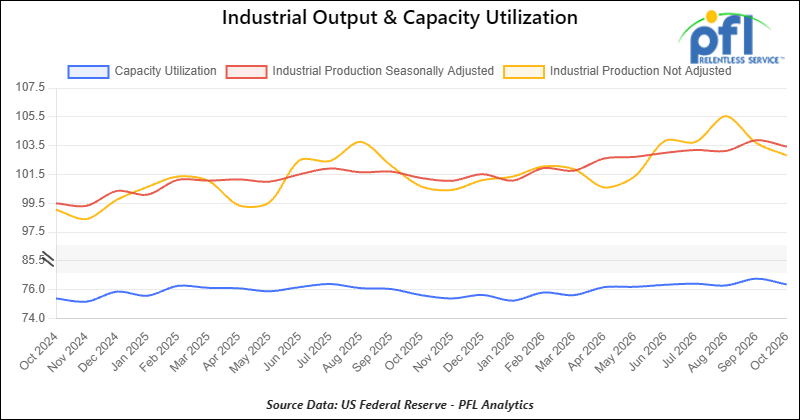
Manufacturing accounts for approximately 75% of total output. Industrial output in October decreased 0.43% from September 2026.
Capacity utilization is a measure of how fully firms are using machinery and equipment. Capacity utilization in October decreased 0.53% from September 2026.
Lease Bids
- 300, 5200CF Covered Hoppers located off of CPKCS or CN in Canada. For use in Petcoke service. Period: 3 Year.
- 10-20, 3200 or 3281 Covered Hoppers located off of CN or CPKCS in Canada. For use in Sodium Sulphate service. Period: 3-5 years. Lined.
- 20-30, Large Cube Covered Hoppers located off of multiple class 1s in Midwest. For use in DDG service. Period: 1 year.
Sales Bids
- 28, 3400CF Covered Hoppers located off of UP or BNSF in Texas. For use in Cement service. Cement Gates needed.
- 20, 17K DOT111 Tanks located off of various class 1s in various locations. For use in corn syrup service.
- 12, 21.5K-25K DOT 111 Tanks located off of various class 1s in Michigan. For use in Diesel, Asphalt, Crude service. Coiled and Insulated.
- 10, 3250CF Covered Hoppers located off of various class 1s in various locations.
- 8, 25.5K – 30K DOT 111 – DOT 117 – CPC 1232 Tanks located off of various class 1s in various locations. Cars need to be coiled and insulated.
- 12, 30K GP Tanks located off of various class 1s in various locations.
Lease Offers
- 15, 6200CF Covered Hoppers located off of all class 1s in Wisconsin. Last used in plastic. Cars are currently clean.
- 30, 6500CF Covered Hoppers located off of all class 1s in Wisconsin. Last used in plastic. Cars are currently clean.
- 93, 31.8K CPC 1232 Tanks located off of Various Class 1s in Texas. Last used in Diesel. Cars are currently clean.
- 30, 25.5K DOT 117J Tank located off of BNSF and UP in Texas. Last used in Benzene. NO BOV, NO LINER.
- 21, 20K DOT 111 Tank located off of BNSF and UP in Texas. Cars are currently clean. Cars are currently clean. C/I, NO Liner.
- 200, 31.8K CPC 1232 Tank located off of BNSF and UP in Texas. Last used in Diesel.
- 50, 25.5K 117R Tank located off of UP and BNSF in Texas. Last used in Fuel Oil. Dirty to Dirty, Available till 4/30/2027.
- 54, 25.5K 117R Tank located off of UP and BNSF in Texas. Last used in Fuel Oil. Dirty to Dirty, Available till 12/31/2027.
- 125, 5200-5400CF Covered Hoppers located off of UP in Arkansas. Last used in Wood Pellet. 1/1/2027 – 10/31/2027.
- 80, 5200-5400CF Covered Hoppers located off of UP in Arkansas. Last used in Wood Pellet. 1/1/2027 – 11/30/2027.
Sales Offers
- 81, 31.8K CPC1232 Tanks located off of UP or BNSF in TX. Last used in Multiple Services. Requal Due in 2025.
- 15, 5750 CF Hopper located off of CSX, NS, CPKCS, CN, BNSF, UP in St Louis. Last used in Grain.
- 50, 30 DOT 111 Tank located off of multiple class 1s in multiple location. Last used in Fuels.
Call PFL today to discuss your needs and our availability and market reach. Whether you are looking to lease cars, lease out cars, buy cars, or sell cars call PFL today at 239-390-2885
Railcar for Sale or Lease
| CAT | Type | Capacity | GRL | QTY | LOC | Class | Prev. Use | Offer | Note |
|---|
| CAT | Type | Size | GRL | QTY | LOC | Class | Term | Commodity | Offer | Note |
|---|
| CAT | Type | Capacity | GRL | QTY | LOC | Class | Prev. Use | Clean | Offer | Note |
|---|
| CAT | Type | Capacity | GRL | QTY | LOC | Class | Commodity | Offer | Note |
|---|
PFL will be at the Following Conferences

- Where: Renaissance Schaumburg Convention Center Hotel
- Attending: David Cohen (954-729-4774), Brian Baker (239-297-4519), and Curtis Chandler (239-405-3365)
- Conference Website

- Where: Fontainebleau Las Vegas
- Attending: David Cohen (954-729-4774) and Brian Baker (239-297-4519)
- Conference Website

- Where: Moody Gardens Hotel
- Attending: David Cohen (954-729-4774), Brian Baker (239-297-4519), and Curtis Chandler (239-405-3365)
- Conference Website

- Where: Moody Gardens Hotel
- Attending: Chase Gunnoe (239-600-9877)
- Conference Website