
“The cleverest of all, in my opinion, is the man who calls himself a fool at least once a month.” – Fyodor Dostoevsky
Jobs Update
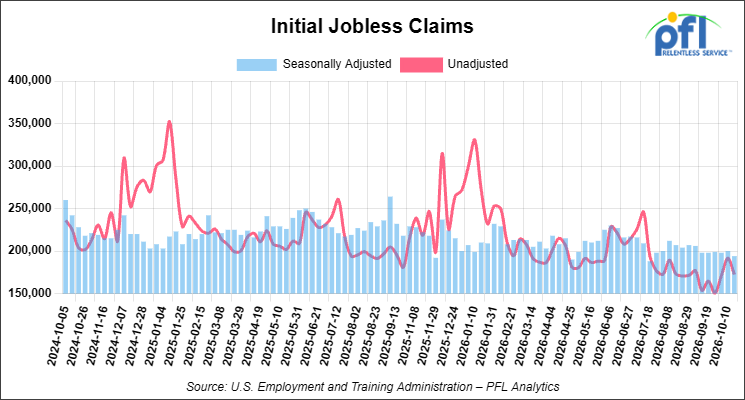
Initial jobless claims seasonally adjusted for the week ending October 17, 2026 came in at 194,000, versus the adjusted number of 200,000 people from the week prior, down 6,000 people week over week.
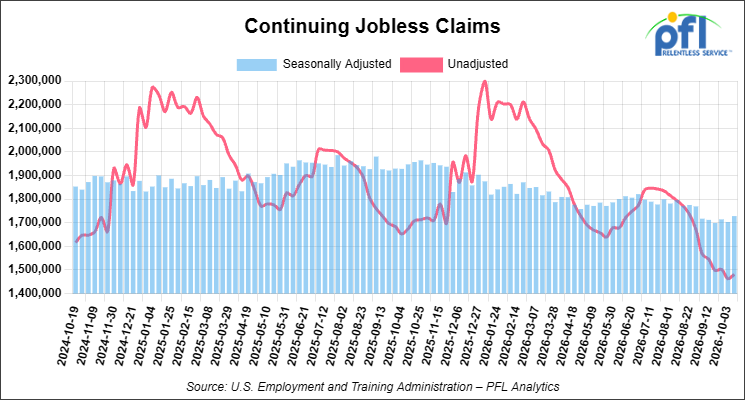
Continuing jobless claims came in at 1,728,000, versus the adjusted number of 1,703,000 people from the week prior, up 25,000 week-over-week.
Stocks closed lower on Friday of last week and lower week-over-week
The DOW closed lower on Friday of last week, down -652.82 points (-1.23%), closing out the week at 52.00, down -51,950.05 points week-over-week. The S&P 500 closed lower on Friday of last week, down -39.75 points (-0.52%), and closed out the week at 7,623.68, down -35.78 points week-over-week. The NASDAQ closed lower on Friday of last week, down -53.52 points (-0.21%), and closed out the week at 25,955.34, down -184.69 points week-over-week.
In overnight trading, DOW futures traded higher and are expected to open at ______ this morning, up/down ______ points from Friday’s close.
Crude oil closed higher on Friday of last week and higher week-over-week
West Texas Intermediate (WTI) crude closed up $3.80 per barrel (3.8%), to close at $103.27 on Friday of last week, and up $1.86 per barrel week-over-week. Brent crude closed up $3.55 per barrel (3.14%), to close at $116.72, and up $6.86 per barrel week-over-week.
One Exchange WCS (Western Canadian Select) for December delivery settled on Friday of last week at US$28 below the WTI-CMA (West Texas Intermediate – Calendar Month Average). The implied value was US$72.77 per barrel.
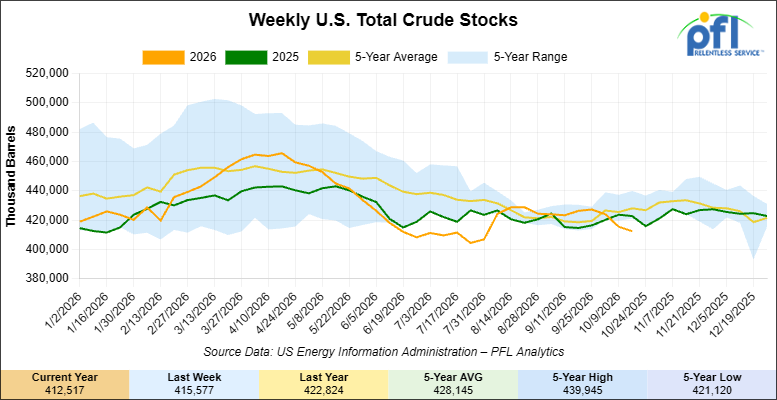
U.S. commercial crude oil inventories (excluding those in the Strategic Petroleum Reserve) decreased by 3.1 million barrels week-over-week. At 412.5 million barrels, U.S. crude oil inventories are 4% below the five-year average for this time of year.
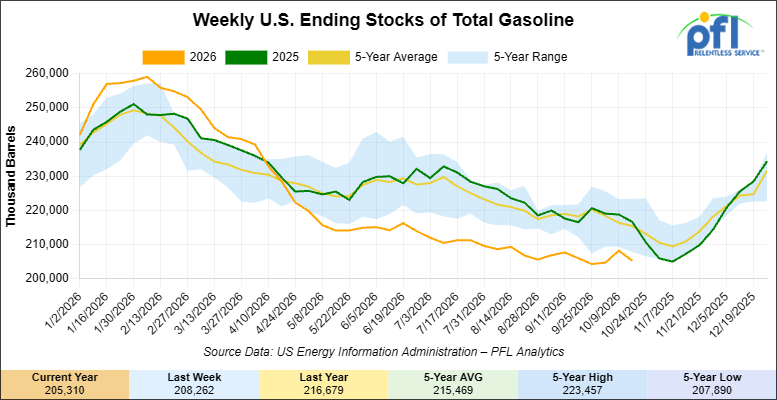
Total motor gasoline inventories decreased by 3 million barrels week-over-week. and are 5% below the five-year average for this time of year.
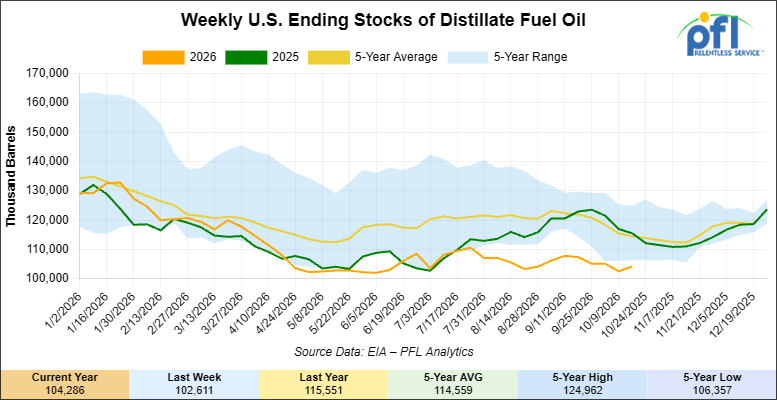
Distillate fuel inventories increased by 1.7 million barrels week-over-week. and are 9% below the five-year average for this time of year.
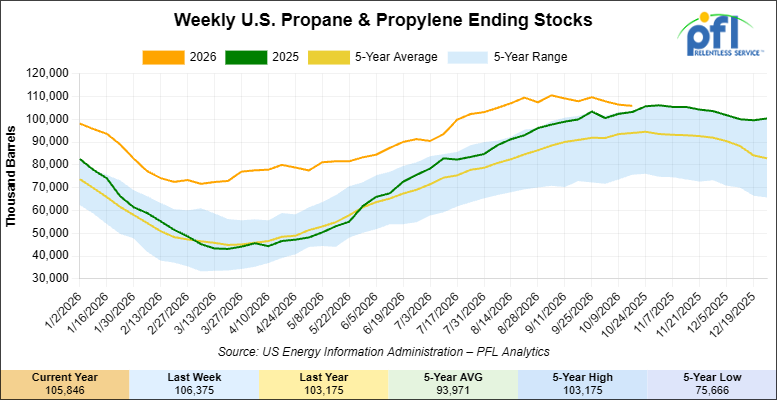
Propane/propylene inventories decreased by 529,000 barrels week-over-week. and are 13% above the five-year average for this time of year.
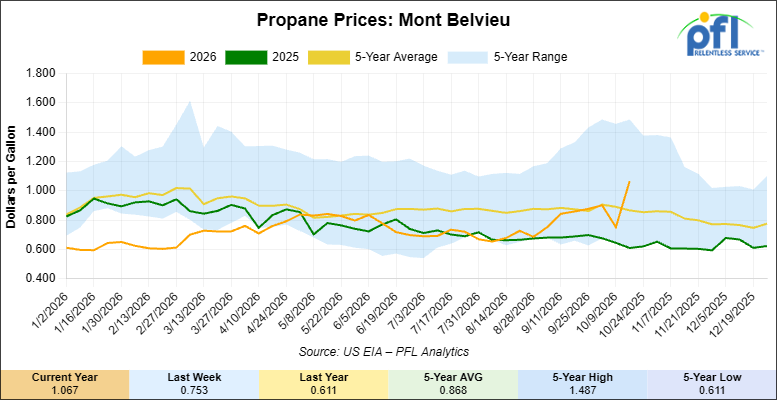
Propane prices closed at 106.7 cents per gallon on Friday of last week, up 31.4 cents per gallon week-over-week, and up 45.6 cents year-over-year.
Overall, total commercial petroleum inventories decreased by 8.5 million barrels week-over-week during the week ending October 16, 2026.
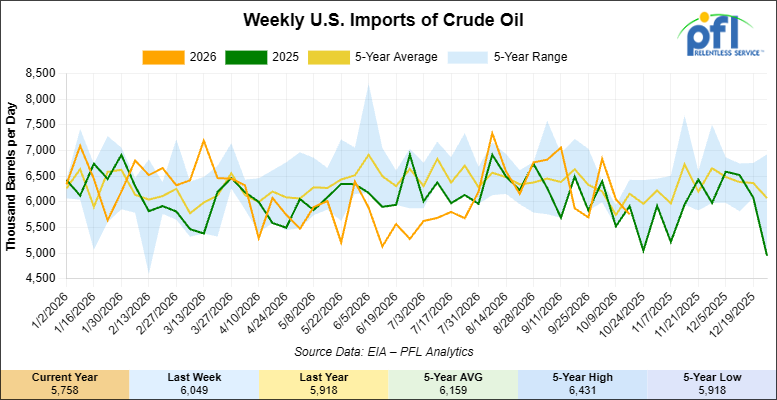
U.S. crude oil imports averaged 5.8 million barrels per day during the week ending October 16, 2026, a decrease of 291,000 barrels per day week-over-week. Total motor gasoline imports (including both finished gasoline and gasoline blending components) averaged 281,000 barrels per day, and distillate fuel imports averaged 117,000 barrels per day during the week ending October 16, 2026.
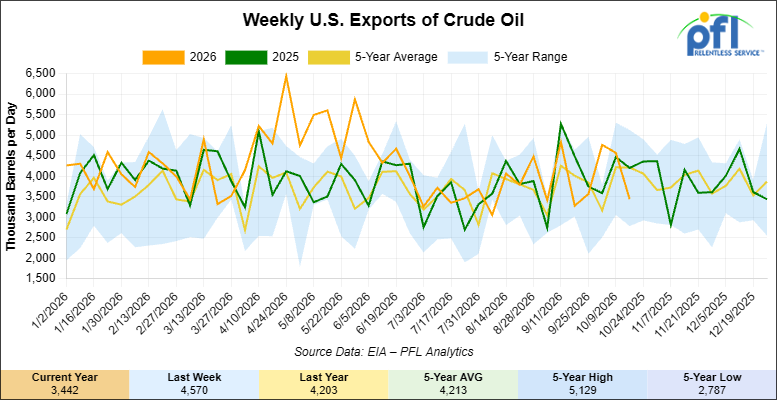
U.S. crude oil exports averaged 3.442 million barrels per day during the week ending October 16, 2026, a decrease of 1.128 million barrels per day week-over-week. Over the past four weeks, crude oil exports averaged 4.087 million barrels per day.
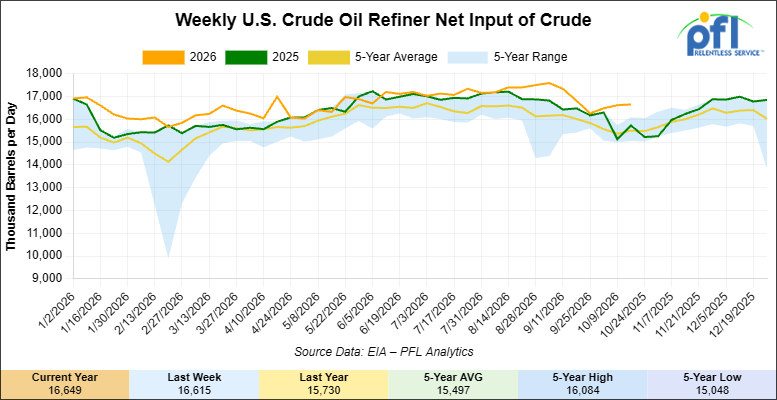
U.S. crude oil refinery inputs averaged 16.6 million barrels per day during the week ending October 16, 2026, which was 34,000 barrels per day more week-over-week.
WTI is poised to open at $98.31, down -$0.71 per barrel from Friday’s close.
North American Rail Traffic
Week Ending October 21, 2026:
Total North American weekly rail volumes were up (+7.82%) in week 43, compared with the same week last year. Total Carloads for the week ending October 21, 2026 were 334,421, up (+3.54%) compared with the same week in 2025, while weekly Intermodal volume was 371,567, up (+11.98%) year over year. 9 of the AAR’s 11 major traffic categories posted year-over-year increases. The largest decrease came from Motor Vehicles and Parts (-1.62%). The largest increase was Intermodal Units (+11.98%).
In the East, CSX’s total volumes were up (+3.85%), with the largest decrease coming from Chemicals (-7.02%), while the largest increase came from Grain (+22.33%). NS’s total volumes were up (+8.83%), with the largest increase coming from Metallic Ores and Metals (+15.32%), while the largest decrease came from Grain (-4.93%).
In the West, BNSF’s total volumes were up (+11.97%), with the largest increase coming from Coal (+20.64%). UP’s total volumes were up (+11.46%), with the largest increase coming from Intermodal Units (+22.18%), while the largest decrease came from Other (-13.22%).
In Canada, CN’s total volumes were down (-7.46%), with the largest increase coming from Coal (+20.64%), while the largest decrease came from Intermodal Units (-35.88%). CPKCS’s total volumes were up (+1.75%), with the largest increase coming from Grain (+28.76%), while the largest decrease came from Coal (-23.79%).
Source Data: AAR – PFL Analytics
North American Rig Count Summary
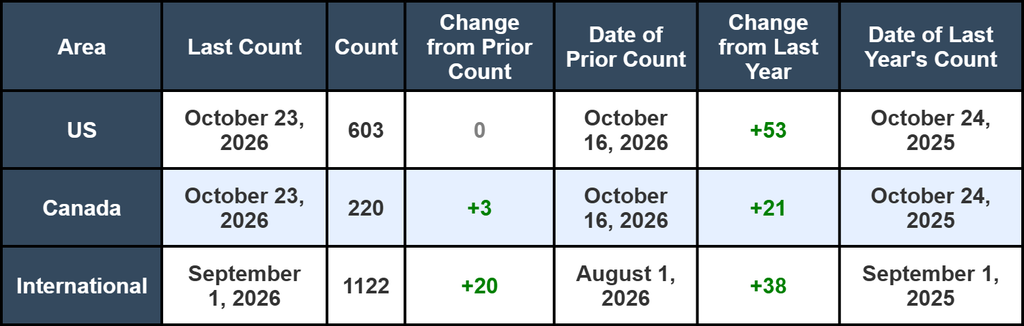
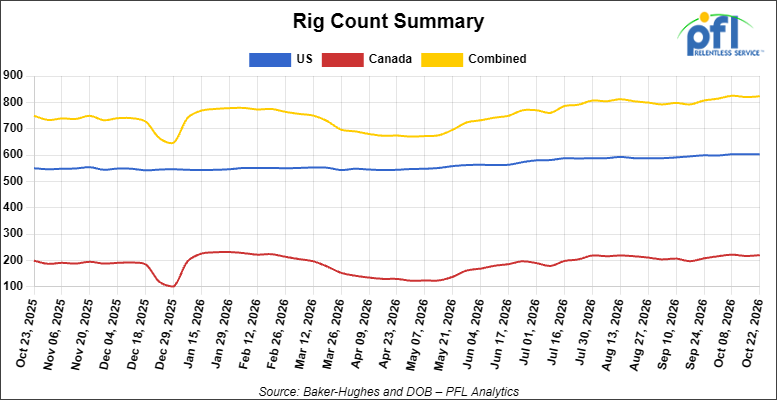
North American rig count was up by +3 rigs week-over-week. The U.S. rig count was unchanged week-over-week, but up by +53 rigs year-over-year. The U.S. currently has 603 active rigs. Canada’s rig count was up by +3 rigs week-over-week and up by +21 rigs year-over-year. Canada currently has 220 active rigs. Overall, year-over-year we are up by +74 rigs collectively.
We are watching a few things out there for you:
We were attending Industry Meetings Last Week
PFL attended the Fall 2026 AAR Tank Car Committee meeting in Dallas. The event was well attended as usual, with strong participation from industry representatives, vendors, and tank car stakeholders. It provided a great opportunity to network, strengthen existing relationships, and discuss current industry conditions. There were no significant regulatory or technical updates to report at this time, but discussions were productive, and we will continue monitoring developments that may impact our industry. Please call us today for more details on what was discussed. Thank you to AAR for keeping us informed. We look forward to seeing everyone at the next meeting!
PFL was also in Norfolk last week for the Southeast Association of Rail Shippers (SEARS) Fall Meeting. Highlights of the meeting sessions included the proposed Union Pacific–Norfolk Southern merger.
The proposed merger would bring together Union Pacific’s western network and Norfolk Southern’s eastern network, creating a coast-to-coast railroad under one operator. The railroads point to fewer interchange handoffs and shorter transit times as potential benefits. For shippers, the important questions are how a combined network would affect service reliability, routing options, competition and rates, along with how the transition would be managed. With regulatory approval still pending, there is plenty to watch as the proposal moves forward.
The 2027 outlook was another highlight as companies look ahead to next year and plan for their rail transportation needs. Beyond the sessions, it was a great few days of networking and catching up with customers, colleagues and others across the industry. Please call us today for more details on what was discussed.
Thank you to SEARS, the speakers and everyone who helped put together the conference. We look forward to seeing everyone at the next meeting!
We Are Watching Petroleum Carloads
The four-week rolling average of petroleum carloads carried on the six largest North American railroads fell to 31,128 from 31,163 which was a decrease of -35 rail cars week-over-week. Canadian volumes were lower. CPKC’s shipments were lower by -4.0% week-over-week, CN’s volumes were lower by -10.0% week-over-week. U.S. shipments were mixed. The NS had the largest percentage increase and was up by +9.0% week-over-week. The CSX had the largest percentage decrease and was down by -5.0%.
We Continue to Watch Our Strategic Petroleum Reserves
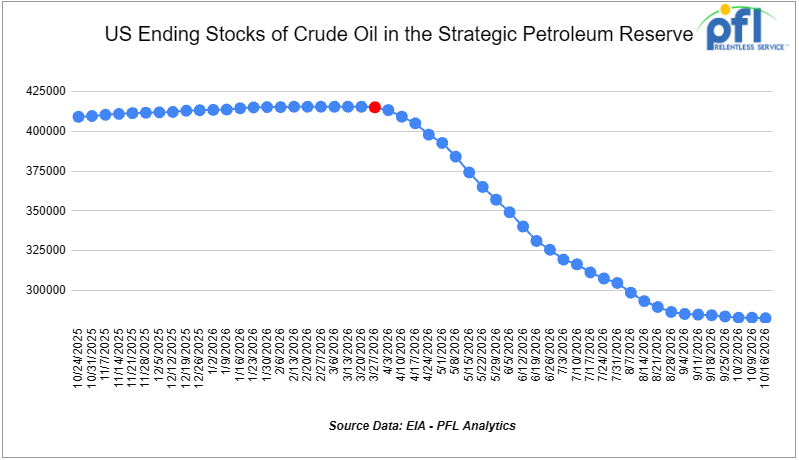
The ongoing emergency drawdown of the U.S. Strategic Petroleum Reserve (SPR) remains a major component of global efforts to offset crude oil supply disruptions stemming from the conflict involving Iran and the continued restrictions on oil shipments through the Strait of Hormuz. Since March, the Department of Energy (DOE) has awarded exchanges covering more than 133 million barrels of crude oil, with additional releases expected as part of a broader international response coordinated through the International Energy Agency (IEA).
The United States continues to execute its commitment to make available up to 172 million barrels from the SPR under the IEA’s collective plan to inject roughly 400 million barrels into global energy markets. Officials have argued that the releases are necessary to help stabilize crude supplies and limit further increases in fuel prices as refiners compete for replacement barrels amid ongoing transportation disruptions. The IEA’s coordinated action remains the largest emergency oil-stock release in the agency’s history.
Inventories in the SPR have declined to 282.983 million barrels, down from 415.442 million barrels at the start of the conflict with Iran and reaching their lowest level since October 1982. The SPR decreased by 300,000 barrels during the week ending October 16th (42,857 barrels per day). Since the first SPR drawdown began, the United States has withdrawn approximately 132.759 million barrels, equivalent to an average of roughly 632,186 barrels per day through the week ending October 16, 2026.
Global petroleum inventories have also tightened considerably. The IEA has reported substantial draws in commercial crude and refined-product stockpiles across major consuming nations, underscoring the strain that the conflict has placed on world energy markets. While oil flows through the Strait of Hormuz have partially recovered from their initial near-shutdown, the IEA continues to identify significant uncertainty surrounding the pace and durability of the recovery.
The Administration continues to emphasize that the current program consists primarily of exchange agreements, rather than outright sales. Under these arrangements, companies receiving crude oil today are required to return the borrowed barrels in the future along with additional volumes as a premium.
We Continue to Watch Left Wing Carney
Albertans voted on Monday of last week to stay in Canada, and the margin was not close. On separation, roughly 75% choose to remain in Canada and roughly 25% choose to start the legal process toward a binding vote to separate. More than 1.5 million ballots were counted by Tuesday morning of last week. Official results will be made available on October 29th. Prime Minister Carney called it a great result for Canada on his way into cabinet and said in a statement that the result would let the country accelerate major infrastructure projects and make Canada a global energy powerhouse with Alberta at its center. Premier Danielle Smith told the province Tuesday evening of last week that she will honor the mandate and will not call another referendum on the question for as long as she is premier, and she pointed to the energy agreement with Ottawa and the Pacific Link pipeline as evidence that Alberta’s arguments had been heard.
There were 9 other questions on the ballot when Alberta voted. The other nine questions were a different story: immigration questions passed with support in the low 60s, while the constitutional questions were close enough that several flipped overnight, which tells you where the energy in that ballot really was. For more information on Alberta’s ballot please contact PFL. We have been following this story closely.
Out in Eastern Canada, Doug Ford Ontario’s Premier who has been at odds with President Trump since the President’s reelection said the rest of Canada now has to deliver on its commitment to Alberta by building pipelines – we will take him at his word.
The physical market was less sentimental last week. Enbridge confirmed on Wednesday of last week that it is turning away 16% of heavy crude nominations at Superior and 19% of light nominations at Kerrobert on the Mainline for November, up from 4% and 8% in October, as fall turnarounds wrapped up and oil sands production keeps climbing. Trans Mountain, which apportioned 7% in October, is expected to ration space again in November. Western Canadian Select at Hardisty closed at $28 under WTI for December delivery on Friday of last week, a discount last seen in 2023, and the forecasters have Alberta output at 5.5 million barrels per day this year on its way to 6 million by 2028, if not sooner. The week Ottawa celebrated a unity win was the week the Mainline turned away roughly one in six heavy barrels. Pacific Link is still a 2032 to 2034 project with no shipper yet confirmed.
In our opinion, the separatists lost the vote last Monday, but until a shovel hits the ground west of Edmonton, the producers are eating a $28 discount per barrel and rising and are still losing the argument. Even at a $20 per barrel discount it is costing the the Canadian producer and the Canadian economy a staggering US$110 million each and every day that passes.
We are watching British Columbia Canada’s Historic Election
British Columbia held its provincial election last week and after nearly 100 years of Liberal rule the province went hard right with the opposition Conservative Party winning a majority promising to ramp up liquefied natural gas production, and unleashing British Columbia as an economic powerhouse. This is good news for Alberta which has been at odds with the province.
- The result marks an end to nine years of power for the left-wing New Democrats, who voiced opposition to new oil pipelines and supported a ban on tankers along the province’s northern coast
- The right-leaning Conservatives won 64 of the 93 seats and the New Democrats won 27. It is the first Conservative provincial election win since 1928
- The Conservatives pledged to double natural gas production by 2032 and more than triple it by 2035
- “I believe in energy… We will cut red tape like it’s never been cut before,” (sounds like Trump) Conservative leader Lorne Doerkson said in his victory speech.
Doerkson, who will become the next premier of the province, promised to “supercharge” BC. The province will host a business summit in Vancouver next year. The Conservatives promised to end emissions limits, replace the province’s carbon tax framework and reach out to energy providers that had left the province’s LNG sector since 2018, including ExxonMobil, Chevron and Woodside
New Democrat Premier David Eby had called for a strong mandate to confront Trump’s tariff threats. The voters did not buy this. Stay tuned to PFL the tide seems to be turning north of the border.
We Continue to Watch Diesel
In addition to letting Russia sell diesel, Washington spent last week throwing everything in the toolbox at diesel. On Monday night the President announced an $8 billion Harvest Fuel Relief Program through the USDA, one-time payments run by the Farm Service Agency on a uniform formula to cover part of the modeled 2026 crop-year losses from high fuel costs. Wednesday the Department of Energy offered to loan up to 315,000 barrels of ultra-low sulphur heating oil from the Northeast Home Heating Oil Reserve, close to a third of the one million barrel reserve, with deliveries by November 13th and the borrowers returning the same volume plus a premium so the reserve is refilled before the 2027-28 heating season. On Thursday night in Sioux City, the President said the Defense Production Act would release up to $150 million to expand refining, storage and logistics at U.S. refineries, drawn from the $1 billion fund Congress created last year, with no project named beyond the Delek Tyler expansion we covered last week. Three interventions in four days, and not one of them puts a barrel of distillate into the system before the November 3rd midterms.
Valero, which reported its best quarter ever on Thursday of last week with refining operating income of $8.8 billion against $1.6 billion a year earlier and net income of $6.8 billion, was not interested in playing along. The company said it has no plans to restart Benicia, idled since April, that the west coast remains a tough place to operate, and chief executive Lane Riggs added that a refinery shut for any length of time takes a long time to bring back and will not help prompt supply, which is worth remembering the next time a cabinet secretary talks about re-opening plants shut in the last ten years. The weekly data gave the administration a little cover: distillate stocks rose 1.7 million barrels to 104.3 million barrels in the week ended October 16th, Gulf Coast ULSD stocks hit a 12-week high as exports bounced back after Isaias, and refinery utilization held at 93.4%. Retail diesel still rose 9.7 cents to $6.276 a gallon in the week of October 19th, the first increase since the $6.529 record in September, and the national inventory is still about 9% below the five-year average.
The harvest that all this money is meant to protect is running late. USDA had corn at 44% harvested as of last Sunday, eight points behind the five-year average, with Iowa, Nebraska and Michigan well back of pace, while soybeans caught up to 64% against a 65% average. The corn quality ratings are now locked in at 56% good to excellent and 17% poor to very poor, so what is left in the field is what the railroads will get. Union Pacific moved 225,000 grain and grain-product carloads in the third quarter, up 5%, with grain revenue up 11% on export demand and revenue per car up 7% to $4,837. Union Pacific paid $4.21 a gallon for locomotive fuel in the quarter, up 64% from a year ago, and its fuel bill rose 69% to just over $1 billion, so the surcharge the grain shipper pays is not going anywhere soon. Fuel surcharge accounted for more of the railroad’s 15% revenue growth than its 6% volume growth did, and it cost the operating ratio 140 basis points, which is the cleanest statement of who is actually carrying the diesel bill in this market.
We Continue to Watch the Merger
Union Pacific used a record third quarter Thursday of last week to tell its merger critics exactly where they stand. Revenue was $7.2 billion, up 15%, carloads were up 6%, the operating ratio was 59.1% and earnings per share rose 16% to $3.49, with revenue, operating income and net income all records. On the call Jim Vena said the condition lists filed by BNSF, CPKC and CSX need to be fact-based rather than wish lists, because Santa Claus is not real, said flatly that the railroad is not going to sell off pieces of itself, and put his confidence in approval at 99.999%. He said the company will reassess after it sees what gets filed by the November 18th comment deadline, and his CFO said the deal is still expected to close in the second half of 2027. Union Pacific has now said out loud what the merger agreement already implied: the deal walks before it divests. The Surface Transportation Board may or may not see it that way, and the first test of its 2001 rules requiring a major merger to enhance competition rather than merely preserve it will not produce a decision until next year at the earliest.
The commodity detail matters more to this readership than the earnings beat. Union Pacific’s energy and specialized markets segment, which carries its crude and refined products, grew 7% to 158,000 carloads with revenue per car up 9%, and the railroad said energy shipments should keep rising through 2026 as the Golden Triangle polymers complex in Texas comes on. Industrial chemicals and plastics were up 2% in carloads and 7% in revenue per car. Norfolk Southern posted record revenue of $3.5 billion the same morning, but an operating ratio of 67.4%, with the adjusted ratio 210 basis points worse than a year ago, and CSX the day before reported record revenue of $4.02 billion on 5% volume growth and earnings per share up 54%. On Union Pacific, energy carloads grew 7% and revenue per energy car grew 9%, which is the order of priorities a shipper should expect from a railroad that no longer needs an interchange partner.
Our read is that for tank car owners the merger question was never really about trackage rights. It is about who sets the fuel surcharge and the cycle time on a 2,500 mile single-line move once there is nobody to interchange with, and nothing in last week’s calls suggested the applicants intend to give that up.
We Are Watching Westridge
Shipping Canadian heavy crude through the expanded Trans Mountain system to the Westridge dock is now more profitable than sending it to the Gulf Coast, and not by a little. The rough netback to Vancouver has averaged about $14.30 a barrel in October after pipeline tolls, against about $8.60 to Houston, a gap of roughly 66% that only reached parity in late July. December-injection high-TAN cargoes traded around $13.33 under December CMA fob Vancouver over October 5th to 19th, roughly a $14 premium to the same barrel at Edmonton and the widest single-cycle spread since the expansion started in May of 2024, against committed heavy tolls of $7.70 to $9.13. Platts has the Pacific dilbit and Cold Lake grades at about $24.55 and $23.15 under Brent at Vancouver, in from the record-low discounts set between mid September and mid October, and ship trackers put Westridge loadings near 600,000 barrels per day in October, roughly 50,000 above any prior monthly record. Chinese independents in Shandong took a record number of November cargoes as Iranian supply dried up, and a three-week voyage from Vancouver beats six weeks from the Atlantic basin when freight has doubled. Canadian heavy re-exports out of Texas and Louisiana ports have collapsed from about 230,000 barrels per day in 2023 to roughly 50,000 barrels per day so far this year, while Westridge is loading about 474,000 barrels per day.
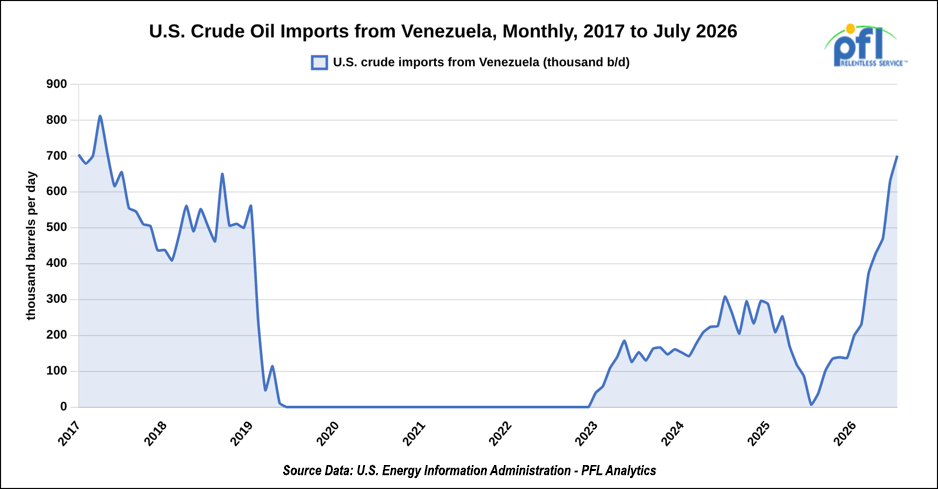
The Gulf Coast is not short of heavy barrels, it just has a cheaper neighbor again. EIA data has U.S. crude imports from Venezuela at 701,000 barrels per day in July, the highest since May 2017 and up from essentially nothing through most of 2019 to 2022 (see chart), with the four weeks to October 16th running around 550,000 barrels per day. Valero said on Thursday of last week, that it ran record volumes of Venezuelan crude in the third quarter because it competed favorably against every other heavy sour option. Chief Executive Lane Riggs said the fourth quarter is already shifting back, with freight pushing Canadian heavy at the Gulf Coast to $27 to $30 under Brent and making it competitive against Latin American grades again, and that Valero will look for ways to run more of it. The Gulf Coast’s 1.7 million barrels per day of coking capacity, more than double anywhere else in the world, is being fed from two directions at once, and Canadian heavy is now priced to win that fight.
For the Alberta to Gulf crude by rail arbitrage this cuts both ways. The discount at Hardisty is wide enough to pay the freight,but the railed barrel lands in a market being supplied by Venezuela at tidewater prices while the Pacific route pays the producer more for the same crude. Whether fourth quarter Gulf Coast heavy demand pulls that arb open for rail, or the Pacific keeps winning it, is the question for the winter.
We Are Watching Golden Triangle
Ethane at Mont Belvieu settled at 32.13 cents a gallon on Tuesday of last week, the highest since September 2023, against a third quarter average around 24 cents and a five-year average near 29 cents. Dow told analysts Thursday of last week that ethane has been outrunning natural gas on growing exports, on international crackers leaning harder on ethane while oil is expensive, and on new Gulf coast cracker capacity preparing to start, though its fourth quarter guidance assumes a retreat into the mid to high 20s on record U.S. production and inventories above historical norms. The new capacity it is talking about is the 2.08 million tonne a year Golden Triangle Polymers cracker at Orange, Texas, the $8.5 billion CPChem and QatarEnergy complex that has been in commissioning since the spring, with units starting this year and full operation in 2027 and two one million tonne polyethylene units aimed at export. Trade talk has the cracker in trial runs for a December to January startup. Union Pacific said the same week that its energy shipments should rise through the end of 2026 as that complex comes on. A 2.08 million tonne cracker is starting up into an ethane market that is already at a three-year high before it takes a molecule.
The product that should worry pressure car owners is not ethane, which moves by pipe, it is butane. The butane premium to propane at Mont Belvieu averaged $236 a tonne over the first half of October, against $41 a year ago and $149 in the back half of September, as domestic blending demand and Asian buyers replacing choked-off Mideast Gulf supply drew stocks down to 56.1 million barrels in July from 66.8 million a year earlier. EIA now sees butane inventories ending the fourth quarter at 52.1 million barrels, lower than it forecast a month ago. Propane is the opposite story, oversupplied at home but bid up for export, with Gulf Coast waterborne propane up 8 cents on the week and Mexico’s retail LPG price cap at a four-year high for a sixth straight week. Butane is the tight product, propane is the long one, and both of them move in the same pressure car. Call PFL today if you need pressure cars, we do have some available.
If the Golden Triangle startup and the export pull hold through the first quarter, the shipper who waited for a cheaper car in our opinion is going to be waiting a while.
We Continue to Watch Tank Cars
The UTLX trade case moved from paper to people last week. The Commerce Department formally initiated the antidumping and countervailing duty investigations on railway tank cars from Mexico on Tuesday of last week, and on Wednesday of last week the International Trade Commission held its preliminary staff conference in Washington, where the industry split along the lines you would expect: UTLX argued for duties, while Trinity and Greenbrier, which build in Mexico, argued the cars are neither dumped nor subsidized and that U.S. steel is the main input. The Commission’s preliminary injury vote is due November 16th with its views to Commerce by November 23rd, Commerce’s preliminary countervailing determination is scheduled for December 24th and the preliminary dumping determination for March 9th of next year, against alleged dumping margins of 12.70% to 32.58%. If the Commission finds a reasonable indication of injury on November 16th, provisional duty deposits on Mexican-built tank cars could be in place before the end of the year. That would stack on top of the Section 232 steel tariff the industry has been absorbing since April, and it is not our place to predict how the Commission votes, only to note that preliminary injury findings are the rule rather than the exception at this stage.
The fleet numbers behind the case have not moved much. Tank cars on line across the six Class Ones averaged 255,431 over the four weeks to October 21st in the STB service data, down 0.2% from the prior four weeks, with CSX down 3.0% and Norfolk Southern up 2.9%. The build rate is the problem. BTS counted about 2,800 tank cars planned for 2026 against the roughly 4,247 a year the industry needs to replace the remaining non-DOT-117 flammable liquid fleet by the deadline. A duty on the country that builds a large share of North America’s tank cars lands on top of a build rate that is already about 1,400 cars a year short of the DOT-117 deadline.
It seems to us at PFL that the five-year DOT-117 rate has nowhere to go but up, if these duties stick. Call PFL today to troubleshoot your fleet requirements and if you have tank cars available, we will surely find a home for them.
We Continue to Watch Crude by Rail
Both Canadian export pipelines are rationing space at the same time the heavy discount is the widest in three years. Enbridge is rejecting 16% of heavy and 19% of light nominations on the 3.1 million b/d Mainline for November, up from 4% and 8% in October, and Trans Mountain is expected to apportion for a second straight month after 7% in October. Western Canadian Select at Hardisty was assessed at $28 under WTI on Wednesday of last week after averaging about $25.70 across the November trading cycle, the weakest heavy differential since 2023. The latest CER data has July exports by rail at 72,298 barrels per day, down 11% from June’s 81,226, with the August number due from the regulator any day now. On paper, the Hardisty discount now clears the $18 Gulf Coast rail hurdle by about $10 a barrel, the widest cushion since the late 2023 cycle.
The rate side has not helped. The Alberta to Gulf coast unit train rate moved up another 53 cents last week to $17.26 a barrel, with manifest at $18.19, against an Enbridge heavy toll from Hardisty to Houston of $9.86, so the railed barrel is carrying about $7.40 more freight than the piped one before anyone talks about car supply. North Dakota is adding barrels too: the state reported August production of 1.16 million barrels per day, a nine-month high, with 105 wells completed in September and the uncompleted inventory down to 250 from nearly 360 in March as operators monetize the price. North Dakota to Philadelphia moved up 36 cents to $11.17 a barrel on a unit train and Bakken at Clearbrook was $103.12, down $1.21 on the week. The Bakken is producing more oil than it has in nine months, and the diesel it makes is retailing above $6 a gallon on the east coast that used to take those barrels by rail.
The constraints have not changed and neither has our framing. There are not many DOT-117J crude cars sitting idle, a new build is a one-to-two year wait, and the car owners and the Class Ones both want five-year commitments before anyone loads a unit train. Crude by rail is not a swing supply. With the Mainline turning away barrels and the discount where it is, it could be just a matter of time when crude by rail kicks in, but we expect a well disciplined approach on the producer front.
Lease Bids
- 300, 5200CF Covered Hoppers located off of CPKCS or CN in Canada. For use in Petcoke service. Period: 3 Year.
- 10-20, 3200 or 3281 Covered Hoppers located off of CN or CPKCS in Canada. For use in Sodium Sulphate service. Period: 3-5 years. Lined.
- 50-100, 29K 117, DOT 111, or CPC 1232 Tank located off of UP or BNSF in Minnesota, Kansas, or Oklahoma. For use in Fuel Oil service. Period: 6 Months. Nov-April.
Sales Bids
- 28, 3400CF Covered Hoppers located off of UP or BNSF in Texas. For use in Cement service. Cement Gates needed.
- 20, 17K DOT111 Tanks located off of various class 1s in various locations. For use in corn syrup service.
- 12, 21.5K-25K DOT 111 Tanks located off of various class 1s in Michigan. For use in Diesel, Asphalt, Crude service. Coiled and Insulated.
Lease Offers
- 15, 6200CF Covered Hoppers located off of all class 1s in Wisconsin. Last used in plastic. Cars are currently clean.
- 30, 6500CF Covered Hoppers located off of all class 1s in Wisconsin. Last used in plastic. Cars are currently clean.
- 50, 30K DOT117J Tanks located off of UP or BNSF in the South. Last used in ethanol.
- 93, 31.8K CPC 1232 Tanks located off of Various Class 1s in Texas. Last used in Diesel. Cars are currently clean.
- 30, 25.5K DOT 117J Tank located off of BNSF and UP in Texas. Last used in Benzene. NO BOV, NO LINER.
- 21, 20K DOT 111 Tank located off of BNSF and UP in Texas. Cars are currently clean. Cars are currently clean. C/I, NO Liner.
- 1000, 31.8K CPC 1232 Tank located off of BNSF and UP in Texas. Last used in Diesel.
Sales Offers
- 81, 31.8K CPC1232 Tanks located off of UP or BNSF in TX. Last used in Multiple Services. Requal Due in 2025.
- 15, 5750 CF Hopper located off of CSX, NS, CPKCS, CN, BNSF, UP in St Louis. Last used in Grain.
- 50, 30 DOT 111 Tank located off of multiple class 1s in multiple location. Last used in Fuels.
Call PFL today to discuss your needs and our availability and market reach. Whether you are looking to lease cars, lease out cars, buy cars, or sell cars call PFL today at 239-390-2885
Railcar for Sale or Lease
| CAT | Type | Capacity | GRL | QTY | LOC | Class | Prev. Use | Offer | Note |
|---|
| CAT | Type | Size | GRL | QTY | LOC | Class | Term | Commodity | Offer | Note |
|---|
| CAT | Type | Capacity | GRL | QTY | LOC | Class | Prev. Use | Clean | Offer | Note |
|---|
| CAT | Type | Capacity | GRL | QTY | LOC | Class | Commodity | Offer | Note |
|---|
PFL will be at the Following Conferences

- Where: The Westin Galleria Dallas
- Attending: David Cohen (954-729-4774), and Curtis Chandler (239-405-3365)
- Conference Website

- Where: The Westin Galleria Dallas
- Attending: Brian Baker (239.297.4519)
- Conference Website