
“Because things are the way they are, things will not stay the way they are.” – Bertolt Brecht
Jobs Update
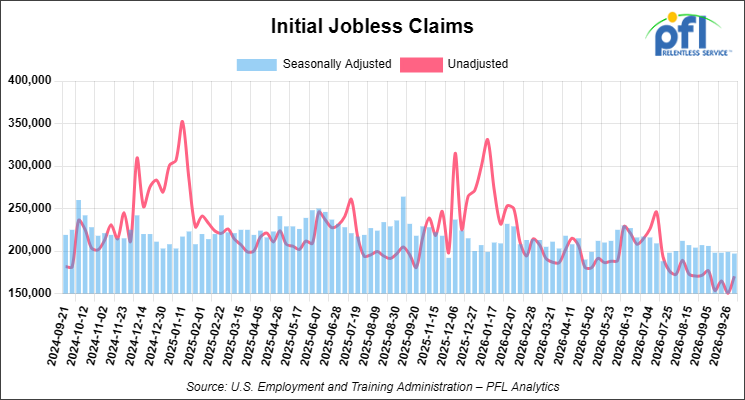
Initial jobless claims seasonally adjusted for the week ending October 3, 2026 came in at 197,000, versus the adjusted number of 199,000 people from the week prior, down 2,000 people week-over-week.
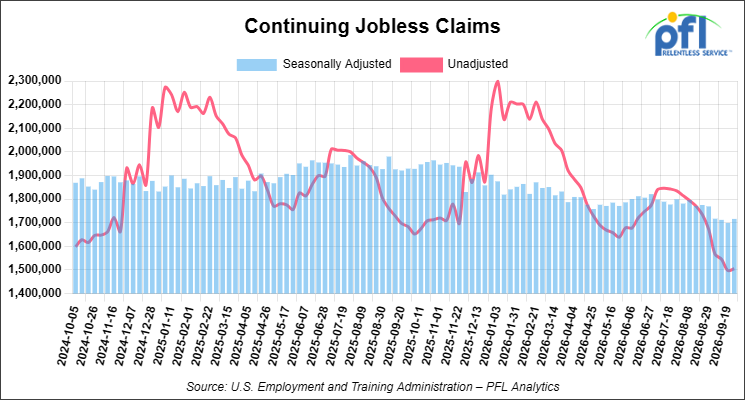
Continuing jobless claims came in at 1,716,000, versus the adjusted number of 1,699,000 people from the week prior, up 17,000 people week-over-week.
Stocks closed higher on Friday of last week and higher week-over-week
The DOW closed higher on Friday of last week, up 423.31 points (0.83%), closing out the week at 51,654.95, up 477.99 points week-over-week. The S&P 500 closed higher on Friday of last week, up 46.18 points (0.53%), and closed out the week at 7,811.54, up 88.82 points week-over-week. The NASDAQ closed higher on Friday of last week, up 172.83 points (0.64%), and closed out the week at 27,366.17, up 175.31 points week-over-week.
In overnight trading, DOW futures traded higher and are expected to open at 51,976 this morning, up 50 points from Friday’s close.
Crude oil closed higher on Friday of last week and higher week-over-week
West Texas Intermediate (WTI) crude closed up $0.36 per barrel (0.39%), to close at $91.85 on Friday of last week, and up $0.74 per barrel week-over-week. Brent crude closed up $0.44 per barrel (0.42%), to close at $104.72, and up $2.47 per barrel week-over-week.
One Exchange WCS (Western Canadian Select) for November delivery settled on Friday of last week at US$25.15 below the WTI-CMA (West Texas Intermediate – Calendar Month Average). The implied value was US$65.31 per barrel.
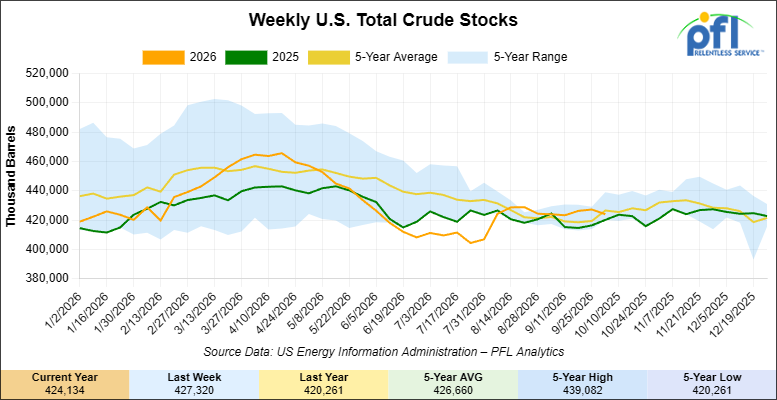
U.S. commercial crude oil inventories (excluding those in the Strategic Petroleum Reserve) decreased by 3.2 million barrels week-over-week. At 424.1 million barrels, U.S. crude oil inventories are 1% below the five-year average for this time of year.
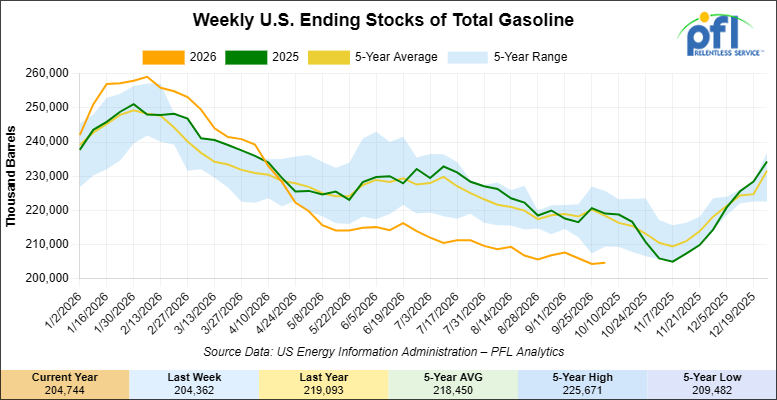
Total motor gasoline inventories increased by 382,000 barrels week-over-week. and are 6% below the five-year average for this time of year.
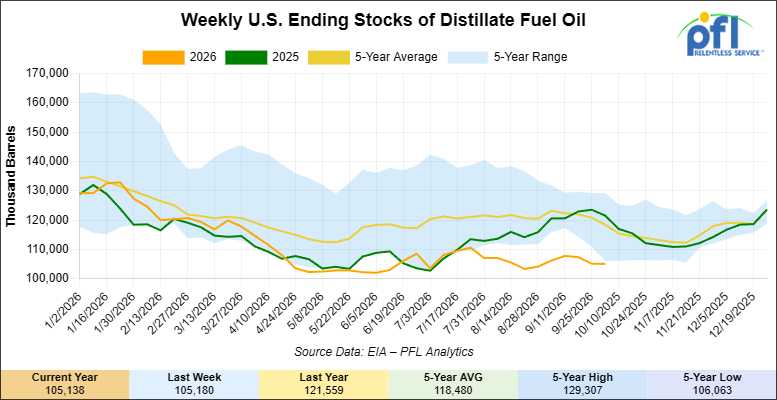
Distillate fuel inventories decreased by 42,000 barrels week-over-week. and are 11% below the five-year average for this time of year.
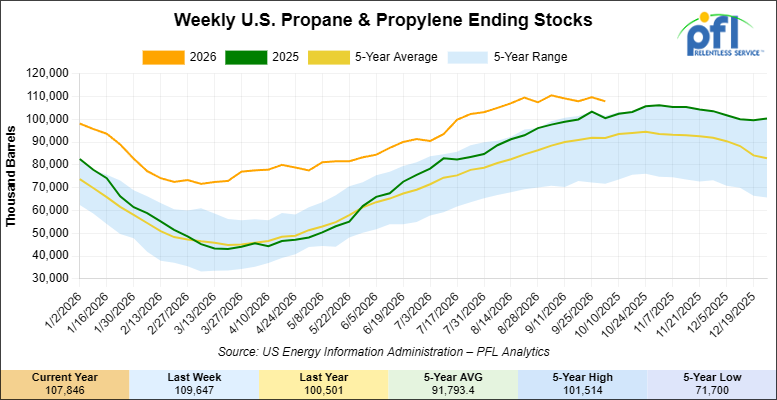
Propane/propylene inventories decreased by 1.8 million barrels week-over-week. and are 17% above the five-year average for this time of year.
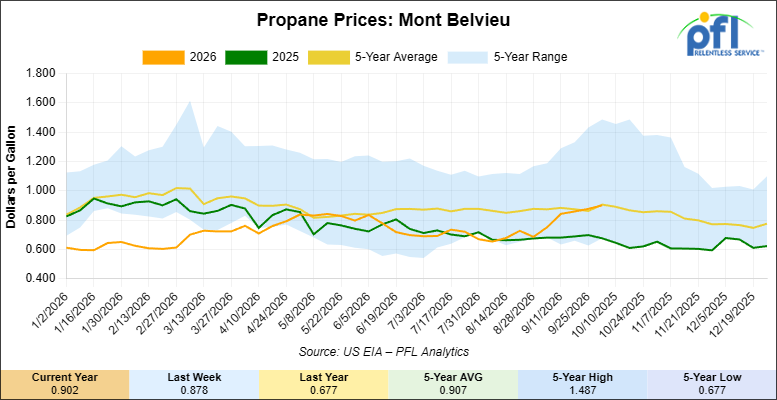
Propane prices closed at 90.2 cents per gallon on Friday of last week, up 2.4 cents per gallon week-over-week, and up 22.5 cents year-over-year.
Overall, total commercial petroleum inventories decreased by 6.9 million barrels week-over-week during the week ending October 2, 2026.
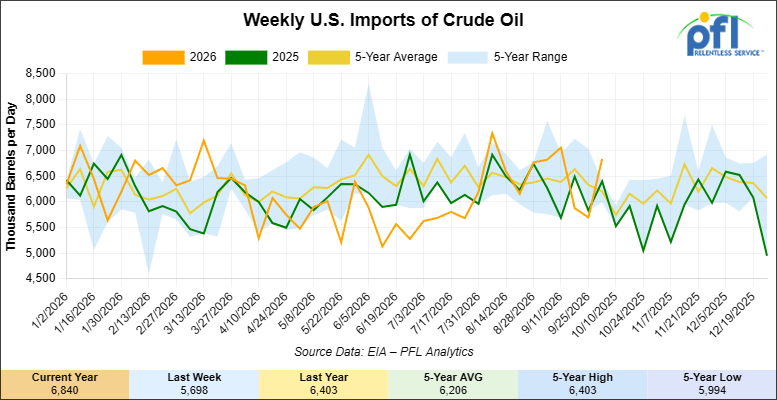
U.S. crude oil imports averaged 6.8 million barrels per day during the week ending October 2, 2026, an increase of 1,142,000 barrels per day week-over-week. Total motor gasoline imports (including both finished gasoline and gasoline blending components) averaged 512,000 barrels per day, and distillate fuel imports averaged 118,000 barrels per day during the week ending October 2, 2026.
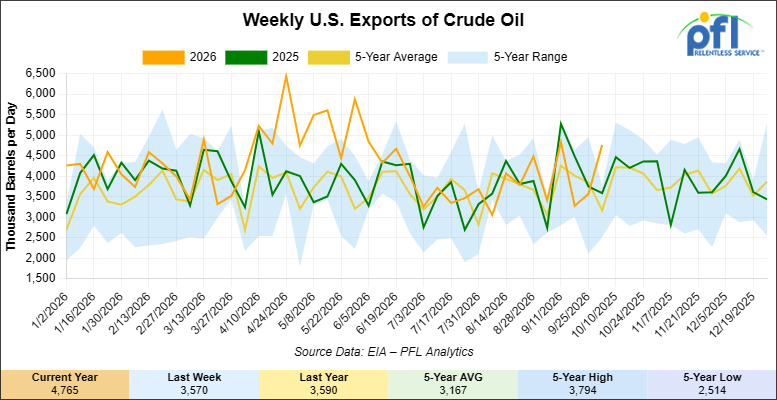
U.S. crude oil exports averaged 4.765 million barrels per day during the week ending October 2, 2026, an increase of 1.195 million barrels per day week-over-week. Over the past four weeks, crude oil exports averaged 4.112 million barrels per day.
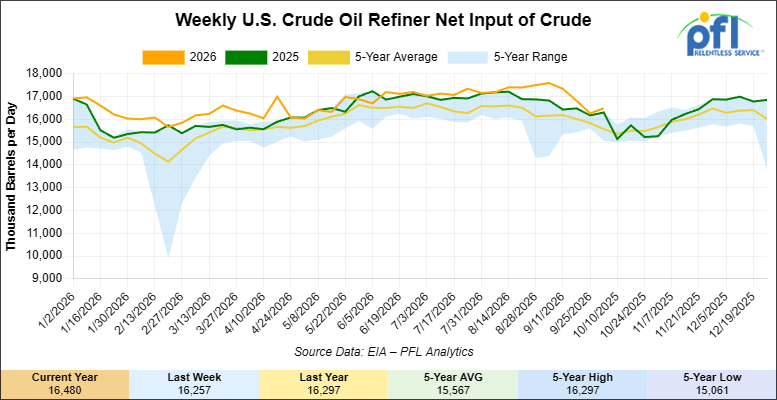
U.S. crude oil refinery inputs averaged 16.5 million barrels per day during the week ending October 2, 2026, which was 223,000 barrels per day more week-over-week.
WTI is poised to open at $92.64, up $0.79 per barrel from Friday’s close.
North American Rail Traffic
Week Ending October 7, 2026:
Total North American weekly rail volumes were up (+5.44%) in week 41, compared with the same week last year. Total Carloads for the week ending October 7, 2026 were 334,153, up (+3.56%) compared with the same week in 2025, while weekly Intermodal volume was 365,520, up (+7.21%) year over year. 9 of the AAR’s 11 major traffic categories posted year-over-year increases. The largest decrease came from Farm Products (-5.69%). The largest increase was Metallic Ores and Metals (+14.16%).
In the East, CSX’s total volumes were up (+2.04%), with the largest decrease coming from Farm Products (-9.89%), while the largest increase came from Metallic Ores and Metals (+19.21%). NS’s total volumes were up (+6.74%), with the largest increase coming from Coal (+32.53%), while the largest decrease came from Grain (-31.51%).
In the West, BNSF’s total volumes were up (+5.59%), with the largest increase coming from Metallic Ores and Metals (+18.63%), while the largest decrease came from Coal (-18.15%). UP’s total volumes were up (+10.74%), with the largest increase coming from Petroleum & Petroleum Products (+19.29%), while the largest decrease came from Other (-10.99%).
In Canada, CN’s total volumes were down (-4.35%), with the largest increase coming from Other (+28.55%), while the largest decrease came from Coal (-18.15%). CPKCS’s total volumes were up (+0.14%), with the largest increase coming from Metallic Ores and Metals (+47.95%), while the largest decrease came from Motor Vehicles and Parts (-29.25%).
Source Data: AAR – PFL Analytics
North American Rig Count Summary
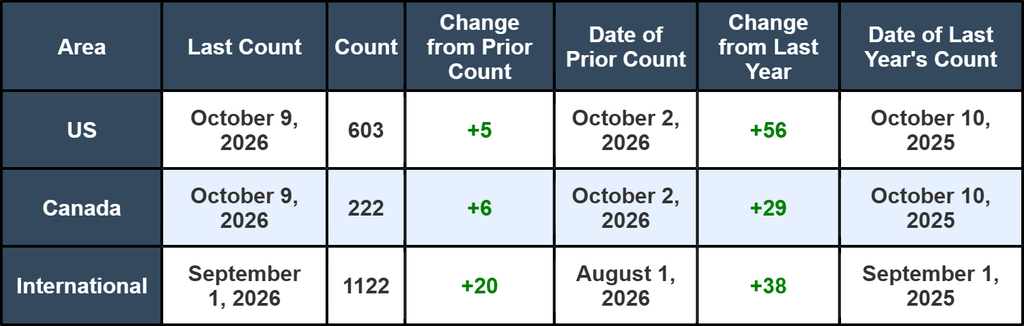
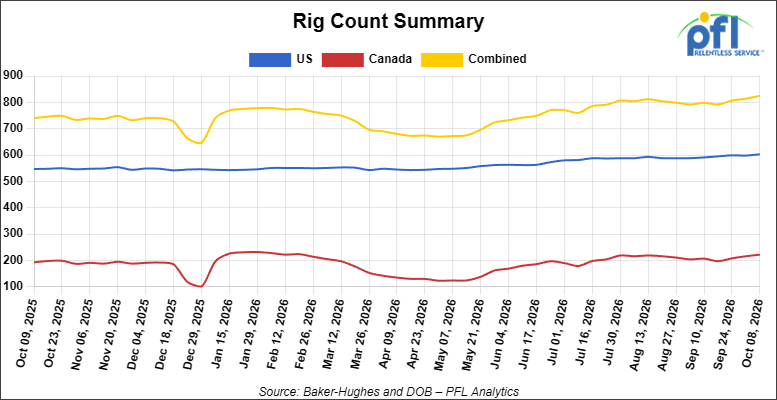
North American rig count was up by +11 rigs week-over-week. The U.S. rig count was up by +5 rigs week-over-week, and up by +56 rigs year-over-year. The U.S. currently has 603 active rigs. Canada’s rig count was up by +6 rigs week-over-week and up by +29 rigs year-over-year. Canada currently has 222 active rigs. Overall, year-over-year we are up by +85 rigs collectively.
We are watching a few things out there for you:
We Are Watching UTLX
UTLX Manufacturing, the Berkshire Hathaway unit that builds tank cars at Alexandria, Louisiana, filed antidumping and countervailing duty petitions on September 30 against tank cars and parts built in Mexico, and last Monday the U.S. International Trade Commission opened its preliminary investigation. Trinity and Greenbrier, the only two importers named, both said last Monday they will fight it at every stage. The petition alleges dumping margins of 12.70% to 32.58%, plus Mexican subsidies that UTLX has not yet put a number on. Readers will recall we covered the 25% Section 232 tariff on imported tank cars in April, which UTLX also asked for and got. Any new duties would be collected in addition to that tariff.
The scope is broad: pressure and general purpose cars, finished or unfinished, plus tank and underframe assemblies. Stainless DOT-111s, DOT-105 and DOT-112 cars rated at 499 psig or higher, and DOT-113 cryogenic cars are carved out. Mexican-built cars have historically crossed the border as instruments of international traffic and never showed up in the customs data, so UTLX counted them from Umler build records instead. By that count 4,531 Mexican-built tank cars entered the U.S. in 2024 and 3,302 in 2025, a 27% drop that Trinity and Greenbrier are sure to put in front of the Commission. The petition names Greenbrier’s plants at Tetla, Frontera and Sahagun and Trinity’s Coahuila operations, which Trinity dates to 1998 at Monclova. Both builders made a point of saying they ship U.S. steel south to build these cars. That is not just public relations: under the April order a derivative product made from U.S.-melted steel is tariffed at 10%, not 25%. Whether these cars actually qualify is something neither builder has said.
The calendar moves fast. Commerce decides whether to initiate by about October 20th, the Commission holds its staff conference on October 21st, and its preliminary injury vote is due on November 16th. If that vote is affirmative, trade counsel peg Commerce’s preliminary countervailing determination at December 24th and the preliminary antidumping determination at March 9, 2027, with final orders in the spring and summer. Cash deposits can be required from the preliminary determinations, which could put cars delivered early in 2027 inside the duty window. These dates routinely get extended, and UTLX’s own counsel is talking about final determinations near the end of 2027.
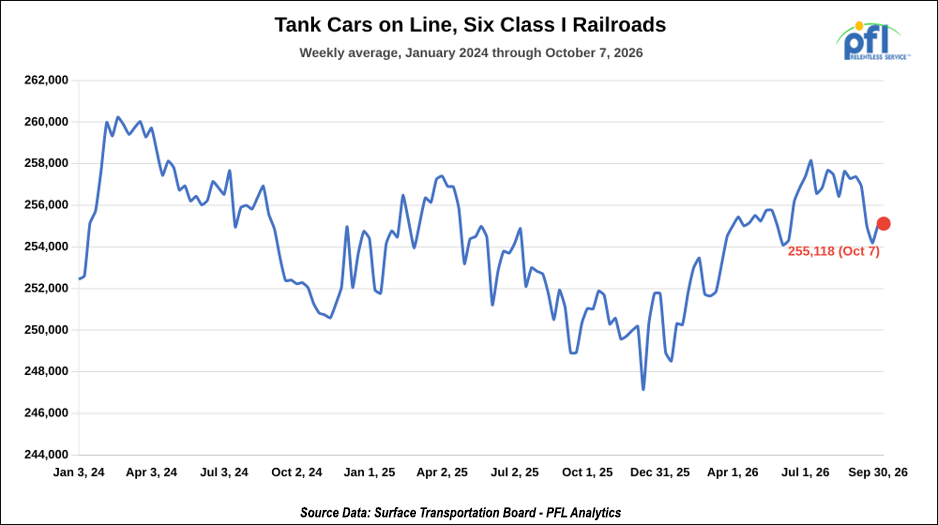
Trinity says it has built more than 73,000 tank cars in the U.S. over the past 15 years and Greenbrier points to its Marmaduke, Arkansas plant, but UTLX’s Neil Finn has put roughly 75% of his competitors’ tank car production in Mexico. The fleet is not growing into this. Tank cars on line at the six Class I railroads averaged 254,835 over the four weeks ended October 7, down 1.0% from the prior four weeks. Only 2,137 new DOT-117s were slated to be built in all of 2026. Trinity reports third quarter results on October 29th.
We Are Watching Petroleum Carloads
The four-week rolling average of petroleum carloads carried on the six largest North American railroads rose to 30,447 from 30,273 which was a increase of +174 rail cars week-over-week. Canadian volumes were mixed. CPKC’s shipments were higher by +3.0% week-over-week, CN’s volumes were lower by -12.0% week-over-week. U.S. shipments were also mixed. The BNSF had the largest percentage increase and was up by +9.0% week-over-week. The NS had the largest percentage decrease and was down by -13.0%
We Continue to Watch Our Strategic Petroleum Reserves
The ongoing emergency drawdown of the U.S. Strategic Petroleum Reserve (SPR) remains a major component of global efforts to offset crude oil supply disruptions stemming from the conflict involving Iran and the continued restrictions on oil shipments through the Strait of Hormuz. Since March, the Department of Energy (DOE) has awarded exchanges covering more than 133 million barrels of crude oil, with additional releases expected as part of a broader international response coordinated through the International Energy Agency (IEA).
The United States continues to execute its commitment to make available up to 172 million barrels from the SPR under the IEA’s collective plan to inject roughly 400 million barrels into global energy markets. Officials have argued that the releases are necessary to help stabilize crude supplies and limit further increases in fuel prices as refiners compete for replacement barrels amid ongoing transportation disruptions. The IEA’s coordinated action remains the largest emergency oil-stock release in the agency’s history.
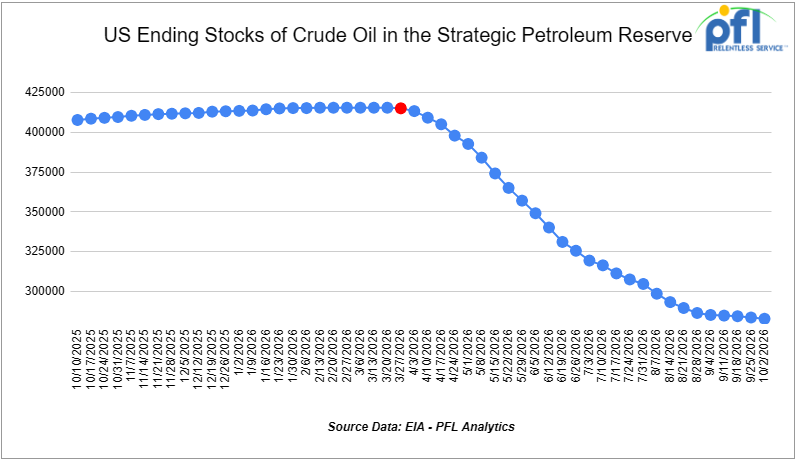
Inventories in the SPR have declined to 282.983 million barrels, down from 415.442 million barrels at the start of the conflict with Iran and reaching their lowest level since October 1982. The SPR declined by a mere 784 thousand barrels during the week ending October 2nd. Since the first SPR drawdown began, the United States has withdrawn approximately 132.459 million barrels, equivalent to an average of roughly 675,811 barrels per day through the week ending October 2, 2026.
Global petroleum inventories have also tightened considerably. The IEA has reported substantial draws in commercial crude and refined-product stockpiles across major consuming nations, underscoring the strain that the conflict has placed on world energy markets. While oil flows through the Strait of Hormuz have partially recovered from their initial near-shutdown, the IEA continues to identify significant uncertainty surrounding the pace and durability of the recovery.
The Administration continues to emphasize that the current program consists primarily of exchange agreements, rather than outright sales. Under these arrangements, companies receiving crude oil today are required to return the borrowed barrels in the future along with additional volumes as a premium. DOE has stated that its exchange structure is designed to return the borrowed crude with additional premium barrels, with the stated objective of strengthening the SPR over time.
We Are Watching Isaias
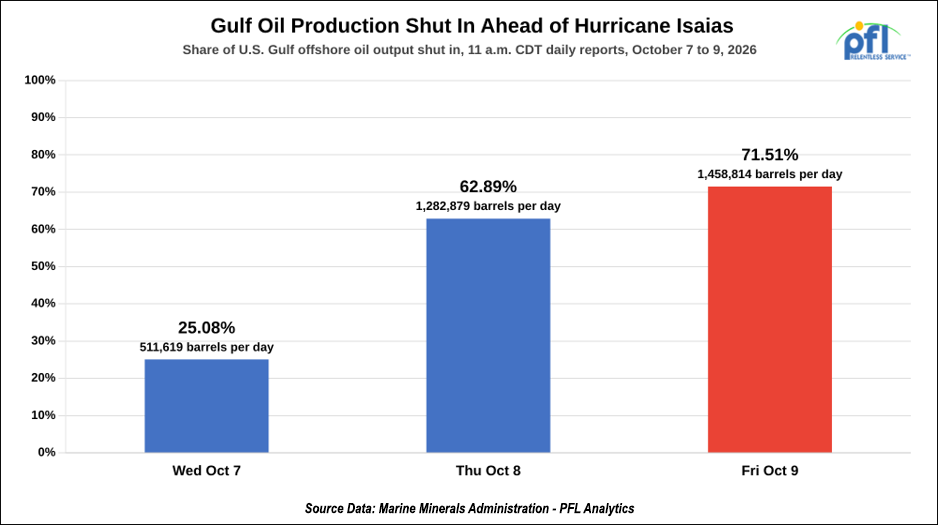
Isaias, the first hurricane of the 2026 Atlantic season, reached Category 3 with 120 mph winds last Friday and made landfall along Alabama’s coast at 8:30 central time as a category 2 hurricane knocking out power for 800,000 people. Offshore operators had shut in 1,458,814 barrels per day of oil, or 71.51% of Gulf output, and 58.84% of natural gas production on Friday of last week with 129 of 371 platforms evacuated. Ivan shut in 77.6% in 2004. Sally, which came ashore at Gulf Shores in 2020, shut in 26.9%.
CSX told customers last Thursday that it was pulling railcars out of low-lying areas, staging generators and lining up alternative routings along its Gulf Coast line. The Coast Guard set Condition Zulu at 2 a.m. Friday for Mobile, Pascagoula, Gulfport, Pensacola and Panama City, and the Port of Mobile closed to vessels and suspended cargo handling with no reopening date. Forecast surge was six to nine feet from the Alabama line east to Grayton Beach and three to five feet in Mobile Bay, with four to eight inches of rain and river flooding expected across southern Alabama as the storm moved inland over the weekend. Katrina took this same CSX line out for about five months in 2005, with more than 40 miles of track and six major bridges rebuilt at a cost above $250 million. Isaias came in well east of where Katrina did its damage, but nobody will know what the railroad looks like until inspectors can get out on it.
The track spared the big southeast Louisiana refining complex. Two plants sat squarely in the path: Chevron’s 356,000 barrel per day Pascagoula refinery and Vertex’s 88,000 barrel per day Mobile plant, where power loss is the main threat and a restart can take up to two weeks even without damage. Gulf Coast diesel was already up 25 cents per gallon on the week to $4.74 before landfall, and Mars sour traded as high as $3 per barrel over WTI on the offshore shut-ins. Shippers with tank cars billed to or through Mobile, Pascagoula or Pensacola should plan on embargoes, holds and out-of-route miles for at least the next week. PFL works with shippers on diversions, storage and replacement cars when a corridor goes down, and our phones are on.
We Continue to Watch Left Wing Carney
Prime Minister Mark Carney’s national interest designation for the Pacific Link pipeline, which we covered last week, lasted seven days before the first lawsuit landed. Cold Lake First Nations filed for judicial review in Federal Court last Thursday, asking the court to quash the October 1 designation and declare that Canada owes it consultation. The Assembly of First Nations says Ottawa made its decision only 12 days after the consultation deadline, and Chief Kelsey Jacko says more than 120 nations were consulted while his was left out. “All the oil comes from my traditional territories,” Jacko said. The Union of British Columbia Indian Chiefs has already promised a fight “in the court rooms, and if necessary, with boots on the ground.”
Cold Lake is not a random plaintiff. It sits on top of the storage site for the Pathways carbon capture project, which Ottawa’s own agreement with Alberta described as “mutually dependent” with the pipeline. Pathways has since been cut to six million tonnes per year in its first phase with a start somewhere between 2032 and 2035. Asked about the suit, the Privy Council Office said last week that these are “two distinct projects” and that consulting on Pathways “rests with the provincial authorities.” Ottawa tied the pipeline to the carbon project when it needed a climate fig leaf and is untying them now that somebody has to consult on it.
Arithmetic is worse than the politics. An ATB Cormark survey released last Friday found 77% of energy executives and investors expect Pacific Link to reach a positive investment decision, but 53% do not see construction before 2028, a year behind Mr. Carney’s September 2027 target. The same survey found 96% of producers plan to grow in 2027, with oil producers targeting about 10%. On a western Canadian base of roughly five million barrels per day, that is about 500,000 barrels per day of new supply in one year. Alberta’s own filing puts Pacific Link’s investment decision between December 2027 and late 2029 and completion between 2032 and 2034, with no committed shipper. Half of the one million barrels per day Pacific Link is supposed to carry could be spoken for by 2027 growth alone, five to seven years before the line moves a barrel. Western Canadian Select closed last Friday at $25.55 per barrel under WTI, the widest since November 2023.
Pacific Link has no shipper, no investment decision and its first lawsuit inside of a week: in our opinion Alberta’s producers should not hold their breath!
We Continue to Watch the Merger
Shintech, the largest PVC producer in the U.S., has broken with the chemical trade associations and told the Surface Transportation Board in a letter that surfaced last week that it supports Union Pacific’s acquisition of Norfolk Southern. “As a solely served customer, Union Pacific transports 100% of our rail traffic from each of our three production locations,” president Y. Saitoh wrote of the Plaquemine, Addis and Freeport plants. UP marketing chief Kenny Rocker followed last Tuesday with a customer letter titled “Silence Is Not Opposition,” claiming support letters from customers representing more than 30% of UP’s volume. “We move plastic from the chemical plant, not the American Chemistry Council,” he wrote. More than 500 of UP’s 10,000 customers are on the record in support, which leaves roughly 95% who have said nothing either way. Alliance for Chemical Distribution chief Eric Byer offered a reason for the quiet: “the fear of retaliation is real and small businesses won’t speak up.” UP’s answer: “We do not retaliate.”
Labor moved the other way. The International Brotherhood of Electrical Workers, with more than 10,000 rail members, came out against the deal last Tuesday, saying “Union Pacific declined to make meaningful commitments on virtually every significant issue.” The opposing unions say they already represented 26,402 of the two railroads’ 39,828 union employees, or 66%, before the electrical workers joined them. None of it dented chief executive Jim Vena, who told Fox Business the same day that he is “99.99%” confident of approval.
Two numbers from last Thursday say more about where shippers stand than any letter count. The Board found UP revenue adequate for 2025 with a 17.09% return on investment against a 9.79% industry cost of capital, the highest of the Class Is and well ahead of CSX at 11.4%, BNSF at 10.91% and Norfolk Southern at 10.29%. TD Cowen’s third quarter survey has rail shippers expecting 4.4% rate increases over the next six to twelve months, up 70 basis points and the biggest jump since 2021. That is before a single interchange disappears. Comments, protests, requests for conditions and responsive applications are due at the Board on November 18. Captive tank car shippers who want conditions have five weeks to get them in writing, because in Omaha quiet is being counted as consent!
We Continue to Watch Diesel
The U.S. average retail diesel price fell 18.3 cents to $6.199 per gallon for the week of October 5th, the second straight decline from the $6.529 record set September 21st, but still up $2.49 per gallon year over year. The relief may already be over. New York Harbor diesel futures jumped 5% last Thursday of last week to $4.85 per gallon. Distillate inventories were essentially unchanged at 105.1 million barrels in the week ended October 2, 12% below the five-year average, with refineries running at 92.7%.
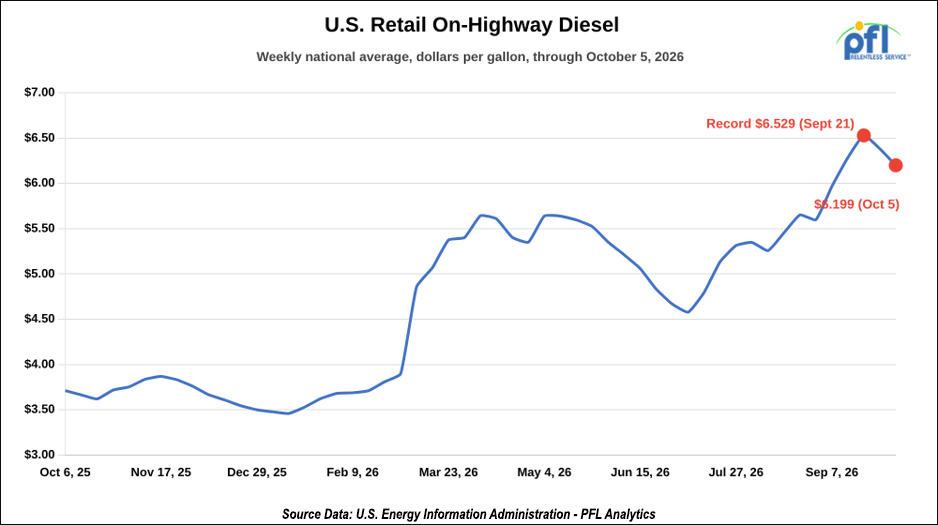
Hormuz is the reason. At least 12 tankers were attacked between September 28 and October 5, the most in any week of the war, and on Tuesday of last week only seven tankers made the transit, the fewest since July 23rd. Brent settled last Thursday of last week at $104.28 and WTI at $91.49. The Energy Information Administration raised its fourth quarter Brent forecast by $14 to $105 on Tuesday of last week and now expects East Coast distillate stocks to run 20% to 30% below average all winter. Add Isaias there is no room for a miss.
Washington keeps reaching for small levers. An executive order last Monday allows red-dyed diesel to be used on the highway through year-end with the 24.4 cent federal tax deferred, and the Environmental Protection Agency waived Texas down to 500 ppm sulfur diesel through October 24. None of it shows up in rail fuel surcharges, which lag the pump. Union Pacific’s mileage-based fuel surcharge steps up from 68 cents per mile in October to 84 cents in November. The Class I average was 59 cents per mile in October, up 40 cents from a year ago, and the Department of Agriculture expects November to pass the record 61 cents set in July. Please budget your freight on the surcharge table, not on the retail headline. It is very easy to lose money in this environment and we do not want to see any PFL customer to do so – call PFL to trouble shoot.
We Are Watching the Harvest
We flagged Iowa’s slow start last week and it has not caught up. Corn was 23% harvested nationally as of October 4 against a five-year average of 27%, and soybeans were 25% against 33%. Iowa had 7% of its corn and 5% of its soybeans in the bin, against five-year averages of 20% and 38%. Nebraska soybeans were at 9% versus 34% and Minnesota at 25% versus 51%. Illinois, which stayed dry, is ahead of pace on both crops.
The rail numbers are split the same way. Grain carloads for the week ended September 26th were 29,862, up 13% from last year and 22% above the three-year average, and CN posted a third quarter record of 7.94 million tonnes out of Western Canada. Shuttle premiums went the other direction: October bids fell $350 in a week to $350 per car above tariff, with BNSF at $575 and UP at $125. Unfilled manifest grain car orders stood at 2,200, nearly three times last year’s average of 783, almost all of it on CPKC and BNSF. Dwell is worse than a year ago on CSX, NS, BNSF and UP, and the St. Louis barge rate of $28.85 per ton is 53% above last year. A late western Corn Belt harvest is going to land on that network all at once.
Wet corn has to be dried, and that is a pressure car story. One Iowa grower told Brownfield he expects to spend 15 to 18 cents per bushel on drying, and in Alberta and Saskatchewan the harvest was only 40% to 50% complete in late September against a typical 70%. U.S. propane and propylene stocks fell 1.8 million barrels to 107.8 million in the week ended October 2. Mont Belvieu propane traded as high as $1.01 per gallon last Friday, the highest since September 2022, after Iran claimed a strike on an LPG carrier in the Strait of Hormuz. Pressurized cars are quoted at $1,200 per month on one to five year terms. PFL has been taking calls from propane shippers looking for pressure cars for crop drying and winter fill. The time to ask was August, but call us anyway, as we have been able to get a couple of deals done here and there it is all about timing!
We Continue to Watch Crude by Rail
Western Canadian Select at Hardisty closed last Friday at $25.15 per barrel under WTI, up from $24.65 a week earlier, the widest since November 2023 and more than $7 through the $18 level where unit trains to the Gulf Coast start to work. The export pipelines are essentially full and record tanker freight has made re-exports off the Gulf Coast cost-prohibitive. The unit train rate from Alberta to the Gulf Coast for November is $17.26 per barrel, up 53 cents on the week.
Tidewater is not providing the relief it did a year ago. Heavy crude off Trans Mountain at Vancouver for December fell $4.55 on the week to $13.40 under WTI, the weakest since that market began trading in 2024, and an Aframax from Vancouver to China cost a record $14 million, or nearly $26 per barrel. The most recent federal data show crude by rail exports of 72,298 barrels per day in July, down 11% from June and 18% below May. August had not been posted as of last Friday.
The barrels are coming. Cenovus agreed last Monday to buy Athabasca Oil for $5.7 billion with plans to take Leismer and Corner to 115,000 barrels per day by 2032, and nearly every producer surveyed by ATB Cormark plans to grow next year. The cars are another matter. There are not many DOT-117J crude cars sitting idle, new ones take one to two years to build and now carry the duty question raised in our lead story, and leasing companies and car owners want five-year commitments, as do the Class Is. DOT-117s are quoted at $1,025 per month on one to five year terms. It seems to us at PFL that this could be the beginning of another crude by rail cycle if trends continue. Time will tell and it is geopolitical dependent. Raw bitumen moving non-haz in coiled and insulated cars remains competitive with pipeline tolls for stranded barrels, and PFL’s customers who locked up cars early are the ones with options now.
We Continue to Watch Enbridge
Enbridge notified Wisconsin regulators of a groundwater release at its Line 5 reroute after pulling pipe beneath the Marengo River. The Bad River Band’s attorney put the flow at 85 to 100 gallons per minute. The Wisconsin Department of Natural Resources said Tuesday of last week that it does not yet know whether an aquifer was breached and that the flow is about 5% of the rate seen in confirmed breaches on similar projects. Monitoring wells are going in, and Enbridge says the water “continues to be monitored and contained.” Tribal chairwoman Elizabeth Arbuckle has asked Governor Tony Evers and the department to revoke the reroute permits.
This is the same project where the largest pipeline release in Wisconsin history, four non-compliance notices and a federal investigation into work site fires have all landed since August, as we have covered. Enbridge’s experts testified last fall that the aquifer risk was zero, and Enbridge paid millions over four breaches on its Line 3 replacement in Minnesota. The 41-mile, $1 billion reroute is roughly two-thirds built and it is the only thing standing between Line 5 and a court order to get off the Bad River reservation. Line 5 moves up to 23 million gallons per day of light crude and natural gas liquids from Superior to Sarnia and is a main source of propane for Michigan and Ontario. PFL has been watching this one for years. Stay tuned to PFL for further updates.
We Are Watching Key Economic Indicators
Purchasing Managers Index (PMI)
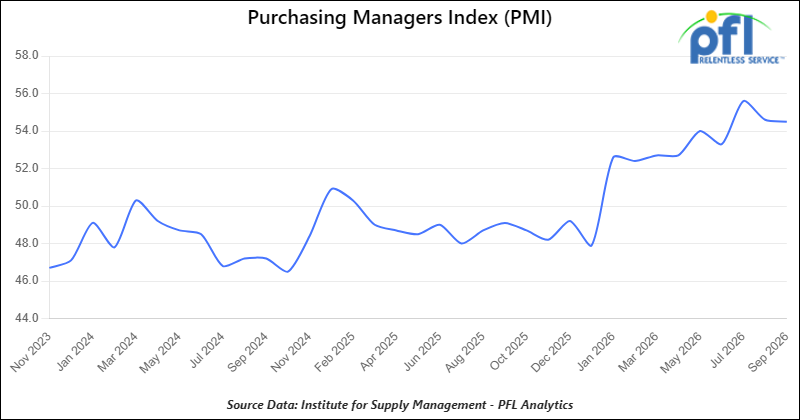
The Institute for Supply Management (ISM) releases two PMI reports each month—one covering manufacturing and the other covering services. These reports are based on surveys of supply managers across the country and measure changes in business activity. A reading above 50% indicates expansion, while a reading below 50% signals contraction, with the pace of change increasing as the index moves farther from 50.
The Manufacturing PMI registered 54.5% in September 2026, down slightly from 54.6% in August, but still marking the ninth consecutive month of expansion. Manufacturing activity remained solidly in expansion territory, with the New Orders Index rising to 55.3% from 53.7% in August, indicating continued growth in demand. Production remained strong at 56.7%, although it moderated from August’s 58.3%. Price pressures increased significantly, with the Prices Index rising to 77.9%, highlighting continued inflationary pressure from higher input costs.
The Services PMI registered 54.9% in September 2026, down from 55.4% in August, but marking the 27th consecutive month of expansion. Business activity and new orders continued to grow, with the Business Activity Index registering 56.5% and the New Orders Index reaching 59.8%. Employment returned to expansion territory at 50.1%, improving from 47.8% in August. However, the Prices Index increased to 74.0%, its highest level since July 2022, highlighting renewed and significant inflationary and operating cost pressures. Overall, the report indicates that the U.S. services sector continues to expand, although growth moderated slightly while price pressures intensified.
Consumer Confidence
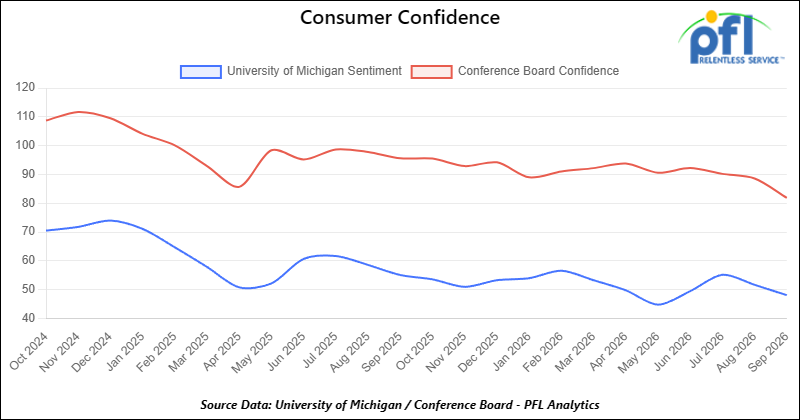
The Index of Consumer Sentiment from the University of Michigan decreased from 51.7 in August to 48.1 in September.
The Conference Board Consumer Confidence Index decreased from 88.6 in August to 81.9 in September.
Lease Bids
- 300, 5200CF Covered Hoppers located off of CPKCS or CN in Canada. For use in Petcoke service. Period: 3 Year.
- 10-20, 3200 or 3281 Covered Hoppers located off of CN or CPKCS in Canada. For use in Sodium Sulphate service. Period: 3-5 years. Lined.
Sales Bids
- 28, 3400CF Covered Hoppers located off of UP or BNSF in Texas. For use in Cement service. Cement Gates needed.
- 20, 17K DOT111 Tanks located off of various class 1s in various locations. For use in corn syrup service.
- 12, 21.5K-25K DOT 111 Tanks located off of various class 1s in Michigan. For use in Diesel, Asphalt, Crude service. Coiled and Insulated.
Lease Offers
- 15, 6200CF Covered Hoppers located off of all class 1s in Wisconsin. Last used in plastic. Cars are currently clean.
- 30, 6500CF Covered Hoppers located off of all class 1s in Wisconsin. Last used in plastic. Cars are currently clean.
- 50, 30K DOT117J Tanks located off of UP or BNSF in the South. Last used in ethanol.
- 93, 31.8K CPC 1232 Tanks located off of Various Class 1s in Texas. Last used in Diesel. Cars are currently clean.
- 22, 21K DOT 115 Stainless Steel Tank located off of BNSF in Texas. Cars are currently clean. Cars are currently clean.
- 30, 25.5K DOT 117J Tank located off of BNSF and UP in Texas. Last used in Benzene. NO BOV, NO LINER.
- 21, 20K DOT 111 Tank located off of BNSF and UP in Texas. Cars are currently clean. Cars are currently clean. C/I, NO Liner.
- 1000, 31.8K CPC 1232 Tank located off of BNSF and UP in Texas. Last used in Diesel.
Sales Offers
- 81, 31.8K CPC1232 Tanks located off of UP or BNSF in TX. Last used in Multiple Services. Requal Due in 2025.
- 15, 5750 CF Hopper located off of CSX, NS, CPKCS, CN, BNSF, UP in St Louis. Last used in Grain.
- 50, 30 DOT 111 Tank located off of multiple class 1s in multiple location. Last used in Fuels.
Call PFL today to discuss your needs and our availability and market reach. Whether you are looking to lease cars, lease out cars, buy cars, or sell cars call PFL today at 239-390-2885
Railcar for Sale or Lease
| CAT | Type | Capacity | GRL | QTY | LOC | Class | Prev. Use | Offer | Note |
|---|
| CAT | Type | Size | GRL | QTY | LOC | Class | Term | Commodity | Offer | Note |
|---|
| CAT | Type | Capacity | GRL | QTY | LOC | Class | Prev. Use | Clean | Offer | Note |
|---|
| CAT | Type | Capacity | GRL | QTY | LOC | Class | Commodity | Offer | Note |
|---|
PFL will be at the Following Conferences

- Where: The Westin Galleria Dallas
- Attending: David Cohen (954-729-4774), and Curtis Chandler (239-405-3365)
- Conference Website

- Where: The Westin Galleria Dallas
- Attending: Brian Baker (239.297.4519)
- Conference Website