
“Good judgment comes from experience, and a lot of that comes from bad judgment.” –Will Rogers
Jobs Update
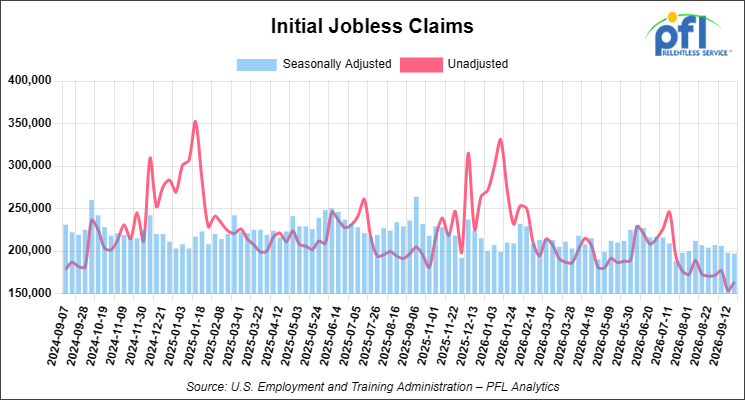
Initial jobless claims seasonally adjusted for the week ending September 19, 2026 came in at 197,000, versus the adjusted number of 198,000 people from the week prior, down 1,000 people week-over-week.
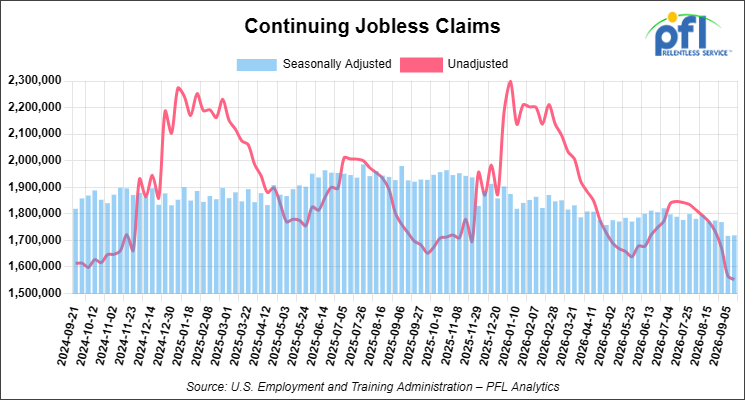
Continuing jobless claims came in at 1,719,000, versus the adjusted number of 1,717,000 people from the week prior, up 2,000 week-over-week.
Stocks closed higher on Friday of last week and higher week-over-week
The DOW closed higher on Friday of last week, up 478.64 points (0.93%), closing out the week at 51,828.62, up 145.98 points week-over-week. The S&P 500 closed higher on Friday of last week, up 39.28 points (0.51%), and closed out the week at 7,743.41, up 92.91 points week-over-week. The NASDAQ closed higher on Friday of last week, up 129.34 points (0.48%), and closed out the week at 27,068.72, up 546.17 points week-over-week.
In overnight trading, DOW futures traded lower and are expected to open at 51,995 this morning, down -168 points from Friday’s close.
Crude oil closed lower on Friday of last week, but mixed week-over-week
West Texas Intermediate (WTI) crude closed down -$2.20 per barrel (-2.3%), to close at $92.41 on Friday of last week, but down $7.89 week-over-week. Brent crude closed down -$2.28 per barrel (-2.1%), to close at $104.32, but up $0.45 per barrel week-over-week.
One Exchange WCS (Western Canadian Select) for November delivery settled on Friday of last week at US$21 below the WTI-CMA (West Texas Intermediate – Calendar Month Average). The implied value was US$68.90 per barrel.
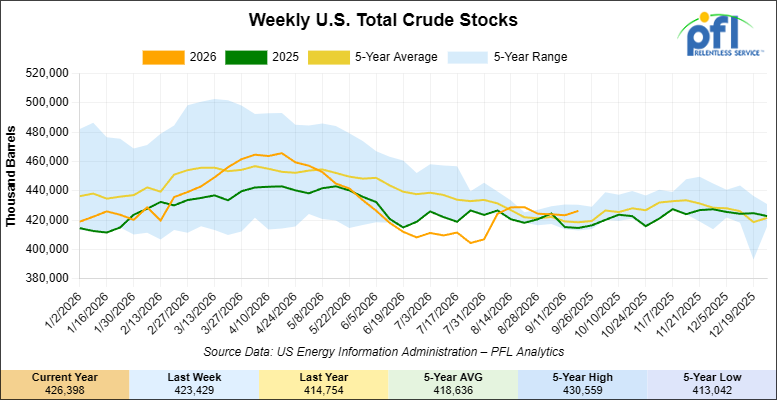
U.S. commercial crude oil inventories (excluding those in the Strategic Petroleum Reserve) increased by 3 million barrels week-over-week. At 426.4 million barrels, U.S. crude oil inventories are 2% above the five-year average for this time of year.
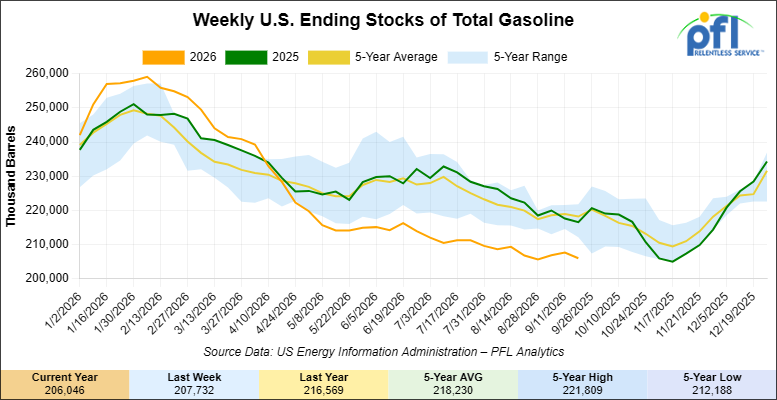
Total motor gasoline inventories decreased by 1.7 million barrels week-over-week and are 6% below the five-year average for this time of year.
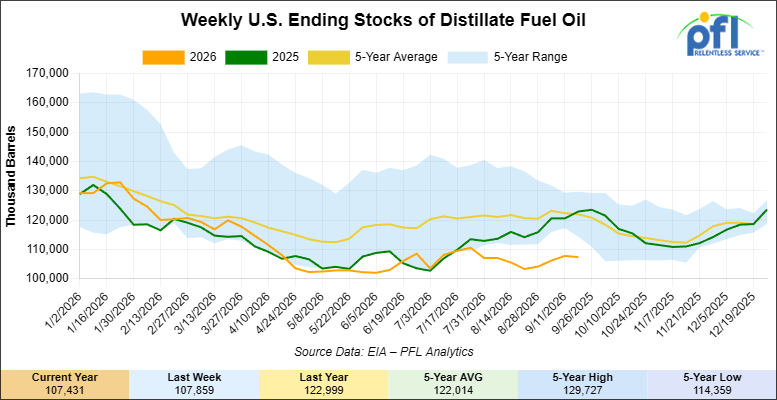
Distillate fuel inventories decreased by 428,000 barrels week-over-week and are 12% below the five-year average for this time of year.
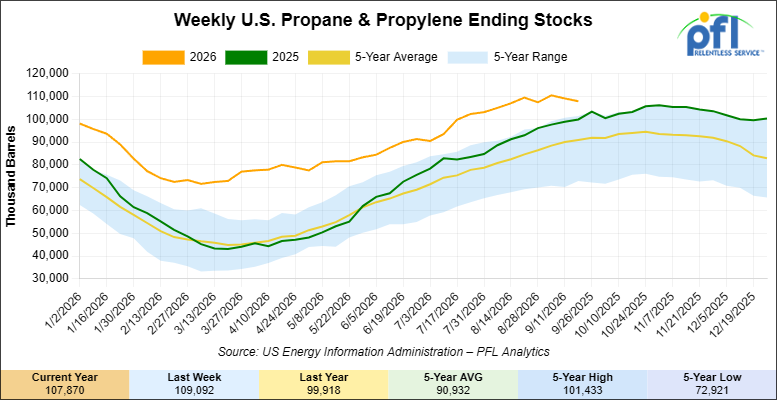
Propane/propylene inventories decreased by 1.2 million barrels week-over-week and are 19% above the five-year average for this time of year.
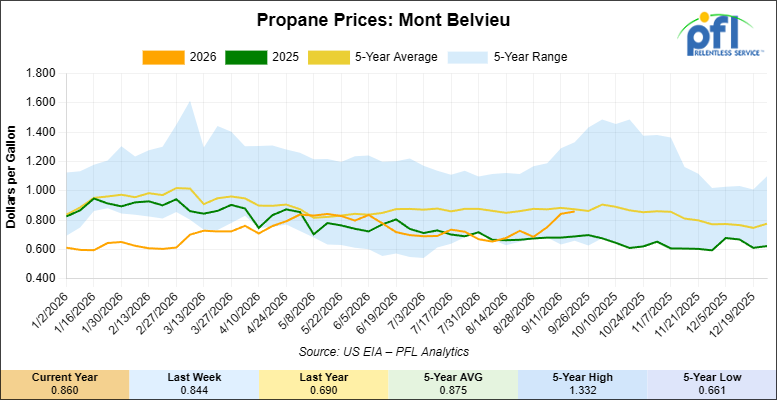
Propane prices closed at 86 cents per gallon on Friday of last week, up 1.6 cents per gallon week-over-week, and up 17 cents year-over-year.
Overall, total commercial petroleum inventories increased by 108,000 barrels week-over-week during the week ending September 18, 2026.
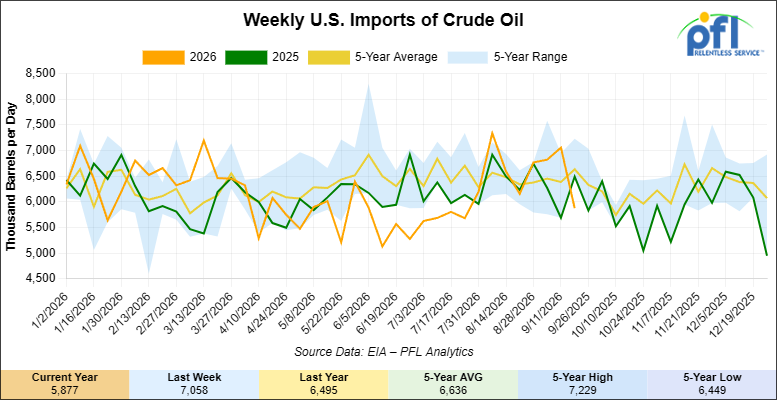
U.S. crude oil imports averaged 5.9 million barrels per day during the week ending September 18, 2026, a decrease of 1,181,000 barrels per day week-over-week. Total motor gasoline imports (including both finished gasoline and gasoline blending components) averaged 401,000 barrels per day, and distillate fuel imports averaged 85,000 barrels per day during the week ending September 18, 2026.
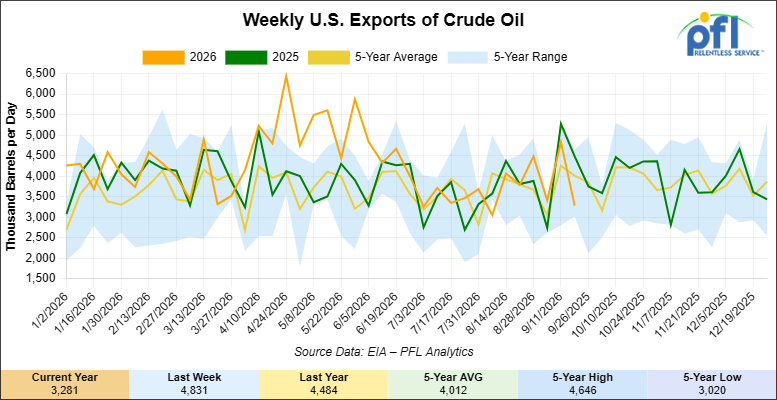
U.S. crude oil exports averaged 3.281 million barrels per day during the week ending September 18, 2026, a decrease of 1.550 million barrels per day week-over-week. Over the past four weeks, crude oil exports averaged 4.003 million barrels per day.
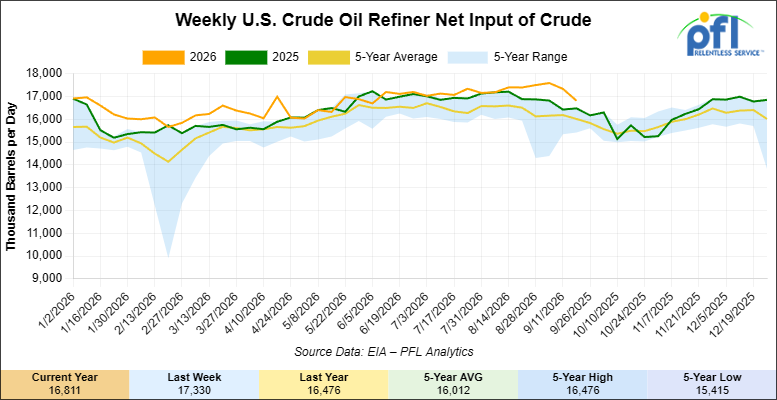
U.S. crude oil refinery inputs averaged 16.8 million barrels per day during the week ending September 18, 2026, which was 519,000 barrels per day less week-over-week.
WTI is poised to open at $95.59, up $3.18 per barrel from Friday’s close.
North American Rail Traffic
Week Ending September 23, 2026:
Total North American weekly rail volumes were up (+4.53%) in week 39, compared with the same week last year. Total Carloads for the week ending September 23, 2026 were 333,150, up (+2.68%) compared with the same week in 2025, while weekly Intermodal volume was 362,415, up (+6.29%) year over year. 9 of the AAR’s 11 major traffic categories posted year-over-year increases. The largest decrease came from Motor Vehicles and Parts (-7.03%). The largest increase was Petroleum & Petroleum Products (+16.08%).
In the East, CSX’s total volumes were up (+3.72%), with the largest decrease coming from Motor Vehicles and Parts (-8.49%), while the largest increase came from Other (+20.88%). NS’s total volumes were up (+2.39%), with the largest increase coming from Coal (+31.53%), while the largest decrease came from Motor Vehicles and Parts (-6.42%).
In the West, BNSF’s total volumes were up (+5.27%), with the largest increase coming from Petroleum & Petroleum Products (+15.96%), while the largest decrease came from Coal (-27.24%). UP’s total volumes were up (+9.16%), with the largest increase coming from Nonmetallic Minerals (+18.84%), while the largest decrease came from Coal (-16.55%).
In Canada, CN’s total volumes were down (-4.21%), with the largest increase coming from Petroleum & Petroleum Products (+43.82%), while the largest decrease came from Coal (-27.24%). CPKCS’s total volumes were up (+1.51%), with the largest increase coming from Grain (+17.59%), while the largest decrease came from Motor Vehicles and Parts (-10.76%).
Source Data: AAR – PFL Analytics
North American Rig Count Summary
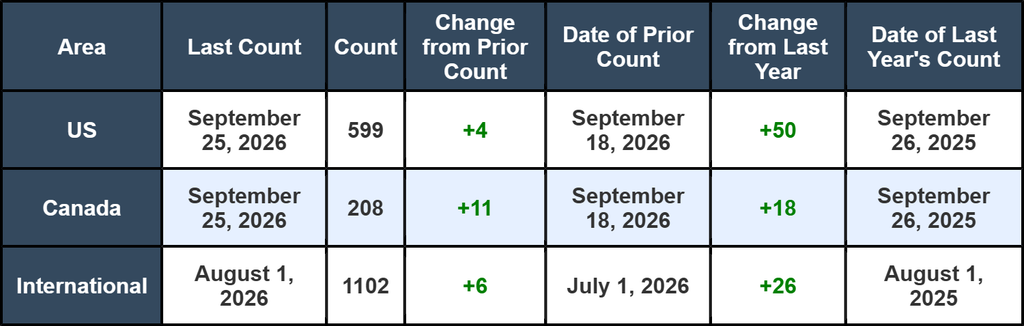
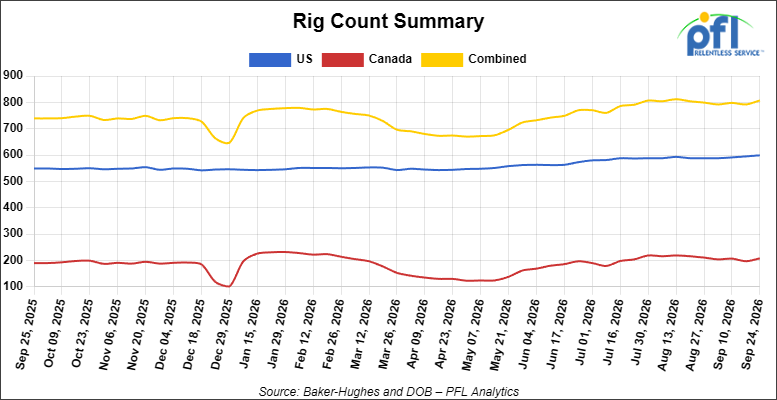
North American rig count was up by +15 rigs week-over-week. The U.S. rig count was up by +4 rigs week-over-week, and up by +50 rigs year-over-year. The U.S. currently has 599 active rigs. Canada’s rig count was up by +11 rigs week-over-week and up by +18 rigs year-over-year. Canada currently has 208 active rigs. Overall, year-over-year we are up by +68 rigs collectively.
We are watching a few things out there for you:
We Are Watching Petroleum Carloads
The four-week rolling average of petroleum carloads carried on the six largest North American railroads rose to 30,125 from 29,930 which was a decrease of +95 rail cars week-over-week. Canadian volumes were higher. CPKC’s shipments were up by +15.0% week-over-week, CN’s volumes were higher by +3.0% week-over-week. U.S. shipments were higher across the board. The UP had the largest percentage increase and was up by +12.0% week-over-week.
We Continue to Watch Our Strategic Petroleum Reserves
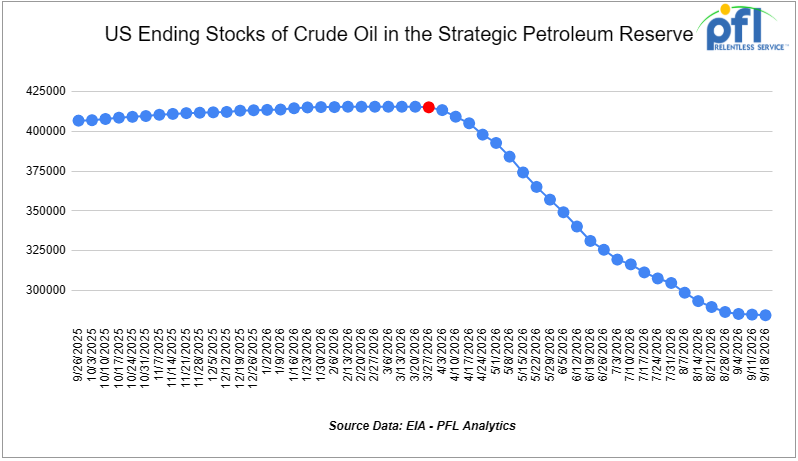
The ongoing emergency drawdown of the U.S. Strategic Petroleum Reserve (SPR) remains a major component of global efforts to offset crude oil supply disruptions stemming from the conflict involving Iran and the continued restrictions on oil shipments through the Strait of Hormuz. Since March, the Department of Energy (DOE) has awarded exchanges covering more than 133 million barrels of crude oil, with additional releases expected as part of a broader international response coordinated through the International Energy Agency (IEA).
The United States continues to execute its commitment to make available up to 172 million barrels from the SPR under the IEA’s collective plan to inject roughly 400 million barrels into global energy markets. Officials have argued that the releases are necessary to help stabilize crude supplies and limit further increases in fuel prices as refiners compete for replacement barrels amid ongoing transportation disruptions. The IEA’s coordinated action remains the largest emergency oil-stock release in the agency’s history.
As releases have accelerated, inventories in the SPR have declined to 284.552 million barrels, down from 415.442 million barrels at the start of the conflict with Iran and reaching their lowest level since October 1982. The SPR declined by 405 thousand barrels during the week ending September 11th. Since the first SPR drawdown began, the United States has withdrawn approximately 130.890 million barrels, equivalent to an average of roughly 719,176 barrels per day through the week ending September 18, 2026.
Global petroleum inventories have also tightened considerably. The IEA has reported substantial draws in commercial crude and refined-product stockpiles across major consuming nations, underscoring the strain that the conflict has placed on world energy markets. While oil flows through the Strait of Hormuz have partially recovered from their initial near-shutdown, the IEA continues to identify significant uncertainty surrounding the pace and durability of the recovery.
The Administration continues to emphasize that the current program consists primarily of exchange agreements, rather than outright sales. Under these arrangements, companies receiving crude oil today are required to return the borrowed barrels in the future along with additional volumes as a premium. DOE has stated that its exchange structure is designed to return the borrowed crude with additional premium barrels, with the stated objective of strengthening the SPR over time.
We Are Watching Canadian Crude by Rail
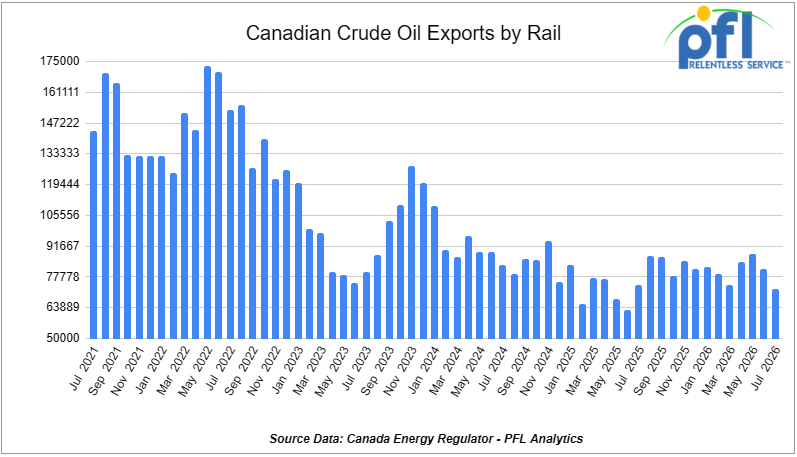
The Canadian Energy regulator reported on September 25, 2026, that 72,298 barrels per day were exported during the month of July 2026, down from 81,226 barrels per day in June of 2026, a decrease of 8,928 barrels per day month-over-month. This is the lowest level reported by CER since June of 2025 where only 62,847 barrels per day were exported.
Crude by rail will always be necessary out of Canada for stranded oil not connected by pipelines. Raw bitumen, which is shipped as a non-haz product and is not able to flow in pipelines, is competitive with pipeline tolls and is a growing market to keep an eye on. In a normal predictable market, we really need to see basis WTI-CMA (West Texas Intermediate – Calendar Month Average) blowout to -18 per barrel for sustained periods of time to make economic sense. Current rail rates from Alberta to the U.S. Gulf Coast have averaged roughly $17 per-barrel, making rail competitive whenever WCS-WTI spreads exceed $18 per barrel, including quality adjustments.
This is not a fleet that switches overnight: car owners and lessors want five-year commitments, the Class 1’s expect similar terms, and new 117J cars carry one to two year build times.
Folks, what we are in now is not a normal and predictable market. Some would say nothing has been normal or predictable since COVID. With pipelines out of Alberta being full or nearly full, one consideration is the outright price of oil itself, with the conflict in Iran not seeming to go away anytime soon, some may step up, take on some cars to get barrels to market quickly. Mistreamers won’t do that, however, we may see the producer step up. For the producer, it is all about what their netback is, not how much it costs to get there. The producer can pay more than $18 per barrel at some point if that is their only outlet and pipelines are full. The risk reward ratio may make sense with elevated prices but the old saying – what goes up, must come down, and the outright price of oil will come down it is just a matter of when. We always have our eyes on this one please stay tuned to PFL or call the desk to trouble shoot.
We Continue to Watch Diesel
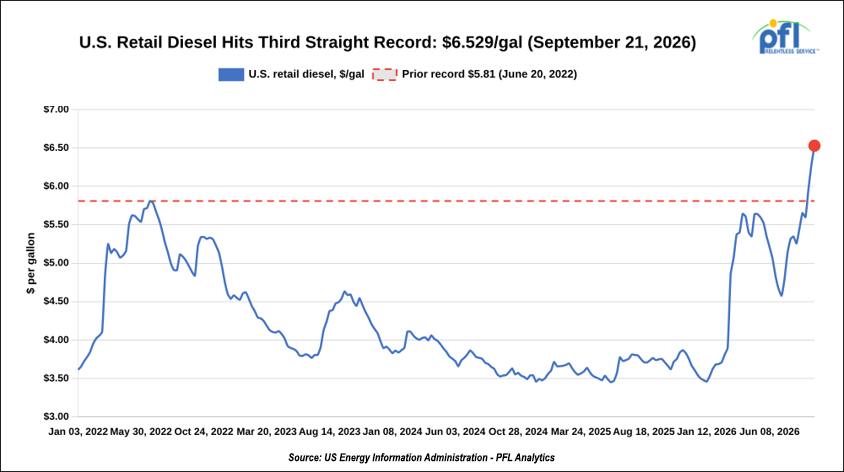
U.S. retail diesel averaged $6.529 per gallon in the EIA survey for Monday, September 21st, up 24.4 cents week over week and the third straight all-time record. Ultra-low sulphur diesel stocks stood at 96.4 million barrels in the week ended September 18th, 14% below a year ago, while distillate demand ran at 3.97 million barrels per day, up 6.3% on the year as the corn harvest gets going. California retail diesel is now above $8.
The politics caught up with the price on Tuesday of last week when President Trump told reporters at the UN, “let’s not send out the diesel.” Treasury Secretary Bessent said the administration was studying a full or partial ban, a Politico report last Wednesday of a 90-day plan knocked Valero and Marathon down roughly 7% and 6% on the week, and the White House then denied a plan existed. Energy Secretary Chris Wright said last Wednesday that a blanket ban “definitely doesn’t work” and that any restraint would most likely be voluntary, a tweak in where diesel flows, not whether it flows. More than 30 trade groups, including API, AFPM, NAM and the Chamber, wrote Trump the same day warning that refiners would fill their diesel tanks within weeks and cut runs across the board, taking gasoline and jet with them.
The U.S. net exported 1.1 million barrels per day of diesel last year, and Mexico takes about 220,000 barrels per day of U.S. distillate, roughly 185,000 of it from the Gulf Coast, a portion of which moves in tank cars to Monterrey and San Luis Potosi. Any export curb, voluntary or otherwise, lands first on the cross-border tank car fleet, and if refiners trim runs to keep tanks from topping out, domestic distillate loadings are right behind it. On a related note, Mexico’s organized crime prosecutor took over the investigation into 371,000 barrels of gasoline and diesel seized September 18th at a rail-served terminal in Guanajuato, so scrutiny of what is arriving by rail south of the border is only going up. Our read is that a voluntary redirection of exports is the most likely outcome, but shippers with cars in Mexico service should have a plan for both directions. PFL will be keeping an eye on this one.
We Continue to Watch the Merger
On Friday, September 18th the Surface Transportation Board unanimously denied the three motions filed August 6th by BNSF, CSX and five shipper associations, including the American Chemistry Council and AFPM, asking it to throw out the Union Pacific and Norfolk Southern application before a merits review. The 4-0 vote was procedural, and the Board went out of its way to say the decision reflects no view on the merits and is no endorsement of the railroads’ analysis. Notices of intent to participate are due Wednesday, comments and requests for conditions are due November 18th, and replies February 16th.
The news was in the concurrence. Richard Kloster, the Board’s newest member, sworn in June 5th, wrote separately that the applicants “still have a long way to go” to show the deal is in the public interest, criticized “a lack of transparency and depth in the application,” and said UP and NS lean heavily on intermodal benefits in a market that is “already competitive.” He described the applicants’ approach as “letting the line out slowly,” offering minor conditions first and waiting to see who complains before offering anything meaningful. In our opinion the concurrence matters more than the ruling: a sitting Board member has told the applicants their conditions package is too thin before the first shipper comment has been filed. UP and NS say they have presented an “unprecedented evidentiary case” backed by more than 2,000 shipper support statements.
This remains the first test of the 2001 rules requiring a major merger to enhance competition, not merely preserve it, and BNSF’s ask for a neutral switching carrier across the Gulf Coast chemical belt is still the item that matters most for tank car shippers. Kloster’s comments suggest the Board may be receptive to conditions with real teeth, which is exactly what UP has said it will not accept. PFL has been watching this one since the deal was announced, and the November filings are where the fight actually starts. Stay tuned.
We Continue to Watch Left Wing Carney
The Prime Minister told the New York Times in an interview published on Wednesday of last week that he has looked at the “extreme tail risk” of U.S. military action against Canada, calling it “not a base case” but saying it would be “irresponsible” not to prepare. On Thursday of last week he hosted Vietnam’s To Lam in Ottawa and signed a strategic partnership as part of the Indo-Pacific pivot. Meanwhile the Section 338 import bans on Canadian alcohol, dairy and motorcycles take effect Tuesday, replacing the 50% tariffs, Ottawa’s counter-tariffs on C$27.6 billion of U.S. goods have been in place since September 8th, and neither side is at the table. The threat to lift the auto tariff to 50% on January 1st still stands.
Now the energy superpower math. Trans Mountain, the only non-U.S. outlet for Alberta crude, ran 96% full in April and was apportioned in June and July. The federally owned pipeline’s answer this fall is a C$9 million drag reducing agent project that adds 90,000 barrels per day in October, less than 2% of the roughly 5.1 million barrels per day Canada is expected to produce in the fourth quarter. The next 210,000 barrels per day is an application, the West Coast Oil Pipeline cannot break ground before September 2027 at the earliest, and the Vancouver dredging that lets tankers load fully will not be done until February 2027. Western Canadian Select at Hardisty finished last week around $21 under WTI, the widest since late 2023, and on roughly 3.5 million barrels per day of heavy output every dollar of widening is about $1.3 billion U.S. a year that leaves Alberta and does not come back.
A Prime Minister war-gaming an American invasion while his energy exports go out the door at a $21 discount has, in our opinion, got his priorities upside down. The market is doing the diversification for him, one discounted barrel at a time.
We Are Watching Trans Mountain
Trans Mountain said Wednesday of last week that its drag reducing agent project will be “completed and commissioned in October,” taking nominal capacity on the dual pipeline system to 980,000 barrels per day from 890,000. The C$9 million job installs 16 injection units at 12 existing pump stations between Hinton and Hope; the CER approved it in June. All September nominations were accepted after apportionment in June and July, so the extra 90,000 barrels per day arrives just as fourth quarter production hits a record and fall maintenance wraps up.
The constraint has shifted to the water. Westridge’s three berths handled 510,000 barrels per day in the second quarter against a 630,000 barrels per day rating because Aframaxes are capped at about 550,000 to 600,000 barrels by tide and draft, versus 750,000 fully loaded. The Vancouver Fraser Port Authority started dredging the Second Narrows channel the same day Trans Mountain issued its update, with work running to February 2027, and Trans Mountain has applied for another 210,000 barrels per day of pumping capacity targeted for the end of 2028. August waterborne exports averaged 491,000 barrels per day, down 9% from July’s record, as Chinese buyers paused during the brief Hormuz reopening; China still took 288,000 barrels per day, and U.S. West Coast refiners picked up the slack at 166,000 barrels per day, up 34%. With Hormuz traffic down again since mid-July, the Asian pull is likely to return.
None of this changes the rail picture before 2027. Ninety thousand barrels per day buys Alberta a few months of breathing room, not a solution, and PFL will be watching Westridge loadings once the dredge is finished.
We Continue to Watch Enbridge
The FBI and ATF confirmed Wednesday of last week that they are investigating two fires at Enbridge properties in northern Wisconsin: a September 14th fire at the company’s Great Lakes office in Superior, where officers found graffiti, and a September 17th fire at a horizontal drilling site on the Line 5 reroute in the Ashland County town of Gingles that destroyed an equipment trailer and two boring machines. Enbridge called the incidents “neither legal nor peaceful,” said it will seek prosecution of the “criminal saboteurs” involved, and gave no damage estimate. The Wisconsin DOJ’s Division of Criminal Investigation and the State Fire Marshal are supporting the probe.
Line 5 has been running on a roughly 1,500 foot temporary bypass around the Saxon spill site since the weekend of September 12th. DNR Secretary Karen Hyun told the Natural Resources Board last Wednesday the agency is “deeply concerned” about the August 25th release, now confirmed at 1.3 million gallons of natural gas liquids and the largest pipeline spill in Wisconsin in more than 50 years, and a DNR spokesperson said the agency “continues to evaluate all options in response to unpermitted construction.” The damaged pipe has gone for metallurgical analysis under a PHMSA corrective action order, and excavation of about two tenths of an acre of contaminated soil begins the week of September 28th. Enbridge is now moving up to 540,000 barrels per day of light crude and NGLs to Sarnia on a bypass the state never permitted, while that same state decides whether the reroute permits it issued in 2024 still stand.
Tribes and environmental groups have asked the DNR to revoke the reroute permits outright, and the Bad River Band has issued a disaster declaration. PFL has been watching this one for years. Sabotage adds an ugly new dimension, but the bigger risk to Line 5 has always been political, and Wisconsin has now joined Michigan on that list. We’ll keep our eye on it.
We Are Watching Safety
The Transportation Safety Board of Canada released its final report Thursday of last week on the April 5th, 2023 derailment of 18 cars of a CN unit grain train near Uncas, Alberta, bound for Prince Rupert. The cause was a shattered rim on a wheel of FURX 841817, a lessor-owned covered hopper; the wheel was manufactured in 1991, twelve years before the AAR’s 2003 steel cleanliness standard, had passed every scheduled inspection, and had already been flagged by impact detector readings for removal in Edmonton when it failed. The TSB estimates about one million pre-2003 wheels are still in service across North America, roughly 250,000 of them coming due for reprofiling soon, and it wants them retired at the shop instead of turned and returned to service. Chair Yoan Marier: “We haven’t heard from the railways any sort of retirement strategy for these wheels.”
The formal recommendation goes to Transport Canada, asking for trend-based analysis of wheel impact load detector data the railways already collect, in place of the single-reading thresholds in use now. The wheel age point was recorded as a safety concern, not a recommendation, so nothing is mandatory yet. If the AAR turns retire-on-reprofile into an interchange rule, the bill lands on the car owner, and fleet owners should know how many pre-2003 wheels they are carrying before someone else tells them. Worth a look at your wheel data.
Two other safety items from last week. The NTSB issued a report last Monday on shoving movements, citing 16 accidents since October 2020 that killed 14 workers and seriously injured two, with two more investigations opened since August, and it recommends the FRA and the Class Is prohibit crews from riding equipment to provide point protection. Separately, the BMWED says CSX is abolishing 165 maintenance-of-way positions and furloughing as many as 1,062 workers, with system gangs off until late February; CSX calls it seasonal. A yard-switching ban and a thousand fewer track workers in the same week is the kind of pairing the FRA will notice, and the timing is not great for an industry promising the STB better service.
Lease Bids
- 20-50, 4000-5000 Covered Hoppers located off of UP or BNSF in Houston. For use in Urea, Potash, and Ammonium Sulfate service. Period: 6-12 Months.
- 300, 5200CF Covered Hoppers located off of CP or CM in Canada. For use in Petcoke service. Period: 3 Year.
- 100, 340W Pressure Tank located off of CN or CP in Canada. For use in Propane service. Period: 6 Months.
- 10-20, 3200 or 3281 Covered Hoppers located off of CN or CP in Canada. For use in Sodium Sulphate service. Period: 3-5 years. Lined.
- 50, 340W Pressure Tanks located off of CN or CP in Canada. For use in Propane service. Period: Winter.
- 30-50, 340W pressure Tanks located off of NS or CSX in Northeast U.S. For use in Propane service. Period: Winter.
- 25, 340W Pressure Tanks located off of UP or BN in US. For use in Propane service. Period: Winter.
- 50, 28.3K 117J Tanks located off of BNSF in Kansas/Oklahoma. For use in Fuel Oil service. Period: 6 Months.
- 100, 30K 117J Tanks located off of CN in Canada. For use in Diesel service. Period: 1 year.
- 150, 340W Pressure Tank located off of CN in Canada. For use in Propane service. Period: 3 Months.
Sales Bids
- 28, 3400CF Covered Hoppers located off of UP or BNSF in Texas. For use in Cement service. Cement Gates needed.
- 20, 17K DOT111 Tanks located off of various class 1s in various locations. For use in corn syrup service.
- 120, Various Open-Top Aluminum Rotary Gondolas located off of various class 1s in various locations. For use in Sulphur service. Built 2004 or later.
- 12, 21.5K-25K DOT 111 Tanks located off of Various Class 1s in Michigan. For use in Diesel, Asphalt, Crude service. Coiled and Insulated.
Lease Offers
- 15, 6200CF Covered Hoppers located off of all class 1s in Wisconsin. Last used in plastic. Cars are currently clean.
- 30, 6500CF Covered Hoppers located off of all class 1s in Wisconsin. Last used in plastic. Cars are currently clean.
- 100, 28.4K DOT 117J Tanks located off of UP or BNSF in Beaumont, TX. Cars are currently clean.
- 50, 30K DOT117J Tanks located off of UP or BNSF in the South. Last used in ethanol.
- 41, 30K DOT 111 Tanks located off of in Brownsville. Last used in Diesel. Cars are currently clean.
- 93, 31.8K CPC 1232 Tanks located off of Various Class 1s in Texas. Last used in Diesel. Cars are currently clean.
- 22, 21K DOT 115 Stainless Steel Tank located off of BNSF in Texas. Cars are currently clean. Cars are currently clean.
- 30, 25.5K DOT 117J Tank located off of BNSF and UP in Texas. Last used in Benzene. NO BOV, NO LINER.
- 21, 20K DOT 111 Tank located off of BNSF and UP in Texas. Cars are currently clean. Cars are currently clean. C/I, NO Liner.
- 1000, 31.8K CPC 1232 Tank located off of BNSF and UP in Texas. Last used in Diesel.
Sales Offers
- 81, 31.8K CPC1232 Tanks located off of UP or BNSF in TX. Last used in Multiple Services. Requal Due in 2025.
- 35, 3400CF Covered Hoppers located off of UP or BNSF in the Midwest. Last used in Sand.
- 15, 5750 CF Hopper located off of CSX, NS, CP, CN, BNSF, UP in St Louis. Last used in Grain.
- 50, 30 DOT 111 Tank located off of multiple class 1s in multiple location. Last used in Fuels.
Call PFL today to discuss your needs and our availability and market reach. Whether you are looking to lease cars, lease out cars, buy cars, or sell cars call PFL today at 239-390-2885
Railcar for Sale or Lease
| CAT | Type | Capacity | GRL | QTY | LOC | Class | Prev. Use | Offer | Note |
|---|
| CAT | Type | Size | GRL | QTY | LOC | Class | Term | Commodity | Offer | Note |
|---|
| CAT | Type | Capacity | GRL | QTY | LOC | Class | Prev. Use | Clean | Offer | Note |
|---|
| CAT | Type | Capacity | GRL | QTY | LOC | Class | Commodity | Offer | Note |
|---|
PFL will be at the Following Conferences

- Where: The Gaylord Opryland Hotel
- Attending: Brian Baker (239.297.4519)
- Conference Website

- Where: The Westin Galleria Dallas
- Attending: David Cohen (954-729-4774), and Curtis Chandler (239-405-3365)
- Conference Website

- Where: The Westin Galleria Dallas
- Attending: Brian Baker (239.297.4519)
- Conference Website