
“The winds and the waves are always on the side of the ablest navigators.” -Edward Gibbon
Jobs Update
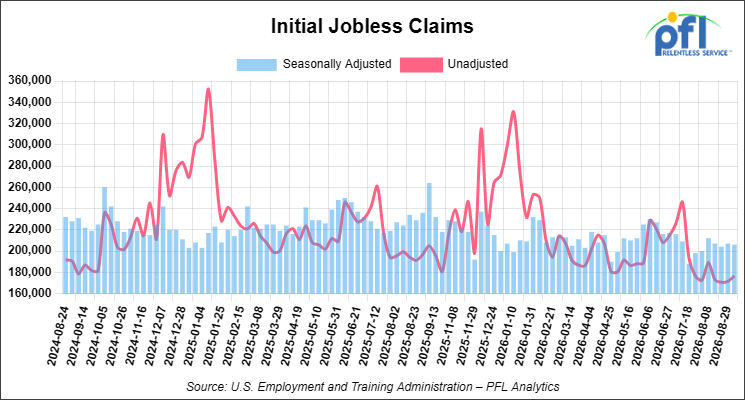
Initial jobless claims seasonally adjusted for the week ending September 5, 2026 came in at 206,000, versus the adjusted number of 207,000 people from the week prior, down 1,000 people week-over-week.
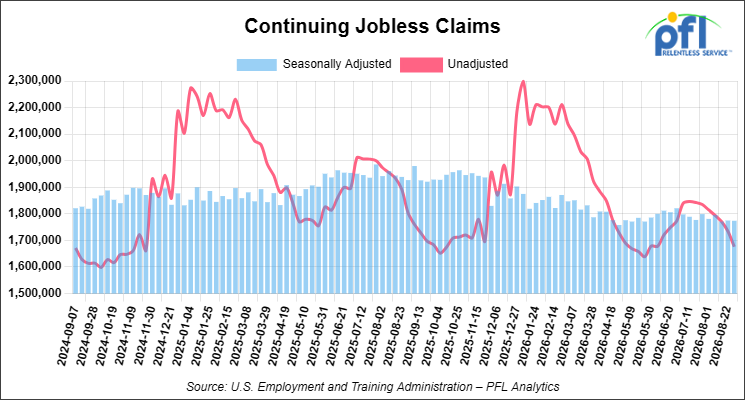
Continuing jobless claims came in at 1,774,000, versus the adjusted number of 1,775,000 people from the week prior, down 1,000 week-over-week.
Stocks closed higher on Friday of last week, but lower week-over-week
The DOW closed higher on Friday of last week, up 509.19 points (0.98%), closing out the week at 52,573.29, down -840.96 points week-over-week. The S&P 500 closed higher on Friday of last week, up 65.28 points (0.86%), and closed out the week at 7,656.98, down -61.62 points week-over-week. The NASDAQ closed higher on Friday of last week, up 251.31 points (0.96%), and closed out the week at 26,333.04, down -173.95 points week-over-week.
In overnight trading, DOW futures traded lower and are expected to open at 52,871 this morning, down -131 points from Friday’s close.
Crude oil closed lower on Friday of last week, but higher week-over-week
West Texas Intermediate (WTI) crude closed down -2.43 per barrel (-2.37%), to close at $100.05 on Friday of last week, but up $8.57 per barrel week-over-week. Brent crude closed down -3.02 per barrel (-2.81%), to close at $104.61, but up $11.93 per barrel week-over-week.
One Exchange WCS (Western Canadian Select) for October delivery settled on Friday of last week at US$16.40 below the WTI-CMA (West Texas Intermediate – Calendar Month Average). The implied value was US$80.51 per barrel.
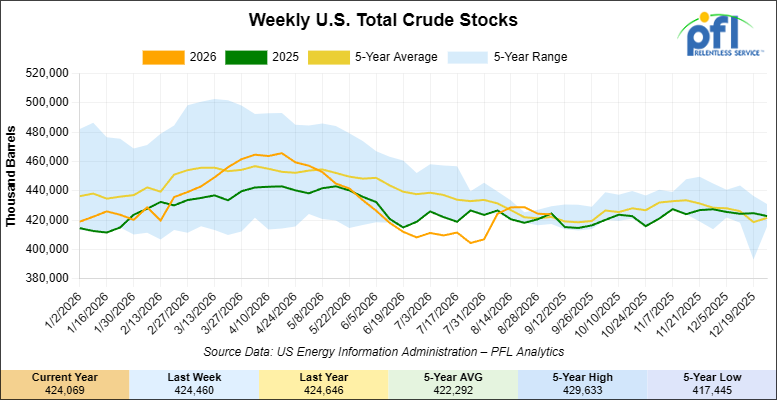
U.S. commercial crude oil inventories (excluding those in the Strategic Petroleum Reserve) decreased by 391,000 barrels week-over-week. At 424.1 million barrels, U.S. crude oil inventories are at the five-year average for this time of year.
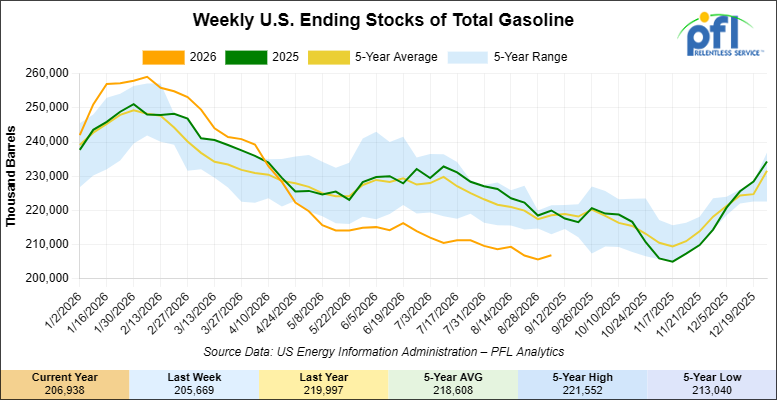
Total motor gasoline inventories increased by 1.3 million barrels week-over-week. and are 5% below the five-year average for this time of year.
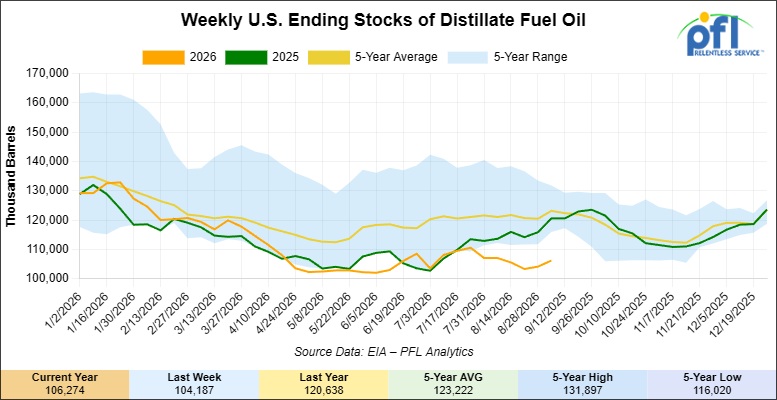
Distillate fuel inventories increased by 2.1 million barrels week-over-week. and are 14% below the five-year average for this time of year.
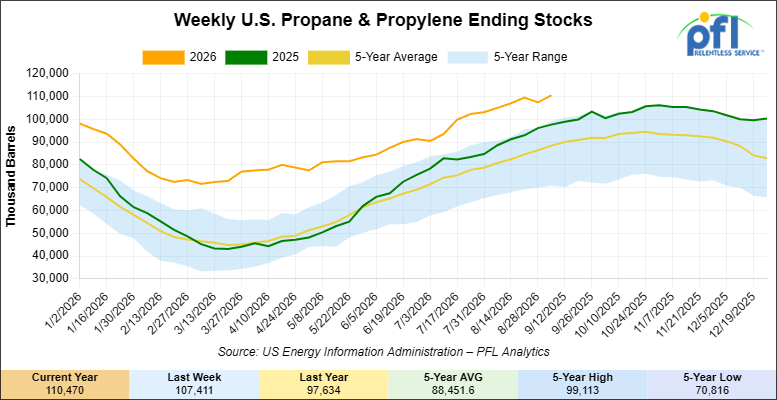
Propane/propylene inventories increased by 3.1 million barrels week-over-week. and are 25% above the five-year average for this time of year.
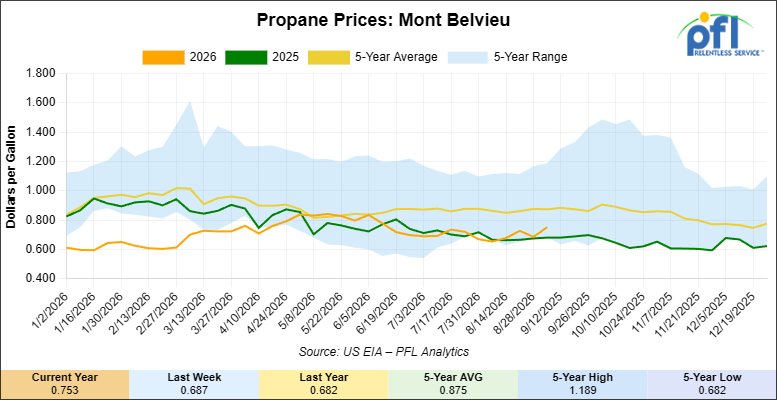
Propane prices closed at 75.3 cents per gallon on Friday of last week, up 6.6 cents per gallon week-over-week, and up 7.1 cents year-over-year.
Overall, total commercial petroleum inventories increased by 6.3 million barrels week-over-week during the week ending September 4, 2026.
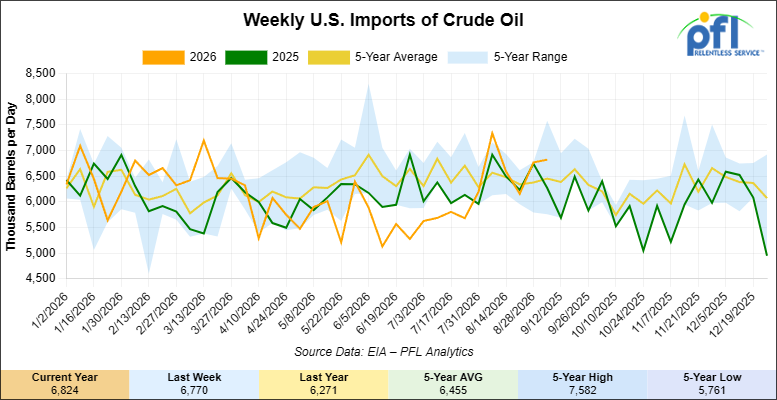
U.S. crude oil imports averaged 6.8 million barrels per day during the week ending September 4, 2026, an increase of 54,000 barrels per day week-over-week. Total motor gasoline imports (including both finished gasoline and gasoline blending components) averaged 464,000 barrels per day, and distillate fuel imports averaged 185,000 barrels per day during the week ending September 4, 2026.
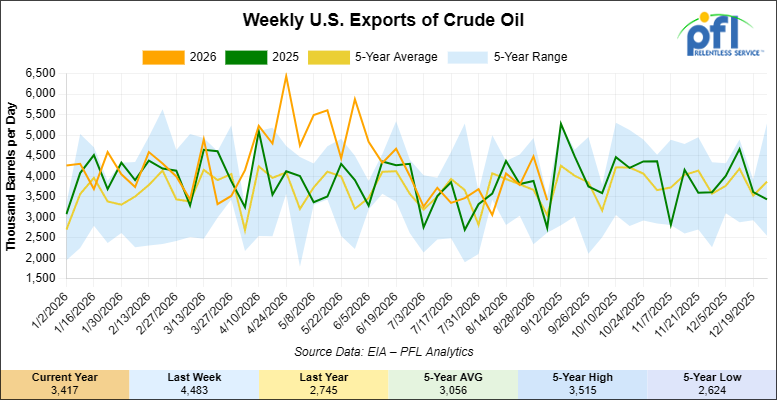
U.S. crude oil exports averaged 3.417 million barrels per day during the week ending September 4, 2026, a decrease of 1.066 million barrels per day week-over-week. Over the past four weeks, crude oil exports averaged 3.94 million barrels per day.
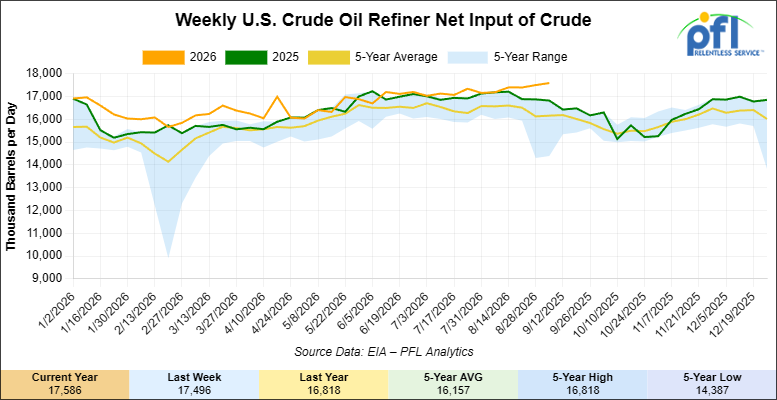
U.S. crude oil refinery inputs averaged 17.6 million barrels per day during the week ending September 4, 2026, which was 90,000 barrels per day more week-over-week.
WTI is poised to open at $102.63, up $2.58 per barrel from Friday’s close.
North American Rail Traffic
Week Ending September 9, 2026:
Total North American weekly rail volumes were up (+12.34%) in week 37, compared with the same week last year. Total Carloads for the week ending September 9, 2026 were 336,311, up (+8.39%) compared with the same week in 2025, while weekly Intermodal volume was 362,779, up (+16.26%) year over year. 11 of the AAR’s 11 major traffic categories posted year-over-year increases. The largest increase was Grain (+21.05%).
In the East, CSX’s total volumes were up (+10.65%), with the largest decrease coming from Petroleum & Petroleum Products (-13.31%), while the largest increase came from Metallic Ores and Metals (+35.22%). NS’s total volumes were up (+8.85%), with the largest increase coming from Petroleum & Petroleum Products (+24.90%), while the largest decrease came from Coal (-12.67%).
In the West, BNSF’s total volumes were up (+15.24%), with the largest increase coming from Grain (+28.93%), while the largest decrease came from Chemicals (-3.04%). UP’s total volumes were up (+18.06%), with the largest increase coming from Intermodal Units (+26.36%), while the largest decrease came from Farm Products (-3.50%).
In Canada, CN’s total volumes were up (+4.74%), with the largest increase coming from Other (+35.22%), while the largest decrease came from Intermodal Units (-18.15%). CPKCS’s total volumes were up (+0.86%), with the largest increase coming from Grain (+23.09%), while the largest decrease came from Other (-31.22%).
Source Data: AAR – PFL Analytics
North American Rig Count Summary
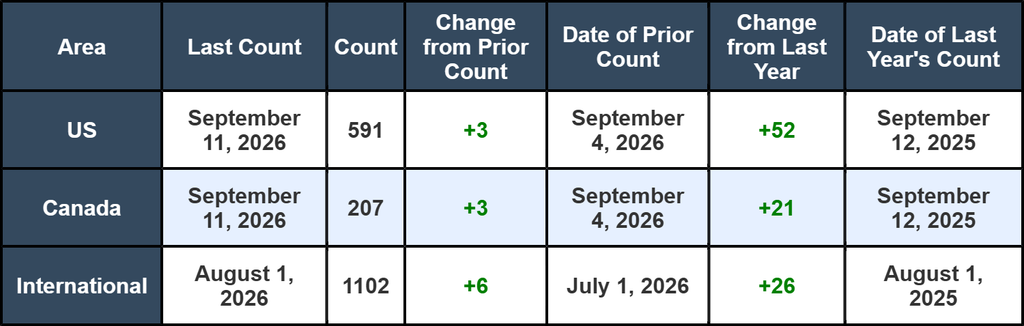
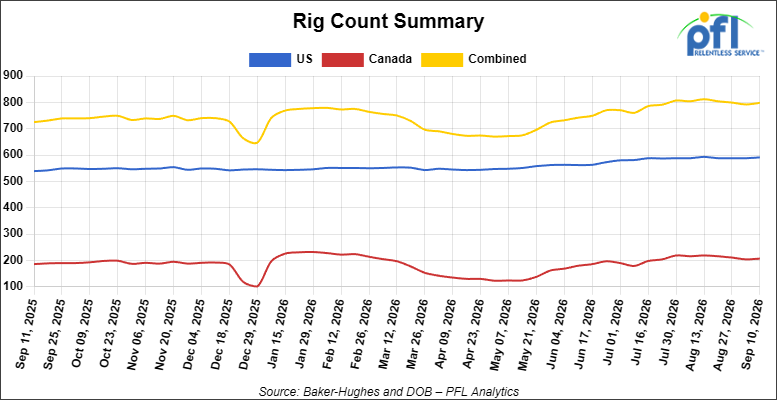
North American rig count was up by +6 rigs week-over-week. The U.S. rig count was up by +3 rigs week-over-week, and up by +52 rigs year-over-year. The U.S. currently has 591 active rigs. Canada’s rig count was up by +3 rigs week-over-week and up by +21 rigs year-over-year. Canada currently has 207 active rigs. Overall, year-over-year we are up by +73 rigs collectively.
We are watching a few things out there for you:
We Are Watching Petroleum Carloads
The four-week rolling average of petroleum carloads carried on the six largest North American railroads fell to 30,123 from 30,487 which was a decrease of -364 rail cars week-over-week. Canadian volumes were mixed. CN’s shipments were up by +6.0% week-over-week, CPKC’s volumes were lower by -14.0% week-over-week. U.S. shipments were also mixed. The UP had the largest percentage increase and was up by +7.0% week-over-week. The CSX had the largest percentage decrease and was down by -9.0% week-over-week.
We Continue to Watch Our Strategic Petroleum Reserves
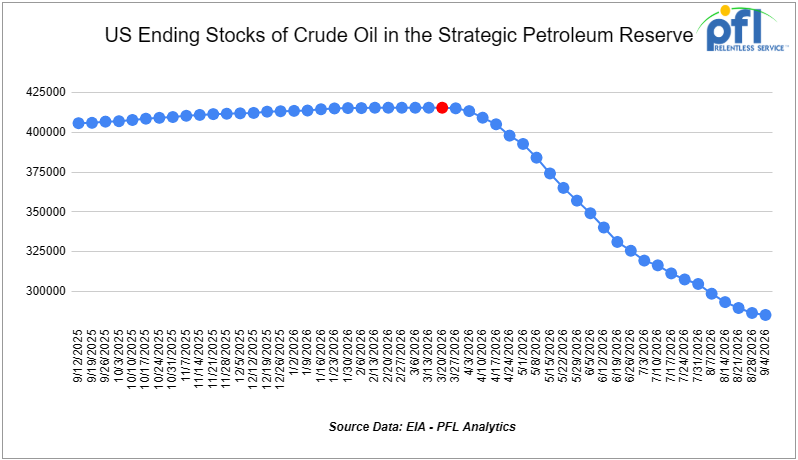
The ongoing emergency drawdown of the U.S. Strategic Petroleum Reserve (SPR) remains a major component of global efforts to offset crude oil supply disruptions stemming from the conflict involving Iran and the continued restrictions on oil shipments through the Strait of Hormuz. Since March, the Department of Energy (DOE) has awarded exchanges covering more than 133 million barrels of crude oil, with additional releases expected as part of a broader international response coordinated through the International Energy Agency (IEA).
The United States continues to execute its commitment to make available up to 172 million barrels from the SPR under the IEA’s collective plan to inject roughly 400 million barrels into global energy markets. Officials have argued that the releases are necessary to help stabilize crude supplies and limit further increases in fuel prices as refiners compete for replacement barrels amid ongoing transportation disruptions. The IEA’s coordinated action remains the largest emergency oil-stock release in the agency’s history.
As releases have accelerated, inventories in the SPR have declined to 285.306 million barrels, down from 415.442 million barrels at the start of the conflict with Iran and reaching their lowest level since October 1982. The SPR declined by 1.244 million barrels during the week ending September 4th. Since the first SPR drawdown began, the United States has withdrawn approximately 130.082 million barrels, equivalent to an average of roughly 774,298 barrels per day through the week ending September 4, 2026.
Global petroleum inventories have also tightened considerably. The IEA has reported substantial draws in commercial crude and refined-product stockpiles across major consuming nations, underscoring the strain that the conflict has placed on world energy markets. While oil flows through the Strait of Hormuz have partially recovered from their initial near-shutdown, the IEA continues to identify significant uncertainty surrounding the pace and durability of the recovery.
The Administration continues to emphasize that the current program consists primarily of exchange agreements, rather than outright sales. Under these arrangements, companies receiving crude oil today are required to return the borrowed barrels in the future along with additional volumes as a premium. DOE has stated that its exchange structure is designed to return the borrowed crude with additional premium barrels, with the stated objective of strengthening the SPR over time.
We Continue to Watch Enbridge
Line 5 was still shut on Friday of last week, seventeen days after a parked flatbed rolled into an open trench near Saxon, Wisconsin, and the restart date has now slipped twice, from September 5th, to September 12th, to nothing firm. On Wednesday of last week, the Wisconsin Department of Natural Resources asked Enbridge to halt construction of the 1,500 foot temporary bypass the company started building on Monday of last week without state permits, issued a notice of noncompliance, and Secretary Karen Hyun put the phrase “pattern of noncompliance” in writing. The regulator wants 1.3 million gallons of released natural gas liquids cleaned up before the line goes back in service, and Enbridge says it is doing both jobs at once. DNR staff on site Tuesday of last week found matting laid in wetlands, three unpermitted bridges over a tributary of Spoon Creek and thin erosion controls, and PHMSA has separately ordered the failed pipe section to a third-party lab for metallurgical testing. Enbridge says it is working with the DNR on the permits while remediation continues, but the outage is at least a week longer than anyone planned, and it may be considerably more.
The market consequence arrived before the regulatory one. Enbridge imposed 25% mid-month apportionment on light crude nominations downstream of Griffith, Indiana on the Mainline last week, two weeks after telling shippers September would run unapportioned, because Line 5 is the leg that carries light barrels east to Sarnia and there is nowhere else on the system to put them. Bakken at Clearbrook, Minnesota surged to as much as $8 per barrel over October Nymex, the strongest since April, and Bakken at Patoka, Illinois climbed $1.55 on the week to better than $9 over. Light Canadian grades are backing up on the other side of the constraint, with Mixed Sweet at Edmonton losing $2.25 on the week to roughly $1.75 over Nymex. Great Lakes and Ontario refiners that normally draw on Line 5 are bidding for Bakken that would otherwise ride the pipe to the Gulf or a unit train to the east coast, and with North Dakota to Philadelphia unit train rates sitting under $11 per barrel, the rail lane east has not looked this competitive against a Patoka premium in a long time.
The heating season problem we flagged last week has not gone away. Propane comes off Line 5 at Superior and at Rapid River, Michigan, and every week the line stays down moves the Upper Peninsula and northern Wisconsin closer to a winter supplied by Edmonton product in pressure cars to Escanaba. Governor Gretchen Whitmer and Attorney General Dana Nessel have said nothing new on the Straits, and they do not need to; Wisconsin is doing the work for them this month. It seems to us at PFL that pressure car availability in the upper Midwest for December is the number worth watching here, because that fleet is the tightest corner of the tank car market and the substitute supply chain runs straight through it.
Enbridge also spent last week buying. On Wednesday of last week the company announced US$2.55 billion in cash for Tallgrass Energy’s crude transportation business: a 75% interest in the 1,050 mile, 460,000 barrel per day Pony Express Pipeline from Guernsey, Wyoming to Cushing, a 51% interest in the 240,000 barrel per day Powder River Gateway system, 8.4 million barrels of storage across nine terminals, a 60.3% interest in the Deep rock terminal at Cushing and Stanchion Energy, a crude marketing business. Enbridge intends to add the $300 million PXP2 expansion, taking Pony Express to roughly 515,000 barrels per day in late 2027 on take-or-pay contracts, and it financed the deal with a C$2.6 billion bought deal. The same day it named Michele Harradence, currently head of gas distribution and storage, to succeed Greg Ebel as chief executive on January 1st. Between the Salt Creek Permian gathering purchase two weeks ago and Pony Express last week, Enbridge has spent more than US$3 billion in a month buying U.S. pipe that moves light and Rockies barrels to Cushing and the Gulf, while its own Canadian Mainline is rationing light crude because one line in Wisconsin is down. Powder River and DJ producers reaching Cushing by pipe at 515,000 barrels per day is one more basin where the rail terminal’s job shifts from base load to backstop, and the deal is expected to close before year end subject to regulatory approval.
We Continue to Watch Left Wing Carney
Ottawa published a regulatory change in the Canada Gazette (liberal left wing paper) on Wednesday of last week that removes interprovincial and international pipelines, cross-border transmission lines, offshore renewables, certain oil sands extraction projects and fossil fuel power plants from the Impact Assessment Act and hands their review to the Canada Energy Regulator (“CER”) alone, under a “one project, one review” banner. Consultations wrapped in July and the notice landed one week before the Prime Minister hosts an investment summit in Toronto with a stated target of $1 trillion in new investment over five years. The change removes a second reviewer from a queue that, to our knowledge, contains no proposed oil export pipeline for it to review. Since Trans Mountain’s expansion, no proponent has filed for a new line to tidewater, the northern British Columbia tanker ban is still on the books, and the only new Alberta egress with a filing date is Trans Mountain’s own 210,000 barrel per day optimization for 2028. Industry told the government it strongly supported a CER-only review, which is true and beside the point; the left wing Prime Minister has still not said whether he would approve a pipeline to the west coast if someone proposed one.
The trade war with Canada got worse last week. Canada’s counter-tariffs on roughly C$28 billion of U.S. goods took effect Monday of last week, covering steel, appliances, agricultural equipment and pulp and paper, and on Tuesday of last week President Trump signed executive orders banning imports of Canadian motorcycles, alcohol and dairy effective September 29th. Finance Minister Champagne answered with $7.5 billion of liquidity support for small and medium businesses, Ontario widened a $1 billion relief program. The left wing Prime Minister, in Calgary on Thursday of last week, signed a hundred-year partnership and a drone deal with President Zelenskyy, he went on to tell reporters, “we’re an energy superpower, and we’re putting that into place.” Every counter-tariffed category is a carload commodity, and the steel line lands on every Canadian repair shop that buys U.S. built components, at a moment when the tank car and hopper fleets in Canada are ageing regardless of who is in office. The economy in Canada shed 42,000 jobs in August, the government’s answer is $8.5 billion of public liquidity and a Gazette notice, Canada’s U.S. ambassador spent the week asking Canadian politicians to tone down the rhetoric.
In our opinion, an energy superpower is measured in barrels per day of egress, not in Gazette notices. Trans Mountain is full, the Mainline is apportioned, and the marginal Alberta barrel is looking at a rail car. Until a proponent files for a pipe to tidewater and the Prime Minister says out loud that he would approve it, last week’s reform is regulatory housekeeping dressed up for an investor conference.
We Are Watching Railcar Storage
The AAR’s Rail Industry Overview published Wednesday of last week put the storage fleet in numbers. Freight cars in storage fell by another 6,700 in August, bringing the total pulled out of storage since January to more than 59,000, and cars in storage as a share of the fleet in service dropped from 21.7% in January to 18.1% in August. A 3.6 – point drop in the stored share in eight months on a fleet of roughly 1.6 million cars is close to 59,000 cars that were paying storage rent in January and are receiving lease rent now. The traffic behind it is broad: total carloads averaged more than 235,000 per week in August, the most since October 2019, intermodal set a monthly record at nearly 297,000 per week, 15 of 20 carload categories rose year over year, chemicals are on pace for an annual record, and grain carloads are up 12% year to date on exports. Coal fell for a sixth straight month, and motor vehicles were down sharply.
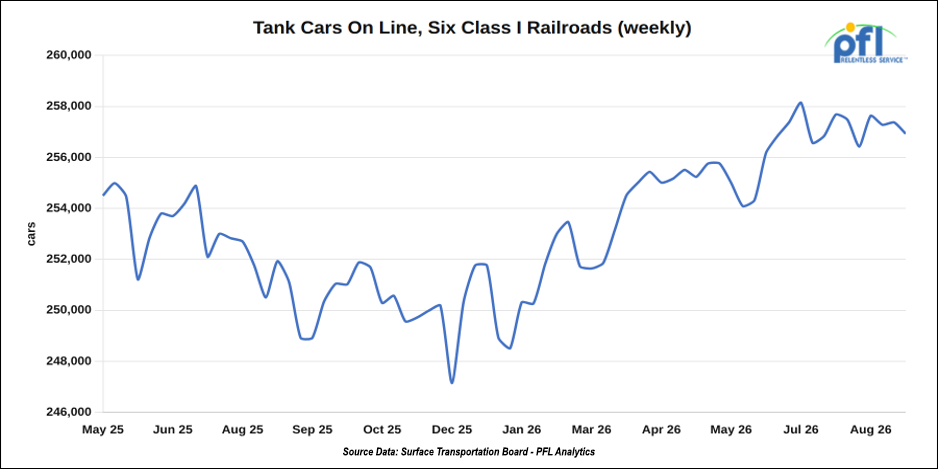
Put that beside what Trinity told the market two weeks ago, roughly 200,000 cars reaching the end of their service lives over the next few years against deliveries near 25,000 this year, and the storage pool is the fleet’s only real slack. It is being drawn at about 7,000 cars a month. What comes out of storage is, by definition, the oldest and least specialized equipment in the fleet; the 117J and pressure fleets are not in storage in size, which is why they were already tight before the storage drawdown started. Tank cars on line across the six reporting Class I railroads averaged 257,109 in the four weeks to September 4, flat on the prior four weeks and about 5,000 above a year earlier, the tank fleet is not coming out of storage; it is already out there working.
PFL has been busy on both sides of this trade at once: return-on-lease programs that park cars in storage instead of sending them through a shop, and cars coming out of storage that need cleaning, requalification and a lease before they earn anything. It seems to us at PFL that the storage yard is where the 2027 lease market is being decided, one train at a time, and the owners who know exactly what they have sitting there are the ones who will get paid for it.
We Continue to Watch Diesel
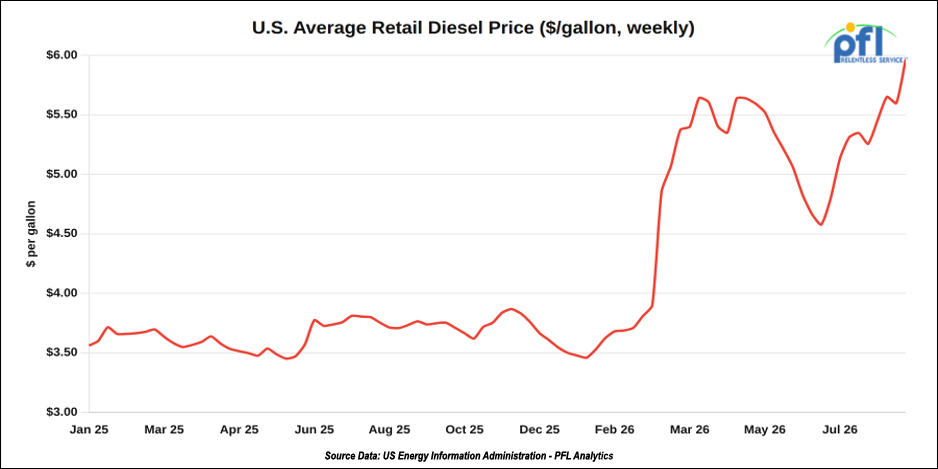
The U.S. average retail diesel price crossed $6.00 per gallon on Friday of last week for the first time on record, at $6.056 per gallon on the AAA survey, less than a week after setting the previous record at $5.85 per gallon and $2.35 per gallon above a year ago. The EIA raised its diesel forecasts in the Short-Term Energy Outlook on Wednesday of last week to an average of $5.07 for 2026 and $4.40 for 2027, up 22 cents and 33 cents from the August outlook; the 2027 number stood at $3.47 in February. The EIA now expects distillate inventories to drop below 100 million barrels this month and to sit below the five-year low through most of 2027, which makes this a structural shortage, not a spike. Refiners ran at 97.8% in the week ended September 4th and averaged 17.6 million barrels per day barrels per day of input. Gulf coast ultra-low sulfur diesel set a record above $4.80 per gallon on Wednesday of last week, and Gulf Coast conventional gasoline topped four-year highs on Thursday of last week as WTI traded through $100 during the session. The agency’s reasons have not changed: Ukraine’s drone campaign against Russian refineries, lost Middle East and Chinese supply, high U.S. net exports of distillate, and fall maintenance arriving on top of harvest demand.
For rail, this is a cost line and a demand line at the same time, and the cost line is about to reset. Class I fuel surcharges key off lagged monthly averages, so a September retail print above $6.00 lands on October and November freight bills, in the middle of harvest and the fall product peak. On the demand side, every refinery running flat out and exporting a third of its distillate is a refinery pulling product tank cars into blendstock and distillate service that were idle a year ago. A $107 crack does not stay a $107 crack, but the refining system has no spare capacity to bring it down quickly, and the EIA is now telling shippers to plan for a low inventory environment through 2027. PFL’s client base moving refined products and blend stocks is being asked the same question every week, and our answer has not changed: in a market like this fleet timing matters more than fleet size, and the cars you need for the first quarter should already be under contract.
We Continue to Watch Hormuz
On Monday of last week, U.S. Central Command destroyed five Iranian tankers linked to the Revolutionary Guard, four in the Gulf of Oman and one off Kharg Island, after unsuccessful Iranian missile attacks on a U.S. warship, following three more tankers hit the weekend before. The Houthis answered on Tuesday of last week with strikes on Abha airport, King Khalid air base and Aramco facilities in Saudi Arabia, wounding 73, and Riyadh counterstruck the same day. Iran’s Supreme National Security Council then said it will declare a maritime exclusion zone outside the strait, in which vessels transiting without permission will be stopped, “in the coming days and weeks.” Transits through the strait fell to about 10 ships a day on Monday of last week, the lowest since May, against a prewar baseline of 130, and a strait passing ten ships a day is closed for practical purposes whatever its legal status.
The freight market is pricing the closure harder than the flat price is. The U.S. Gulf to China VLCC rate hit a record $29.5 million lump sum on Friday of the week before last, up 21.6% in a week, with owners talking $30 million, as Chinese buyers who lost Saudi cargoes to the Houthi campaign in the Bab el-Mandeb turned to Brazil and the U.S. Gulf in masse. On the west coast, Trans Mountain accepted all September nominations without apportionment on the 890,000 barrel per day system, and market sources expect flows to keep rising on Chinese and U.S. west coast demand after the system ran at 96% in April. Trans Mountain running unapportioned at full nominations with Chinese buyers paying record freight for Atlantic basin barrels means the west coast egress is spoken for, and the marginal Alberta barrel is looking at an apportioned Mainline or a rail car. We wrote last week that this could be the start of another crude by rail cycle if the trends hold, and the trend is holding for now. We at PFL believe that the conversation about 117J availability for 2027 has already started in Calgary, and we were not the ones who started it.
We Are Watching Venezuela
U.S. Gulf coast imports of Venezuelan crude reached nearly 630,000 barrels per day in June from 200,000 barrels per day at the start of the year, and Venezuela has been the top overseas supplier to the Gulf coast every month since March, with Valero, Citgo, Phillips 66 and Chevron taking the bulk of it. Chevron agreed on September 2 to invest more than $7 billion over five years to double its Venezuelan production, on top of the August deal under which Washington takes a 35% stake in a Barbados-registered vehicle planning to develop 17 Venezuelan fields in exchange for 20% of future output at cost. Canadian heavy crude into the Gulf coast has fallen to 337,000 barrels per day in the first half of 2026 from 416,000 in 2025, and heavy Western Canadian Select at Houston has averaged more than $13 under WTI Houston for October trade against a $5.50 discount a year ago. Merey at the U.S. Gulf Coast is offered at roughly $15 under Ice Brent and touched a $20 discount at the end of August, Colombian and Mexican heavy exports to the Gulf lost about 75,000 barrels per day between January and June, and Gulf coast coker inputs hit 1.29 million barrels per day in May, the highest since December 2024. June’s Venezuelan imports averaged 15 API against 23 for Canadian imports, which is exactly the barrel a Gulf coast coker was built for.
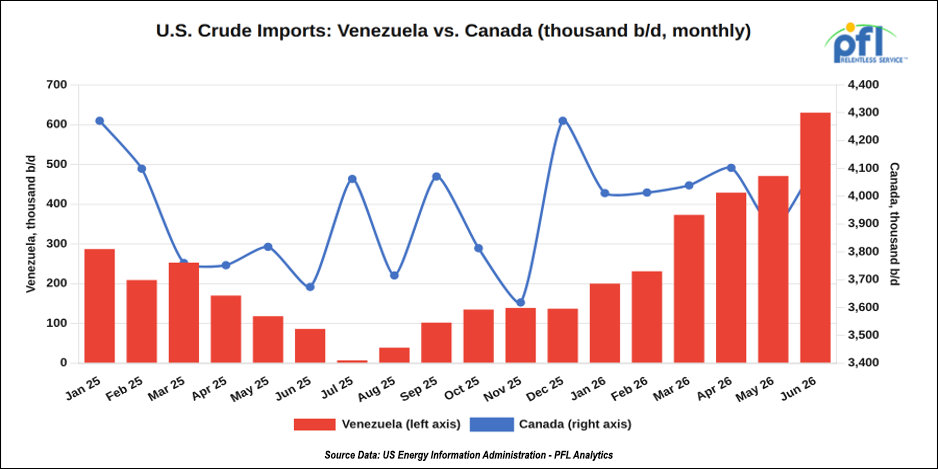
This is the story that decides whether Alberta to Gulf coast crude by rail works, and right now it does not. One Exchange WCS for October settled at $16.40 under WTI calendar month average on Friday of last week, which is roughly the all-in unit train cost from Alberta to the Gulf, so rail to Houston clears at break-even on paper while Venezuelan barrels sit at the dock at $15 under Brent after a four-day voyage. When the Gulf Coast is being fed 15 API Merey at that discount, Alberta bitumen on a 3,000 mile rail trip is competing for the coker slot on price alone, and losing. Canadian heavy is going where the Venezuelan barrel is not: the Midwest took 2.92 million barrels per day in the first half against 2.75 million last year, Westridge is loading for China, and Enbridge opened its Houston terminal in July with 2.5 million barrels of tankage and plans for 15 million. The rail lanes with a live bid this fall are Bakken east while Line 5 is down and Bakken west to Puget Sound, not Hardisty to the Gulf. PFL is watching this one closely and is working with shippers on the lanes that do pencil, because a heavy crude market this lopsided rarely stays that way for long.
We Are Watching the Panama Canal
The Panama Canal Authority cut the Neopanamax draft to 48.0 feet on September 2 and will cut it again to 47.5 feet on October 1st, trimmed Neopanamax transits to nine a day from September 3 and Panamax transits from 25 to 23 a day from September 15th, all on below-normal rainfall in the Gatun Lake watershed with El Niño conditions expected to run into next year. On September 1 SK Gas paid $5.3 million at auction for a single transit slot for the LPG carrier G. Spirit, the highest price ever reported for the waterway. A $5.3 million slot on a 45,000 ton propane cargo is roughly $118 a ton before the freight, which is most of the delivered margin on a Houston to Asia cargo, and it is being paid because the alternative is a Cape route that adds weeks. U.S. seaborne LPG exports to Mexico fell 30% year over year in August to 270,600 tons on ship-tracking data, and volumes to Mexico’s Pacific coast, which cross the canal from the Gulf, fell 46% to about 47,200 tons.
Mexico’s Pacific coast runs on U.S. Gulf Coast propane, and when the canal cannot pass it the importers look north by land. Canadian cargoes into Mexico, rare historically at 12,000 tons or so in a good year, are already at 17,000 tons this year, and the overland substitute for a Pacific coast import is a pressure car out of Conway or Edmonton. Mexico’s safety regulator Asea also opened a 60-day consultation on Monday of last week on a new LPG distribution standard, PROY-NOM-030-ASEA-2026, covering equipment inspection, emergency shut-off valves on tank trucks and operator training. Pressure cars are the tightest corner of the tank car market heading into winter on both sides of the border, and a canal that cannot pass LPG to Mexico’s Pacific coast adds a southbound rail bid to a fleet that has nothing to spare. PFL already has winter propane inquiries for 340W pressure cars off CN, CP, NS, CSX, UP and BNSF on the books, and we suspect the Mexican ones are next.
We Are Watching PHMSA
PHMSA used its federal preemption authority twice last week. On Thursday of last week it published a determination that California’s 2028 mandate requiring all propane cylinders sold in the state to be reusable or refillable is preempted by the Hazardous Materials Transportation Act, on a petition from Worthington Enterprises backed by the National Propane Gas Association, because the state rule effectively sets design and manufacturing requirements for DOT-39 cylinders that federal rules already authorize. In a separate administrative notice it blocked a New Jersey state lawsuit by a former tanker truck driver against multiple refiners over benzene exposure from gasoline, finding that state claims on marking, training, loading and unloading and hazmat classification are preempted, with similar suits pending in Pennsylvania, New York and Louisiana. Transportation Secretary Sean Duffy’s line was that the department is “stopping this nonsense in its tracks,” and the doctrine he is stopping it with is the same one the tank car industry leans on every time a state legislature reaches for rail hazmat rules of its own.
The practical read for car owners is that Washington is willing to spend preemption authority on fairly small state actions, which may make it less likely that a state-level tank car speed limit, crew size rule or hazmat routing restriction survives a challenge, though we would not predict an outcome in any specific case. A uniform federal hazmat regime is the reason a DOT-117 built in Texas can load in Alberta and unload in New Jersey without three sets of paperwork, and last week was a reminder that the current administration intends to keep it that way. PFL will keep an eye on this one and is happy to work with shippers who need specialty designs that have to travel across more than one jurisdiction.
We Are Watching Key Economic Indicators
Producer Price Index
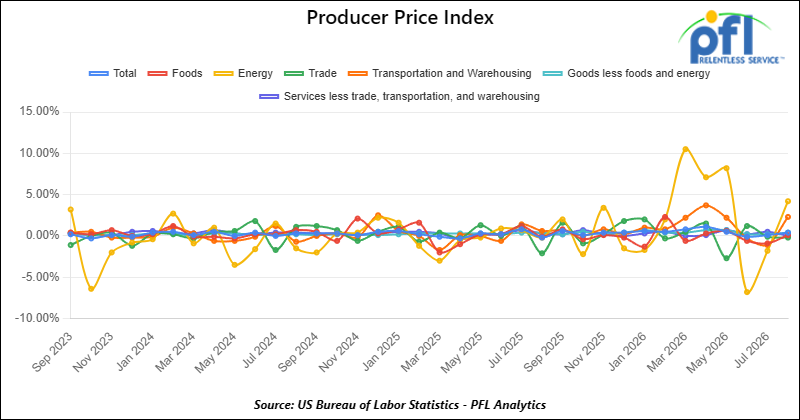
In August 2026, the Producer Price Index (PPI) increased 0.4% month-over-month, following a 0.1% increase in July, indicating a renewed acceleration in producer price pressures. Core PPI (final demand less foods, energy, and trade services) increased 0.3% month over month, moderating from July’s 0.4% increase, but continuing to indicate elevated underlying price pressures. The monthly increase was driven primarily by goods, which rose 1.1%, following a 0.4% decline in July. Within goods, energy prices increased sharply by 4.2%, while food prices rose 0.1%. Goods less foods and energy increased 0.4%, suggesting that core goods prices also remained firm. Within services, prices increased 0.1%, with trade margins declining 0.2% and transportation and warehousing increasing 2.3%. Services less trade, transportation, and warehousing were unchanged, pointing to relatively stable underlying service-sector prices despite the increase in overall PPI.
In August 2026, the Consumer Price Index (CPI) increased 0.4% month-over-month, accelerating from July’s 0.1% increase, while the index was up 3.4% year over year. Core CPI (all items less food and energy) increased 0.3% month-over-month and was up 2.4% year-over-year. Energy prices were a major contributor to the monthly increase, with gasoline prices rising sharply amid continued energy-market pressures. Food prices increased 0.1% during the month, while shelter increased 0.3% and remained an important contributor to the overall increase. Within core inflation, several service categories increased, while some areas of consumer spending showed more moderate price growth. The August report showed a clear pickup in monthly inflation, although the year-over-year core rate continued to moderate, suggesting that underlying inflation pressures remain persistent while headline inflation is being pushed higher by energy costs.
Consumer Confidence
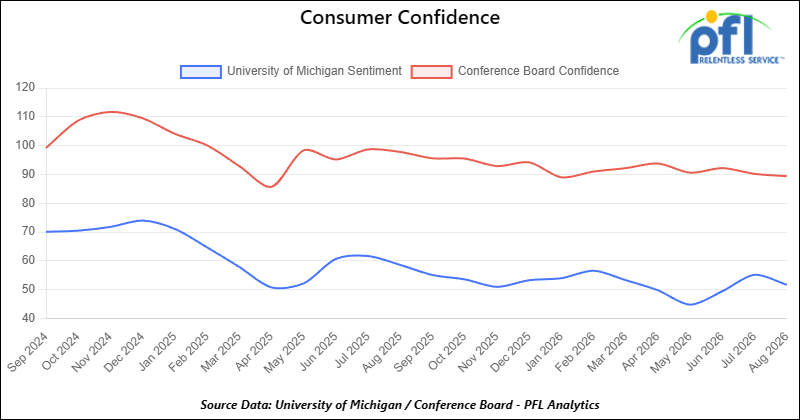
The Index of Consumer Sentiment from the University of Michigan decreased from 55.2 in July to 51.7 in August.
The Conference Board Consumer Confidence Index decreased from 90.2 in July to 89.4 in August.
Lease Bids
- 20-50, 4000-5000 Covered Hoppers located off of UP or BNSF in Houston. For use in Urea, Potash, and Ammonium Sulfate service. Period: 6-12 Months.
- 300, 5200CF Covered Hoppers located off of CP or CM in Canada. For use in Petcoke service. Period: 3 Year.
- 100, 340W Pressure Tank located off of CN or CP in Canada. For use in Propane service. Period: 6 Months.
- 10-20, 3200 or 3281 Covered Hoppers located off of CN or CP in Canada. For use in Sodium Sulphate service. Period: 3-5 years. Lined.
- 50, 340W Pressure Tanks located off of CN or CP in Canada. For use in Propane service. Period: Winter.
- 30-50, 340W pressure Tanks located off of NS or CSX in Northeast U.S. For use in Propane service. Period: Winter.
- 25, 340W Pressure Tanks located off of UP or BN in US. For use in Propane service. Period: Winter.
- 50, 28.3K 117J Tanks located off of BNSF in Kansas/Oklahoma. For use in Fuel Oil service. Period: 6 Months.
- 100, 30K 117J Tanks located off of CN in Canada. For use in Diesel service. Period: 1 year.
- 150, 340W Pressure Tank located off of CN in Canada. For use in Propane service. Period: 3 Months.
Sales Bids
- 28, 3400CF Covered Hoppers located off of UP or BNSF in Texas. For use in Cement service. Cement Gates needed.
- 20, 17K DOT111 Tanks located off of various class 1s in various locations. For use in corn syrup service.
- 120, Various Open-Top Aluminum Rotary Gondolas located off of various class 1s in various locations. For use in Sulphur service. Built 2004 or later.
- 12, 21.5K-25K DOT 111 Tanks located off of Various Class 1s in Michigan. For use in Diesel, Asphalt, Crude service. Coiled and Insulated.
Lease Offers
- 21, 6351 Covered Hoppers located off of CN in Wisconsin. Last used in DDG. Available until February 2027.
- 29, 6500 Covered Hoppers located off of CN in Wisconsin. Last used in DDG. Available until February 2027.
- 15, 6200CF Covered Hoppers located off of all class 1s in Wisconsin. Last used in plastic. Cars are currently clean.
- 30, 6500CF Covered Hoppers located off of all class 1s in Wisconsin. Last used in plastic. Cars are currently clean.
- 100, 28.4K DOT 117J Tanks located off of UP or BNSF in Beaumont, TX. Cars are currently clean.
- 50, 30K DOT117J Tanks located off of UP or BNSF in the South. Last used in ethanol.
- 10, 29K DOT 117R Tanks located off of BNSF and UP in Texas. Last used in gasoline additive. Coiled and Insulated.
- 39, 31K CPC1232 Tanks located off of All Class 1s in Iowa. Last used in diesel.
- 2, 30K DOT 117R Tanks located off of BNSF and UP in Texas. Last used in Diesel.
- 1, 30K DOT 117R Tanks located off of BNSF and UP in Texas. Last used in gas blend stock.
- 3, 30K DOT 117R Tanks located off of BNSF and UP in Texas. Last used in gasoline.
- 41, 30K DOT 111 Tanks located off of in Brownsville. Last used in Diesel. Cars are currently clean.
- 93, 31.8K CPC 1232 Tanks located off of Various Class 1s in Texas. Last used in Diesel. Cars are currently clean.
- 22, 21K DOT 115 Stainless Steel Tank located off of BNSF in Texas. Cars are currently clean. Cars are currently clean.
Sales Offers
- 81, 31.8K CPC1232 Tanks located off of UP or BNSF in TX. Last used in Multiple Services. Requal Due in 2025.
- 35, 3400CF Covered Hoppers located off of UP or BNSF in the Midwest. Last used in Sand.
- 15, 5750 CF Hopper located off of CSX, NS, CP, CN, BNSF, UP in St Louis. Last used in Grain.
- 50, 30 DOT 111 Tank located off of multiple class 1s in multiple location. Last used in Fuels..
Call PFL today to discuss your needs and our availability and market reach. Whether you are looking to lease cars, lease out cars, buy cars, or sell cars call PFL today at 239-390-2885
Railcar for Sale or Lease
| CAT | Type | Capacity | GRL | QTY | LOC | Class | Prev. Use | Offer | Note |
|---|
| CAT | Type | Size | GRL | QTY | LOC | Class | Term | Commodity | Offer | Note |
|---|
| CAT | Type | Capacity | GRL | QTY | LOC | Class | Prev. Use | Clean | Offer | Note |
|---|
| CAT | Type | Capacity | GRL | QTY | LOC | Class | Commodity | Offer | Note |
|---|
PFL will be at the Following Conferences

- Where: The Gaylord Opryland Hotel
- Attending: Brian Baker (239.297.4519)
- Conference Website

- Where: The Westin Galleria Dallas
- Attending: David Cohen (954-729-4774), and Curtis Chandler (239-405-3365)
- Conference Website

- Where: The Westin Galleria Dallas
- Attending: Brian Baker (239.297.4519)
- Conference Website