
“If you aren’t fired with enthusiasm, you will be fired with enthusiasm.” -Vince Lombardi
Jobs Update
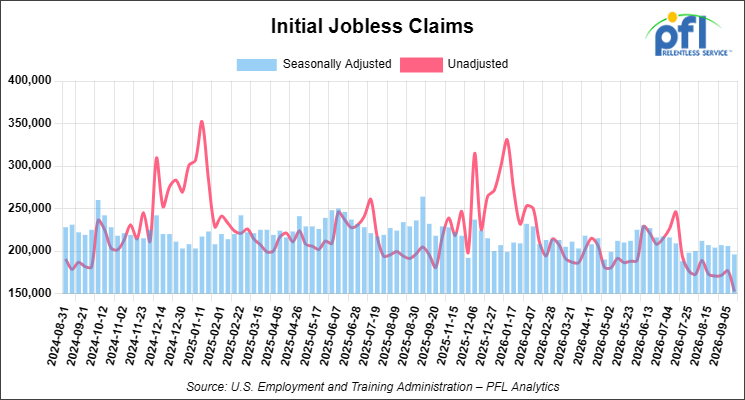
Initial jobless claims seasonally adjusted for the week ending September 12, 2026 came in at 196,000, versus the adjusted number of 206,000 people from the week prior, down 10,000 people week-over-week.
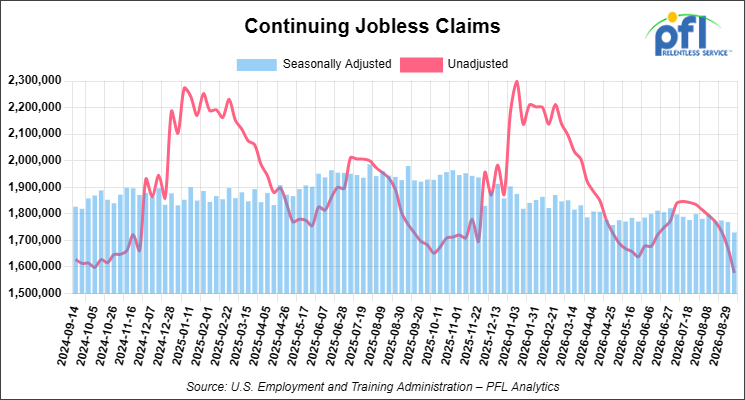
Continuing jobless claims came in at 1,730,000, versus the adjusted number of 1,769,000 people from the week prior, down 39,000 week-over-week.
Stocks closed mixed on Friday of last week and mixed week-over-week
The DOW closed lower on Friday of last week, down -95.40 points (-0.18%), closing out the week at 51,682.64, down -890.65 points week-over-week. The S&P 500 closed higher on Friday of last week, up 12.74 points (0.17%), and closed out the week at 7,650.50, down -6.48 points week-over-week. The NASDAQ closed higher on Friday of last week, up 104.25 points (0.39%), and closed out the week at 26,522.55, up 189.51 points week-over-week.
In overnight trading, DOW futures traded higher and are expected to open at 52,462 this morning, up +383 points from Friday’s close.
Crude oil closed lower on Friday of last week, but mixed week-over-week
West Texas Intermediate (WTI) crude closed down -$1.61 per barrel (-1.58%), to close at $100.30 on Friday of last week, but up $0.25 per barrel week-over-week. Brent crude closed down -$0.95 per barrel (-0.93%), to close at $103.87, and down $0.74 per barrel week-over-week.
One Exchange WCS (Western Canadian Select) for November delivery settled on Friday of last week at US$19.75 below the WTI-CMA (West Texas Intermediate – Calendar Month Average). The implied value was US$71.60 per barrel.
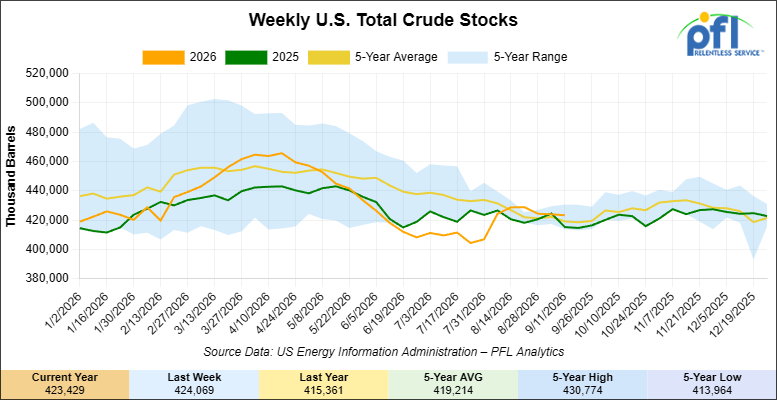
U.S. commercial crude oil inventories (excluding those in the Strategic Petroleum Reserve) decreased by 640,000 barrels week-over-week at 423.4 million barrels, U.S. crude oil inventories are 1% above the five-year average for this time of year.
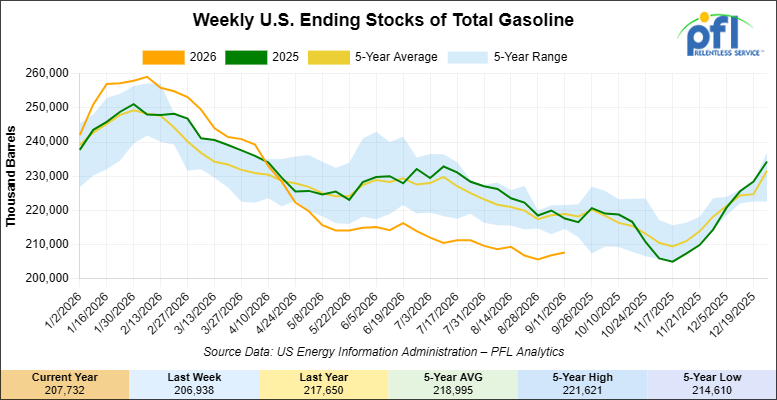
Total motor gasoline inventories increased by 794,000 barrels week-over-week and are 5% below the five-year average for this time of year.
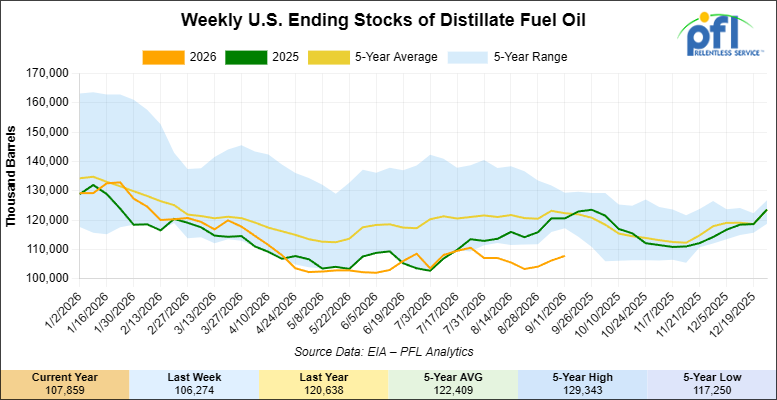
Distillate fuel inventories increased by 1.6 million barrels week-over-week and are 12% below the five-year average for this time of year.
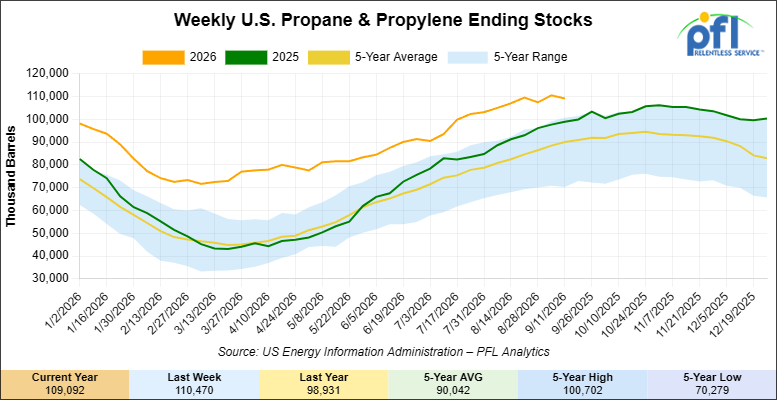
Propane/propylene inventories decreased by 1.4 million barrels week-over-week and are 21% above the five-year average for this time of year.
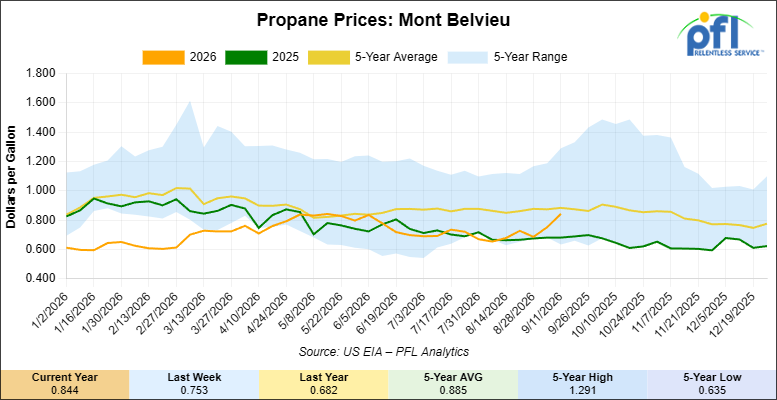
Propane prices closed at 84.4 cents per gallon on Friday of last week, up 9.1 cents per gallon week-over-week, and up 16.2 cents year-over-year.
Overall, total commercial petroleum inventories increased by 2.6 million barrels week-over-week during the week ending September 11, 2026.
U.S. crude oil imports averaged 7.1 million barrels per day during the week ending September 11, 2026, an increase of 234,000 barrels per day week-over-week. Total motor gasoline imports (including both finished gasoline and gasoline blending components) averaged 537,000 barrels per day, and distillate fuel imports averaged 114,000 barrels per day during the week ending September 11, 2026.
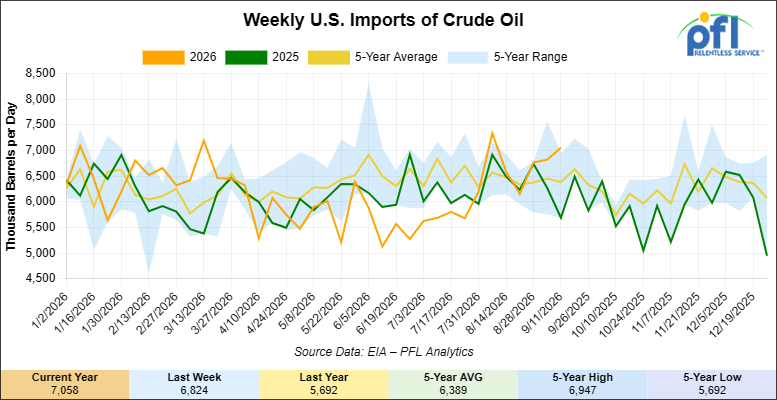
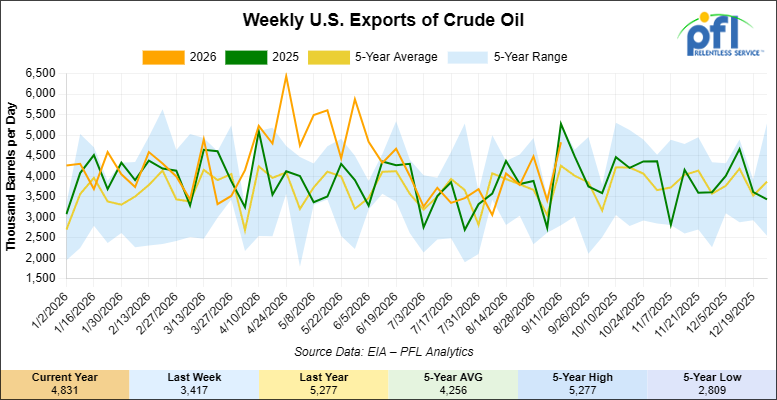
U.S. crude oil exports averaged 4.831 million barrels per day during the week ending September 11, 2026, an increase of 1.414 million barrels per day week-over-week. Over the past four weeks, crude oil exports averaged 4.131 million barrels per day.
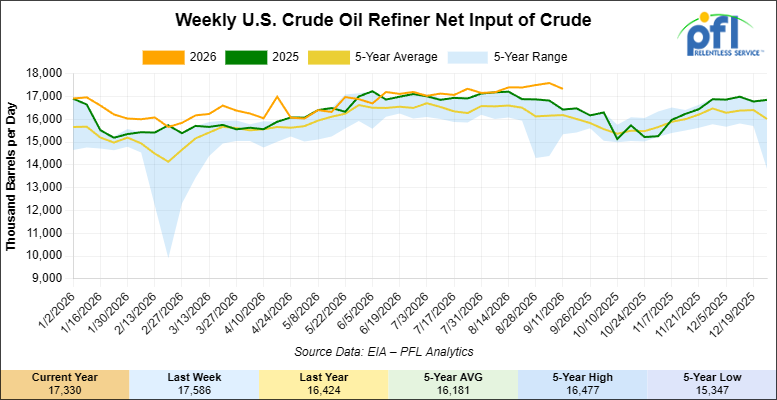
U.S. crude oil refinery inputs averaged 17.3 million barrels per day during the week ending September 11, 2026, which was 256,000 barrels per day less week-over-week.
WTI is poised to open at $93.27, down $2.81 per barrel from Friday’s close.
North American Rail Traffic
Week Ending September 16, 2026:
Total North American weekly rail volumes were down (-2.14%) in week 38, compared with the same week last year. Total Carloads for the week ending September 16, 2026 were 324,563, down (-0.97%) compared with the same week in 2025, while weekly Intermodal volume was 331,123, down (-3.26%) year over year. 6 of the AAR’s 11 major traffic categories posted year-over-year increases. The largest decrease came from Motor Vehicles and Parts (-12.57%). The largest increase was Grain (+13.49%).
In the East, CSX’s total volumes were down (-5.68%), with the largest decrease coming from Nonmetallic Minerals (-17.17%), while the largest increase came from Forest Products (+9.39%). NS’s total volumes were down (-5.68%), with the largest increase coming from Grain (+17.38%), while the largest decrease came from Motor Vehicles and Parts (-16.19%).
In the West, BNSF’s total volumes were up (+1.42%), with the largest increase coming from Metallic Ores and Metals (+20.17%), while the largest decrease came from Other (-12.16%). UP’s total volumes were down (-0.62%), with the largest increase coming from Grain (+25.41%), while the largest decrease came from Other (-20.67%).
In Canada, CN’s total volumes were down (-0.74%), with the largest increase coming from Grain (+28.58%), while the largest decrease came from Motor Vehicles and Parts (-13.09%). CPKCS’s total volumes were down (-1.04%), with the largest increase coming from Farm Products (+27.75%), while the largest decrease came from Petroleum & Petroleum Products (-26.76%).
Source Data: AAR – PFL Analytics
North American Rig Count Summary
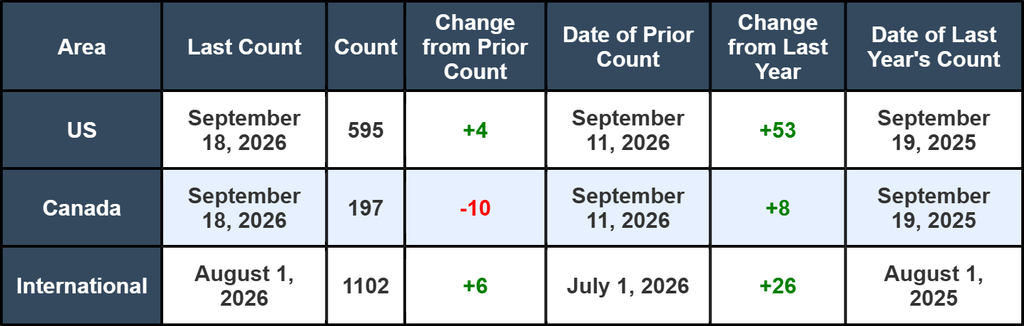
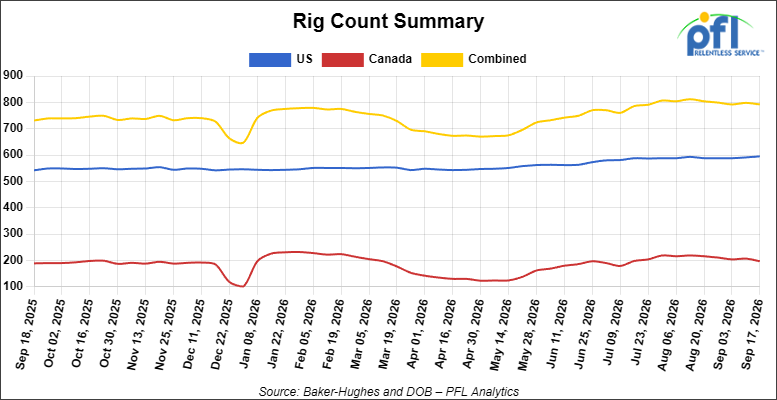
North American rig count was down by -6 rigs week-over-week. The U.S. rig count was up by +4 rigs week-over-week, and up by +53 rigs year-over-year. The U.S. currently has 595 active rigs. Canada’s rig count was down by -10 rigs week-over-week, but up by +8 rigs year-over-year. Canada currently has 197 active rigs. Overall, year-over-year we are up by +61 rigs collectively.
We are watching a few things out there for you:
We Are Watching Petroleum Carloads
The four-week rolling average of petroleum carloads carried on the six largest North American railroads fell to 29,930 from 30,123 which was a decrease of -193 rail cars week-over-week. Canadian volumes were mixed. CPKC’s shipments were up by +5.0% week-over-week, CN’s volumes were lower by -5.0% week-over-week. U.S. shipments were also mixed. The CSX had the largest percentage increase and was up by +5.0% week-over-week. The NS had the largest percentage decrease and was down by -9.0% week-over-week.
We Continue to Watch Our Strategic Petroleum Reserves
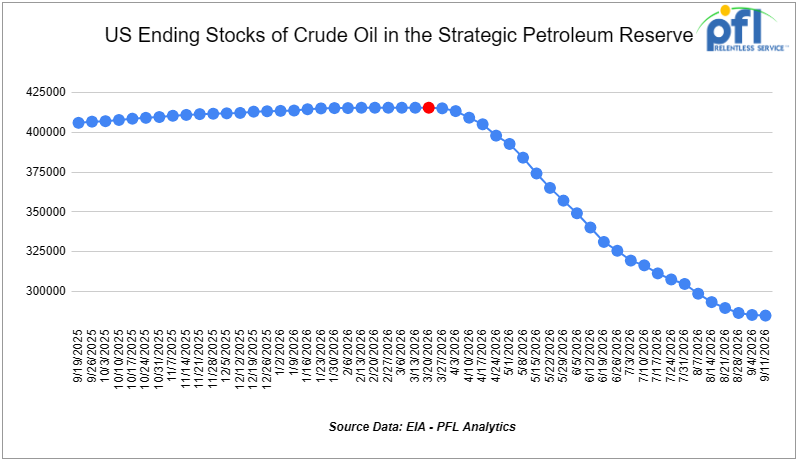
The ongoing emergency drawdown of the U.S. Strategic Petroleum Reserve (SPR) remains a major component of global efforts to offset crude oil supply disruptions stemming from the conflict involving Iran and the continued restrictions on oil shipments through the Strait of Hormuz. Since March, the Department of Energy (DOE) has awarded exchanges covering more than 133 million barrels of crude oil, with additional releases expected as part of a broader international response coordinated through the International Energy Agency (IEA).
The United States continues to execute its commitment to make available up to 172 million barrels from the SPR under the IEA’s collective plan to inject roughly 400 million barrels into global energy markets. Officials have argued that the releases are necessary to help stabilize crude supplies and limit further increases in fuel prices as refiners compete for replacement barrels amid ongoing transportation disruptions. The IEA’s coordinated action remains the largest emergency oil-stock release in the agency’s history.
As releases have accelerated, inventories in the SPR have declined to 284.957 million barrels, down from 415.442 million barrels at the start of the conflict with Iran and reaching their lowest level since October 1982. The SPR declined by 403,000 barrels during the week ending September 11th. Since the first SPR drawdown began, the United States has withdrawn approximately 130.485 million barrels, equivalent to an average of roughly 745,629 barrels per day through the week ending September 11, 2026.
Global petroleum inventories have also tightened considerably. The IEA has reported substantial draws in commercial crude and refined-product stockpiles across major consuming nations, underscoring the strain that the conflict has placed on world energy markets. While oil flows through the Strait of Hormuz have partially recovered from their initial near-shutdown, the IEA continues to identify significant uncertainty surrounding the pace and durability of the recovery.
The Administration continues to emphasize that the current program consists primarily of exchange agreements, rather than outright sales. Under these arrangements, companies receiving crude oil today are required to return the borrowed barrels in the future along with additional volumes as a premium. DOE has stated that its exchange structure is designed to return the borrowed crude with additional premium barrels, with the stated objective of strengthening the SPR over time.
We Continue to watch Canadian Crude Dynamics
ExxonMobil’s 264,000 barrel per day Joliet refinery, built to run Canadian heavy, went down after a power outage on Sunday, September 13th. One Exchange WCS (Western Canadian Select) for October delivery settled on Monday of last week at US$17.35 below the WTI-CMA (West Texas Intermediate – Calendar Month Average) up from $16.75 the Friday before on the back of the outage. November barrels traded as wide as $20.15 under, the widest discount since December 2023. By Friday of last week that basis settled at US$19.75 below the WTI-CMA. The implied value was US$71.60 per barrel.
The pressure is coming from multiple directions. Upgrader turnarounds at Syncrude and Suncor’s Base Plant are pushing bitumen into the heavy pool into mid-October, and U.S. imports from Venezuela reached 782,000 barrels per day in the week ended September 11th, the highest since August 2017. Once maintenance wraps up, record production runs into full pipes, and the next relief is roughly 90,000 barrels per day of added Trans Mountain capacity expected in December or January.
Canadian crude exports by rail were 81,226 barrels per day in June, the latest CER data, down from 87,977 in May. With November trading close to, or at, $20 under, the spread has pushed through the level that has historically moved barrels by rail, but it has yet to hold there and the Venezuela factor is now at play. The higher Venezuela import numbers are having an impact on Canadian heavy barrels in the gulf itself. Crude by rail is not a swing: 117J coiled and insulated cars are scarce, new builds take one to two years, and car owners and Class Ones both want five-year commitments. It is just not a transportation play anymore.
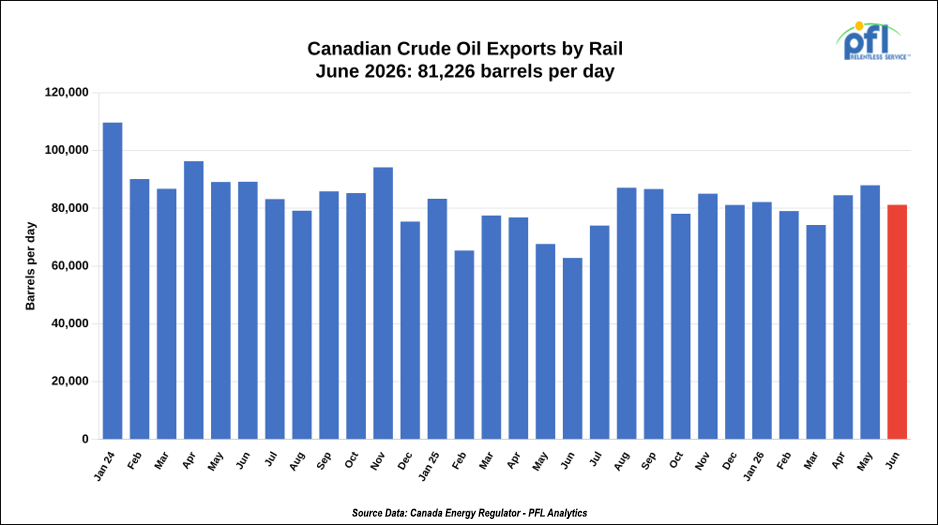
Updated Canadian crude by rail numbers for July 2026 are expected to be out sometime this week.
There is no question about it, set politics aside Canada does need a pipeline now. Biden canceling the Keystone was a huge mistake not only for the Canadian producer but the U.S. and the free world’s energy security. On basis alone, the volumes currently moving on other pipelines are costing Canadian producers $22 million dollars per day. Crude by rail is going to get interesting real soon – do barrels get moved on a railcar or do they get shut in? It’s a balancing act, folks.
We Are Watching Propane
U.S. propane inventories drew 1.4 million barrels in the week ended September 11th to 109.1 million barrels, and exports jumped to 2.213 million barrels per day. Fundamentals look soft, yet flat prices at Conway and Mont Belvieu are up roughly 10 cents per gallon since the start of September as propane trades off crude and the Middle East.
North of the border the picture is lopsided. Western Canadian propane stocks stood at 7.78 million barrels on September 1st, 13% above a year ago, while eastern Canada sat at 2.81 million barrels, about 11% below a year ago levels. That east-west gap heading into heating season is the kind of imbalance that tends to move by pressure car. We’ll keep our eye on this one; pressure car availability has tightened and if winter comes early it will be all hands on deck.
We Continue to Watch Enbridge
Enbridge put Line 5 back in service on Monday of last week, running product around the damaged section near Saxon, Wisconsin on a temporary bypass it finished two days earlier. The restart went ahead even though the Wisconsin Department of Natural Resources had issued Enbridge a notice of non-compliance the week before, ordering it to halt the bypass work. The line had been down since August 25th, when an unoccupied truck rolled into an open work area on the reroute and broke a valve, releasing roughly 1.3 million gallons of natural gas liquids.
Enbridge’s case for moving fast was propane. The company said three propane fractionators would have been left without feedstock heading into the heating season had Line 5 stayed down. On the crude side, Enbridge apportioned October heavy crude nominations on the Mainline by 4% and light by 8%, well under the double-digit rationing many shippers had braced for, but that seems to reflect oil sands turnarounds that run into mid-October more than any real slack in the system. November is the month to watch, when upgraders come back and fourth-quarter Alberta crude and condensate output heads toward 5.1 million barrels per day with no new egress in place.
Plains All American agreed last week to buy Silver Creek’s Powder River Basin crude assets for $585 million, including a 49% stake in the 240,000 barrel per day Powder River Gateway joint venture. That makes Plains Enbridge’s partner in Powder River Gateway, one week after Enbridge picked up Tallgrass’s 51% stake as part of its $2.55 billion deal. Enbridge also opened a non-binding open season for West Texas Express, a proposed 2 billion cubic feet per day Permian gas line to El Paso aimed at a late 2029 start. Enbridge is buying and building in Wyoming and Texas while the second phase of Mainline Optimization sits on the shelf. We’ll keep our eye on the November notice.
We Continue to Watch Left Wing Carney
Prime Minister Carney spent last week in Europe. Last Wednesday, European Commission President Ursula von der Leyen used her State of the Union address, with Carney in the room, to invite Canada to become the EU’s first associate member. President Trump answered the same day, calling the idea laughable and threatening “very serious tariffs” on Europe if he judged it a hostile act. Carney told the European Parliament on Thursday of last week that Canada welcomes the ambition and promised a vote in Parliament on the final structure.
Part of the pitch in Strasbourg was Canadian energy security for Europe through new port infrastructure in the High North and on the East Coast. None of that exists. What does exist, however, is a heavy barrel that seemingly can’t find a home.
The one project that could change that math is still on paper. Public comment on the West Coast Oil Pipeline closed last Friday, and the Implementation Agreement targets a national interest designation by October 1st. Even on that schedule construction would not start before September 2027, and a federal official has said oil may not flow until 2033 or 2034. That is most of a decade of Alberta heavy fighting Venezuela for the same Gulf Coast coking capacity. In our opinion, courting a new trading club in Brussels does nothing for a barrel stuck in Hardisty and does not do very much for Canada for that matter except stroke Carney’s ego.
We Continue to Watch Diesel
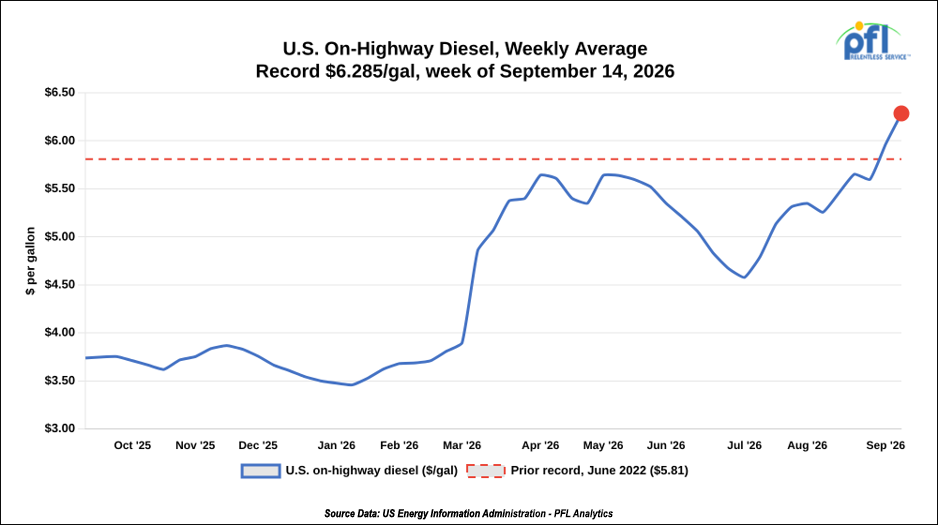
The EIA’s weekly U.S. on-highway diesel average jumped 31.8 cents to $6.285 per gallon for the week of September 14th, the highest in the survey’s history and 68% above a year ago. Every region now averages above $6, with the West Coast at $7.25 and California at $8.039. The prior record of $5.81, set in June 2022, has been cleared by almost 48 cents.
The railroads spent last week at Morgan Stanley’s Laguna conference calling it a double-edged sword. Norfolk Southern’s CFO Jason Zampi described elevated fuel for the rest of the year as a significant headwind, but said freight is coming to NS because of extraordinary truck costs, and not only intermodal: lumber, steel and metals are converting too. UP’s CFO Jennifer Hamann said UP’s traffic is up 5% quarter to date, and for the first time since 2018, UP has all of its domestic intermodal containers deployed. Spot truckload rates moved above contract rates earlier in September for the first time since 2021.
There is little relief coming from the supply side. U.S. refiners are running at the highest rates since 2004, Interior Secretary Doug Burgum said on Monday of last week that an export ban is not on the table, and Energy Secretary Chris Wright floated Defense Production Act money for refinery expansions. Saudi Arabia’s East-West pipeline, its only export route that bypasses Hormuz, has been shut since the drone strike of September 11th. The truck-to-rail shift is real, and carload shippers would do well to look at their car needs before equipment gets as tight as UP’s container pool. We are watching this one.
We Continue to Watch Renewables
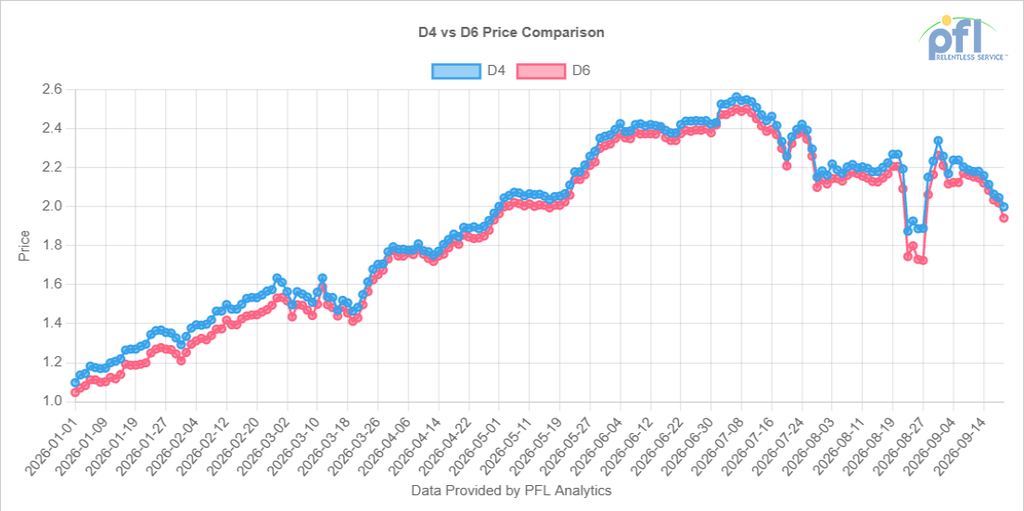
Major Renewable Identification Number (RIN) credit values fell to three-week lows last week as the BOHO spread fell into negative territory for the first time since 2019. Prices for Ethanol-related D6 and biomass-based diesel D4 RINs were lower every day last week. BOHO measures the price differential between soybean oil (a key biofuels feedstock commonly known as bean oil, or BO) and ULSD (also known as heating oil, or HO). It affects the economics of biofuels blending and provides a gauge for the feasibility of producing a typical BO-derived gallon of biomass-based diesel versus traditional petroleum-based diesel.
D4 RINs closed out the day (and the week) on Friday of last week at $1.96 per RIN, down 10 cents per RIN day-over-day, and down 21 cents per RIN week-over-week. Meanwhile, D6 RINs closed out the day (and the week) at $1.90 per RIN, also down 10 cents per RIN day-over-day, and down 21 cents per RIN week-over-week.
In Ethanol news. The Senate Committee on Agriculture, Nutrition and Forestry narrowly advanced the pending farm bill on Wednesday of last week, which includes a package to allow for year-round access to E15.
In a 12-11 vote, the committee passed the package along party lines following the return of Republican Sen. Mitch McConnell of Kentucky from a prolonged absence due to a fall in June.
Notably, the package includes a provision that would allow for year-round blending of E15 while also significantly constraining the small refinery exemption (SRE) program under the Renewable Fuel Standard (RFS).
We Continue to Watch the UP and NS Merger
Union Pacific CEO Jim Vena used his Laguna appearance last Wednesday to reject the trackage rights his competitors want as the price of approval, saying a long-distance rights deal does not “make a particle of sense in business.” UP’s merger agreement lets it walk away if the Surface Transportation Board attaches onerous conditions, at the cost of a $2.5 billion breakup fee to Norfolk Southern.
BNSF laid out its asks in a filing on September 9th: overhead trackage rights over about 824 miles of NS between Chicago and Bethlehem, Pennsylvania, and a neutral switching or terminal railroad serving every BNSF and UP-served facility on the Gulf Coast from Corpus Christi to the west bank of the Mississippi. CPKC wants more access to UP’s Gulf network between Robstown and Beaumont and around Baton Rouge. For tank car shippers, the Gulf Coast request is the one that matters, since BNSF argues many plants in the country’s largest chemical-producing region are captive to UP.
CN has already cut its deal with UP, and CEO Tracy Robinson said at Laguna that CN would provide competitive options at two-to-one and three-to-two points if the merger goes ahead. Notices of intent to participate are due September 30th, and comments and requests for conditions are due November 18th. Whether this deal survives may come down to how many conditions the STB is willing to attach. PFL’s Gulf Coast clients have the most at stake here, and we will keep our eye on the November filings.
We are Watching Class 1 Industry Headcount
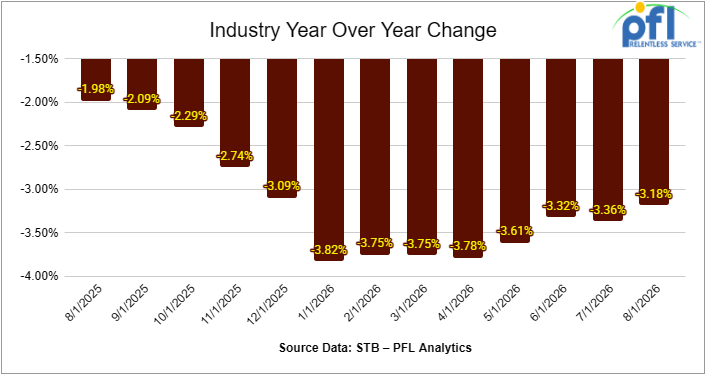
Class I railroads employed 114,460 workers in the United States in August 2026, a -0.24% decrease from July 2026’s count of 114,738 and a -3.18% year-over-year decrease from August 2025’s total of 118,223, according to Surface Transportation Board data.
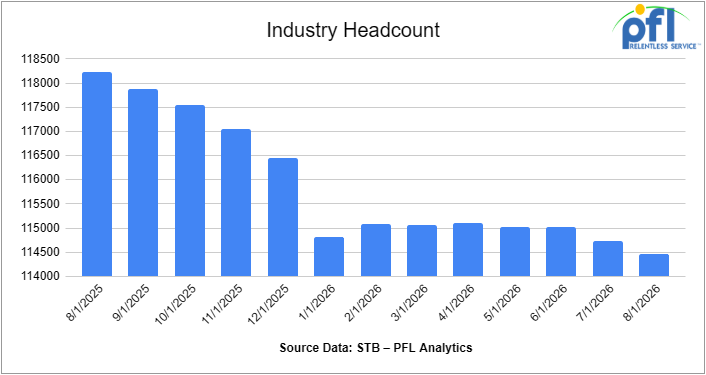
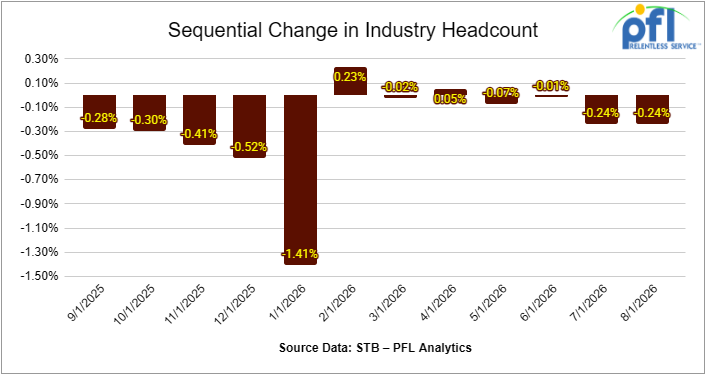
One of the six employment categories posted a month-over-month increase between July and August 2026. Transportation (train and engine) increased 0.13% to 49,020 workers.
The categories that posted month-over-month decreases were Executives, officials, and staff assistants, down -0.60% to 7,912 workers; Professional and Administrative, down -1.38% to 8,747 workers; Maintenance of Way and Structures, down -0.15% to 28,491 workers; Maintenance of Equipment and Stores, down -0.75% to 15,682 workers; and Transportation (other than train and engine), down -0.26% to 4,608 workers.
No employment categories posted a year-over-year gain in August 2026.
Categories that registered year-over-year decreases in August 2026 were Executives, officials, and staff assistants, down -2.93%; Professional and Administrative, down -4.72%; Maintenance of Way and Structures, down -1.79%; Maintenance of Equipment and Stores, down -5.31%; Transportation (other than train and engine), down -5.84%; and Transportation (train and engine), down -2.79%.
We are Watching Key Economic Indicators
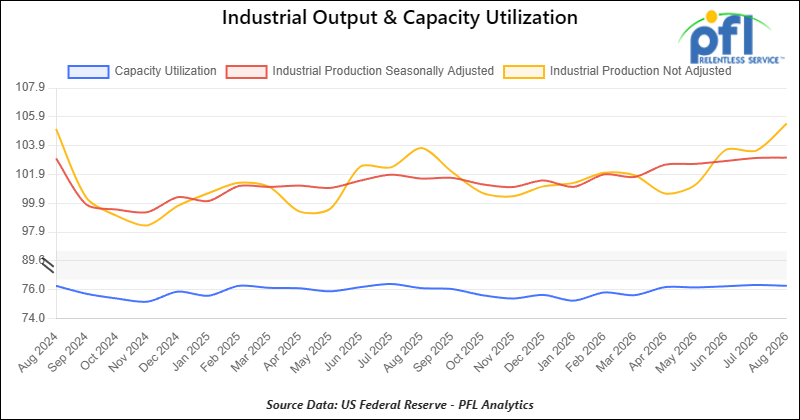
Industrial Output and Capacity Utilization
Manufacturing accounts for approximately 75% of total output. Industrial output in August increased 0.02% from July 2026.
Capacity utilization is a measure of how fully firms are using machinery and equipment. Capacity utilization in August decreased 0.08% from July 2026.
Lease Bids
- 20-50, 4000-5000 Covered Hoppers located off of UP or BNSF in Houston. For use in Urea, Potash, and Ammonium Sulfate service. Period: 6-12 Months.
- 300, 5200CF Covered Hoppers located off of CP or CM in Canada. For use in Petcoke service. Period: 3 Year.
- 100, 340W Pressure Tank located off of CN or CP in Canada. For use in Propane service. Period: 6 Months.
- 10-20, 3200 or 3281 Covered Hoppers located off of CN or CP in Canada. For use in Sodium Sulphate service. Period: 3-5 years. Lined.
- 50, 340W Pressure Tanks located off of CN or CP in Canada. For use in Propane service. Period: Winter.
- 30-50, 340W pressure Tanks located off of NS or CSX in Northeast U.S. For use in Propane service. Period: Winter.
- 25, 340W Pressure Tanks located off of UP or BN in US. For use in Propane service. Period: Winter.
- 50, 28.3K 117J Tanks located off of BNSF in Kansas/Oklahoma. For use in Fuel Oil service. Period: 6 Months.
- 100, 30K 117J Tanks located off of CN in Canada. For use in Diesel service. Period: 1 year.
- 150, 340W Pressure Tank located off of CN in Canada. For use in Propane service. Period: 3 Months.
Sales Bids
- 28, 3400CF Covered Hoppers located off of UP or BNSF in Texas. For use in Cement service. Cement Gates needed.
- 20, 17K DOT111 Tanks located off of various class 1s in various locations. For use in corn syrup service.
- 120, Various Open-Top Aluminum Rotary Gondolas located off of various class 1s in various locations. For use in Sulphur service. Built 2004 or later.
- 12, 21.5K-25K DOT 111 Tanks located off of Various Class 1s in Michigan. For use in Diesel, Asphalt, Crude service. Coiled and Insulated.
Lease Offers
- 21, 6351 Covered Hoppers located off of CN in Wisconsin. Last used in DDG. Available until February 2027.
- 29, 6500 Covered Hoppers located off of CN in Wisconsin. Last used in DDG. Available until February 2027.
- 15, 6200CF Covered Hoppers located off of all class 1s in Wisconsin. Last used in plastic. Cars are currently clean.
- 30, 6500CF Covered Hoppers located off of all class 1s in Wisconsin. Last used in plastic. Cars are currently clean.
- 100, 28.4K DOT 117J Tanks located off of UP or BNSF in Beaumont, TX. Cars are currently clean.
- 50, 30K DOT117J Tanks located off of UP or BNSF in the South. Last used in ethanol.
- 41, 30K DOT 111 Tanks located off of in Brownsville. Last used in Diesel. Cars are currently clean.
- 93, 31.8K CPC 1232 Tanks located off of Various Class 1s in Texas. Last used in Diesel. Cars are currently clean.
- 22, 21K DOT 115 Stainless Steel Tank located off of BNSF in Texas. Cars are currently clean. Cars are currently clean.
Sales Offers
- 81, 31.8K CPC1232 Tanks located off of UP or BNSF in TX. Last used in Multiple Services. Requal Due in 2025.
- 35, 3400CF Covered Hoppers located off of UP or BNSF in the Midwest. Last used in Sand.
- 15, 5750 CF Hopper located off of CSX, NS, CP, CN, BNSF, UP in St Louis. Last used in Grain.
- 50, 30 DOT 111 Tank located off of multiple class 1s in multiple location. Last used in Fuels.
Call PFL today to discuss your needs and our availability and market reach. Whether you are looking to lease cars, lease out cars, buy cars, or sell cars call PFL today at 239-390-2885
Railcar for Sale or Lease
| CAT | Type | Capacity | GRL | QTY | LOC | Class | Prev. Use | Offer | Note |
|---|
| CAT | Type | Size | GRL | QTY | LOC | Class | Term | Commodity | Offer | Note |
|---|
| CAT | Type | Capacity | GRL | QTY | LOC | Class | Prev. Use | Clean | Offer | Note |
|---|
| CAT | Type | Capacity | GRL | QTY | LOC | Class | Commodity | Offer | Note |
|---|
PFL will be at the Following Conferences

- Where: The Gaylord Opryland Hotel
- Attending: Brian Baker (239.297.4519)
- Conference Website

- Where: The Westin Galleria Dallas
- Attending: David Cohen (954-729-4774), and Curtis Chandler (239-405-3365)
- Conference Website

- Where: The Westin Galleria Dallas
- Attending: Brian Baker (239.297.4519)
- Conference Website