
“A ship is safe in harbor, but that’s not what ships are for.” — John A. Shedd
Jobs Update
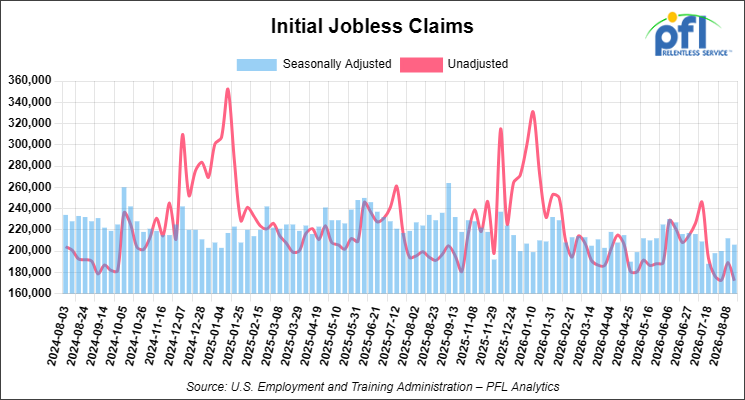
Initial jobless claims seasonally adjusted for the week ending August 15, 2026 came in at 206,000, versus the adjusted number of 212,000 people from the week prior, down 6,000 people week-over-week.
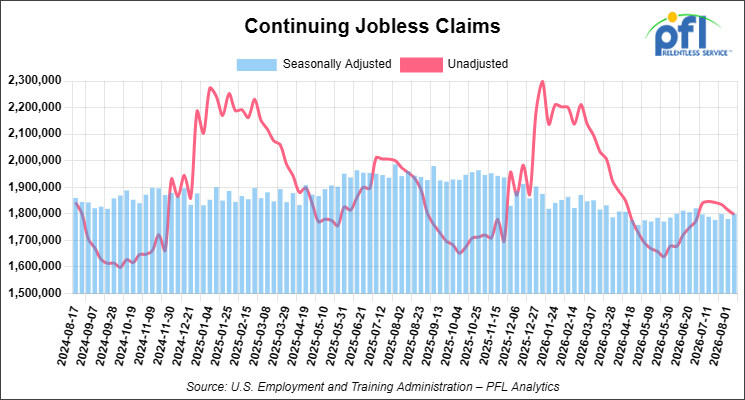
Continuing jobless claims came in at 1,799,000, versus the adjusted number of 1,781,000 people from the week prior, up 18,000 week-over-week.
Stocks closed higher on Friday of last week, but lower week-over-week
The DOW closed higher on Friday of last week, up 517.8 points (0.98%), closing out the week at 53,277.01, down -455.40 points week-over-week. The S&P 500 closed higher on Friday of last week, up 33.21 points (0.43%), and closed out the week at 7,674.37, down -111.39 points week-over-week. The NASDAQ closed higher on Friday of last week, up 113.29 points (0.43%), and closed out the week at 26,180.45, down -548.71 points week-over-week.
In overnight trading, DOW futures traded lower and are expected to open at 53,335 this morning, down 18 points from Friday’s close.
Crude oil closed higher on Friday of last week and higher week-over-week
West Texas Intermediate (WTI) crude closed up $0.23 per barrel (0.26%), to close at $87.06 on Friday of last week, and up $4.66 per barrel week-over-week. Brent crude closed up $0.61 per barrel (0.65%), to close at $94.39, up $5.87 per barrel week-over-week.
One Exchange WCS (Western Canadian Select) for October delivery settled on Friday of last week at US$16.50 below the WTI-CMA (West Texas Intermediate – Calendar Month Average). The implied value was US$67.63 per barrel.
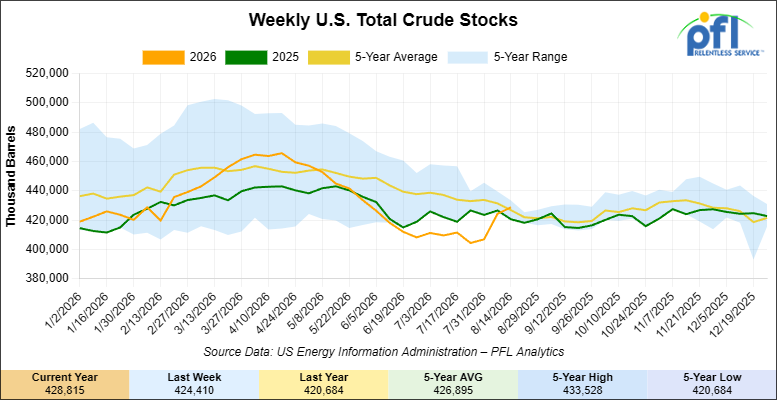
U.S. commercial crude oil inventories (excluding those in the Strategic Petroleum Reserve) increased by 4.4 million barrels week-over-week. At 428.8 million barrels, U.S. crude oil inventories are at the five-year average for this time of year.
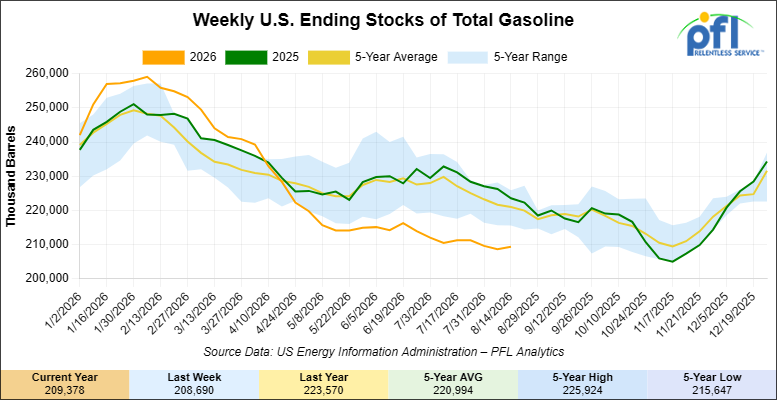
Total motor gasoline inventories increased by 700,000 barrels week-over-week and are 5% below the five-year average for this time of year.
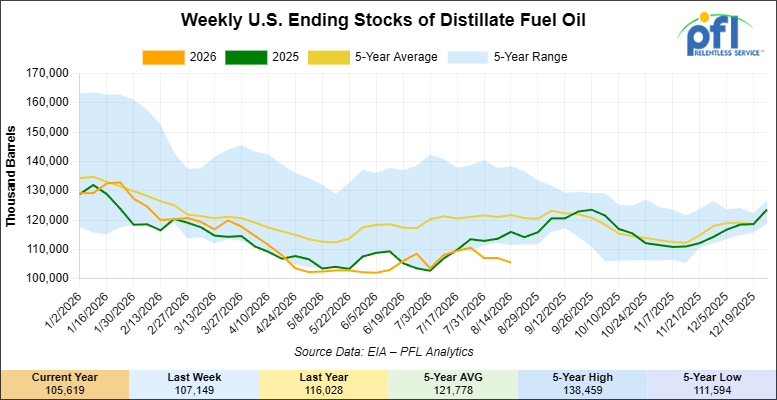
Distillate fuel inventories decreased by 1.5 million barrels week-over-week and are 13% below the five-year average for this time of year.
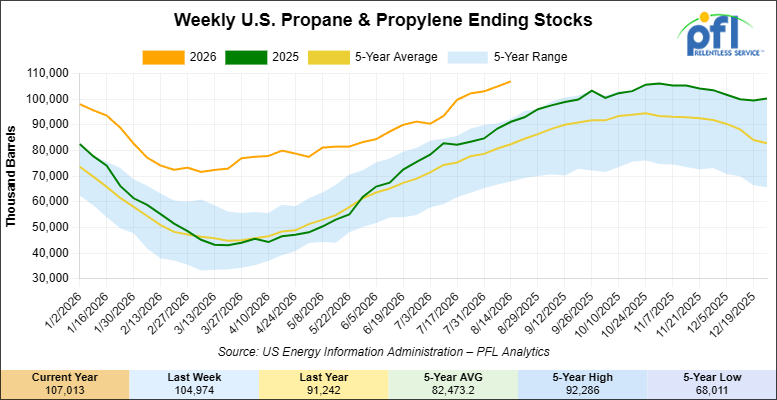
Propane/propylene inventories increased by 2 million barrels week-over-week and are 31% above the five-year average for this time of year.
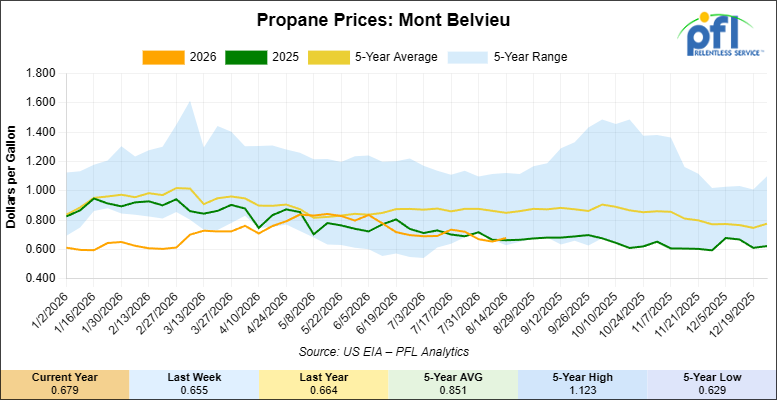
Propane prices closed at 67.9 cents per gallon on Friday of last week, up 2.4 cents per gallon week-over-week, and up 1.5 cents year-over-year.
Overall, total commercial petroleum inventories increased by 8.8 million barrels week-over-week during the week ending August 14, 2026.
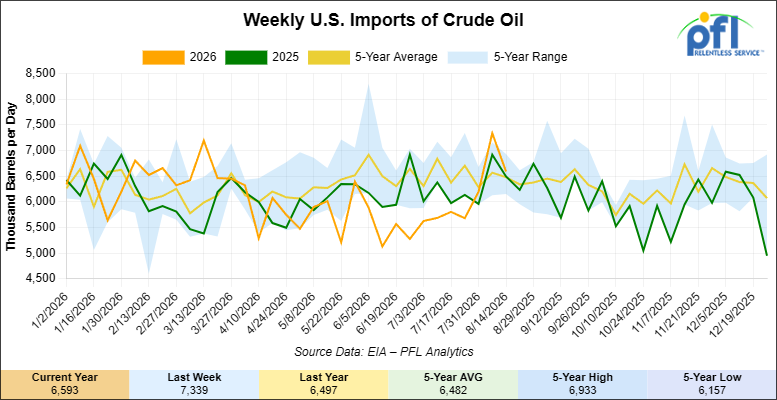
U.S. crude oil imports averaged 6.6 million barrels per day during the week ending August 14, 2026, a decrease of 746,000 barrels per day week-over-week. Over the past four weeks, crude oil imports averaged 6.5 million barrels per day, 1.2% more than the same four-week period last year. Total motor gasoline imports (including both finished gasoline and gasoline blending components) averaged 366,000 barrels per day, and distillate fuel imports averaged 109,000 barrels per day during the week ending August 14, 2026.
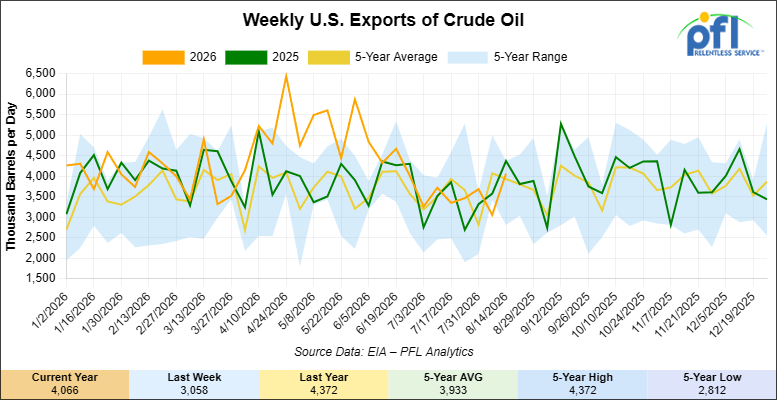
U.S. crude oil exports averaged 4.066 million barrels per day during the week ending August 14, 2026, an increase of 1.008 million barrels per day week-over-week. Over the past four weeks, crude oil exports averaged 3.569 million barrels per day.
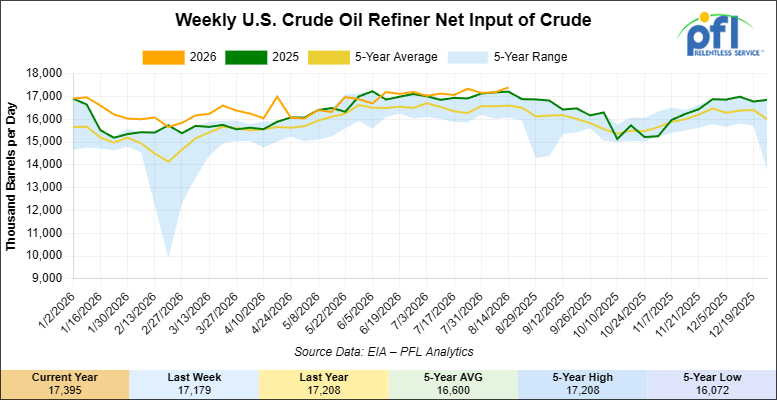
U.S. crude oil refinery inputs averaged 17.4 million barrels per day during the week ending August 14, 2026, which was 215,000 barrels per day more week-over-week.
WTI is poised to open at $85.23, down -$1.83 per barrel from Friday’s close.
North American Rail Traffic
Week Ending August 19, 2026:
Total North American weekly rail volumes were up (+2.10%) in week 34, compared with the same week last year. Total Carloads for the week ending August 19, 2026 were 331,062, up (+2.48%) compared with the same week in 2025, while weekly Intermodal volume was 352,258, up (+1.75%) year over year. 8 of the AAR’s 11 major traffic categories posted year-over-year increases. The largest decrease came from Motor Vehicles and Parts (-10.25%). The largest increase was Other (+12.01%).
In the East, CSX’s total volumes were up (+1.87%), with the largest decrease coming from Motor Vehicles and Parts (-10.19%), while the largest increase came from Other (+23.01%). NS’s total volumes were down (-0.28%), with the largest increase coming from Petroleum & Petroleum Products (+14.08%), while the largest decrease came from Motor Vehicles and Parts (-17.58%).
In the West, BNSF’s total volumes were up (+3.04%), with the largest increase coming from Coal (+27.86%), while the largest decrease came from Other (-6.29%). UP’s total volumes were up (+4.09%), with the largest increase coming from Other (+10.97%), while the largest decrease came from Coal (-7.83%).
In Canada, CN’s total volumes were up (+2.70%), with the largest increase coming from Coal (+27.86%), while the largest decrease came from Other (-18.63%). CPKCS’s total volumes were down (-3.21%), with the largest increase coming from Metallic Ores and Metals (+38.17%), while the largest decrease came from Motor Vehicles and Parts (-18.16%).
Source Data: AAR – PFL Analytics
North American Rig Count Summary
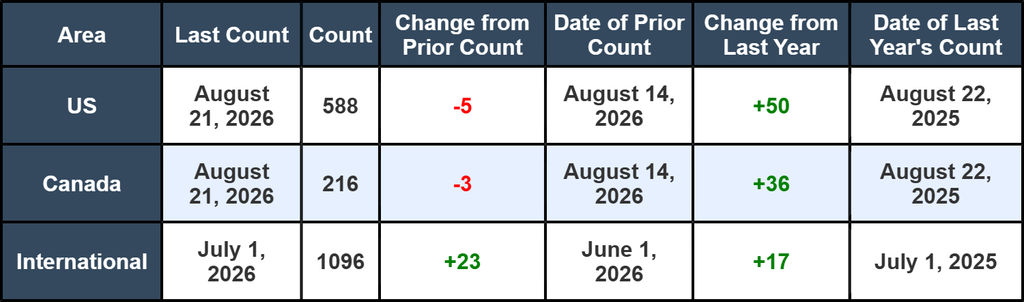
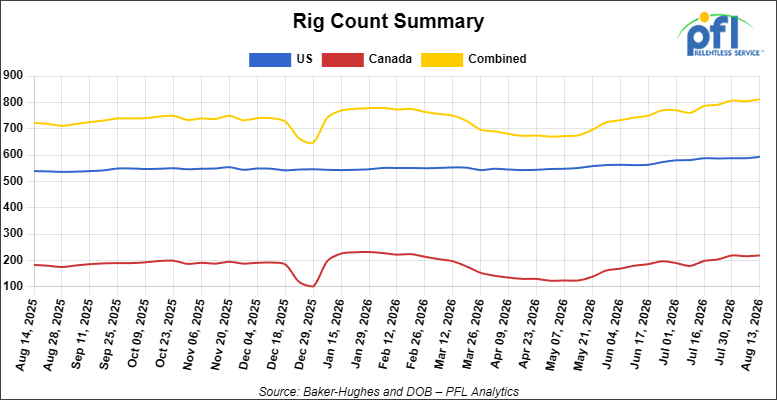
North American rig count was down by -8 rigs week-over-week. The US rig count was down by -5 rigs week-over-week, but up by +50 rigs year-over-year. The US currently has 588 active rigs. Canada’s rig count was down by -3 rigs week-over-week but up by +36 rigs year-over-year. Canada currently has 216 active rigs. Overall, year-over-year we are up by +86 rigs collectively.
We are watching a few things out there for you:
We Are Watching Petroleum Carloads
The four-week rolling average of petroleum carloads carried on the six largest North American railroads rose to 30,201 from 29,912 which was an increase of +289 rail cars week-over-week. Canadian volumes were lower. CN’s shipments were lower by -5.0% week-over-week, CPKC’s volumes were lower by -7.0% week-over-week. U.S. shipments were mostly lower. The UP was the sole gainer and was up by +1.0% week-over-week. The BNSF had the largest percentage decrease and was down by -7.0% week-over-week.
We Continue to Watch Our Strategic Petroleum Reserves
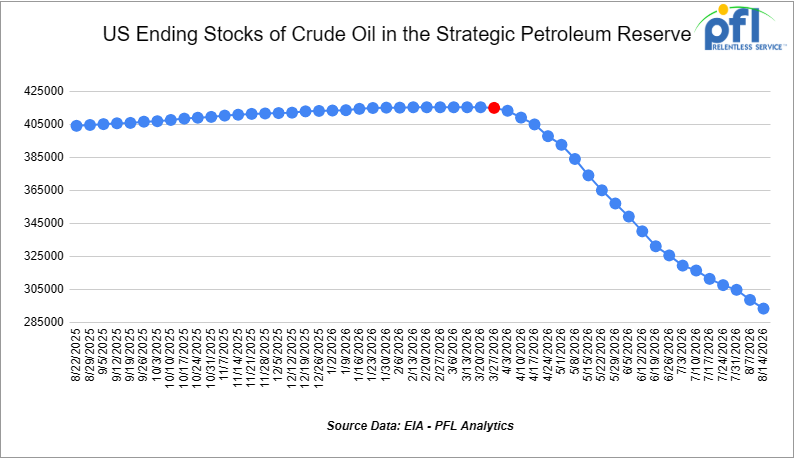
The ongoing emergency drawdown of the U.S. Strategic Petroleum Reserve (SPR) remains a major component of global efforts to offset crude oil supply disruptions stemming from the conflict involving Iran and the continued restrictions on oil shipments through the Strait of Hormuz. Since March, the Department of Energy (DOE) has awarded exchanges covering more than 133 million barrels of crude oil, with additional releases expected as part of a broader international response coordinated through the International Energy Agency (IEA). DOE’s most recent publicly documented award total remains more than 133 million barrels, while the department has continued executing the broader 172-million-barrel commitment.
The United States continues to execute its commitment to make available up to 172 million barrels from the SPR under the IEA’s collective plan to inject roughly 400 million barrels into global energy markets. Officials have argued that the releases are necessary to help stabilize crude supplies and limit further increases in fuel prices as refiners compete for replacement barrels amid ongoing transportation disruptions. The IEA’s coordinated action remains the largest emergency oil-stock release in the agency’s history.
As releases have accelerated, inventories in the SPR have declined to 293.426 million barrels, down from 415.442 million barrels at the start of the conflict with Iran and reaching their lowest level since December 1982. The SPR declined by 5.268 million barrels during the week ending August 14, 2026. Since the first SPR drawdown began, the United States has withdrawn approximately 121.638 million barrels, equivalent to an average of roughly 868,843 barrels per day through the week ending August 14, 2026.
Global petroleum inventories have also tightened considerably. The IEA has reported substantial draws in commercial crude and refined-product stockpiles across major consuming nations, underscoring the strain that the conflict has placed on world energy markets. While oil flows through the Strait of Hormuz have partially recovered from their initial near-shutdown, the IEA continues to identify significant uncertainty surrounding the pace and durability of the recovery.
The Administration continues to emphasize that the current program consists primarily of exchange agreements, rather than outright sales. Under these arrangements, companies receiving crude oil today are required to return the borrowed barrels in the future along with additional volumes as a premium. DOE has stated that its exchange structure is designed to return the borrowed crude with additional premium barrels, with the stated objective of strengthening the SPR over time.
We Continue to Watch Tariffs
Trade talks collapsed between Canada and the United States late last Friday night. Left wing Prime Minister Carney suspended negotiations and recalled Canada’s negotiators minutes before the deadline, saying last-minute changes to the U.S. terms were unfair, uneconomic and called into question the reliability of any deal. U.S. Trade Representative Jamieson Greer countered that new Canadian demands and walk-backs had upended a package that included tariff reductions on steel, aluminum, autos and lumber. 50% Section 338 duties took effect in the early hours of last Saturday on roughly $20 billion of Canadian goods, and no further talks are scheduled.
What is not on the list matters more to this readership than what is. Energy, potash and critical minerals were carved out, so crude, refined products and fertilizer continue to move on current terms. The duties hit motor vehicles, alcohol, dairy, cement and building materials, clothing, furniture and hockey equipment, amounting to something over 5% of Canadian exports to the U.S. Carney has committed to match dollar for dollar, and the composition of that retaliation is the number worth waiting for, because Ottawa’s counter-tariffs in the last round reached well beyond the sectors Washington had targeted.
The Keystone XL revival the President floated Tuesday of last week goes back in the drawer alongside everything else. TC Energy cancelled the project in 2021 and wrote it off, no sponsor has put its name to a rebuild, and South Bow is already repurposing about 150 km of unused Keystone XL pipe into the proposed 550,000 b/d Prairie Connector. Most of the Canadian-side capacity being celebrated midweek was already in a queue under a different name, with a different owner, at roughly two thirds the volume. Any pipeline that was a bargaining chip midweek and gone by the weekend, was never a fleet planning input.
For rail the direct exposure is limited today, since the carve-out covers the commodities that fill tank cars and most covered hoppers. The second-order exposure is real enough: manifest volumes moving autos, lumber and building products across the border, and whatever Ottawa selects for retaliation. It seems to us at PFL, that the durable lesson from the week is that Washington will now put pipeline approvals on the table as tariff currency, and Ottawa will walk away rather than take the trade. That is a different negotiating world than the one Canadian shippers planned around two years ago, and we will be keeping our eye on this one.
We Continue to Watch the UP – NS Merger
The Surface Transportation Board removed the Union Pacific and Norfolk Southern proceedings from abeyance last Tuesday and adopted a procedural schedule, having held the case since May pending supplemental filings the applicants delivered on July 7th and July 27th. Notices of intent to participate are due September 4th, comments and protests on the merits are due November 18th, preliminary comments from the Departments of Justice and Transportation are due December 3rd, and responses are due February 16, 2027. The schedule carries the evidentiary record past of May 28, 2027, with a final decision due within 90 days of the close of record.
The Board was careful to say that resuming the review reflects no view on the merits. It was less careful in its treatment of the applicants’ workpapers, finding that Union Pacific and Norfolk Southern had filtered out data they considered immaterial before submission, in several instances stripping substantial portions of the underlying analysis, and directing them to resubmit with unfiltered data. The Board also denied the request to sever the Terminal Railroad Association of St. Louis divestiture into an expedited side proceeding, keeping it inside the main case.
BNSF, CSX, the Freight Rail Customer Alliance and the National Grain and Feed Association had asked for the longest evidentiary period the statute allows, and they got most of it. This is the first Class I combination to be judged under the tougher 2001 rules requiring applicants to show a merger enhances competition, rather than merely preserving it, and the Board has now signalled it intends to take the full statutory runway to do so.
For shippers the practical consequence is another eighteen months of planning against two possible networks. PFL is working with customers whose lease renewals and routing assumptions now straddle a decision date that keeps moving out, and we would rather build that optionality in at signing than negotiate it later.
We are Watching the Bakken
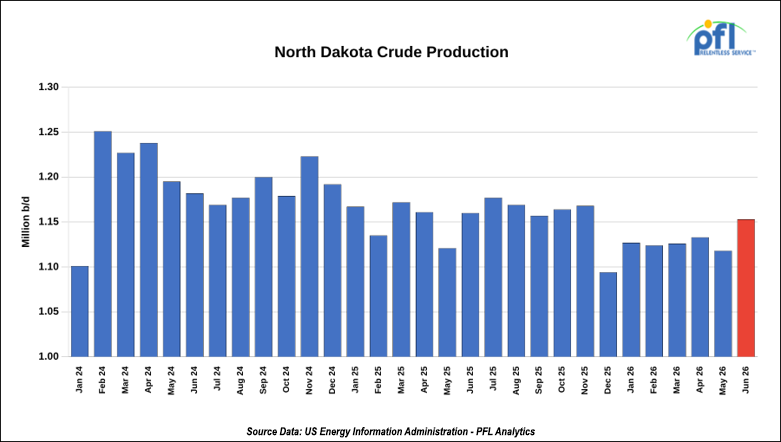
North Dakota Mineral Resources Director Nathan Anderson delivered the Director’s tale on crude oil production in North Dakota on Thursday of last week. June output averaged 1.153 million b/d, up 28,000 b/d in May and the highest since November. The state’s market price for June was $80.56 against a revenue forecast built on $59, with WTI trading near $86 at the time of the briefing. Wells waiting on completion fell to 290 from 328, the lowest since early 2025, which tells you operators are converting inventory, rather than waiting on price.
The rig count is the number that matters for 2027 volumes. North Dakota was running 33 rigs in mid-August against 26 in mid-July, and five of the additions came from operators that had no rig in the state a month earlier, among them Eben Operating, Firebird Services, Iron Oil Operating, Murex Petroleum and Zavanna Energy Operating. Producing wells hit an all-time high of 19,961. First-half output still runs roughly 25,000 b/d below the same period of 2025, so this is a recovery, rather than a boom.
Pipeline takes the marginal barrel first, and it will keep doing so until it is full. Bakken unit train economics to the Gulf Coast sit near $10.40 a barrel and to Philadelphia near $10.80, which is a rate that clears only when a coastal refiner is short or when a differential opens wide enough to pay for it. Seven more rigs, a shrinking uncompleted well inventory and a state price above $80 all push in the same direction over the next several quarters.
The fleet is the constraint, not the demand. There are not many DOT-117J crude cars sitting idle, build slots run one to two years out, and leasing companies and car owners are asking five-year commitments before they will commit equipment, with the Class Ones echoing similar long-term terms. It seems to us at PFL, that shippers who wait for the differential to confirm a trade may find the cars already spoken for. Time will tell, and it remains geopolitically dependent, but this is the closest the Bakken has looked to a rail cycle in some time. Call PFL before you need the cars, not after.
We Continue to Watch Left Wing Carney
Alberta Premier Danielle Smith spent Thursday of last week at the Canadian Energy Executive Association conference in Banff defending the “grand bargain,” the trilateral memorandum that ties the Pathways carbon capture project and a revamped carbon pricing scheme to federal approval of a West Coast pipeline. Smith argued the memorandum gives industry flexibility and removes the timeline-driven approach of the previous Liberal government.
The arithmetic deserves an airing. Pathways as announced in 2021 targeted 22 million tonnes per year of emissions reductions by 2030, with oil sands operators committing to capture 10 to 12 million tonnes. Under the memorandum the carbon capture target is 6 million tonnes per year by the mid-2030s, with a further 10 million tonnes by 2045 not tied to any specific technology. That is a 73% cut to the 2030 capture target and roughly a decade of slippage, and Ottawa is presenting it as a breakthrough.
Producers are not behaving as though a breakthrough occurred. Canadian Natural has 340,000 b/d of growth on hold pending definitive agreements, specifically the 30,000 b/d Jackfish expansion, 70,000 b/d Pike 2, a 150,000 b/d Jackpine mine and 90,000 b/d of extraction and froth treatment at Horizon. The governments set themselves a November 15th deadline to convert the memorandum into definitive agreements. Suncor has said it is not yet willing to accelerate, and Enbridge postponed its Mainline second phase in the same fortnight.
The Prime Minister spent a year defending an emissions cap and now asks for credit for a non-binding document that the country’s largest oil sands operators will not yet spend against. In our opinion, a memorandum that leaves a quarter of a million barrels a day of announced projects parked is not policy success, it is policy postponement, and the November deadline is the only part of it worth marking on a calendar.
We are Watching the CPKC
Members of IBEW Canadian Signals and Communications System Council 11 rejected CPKC’s latest offer earlier this month, with 256 of 287 voting against on a 97% turnout. That is an 89% rejection twelve weeks into a strike that began May 31st and involves roughly 300 signals and communications employees between Vancouver and Montreal.
The dispute is over wages, on-call obligations, employee expenses and scheduling. CPKC has pointed to the seven-days-on, seven-days-off rotation already used by its Calgary workers as a template, while the union argues it does not transfer to communities such as Revelstoke. The railway says its contingency plans remain in place and operations continue, and it is separately relocating 123 Revelstoke railroaders to Kamloops. The union has filed 19 complaints with the Canada Industrial Relations Board.
The timing is what gives this a freight consequence rather than a labour-page consequence. CPKC closed the 2025-2026 crop year with a record 30.66 million tonnes of Canadian grain, 11% above the prior year, and the new crop year opened August 1st. The railway’s service plan contemplates up to 700,000 tonnes a week while the Port of Thunder Bay is open, supported by newly leased high-capacity hopper cars coming on line this month. Signals and communications work is invisible right up until the moment it constrains train spacing, and harvest peak is six to eight weeks out.
We are Watching Refining
U.S. refineries ran at 97.2% of operable capacity in the week ending on August 14th, up a full percentage point on the week, with crude inputs averaging 17.4 million b/d. Distillate inventories fell 1.5 million barrels to 105.6 million and sit about 13% below the five-year average, the tightest part of the barrel. Crude inputs through the first seven months of 2026, have been the highest since 2019, and the EIA expects crack spreads to keep runs near the top of the five-year range through year-end.
A refining system running flat out bids aggressively for every heavy barrel it can cover, and that bid is what keeps the Western Canadian Select discount narrow. Narrow discounts are the enemy of crude by rail economics. The rail move needs a wide spread to pay for itself, and refiners at 97% utilization are actively working against that spread by competing for the same barrels that would otherwise be stranded.
The offset is that a system with no spare capacity has no tolerance for an outage. A fire, a turnaround that runs long or a lightning strike on a products terminal removes barrels the market has no cushion to replace, and the arbitrage windows that open in those moments are short and steep. PFL has watched enough to know that these events do happen and happen without notice. Having spare equipment as a contingency is not a bad idea call PFL today to trouble shoot all your rail car needs,
We Continue to Watch Enbridge
Building on our coverage of the Mainline over the past several weeks, the postponement of Mainline Optimization Phase 2 is hardening into something closer to a shelving. The Line 26 Optimization project page came off Enbridge’s website on July 31st, and the landowner open houses that had been planned across southeast Saskatchewan for this fall are no longer scheduled. Line 26 was to be reversed to carry Canadian crude south from Cromer to connect with Dakota Access, which made it the single most direct competitor to Bakken and Alberta rail volumes.
Capital is going to the U.S. end of the system instead. Enbridge is advancing a 100,000 b/d Flanagan South expansion and a 50,000 b/d Southern Access Extension through open season, and Mainline Optimization Phase 1, worth 150,000 b/d on the Mainline and 100,000 b/d on Flanagan South, remains on track for 2027. Liquids pipelines president Colin Gruending has said producers will not make commitments capable of supporting a final investment decision until the regulatory framework is settled, and has flagged a small system imbalance around 2028.
There is a structural reason Enbridge cannot solve this the way its competitors can. The Mainline is a common carrier with capacity nominated monthly, so it cannot underwrite an expansion with the long-term take-or-pay contracts available to Trans Mountain, the proposed West Coast line or Prairie Connector. The 250,000 b/d that Phase 2 would have carried, does not disappear from the basin. It sits in the ground, in storage, or on a train.
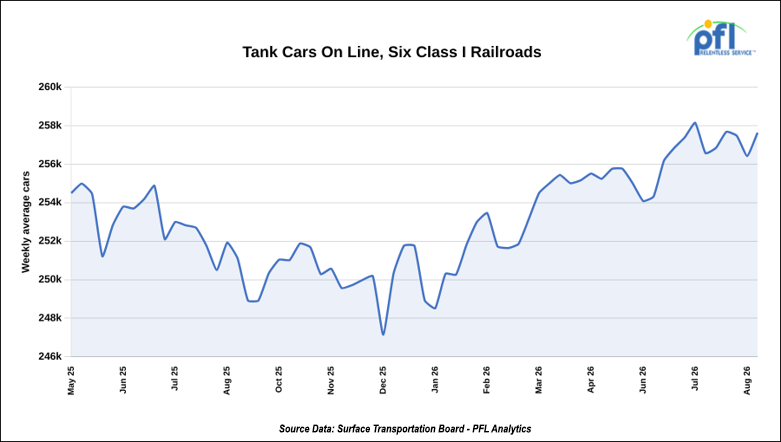
Tank cars on line across the six largest North American railroads averaged 257,637 in the week ended August 19th, against a trough near 247,000 last December. That is roughly 10,000 additional tank cars absorbed into the network in eight months, and the fleet is not being rebuilt at anything close to that pace. PFL has been saying for some time that egress delays end up on rail, and the equipment market is already pricing what the pipeline announcements have not yet admitted. Give us a call while there are still cars out there to talk about. After saying that on a geopolitical basis the dynamics could change over night with the opening of the strait.
We are watching Key Economic Indicators
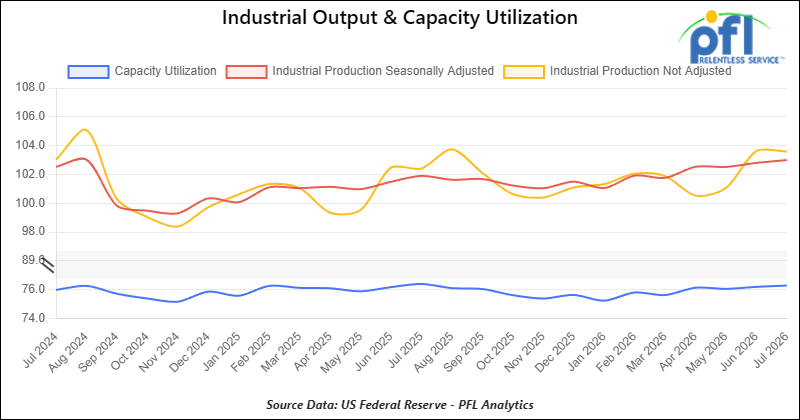
Industrial Output and Capacity Utilization
Manufacturing accounts for approximately 75% of total output. Manufacturing output in July increased 0.20% from June 2026.
Capacity utilization is a measure of how fully firms are using machinery and equipment. Capacity utilization increased by 0.08% from June in July.
Lease Bids
- 20-50, 4000-5000 Covered Hoppers located off of UP or BNSF in Houston. For use in Urea, Potash, and Ammonium Sulfate service. Period: 6-12 Months.
- 30-50, 25.5K DOT 111 Tanks located off of All Class 1s in various locations. For use in Asphalt service. Period: 1-3 Years.
- 40, 29K DOT 111 Tanks located off of UP or BNSF in the Midwest. For use in Veg Oil service. Period: 5 Year.
- 20, DOT 117J Tanks located off of NS, CSX, CN, or CPKC in various locations. For use in C5 service. Period: 1 year. Need gauge rods.
- 300, 5200CF Covered Hoppers located off of CP or CM in Canada. For use in Petcoke service. Period: 3 Year.
- 10, 30K 117J Tanks located off of BNSF in Canada. For use in Propane or Butane service. Period: 3 Year.
- 20, 28K or larger 117J Tanks located off of BNSF or UP in California. For use in Crude service. Period: 6 months.
- 75, 30K DOT 117 Tanks located off of NS in Ohio. For use in Condensate service. Period: 6-12 Months. Mag Rods Not Needed.
- 100, 28.3K DOT 111 or 117 Tanks located off of CP or CN in Canada. For use in VGO service. Period: 1-3 Years.
- 5, 28.3K DOT 111 or 117 Tanks located off of CN in Canada. For use in Bitumen service. Period: Trip Lease.
- 5-10, 25.5K DOT 111 Tanks located off of CN in Canada. For use in Caustic service. Period: 3-6 Months.
- 100, 340W Pressure Tank located off of CN or CP in Canada. For use in Propane service. Period: 6 Months.
- 10-20, 3200 or 3281 Covered Hoppers located off of CN or CP in Canada. For use in Sodium Sulphate service. Period: 3-5 years. Lined.
- 50, 340W Pressure Tanks located off of CN or CP in Canada. For use in Propane service. Period: Winter.
- 30-50, 340W pressure Tanks located off of NS or CSX in Northeast U.S. For use in Propane service. Period: Winter.
- 25, 340W Pressure Tanks located off of UP or BN in US. For use in Propane service. Period: Winter.
- 50, 28.3K 117J Tanks located off of BNSF in Kansas/Oklahoma. For use in Fuel Oil service. Period: 6 Months.
- 100, 30K 117J Tanks located off of CN in Canada. For use in Diesel service. Period: 1 year.
Sales Bids
- 28, 3400CF Covered Hoppers located off of UP or BNSF in Texas. For use in Cement service. Cement Gates needed.
- 20, 17K DOT111 Tanks located off of various class 1s in various locations. For use in corn syrup service.
- 120, Various Open-Top Aluminum Rotary Gondolas located off of various class 1s in various locations. For use in Sulphur service. Built 2004 or later.
- 12, 21.5K-25K DOT 111 Tanks located off of Various Class 1s in Michigan. For use in Diesel, Asphalt, Crude service. Coiled and Insulated.
Lease Offers
- 21, 6351 Covered Hoppers located off of CN in Wisconsin. Last used in DDG. Available until February 2027.
- 29, 6500 Covered Hoppers located off of CN in Wisconsin. Last used in DDG. Available until February 2027.
- 15, 6200CF Covered Hoppers located off of all class 1s in Wisconsin. Last used in plastic. Cars are currently clean.
- 30, 6500CF Covered Hoppers located off of all class 1s in Wisconsin. Last used in plastic. Cars are currently clean.
- 100, 28.4K DOT 117J Tanks located off of UP or BNSF in Beaumont, TX. Cars are currently clean.
- 50, 30K DOT117J Tanks located off of UP or BNSF in the South. Last used in ethanol.
- 10, 29K DOT 117R Tanks located off of BNSF and UP in Texas. Last used in gasoline additive. Coiled and Insulated.
- 39, 31K CPC1232 Tanks located off of All Class 1s in Iowa. Last used in diesel.
- 2, 30K DOT 117R Tanks located off of BNSF and UP in Texas. Last used in Diesel.
- 1, 30K DOT 117R Tanks located off of BNSF and UP in Texas. Last used in gas blend stock.
- 3, 30K DOT 117R Tanks located off of BNSF and UP in Texas. Last used in gasoline.
- 41, 30K DOT 111 Tanks located off of in Brownsville. Last used in Diesel. Cars are currently clean.
Sales Offers
- 81, 31.8K CPC1232 Tanks located off of UP or BNSF in TX. Last used in Multiple Services. Requal Due in 2025.
- 35, 3400CF Covered Hoppers located off of UP or BNSF in the Midwest. Last used in Sand.
- 25, 30K 117J Tanks located off of CSX in Jackson, TN. Last used in Fuels. Newly Requalified.
- 15, 5750 CF Hopper located off of CSX, NS, CP, CN, BNSF, UP in St Louis. Last used in Grain.
- 50, 30 DOT 111 Tank located off of multiple class 1s in multiple location. Last used in Fuels.
Call PFL today to discuss your needs and our availability and market reach. Whether you are looking to lease cars, lease out cars, buy cars, or sell cars call PFL today at 239-390-2885
Railcar for Sale or Lease
| CAT | Type | Capacity | GRL | QTY | LOC | Class | Prev. Use | Offer | Note |
|---|
| CAT | Type | Size | GRL | QTY | LOC | Class | Term | Commodity | Offer | Note |
|---|
| CAT | Type | Capacity | GRL | QTY | LOC | Class | Prev. Use | Clean | Offer | Note |
|---|
| CAT | Type | Capacity | GRL | QTY | LOC | Class | Commodity | Offer | Note |
|---|
PFL will be at the Following Conferences

- Where: The Westin Galleria Dallas
- Attending: David Cohen (954-729-4774), and Curtis Chandler (239-405-3365)
- Conference Website

- Where: The Westin Galleria Dallas
- Attending: Brian Baker (239.297.4519)
- Conference Website