
“If we ever forget that we are one nation under God, then we will be a nation gone under.” – Ronald Regan
Jobs Update
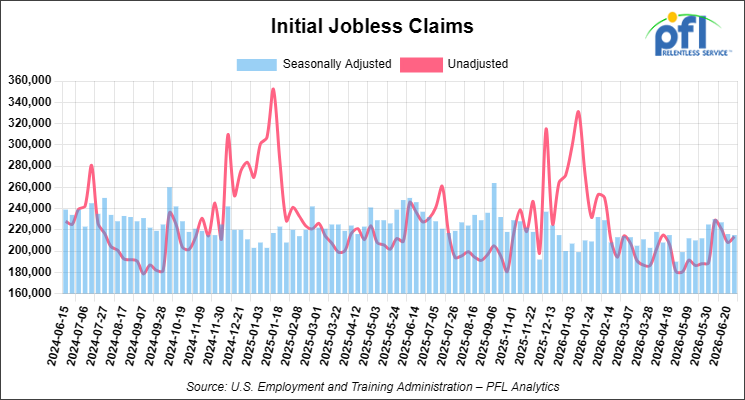
Initial jobless claims seasonally adjusted for the week ending June 27, 2026 came in at 215,000, versus the adjusted number of 216,000 people from the week prior, down 1,000 people week-over-week.
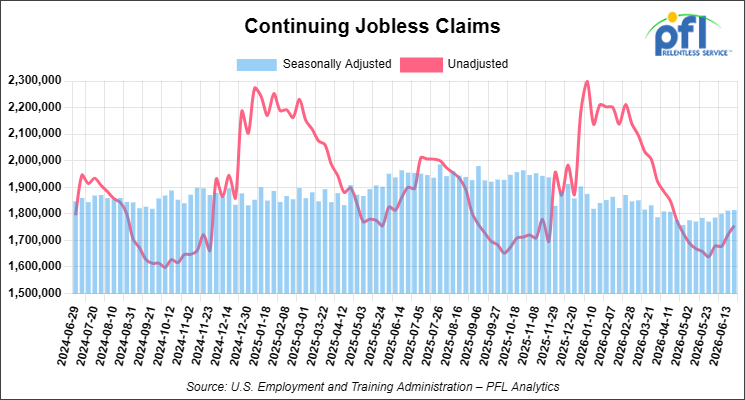
Continuing jobless claims came in at 1,814,000, versus the adjusted number of 1,812,000 people from the week prior, up 2,000 week-over-week.
Stocks closed mixed on Thursday of last week but higher week-over-week
The DOW closed higher on Thursday of last week, up 594.83 points (1.14%), closing out the week at 52,900.07, up 1,023.96 points week-over-week. The S&P 500 closed higher on Thursday of last week, up 0.01 points (0.00%), and closed out the week at 7,483.24, up 129.22 points week-over-week. The NASDAQ closed lower on Thursday of last week, down -207.36 points (-0.80%), and closed out the week at 25,832.67, up 535.05 points week-over-week.
In overnight trading, DOW futures traded higher and are expected to open at 53,214 this morning, up 31 points from Thursday’s close.
Crude oil closed higher on Thursday of last week but lower week-over-week
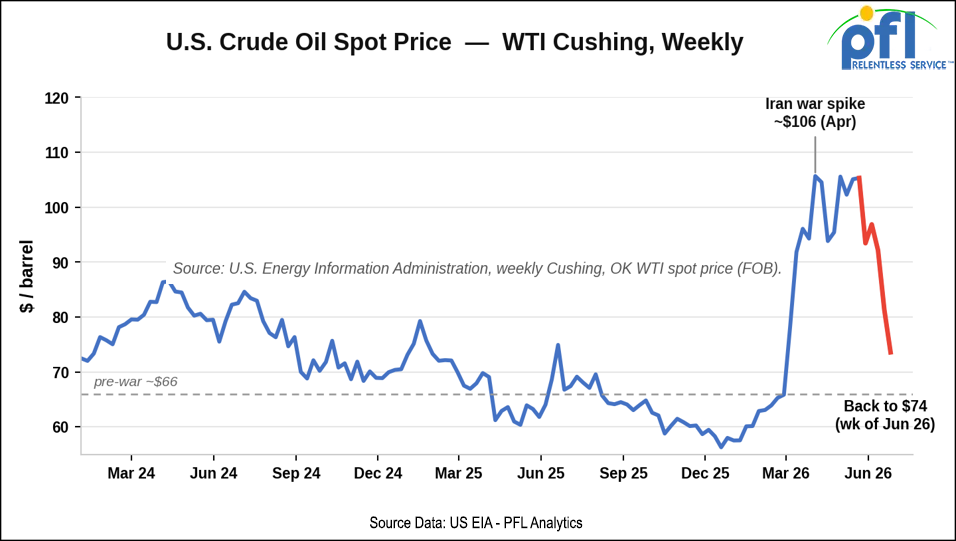
West Texas Intermediate (WTI) crude closed up $0.11 per barrel (0.2%), to close at $68.69 on Thursday of last week, but down $0.54 week-over-week. Brent crude closed up $0.23 per barrel (0.3%), to close at $71.80, but down $0.19 week-over-week.
One Exchange WCS (Western Canadian Select) for August delivery settled on Thursday of last week at US$15.35 below the WTI-CMA (West Texas Intermediate – Calendar Month Average). The implied value was US$53.27 per barrel.
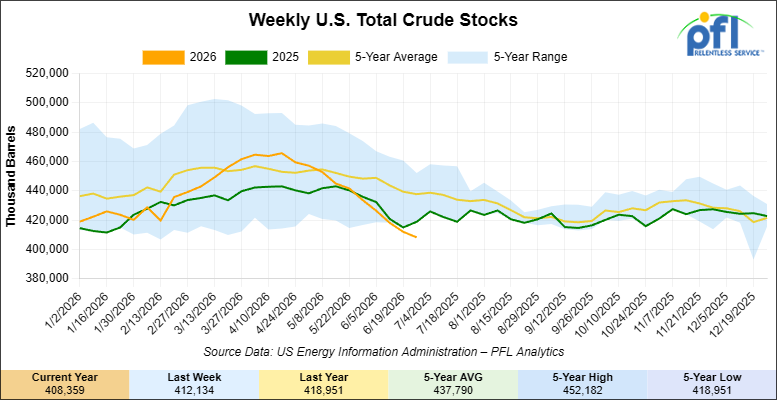
U.S. commercial crude oil inventories (excluding those in the Strategic Petroleum Reserve) decreased by 3.8 million barrels week-over-week. At 408.4 million barrels, U.S. crude oil inventories are 7% below the five-year average for this time of year.
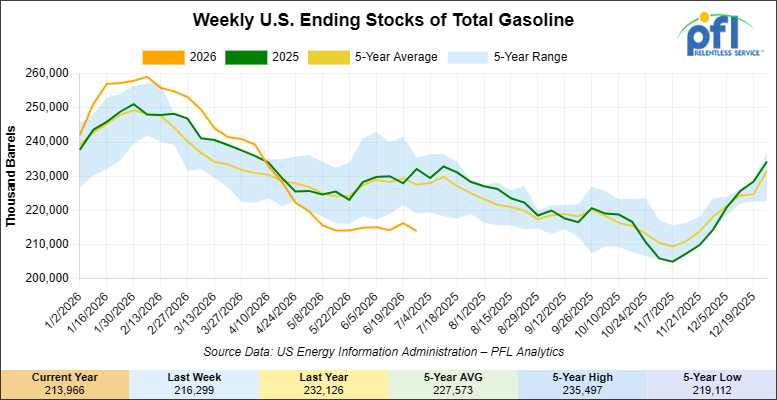
Total motor gasoline inventories decreased by 2.3 million barrels week-over-week and are 7% below the five-year average for this time of year.
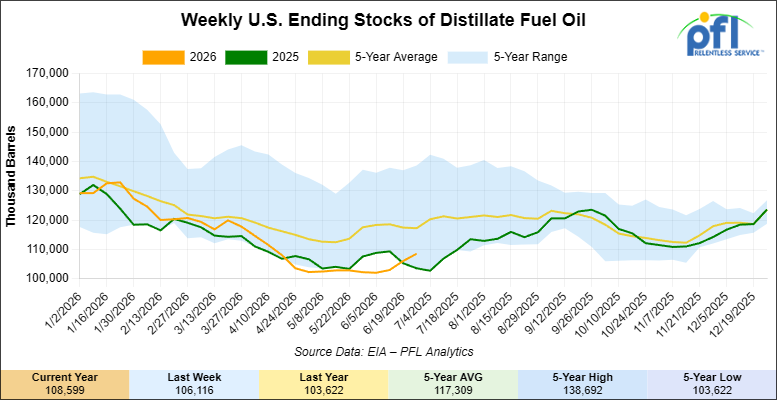
Distillate fuel inventories increased by 2.5 million barrels week-over-week and are 8% below the five-year average for this time of year.
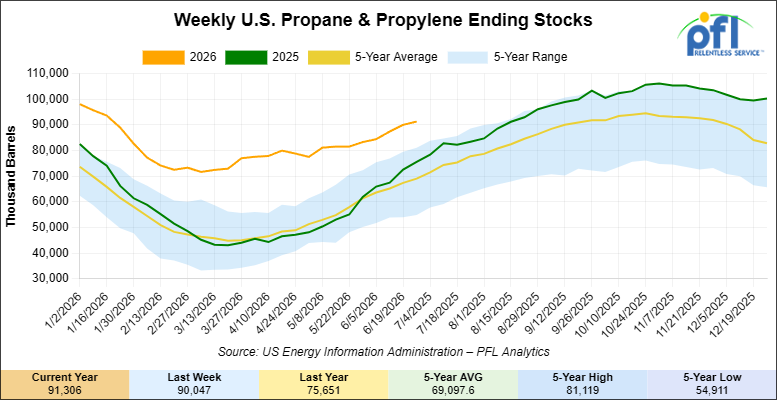
Propane/propylene inventories increased by 1.3 million barrels week-over-week and are 33% above the five-year average for this time of year.
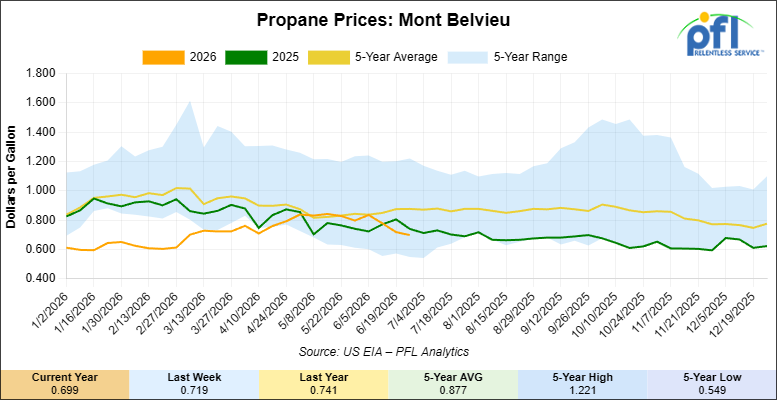
Propane prices closed at 69.9 cents per gallon on Friday of last week, down 2 cents per gallon week-over-week, and down 4.2 cents year-over-year.
Overall, total commercial petroleum inventories decreased by 700,000 barrels week-over-week during the week ending June 26, 2026.
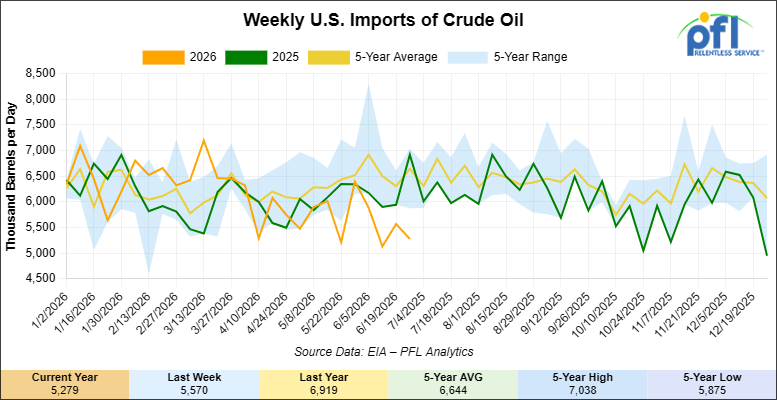
U.S. crude oil imports averaged 5.3 million barrels per day during the week ending June 26, 2026, a decrease of 291,000 barrels per day week-over-week. Over the past four weeks, crude oil imports averaged 5.5 million barrels per day, 10.9% less than the same four-week period last year. Total motor gasoline imports (including both finished gasoline and gasoline blending components) averaged 639,000 barrels per day, and distillate fuel imports averaged 108,000 barrels per day during the week ending June 26, 2026.
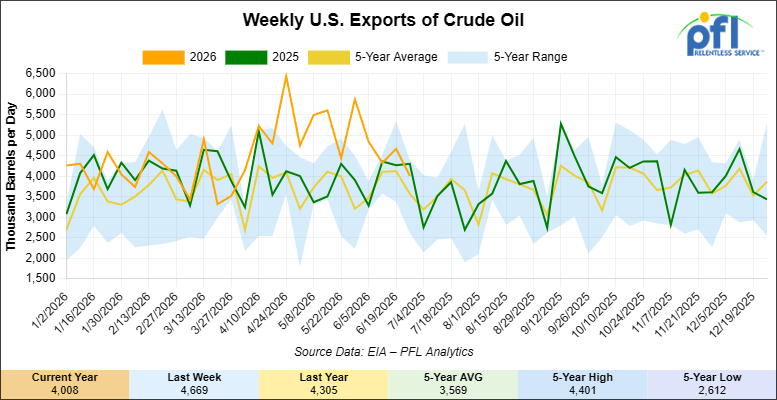
U.S. crude oil exports averaged 4.008 million barrels per day during the week ending June 26, 2026, a decrease of 661,000 barrels per day week-over-week. Over the past four weeks, crude oil exports averaged 4.461 million barrels per day.
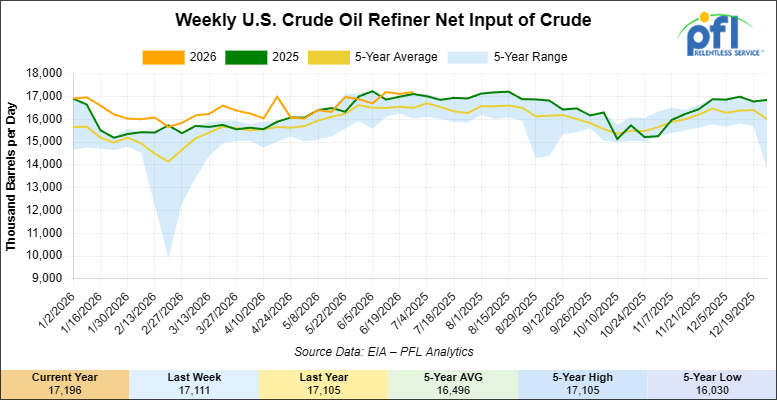
U.S. crude oil refinery inputs averaged 17.2 million barrels per day during the week ending June 26, 2026, which was 85,000 barrels per day more week-over-week.
WTI is poised to open at $70.44, up $1.21 per barrel from Friday’s close.
North American Rail Traffic
Week Ending July 1, 2026:
Total North American weekly rail volumes were up (+6.13%) in week 27, compared with the same week last year. Total Carloads for the week ending July 1, 2026 were 335,005, up (+2.65%) compared with the same week in 2025, while weekly Intermodal volume was 354,541, up (+9.65%) year-over-year. 8 of the AAR’s 11 major traffic categories posted year-over-year increases. The largest decrease came from Motor Vehicles and Parts (-4.23%). The largest increase was Other (+12.29%).
In the East, CSX’s total volumes were up (+7.39%), with the largest decrease coming from Grain (-15.17%), while the largest increase came from Other (+17.55%). NS’s total volumes were up (+7.10%), with the largest increase coming from Nonmetallic Minerals (+20.23%), while the largest decrease came from Motor Vehicles and Parts (-6.29%).
In the West, BNSF’s total volumes were up (+8.99%), with the largest increase coming from Other (+28.43%), while the largest decrease came from Chemicals (-9.60%). UP’s total volumes were up (+4.08%), with the largest increase coming from Grain (+14.72%), while the largest decrease came from Coal (-16.49%).
In Canada, CN’s total volumes were down (-2.58%), with the largest increase coming from Grain (+40.32%), while the largest decrease came from Metallic Ores and Metals (-13.95%). CPKCS’s total volumes were up (+6.10%), with the largest increase coming from Other (+51.70%), while the largest decrease came from Chemicals (-22.70%).
Source Data: AAR – PFL Analytics
North American Rig Count Summary
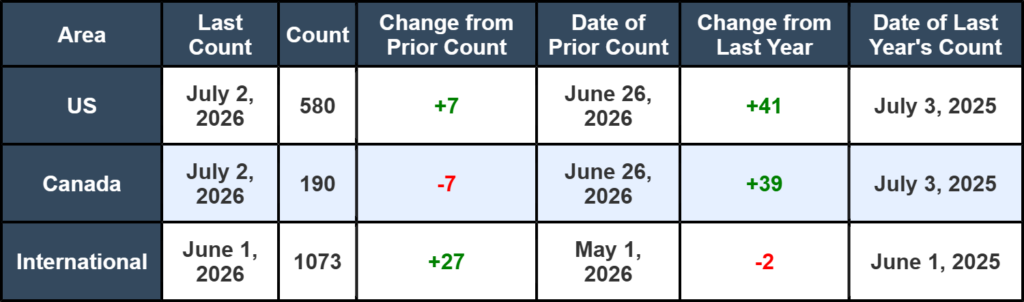
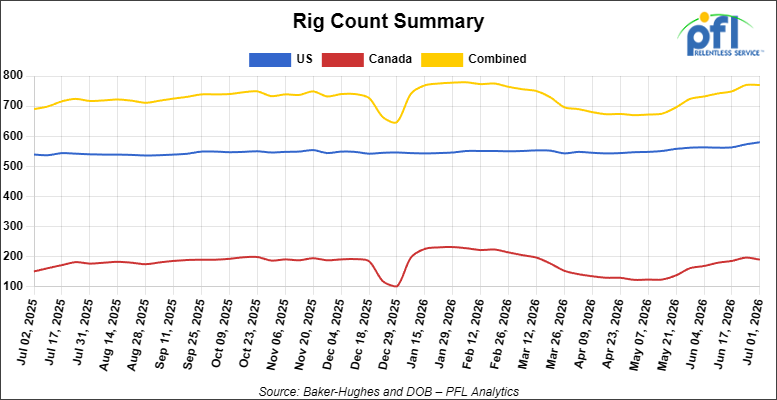
North American rig count was unchanged week-over-week. The U.S. rig count was up by +7 rigs week-over-week, and up by +41 rigs year-over-year. The U.S. currently has 580 active rigs. Canada’s rig count was down by -7 rigs week-over-week, but up by +39 rigs year-over-year. Canada currently has 190 active rigs. Overall, year-over-year we are up by +80 rigs collectively.
International rig count was up by +27 rigs month-over-month but down by -2 rigs year-over-year. Internationally there are 1073 active rigs.
We are watching a few things out there for you:
We were watching July 4th
Well, folks we hope everyone had a great July 4th weekend. The Country got into what seemed to be a multi week celebration in a big way. Having the World Cup over here in North America added to the flair.
Over the July 4th weekend, railroads and rail industry suppliers across North America recognized America’s 250th anniversary with a series of commemorative locomotives and railcars celebrating the industry’s long-standing role in supporting the nation’s economy and supply chains.
The effort extended well beyond the class 1’s. Last week, Genesee & Wyoming unveiled a commemorative locomotive featuring Mount Rushmore, OmniTRAX introduced a patriotic locomotive on its Chicago Rail Link, The Prairie Line dedicated locomotive No. 1776 to members of the U.S. Armed Forces, and Union Tank Car Company (UTLX) rolled out a custom-painted tank car honoring American manufacturing. These joined America250 locomotives previously introduced by Class I railroads including BNSF, CPKC, CN, CSX, Norfolk Southern, and Union Pacific, with all expected to remain in regular freight service across their respective networks.
While primarily commemorative, the coordinated effort highlights freight rail’s continued role in moving the commodities that support North American industry, including agricultural products, chemicals, energy products, steel, automotive parts, consumer goods, and intermodal freight. Rather than serving as static displays, the locomotives and railcars will continue operating across North America throughout the anniversary celebration.
The broad participation from Class I railroads, short lines, railcar manufacturers, and suppliers demonstrates a shared focus on freight rail’s role in supporting North America manufacturing, commerce, and supply chains as the industry looks toward continued investment and growth.
PFL had its annual July 4th fireworks show and celebration on July 4th and it reminded us how important each and everyone of you our readers are vital in keeping this country moving, rocking and rolling in the free world. Happy 250 America and for our Canadian friends we hope that you had a great Canada day celebration.
We Continue to Watch Hormuz
The war premium has fully unwound. WTI has traded back below $70 and Brent below $71, both at their lowest since late February, the day before the Iran war began. Flows through the Strait of Hormuz have recovered beyond 10 million barrels per day with the U.S. naval blockade lifted, the UAE back above pre-war export levels, and Iranian barrels returning to the water, which has turned a four-month supply scare into a surplus.
The demand side is confirming the move. U.S. retail gasoline fell to roughly $3.83 last week, the lowest since early March, as U.S. crude inventories have drawn steadily to historic lows. OPEC+ is ramping into the reopening even as it fractures, with Iraq pressing for a larger quota and floating an exit after the UAE already walked in May. The next round of U.S.-Iran talks slipped in Doha, so headline risk is not gone, but the market is pricing in normalization.
We Continue to Watch Our Strategic Petroleum Reserves
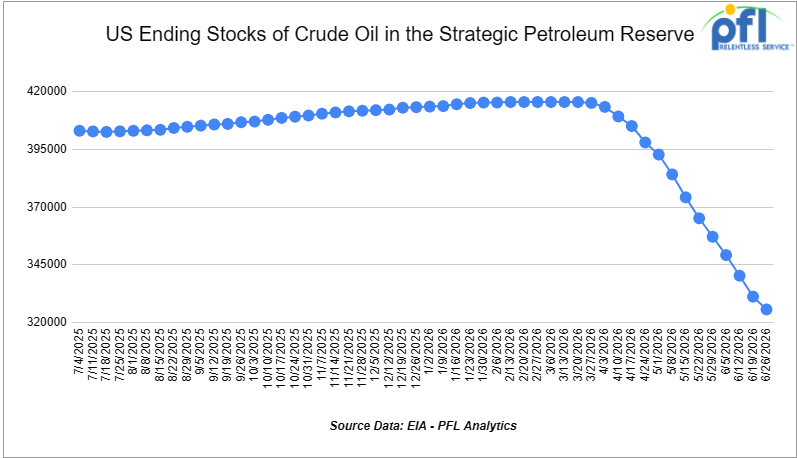
The ongoing emergency drawdown of the U.S. Strategic Petroleum Reserve (SPR) remains a major component of global efforts to offset crude oil supply disruptions stemming from the conflict involving Iran and the continued restrictions on oil shipments through the Strait of Hormuz. Since March, the Department of Energy (DOE) has awarded exchanges covering more than 133 million barrels of crude oil, with additional releases expected as part of a broader international response coordinated through the International Energy Agency (IEA). .
The United States continues to execute its commitment to make available up to 172 million barrels from the SPR under the IEA’s collective plan to inject roughly 400 million barrels into global energy markets. Officials have argued that the releases are necessary to help stabilize crude supplies and limit further increases in fuel prices as refiners compete for replacement barrels amid ongoing transportation disruptions.
As releases have accelerated, inventories in the SPR have declined to 325.655 million barrels, down sharply from levels above 450 million barrels earlier this year and reaching their lowest level since June 1983 . Recent weekly withdrawals have ranked among the largest on record, highlighting the scale of the government’s intervention in oil markets. On average, since the war started with Iran, the United States has withdrawn approximately 1.15 million barrels per day from the SPR through the week ending June 26, 2026.
Global petroleum inventories have also tightened considerably. The IEA has reported substantial draws in commercial crude and refined-product stockpiles across major consuming nations, underscoring the strain that the conflict has placed on world energy markets. Agency officials have indicated that further coordinated actions remain possible should supply disruptions persist or intensify.
The Administration continues to emphasize that the current program consists primarily of exchange agreements, rather than outright sales. Under these arrangements, companies receiving crude oil today are required to return the borrowed barrels in the future along with additional volumes as a premium. Energy Secretary Chris Wright has stated that the objective is to eventually restore the SPR to levels above those that existed prior to the current emergency releases.
We Are Watching Left Wing Carney
Ottawa referred Alberta’s proposed 1 million barrel per day West Coast oil pipeline to the Major Projects Office on Thursday of last week, the clearest sign yet that the Carney government seemingly intends to see a bitumen line to tidewater built on its watch. The project is structured as an equal federal-provincial partnership, with Trans Mountain Corporation (government owned pipeline) leading development, Pembina Pipeline was named as the lone named private investor, and there is a reserved equity stake for Indigenous communities. The route would largely follow the existing Trans Mountain corridor to a deep-water port in the Vancouver area capable of loading very large crude carriers, and Ottawa is targeting a national-interest listing by October 1st with construction possible as early as September 2027.
That same day, Carney and B.C. Premier David Eby signed a Canada-B.C. agreement that keeps the northern tanker ban intact and expands the Roberts Bank terminal in Delta, killing Premier Smith’s preferred Prince Rupert deep-water endpoint. Eby stated that the province will not go to court to fight a pipeline project and removed the legal obstruction that dogged the original Trans Mountain expansion. Ottawa has been explicit that the pipeline remains conditional on the Pathways carbon-capture project proceeding, so two multi-billion-dollar megaprojects are now lashed together.
For a Liberal government that spent a decade stacking climate policy on the oil patch, this is a full reversal, and Carney said so himself last Tuesday in a video telling Canadians the country cannot restrain the growth of oil and gas. The tell is that after a referral, a route sketch, and a partnership announcement, there is still no private proponent willing to finance and build the line, which Carney conceded last week. A one-million-barrel proposal with no builder, no funding model, and a decision gate that does not close until October is just a press release but time will tell.
We Are Watching Greenbrier
Greenbrier’s fiscal third quarter, was reported last Wednesday for the period ended May 31, is a clean read on a bifurcated market. The owned lease fleet grew 23% sequentially to 20,600 cars at 99% utilization, with demand called out specifically for tank cars and covered hoppers. Leasing is doing the heavy lifting while manufacturing softens, with revenue at $576.5mn against $842.7mn a year earlier and a fresh $425mn non-recourse term loan taken to keep feeding the lease fleet.
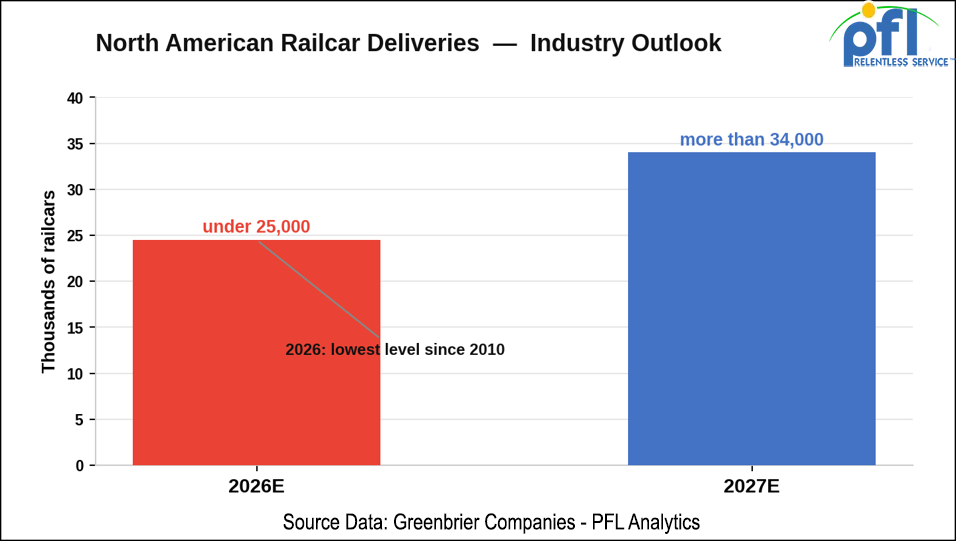
The build side is the soft spot. New orders were 2,200 units against 3,600 delivered, dropping the backlog to roughly $2.0bn from $2.2bn a year ago and $3.4bn the year before. Management pegged calendar-2026 North American railcar deliveries as the lowest since 2010, under 25,000 units, before a rebound above 34,000 in 2027. The company is also watching a possible tariff on tank cars built in Mexico, which would feed straight into new-car cost.
The signal for a fleet owner is that a starved order book on top of 99% utilization is what holds lease economics firm on the cars already on the rails. It seems to us at PFL that Greenbrier results of the leasing industry are reminiscent of all owners who have high utilization rates and the secondary market, once robust, is thinning.
We Are Watching Refineries
The U.S. refining map took several hits at once last week. A June 25 fire at Monroe Energy’s 185,000 b/d Trainer refinery in Pennsylvania pulled a key Atlantic Coast plant offline and helped drive regional refinery runs to about 68%, the lowest since April 2025. That came on top of reported unit outages at Gulf Coast plants, and Gulf Coast gasoline stocks fell to 20-month lows as strong exports compounded the disruptions.
The rail angle sits in PADD 1. A hobbled Trainer and thin Atlantic Coast supply is the kind of setup that historically pulls Bakken barrels east, by pipe where it exists and by rail at the margin. What is capping that pull this year is the Jones Act waiver, which is letting foreign-flag tankers move product coastwise into the northeast, and how much of the shortfall clears by rail depends on how long these units stay down and whether the waiver is extended past mid-August.
We Are Watching the USMCA Review
The Trump administration declined to renew the U.S.-Mexico-Canada Agreement at its scheduled six-year review last Wednesday, leaving the deal in force but triggering a round of annual reviews that runs to 2036. There is no immediate hit to freight rail, but the industries most exposed to the outcome, automotive, chemicals, plastics, steel, agriculture, and intermodal, are core rail traffic. The next round of U.S.-Mexico talks is expected to begin the week of July 20, with Canada so far largely kept out of the negotiating room.
The direction of the effect depends on where the rules land. Stricter regional content requirements would, over time, favor North American manufacturing and the raw-material, industrial, and finished-goods shipments that move it by rail, a net positive for volumes. The near-term risk runs the other way, as shippers facing an uncertain rulebook tend to defer the plant and sourcing decisions that generate that traffic in the first place.
For the cross-border franchises this matters most to CPKC, whose single-line Mexico-to-Canada network is built around exactly the automotive and industrial flows now on the table. The July 20 round is the next real signal on rules of origin, and it is worth watching before anyone commits to fleet or routing changes.
We Are Watching Carbon by Rail
A genuinely new tank car demand category is taking shape. Union Pacific is moving to haul carbon dioxide captured at Midwest ethanol plants to sequestration sites in Wyoming along its Overland Route, with a target startup in late 2027. Greenbrier says it already has next-generation CO2 tank cars under construction against multiple orders, and the economics run on the $85-per-ton 45Q credit for captured and stored carbon.
What makes this more than a one-railroad story is that overlaying ethanol producers with favorable geology puts BNSF, CPKC, and CN in line for the same traffic, and it rhymes directly with the Pathways carbon-capture build-out that Ottawa and has now tied to a new Alberta pipeline. For a fleet that has spent a decade watching crude by rail car counts shrink, a durable, credit-backed CO2 flow could be the kind of new lease demand worth looking into. Last we checked CO2 cars were very expensive. We will be keeping our eye on this one.
We Are Watching the Jones Act
The national-security rationale for the coastwise waiver is wearing thin. A Chinese-flagged tanker operated by a Cosco subsidiary the Pentagon has flagged as a security risk is running everyday domestic cargoes such as asphalt into Baltimore under a waiver meant to backstop military fuel supply during the Hormuz disruption. Roughly a quarter of the waiver voyages approved since March have gone to Chinese-owned or Chinese-subsidized ships.
The waiver runs to mid-August with no word on extension. Every coastwise cargo that moves on a foreign-flag tanker is a cargo that domestic tug-and-barge operators, and at the margin the railroads, would otherwise carry. The domestic maritime lobby is making the point loudly, and if the administration lets the waiver lapse into a tight East Coast product market, the displaced volume has to find another mode.
We Continue to Watch the Surface Transportation Board
The UP-NS clock is inside four weeks. The applicants’ supplemental filing is due July 27, with the merits proceeding and the environmental review still held in abeyance and the Board having denied a broad ex-parte waiver. Nothing new filed over the past week, so this is a status check rather than a development.
The base case remains a long review. The Board is applying its 2001 merger rules for the first time to a Class I combination, the companies still point to an early-2027 close, and if the supplement lands clean at month-end the environmental review and its public meetings would then set the real timeline. We will treat any read on the eventual outcome as speculation until the record actually builds.
We Are Watching Key Economic Indicators
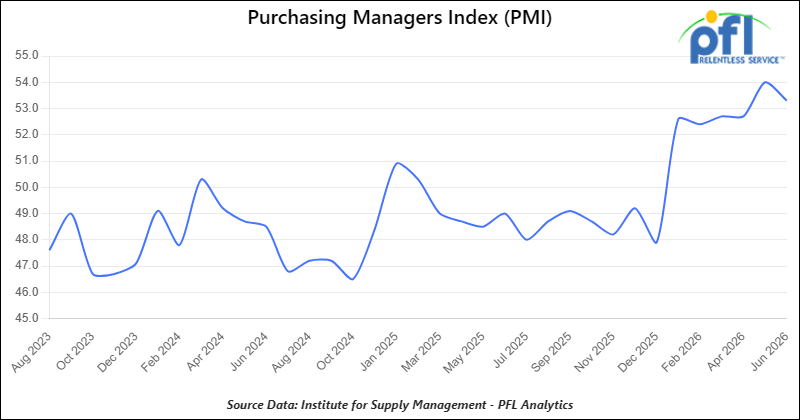
Purchasing Managers Index (PMI)
The Institute for Supply Management releases two PMI reports—one covering manufacturing and the other covering services. These reports are based on surveys of supply managers across the country and track changes in business activity. A reading above 50% on the index indicates expansion, while a reading below 50% signifies contraction, with a faster pace of change the farther the reading is from 50.
The Manufacturing PMI registered 53.3% in June 2026, down from 54.0% in May but still marking the sixth consecutive month of expansion. While manufacturing activity moderated from May’s four-year high, growth continued to be supported by expanding new orders and production. The New Orders Index eased to 56.0% from 56.8% in May, while the Employment Index improved to 49.7% from 48.6%, though it remained in contraction territory, indicating manufacturers continue to be cautious about hiring.
The Services PMI for June 2026 has not yet been released. The most recent reading remains 54.5% (May 2026), up from 53.6% in April, reflecting the sector’s 23rd consecutive month of expansion. Business activity and new orders both strengthened during the month, with the New Orders Index increasing to 57.3% from 53.5% in April. However, the Employment Index fell to 47.9%, signaling continued weakness in service-sector hiring despite solid overall business activity.
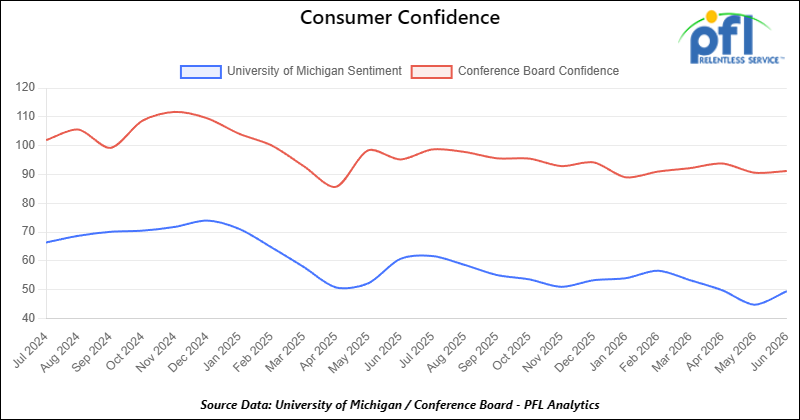
Consumer Confidence
The Index of Consumer Sentiment from the University of Michigan increased from 49.5 in May to 44.8 in June.
The Conference Board Consumer Confidence Index decreased from 90.6 in May to 91.2 in June.
Lease Bids
- 20-50, 4000-5000 Covered Hoppers located off of UP or BNSF in Houston. For use in Urea, Potash, and Ammonium Sulfate service. Period: 6-12 Months.
- 30-50, 25.5K DOT 111 Tanks located off of All Class 1s in various locations. For use in Asphalt service. Period: 1-3 Years.
- 40, 29K DOT 111 Tanks located off of UP or BNSF in the Midwest. For use in Veg Oil service. Period: 5 Year.
- 20, DOT 117J Tanks located off of NS, CSX, CN, or CPKC in various locations. For use in C5 service. Period: 1 year. Need gauge rods.
- 300, 5200CF Covered Hoppers located off of CP or CM in Canada. For use in Petcoke service. Period: 3 Year.
- 10, 30K 117J Tanks located off of BNSF in Canada. For use in Propane or Butane service. Period: 3 Year.
- 20, 28K or larger 117J Tanks located off of BNSF or UP in California. For use in Crude service. Period: 6 months.
- 75, 30K 117 Tanks located off of NS in Ohio. For use in Condensate service. Period: 6-12 Months. Mag Rods Not Needed.
- 100, 28.3K DOT 111 or 117 Tanks located off of CP or CN in Canada. For use in VGO service. Period: 1-3 Years.
- 5, 28.3K DOT 111 or 117 Tanks located off of CN in Canada. For use in Bitumen service. Period: Trip Lease.
- 5-10, 25.5K DOT 111 Tanks located off of CN in Canada. For use in Caustic service. Period: 3-6 Months.
Sales Bids
- 28, 3400CF Covered Hoppers located off of UP or BNSF in Texas. For use in Cement service. Cement Gates needed.
- 20, 17K DOT111 Tanks located off of various class 1s in various locations. For use in corn syrup service.
- 120, Various Open-Top Aluminum Rotary Gondolas located off of various class 1s in various locations. For use in Sulphur service. Built 2004 or later.
Lease Offers
- 21, 6351 Covered Hoppers located off of CN in Wisconsin. Last used in DDG. Available until February 2027.
- 29, 6500 Covered Hoppers located off of CN in Wisconsin. Last used in DDG. Available until February 2027.
- 50, 20K DOT117J Tanks located off of all class 1s in Moving. Last used in styrene.
- 29, 25.5K DOT117J Tanks located off of UP or BNSF in Texas. Cars are currently clean.
- 200, 340W DOT 112J Tanks located off of all class 1s in Multiple Locations. Last used in propane and butane. Cars are currently clean.
- 15, 6200CF Covered Hoppers located off of all class 1s in Wisconsin. Last used in plastic. Cars are currently clean.
- 30, 6500CF Covered Hoppers located off of all class 1s in Wisconsin. Last used in plastic. Cars are currently clean.
- 6, 21K Stainless Steel Tanks located off of UP in Texas / Mexico Border. Last used in surfactant. Cars are currently clean.
- 100, 28.4K DOT 117J Tanks located off of UP or BNSF in Beaumont, TX. Cars are currently clean.
- 50, 30K DOT117J Tanks located off of UP or BNSF in the South. Last used in ethanol.
- 30, 30K DOT 117R Tanks located off of BNSF in Washington. Last used in renewable jet fuel.
- 80, 30K DOT 117R Tanks located off of BNSF in Washington. Last used in renewable diesel.
- 10, 30K DOT 117R Tanks located off of BNSF in Washington. Last used in renewable naphtha.
- 10, 29K DOT 117R Tanks located off of BNSF and UP in Texas. Last used in gasoline additive. Coiled and Insulated.
- 39, 31K CPC1232 Tanks located off of All Class 1s in Iowa. Last used in diesel.
- 2, 30K DOT 117R Tanks located off of BNSF and UP in Texas. Last used in giesel.
- 1, 30K DOT 117R Tanks located off of BNSF and UP in Texas. Last used in gas blend stock.
- 3, 30K DOT 117R Tanks located off of BNSF and UP in Texas. Last used in gasoline.
Sales Offers
- 81, 31.8K CPC1232 Tanks located off of UP or BNSF in TX. Last used in Multiple Services. Requal Due in 2025.
- 35, 3400CF Covered Hoppers located off of UP or BNSF in the Midwest. Last used in Sand.
- 25, 30K 117J Tanks located off of CSX in Jackson, TN. Last used in Fuels. Newly Requalified.
Call PFL today to discuss your needs and our availability and market reach. Whether you are looking to lease cars, lease out cars, buy cars, or sell cars call PFL today at 239-390-2885
Railcar for Sale or Lease
| CAT | Type | Capacity | GRL | QTY | LOC | Class | Prev. Use | Offer | Note |
|---|
| CAT | Type | Size | GRL | QTY | LOC | Class | Term | Commodity | Offer | Note |
|---|
| CAT | Type | Capacity | GRL | QTY | LOC | Class | Prev. Use | Clean | Offer | Note |
|---|
| CAT | Type | Capacity | GRL | QTY | LOC | Class | Commodity | Offer | Note |
|---|
PFL will be at the Following Conferences

- Where: The Westin Galleria Dallas
- Attending: David Cohen (954-729-4774), and Curtis Chandler (239-405-3365)
- Conference Website

- Where: The Westin Galleria Dallas
- Attending: Brian Baker (239.297.4519)
- Conference Website