The post PFL Railcar Report 10-19-2026 appeared first on PFL Petroleum Services LTD.
]]>Jobs Update
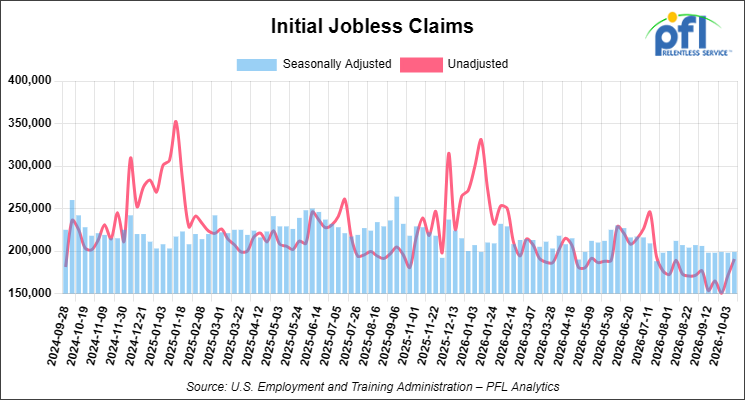
Initial jobless claims seasonally adjusted for the week ending October 10, 2026 came in at 199,000, versus the adjusted number of 198,000 people from the week prior, up 1,000 people week-over-week.
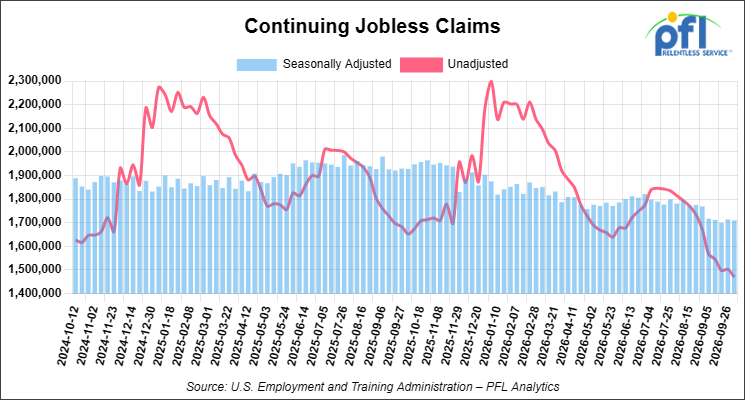
Continuing jobless claims came in at 1,710,000, versus the adjusted number of 1,714,000 people from the week prior, down 4,000 week-over-week.
Stocks closed lower on Friday of last week and mixed week-over-week
The DOW closed lower on Friday of last week, down -175.64 points (-0.24%), closing out the week at 52,002.05, up 347.10 points week-over-week. The S&P 500 closed lower on Friday of last week, down -84.60 points (-1.09%), and closed out the week at 7,659.46, down -152.08 points week-over-week. The NASDAQ closed lower on Friday of last week, down -572.99 points (-2.14%), and closed out the week at 26,140.03, down -1,226.14 points week-over-week.
In overnight trading, DOW futures traded higher and are expected to open at 52,216 this morning, up 2 points from Friday’s close.
Crude oil closed higher on Friday of last week and higher week-over-week
West Texas Intermediate (WTI) crude closed up $3.44 per barrel (3.5%), to close at $101.41 on Friday of last week, and up $9.56 per barrel week-over-week. Brent crude closed up $3.94 per barrel (3.7%), to close at $109.86, and up $5.14 per barrel week-over-week.
One Exchange WCS (Western Canadian Select) for November delivery settled on Friday of last week at US$26.95 below the WTI-CMA (West Texas Intermediate – Calendar Month Average). The implied value was US$74.46 per barrel.
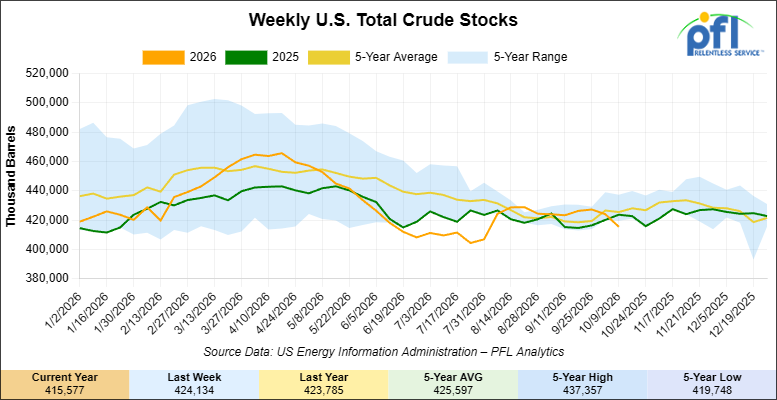
U.S. commercial crude oil inventories (excluding those in the Strategic Petroleum Reserve) decreased by 8.6 million barrels week-over-week. At 415.6 million barrels, U.S. crude oil inventories are 2% below the five-year average for this time of year.
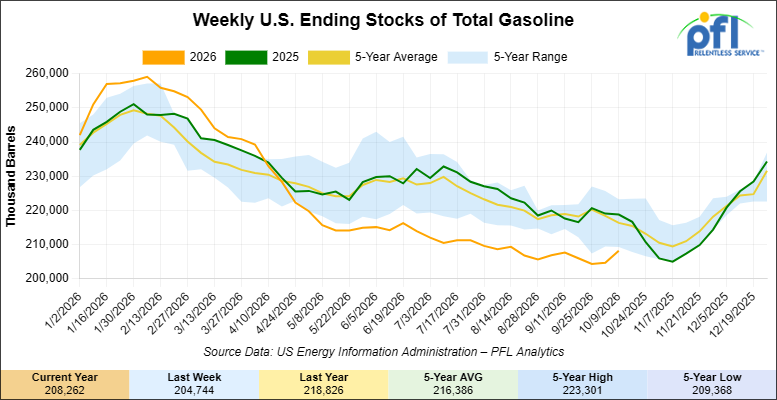
Total motor gasoline inventories increased by 3.5 million barrels week-over-week. and are 4% below the five-year average for this time of year.
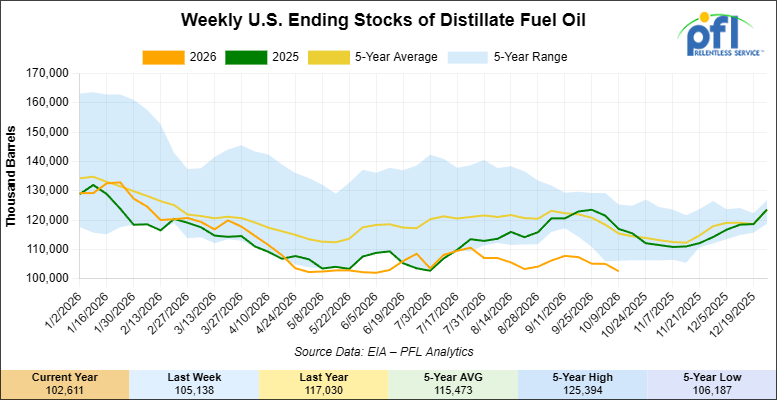
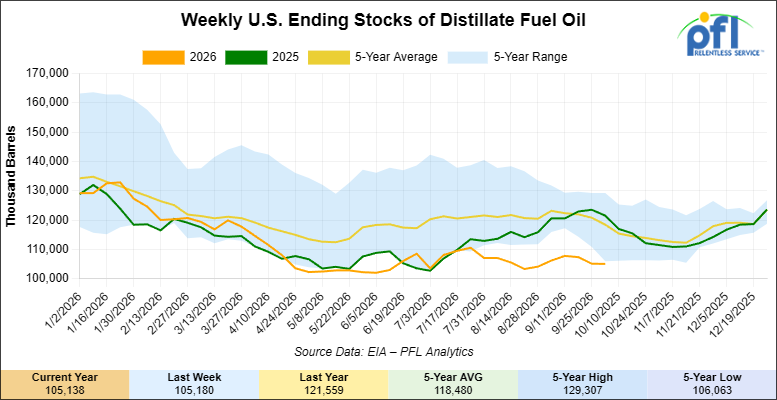
Distillate fuel inventories decreased by 2.5 million barrels week-over-week. and are 11% below the five-year average for this time of year.
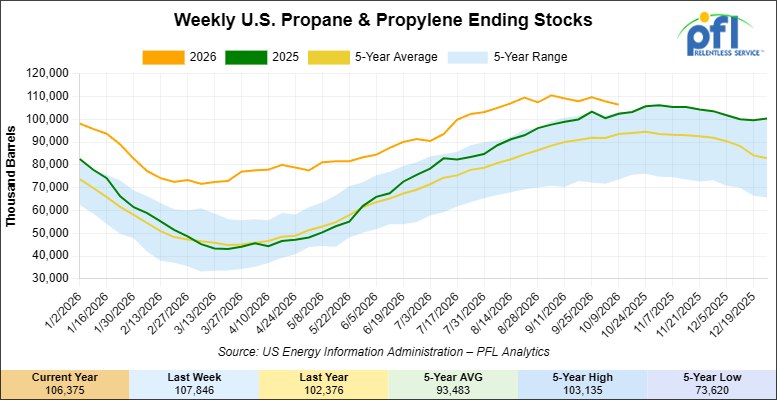
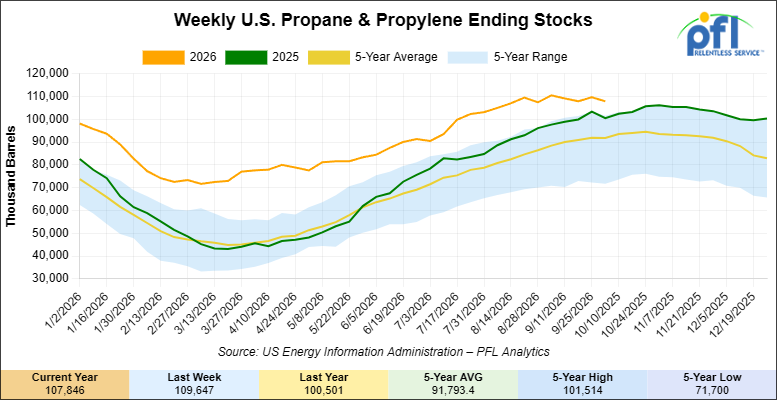
Propane/propylene inventories decreased by 1.5 million barrels week-over-week. and are 14% above the five-year average for this time of year.
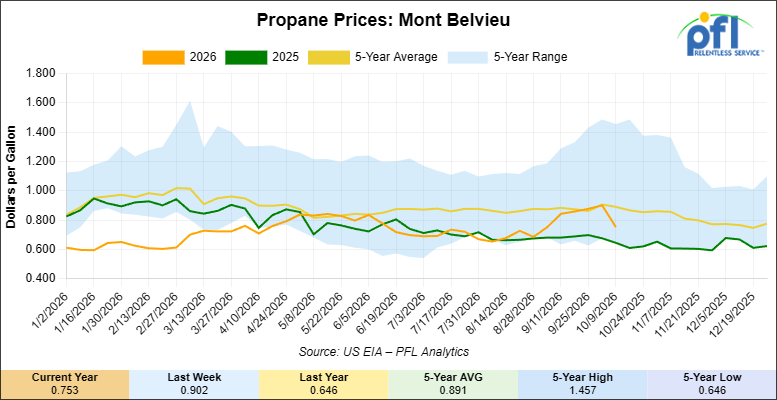
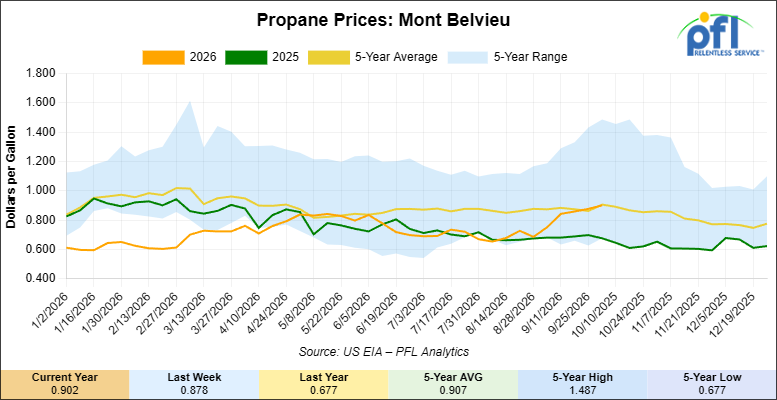
Propane prices closed at 75.3 cents per gallon on Friday of last week, down 14.9 cents per gallon week-over-week, but up 10.7 cents year-over-year.
Overall, total commercial petroleum inventories decreased by 13.4 million barrels week-over-week during the week ending October 9, 2026.
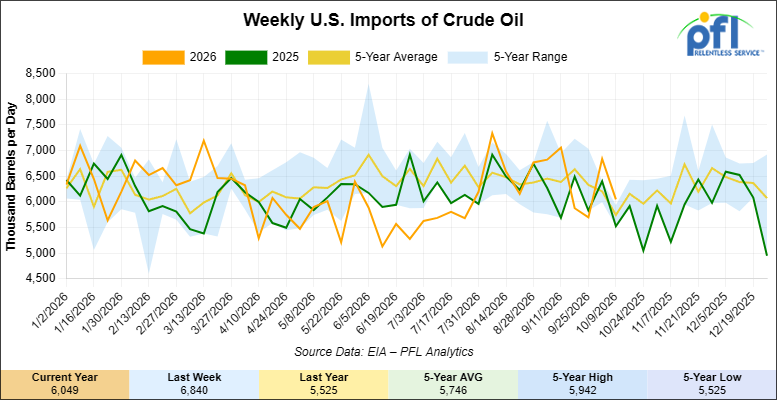
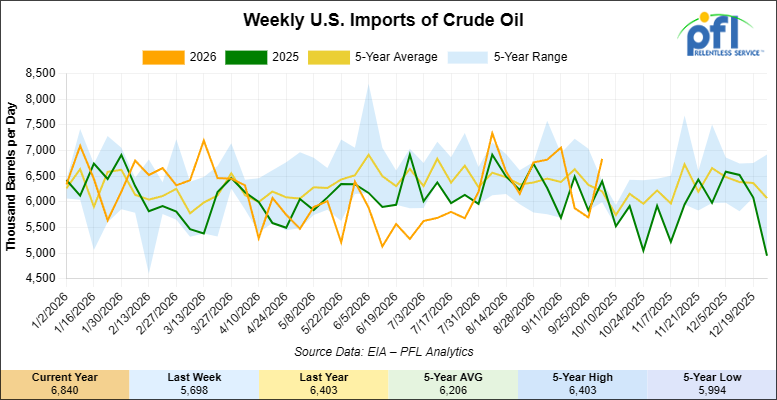
U.S. crude oil imports averaged 6.0 million barrels per day during the week ending October 9, 2026, a decrease of 791,000 barrels per day week-over-week. Total motor gasoline imports (including both finished gasoline and gasoline blending components) averaged 508,000 barrels per day, and distillate fuel imports averaged 145,000 barrels per day during the week ending October 9, 2026.
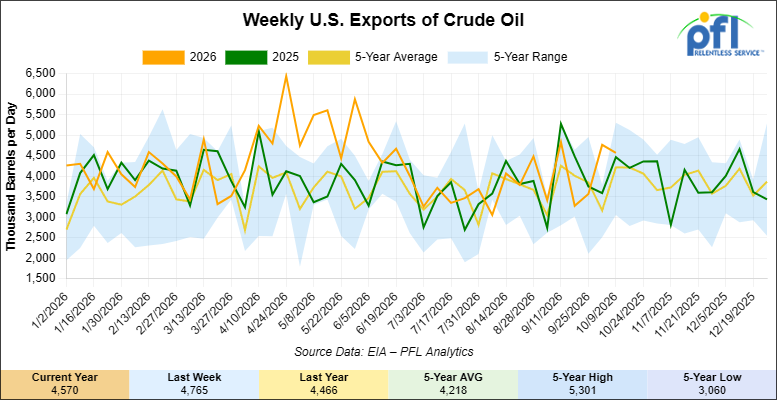
U.S. crude oil exports averaged 4.57 million barrels per day during the week ending October 9, 2026, a decrease of 195,000 barrels per day week-over-week. Over the past four weeks, crude oil exports averaged 4.047 million barrels per day.
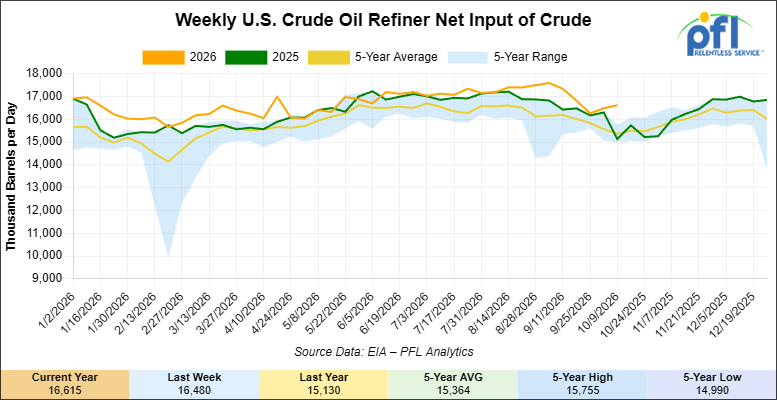
U.S. crude oil refinery inputs averaged 16.6 million barrels per day during the week ending October 9, 2026, which was 135,000 barrels per day more week-over-week.
WTI is poised to open at $98.31, down -$0.71 per barrel from Friday’s close.
North American Rail Traffic
Week Ending October 14, 2026:
Total North American weekly rail volumes were up (+6.79%) in week 42, compared with the same week last year. Total Carloads for the week ending October 14, 2026 were 333,648, up (+2.96%) compared with the same week in 2025, while weekly Intermodal volume was 367,691, up (+10.52%) year over year. 10 of the AAR’s 11 major traffic categories posted year-over-year increases. The only decrease came from Farm Products (-4.70%). The largest increase was Petroleum & Petroleum Products (+10.69%).
In the East, CSX’s total volumes were up (+4.96%), with the largest decrease coming from Nonmetallic Minerals (-5.17%), while the largest increase came from Grain (+15.91%). NS’s total volumes were up (+5.75%), with the largest increase coming from Coal (+17.97%), while the largest decrease came from Grain (-6.54%).
In the West, BNSF’s total volumes were up (+9.42%), with the largest increase coming from Metallic Ores and Metals (+19.62%), while the largest decrease came from Coal (-13.44%). UP’s total volumes were up (+11.05%), with the largest increase coming from Intermodal Units (+19.36%), while the largest decrease came from Farm Products (-13.66%).
In Canada, CN’s total volumes were down (-9.58%), with the largest increase coming from Petroleum & Petroleum Products (+15.75%), while the largest decrease came from Other (-39.48%). CPKCS’s total volumes were up (+7.58%), with the largest increase coming from Other (+33.33%), while the largest decrease came from Motor Vehicles and Parts (-20.73%).
Source Data: AAR – PFL Analytics
North American Rig Count Summary
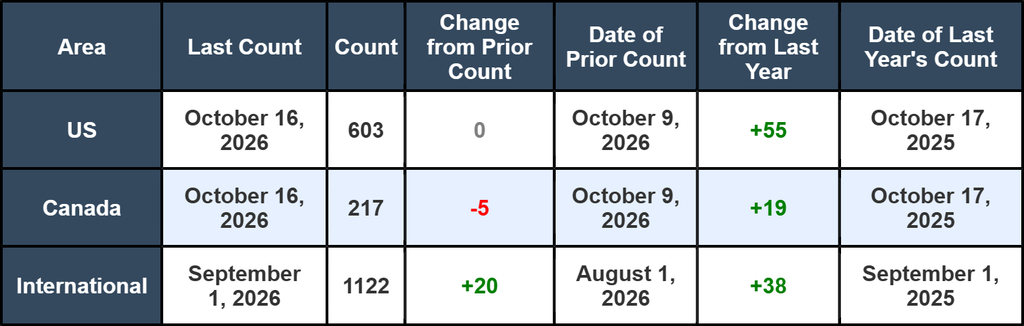
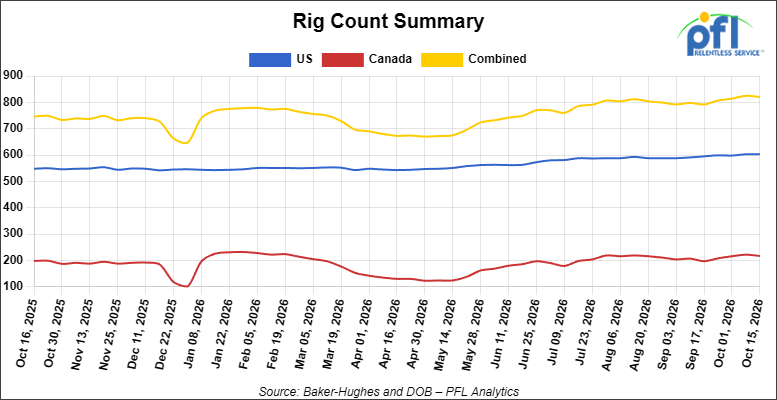
North American rig count was down by -5 rigs week-over-week. The U.S. rig count was unchanged week-over-week, and up by +55 rigs year-over-year. The U.S. currently has 603 active rigs. Canada’s rig count was down by -5 rigs week-over-week, but up by +19 rigs year-over-year. Canada currently has 217 active rigs. Overall, year-over-year we are up by +74 rigs collectively.
We are watching a few things out there for you:
We Are Watching Petroleum Carloads
The four-week rolling average of petroleum carloads carried on the six largest North American railroads rose to 31,163 from 30,447 which was an increase of +716 rail cars week-over-week. Canadian volumes were higher. CPKC’s shipments were higher by +6.0% week-over-week, CN’s volumes were higher by +16.0% week-over-week. U.S. shipments were up across the board. The CSX had the largest percentage increase and was up by +7.0% week-over-week.
We Continue to Watch Our Strategic Petroleum Reserves
The ongoing emergency drawdown of the U.S. Strategic Petroleum Reserve (SPR) remains a major component of global efforts to offset crude oil supply disruptions stemming from the conflict involving Iran and the continued restrictions on oil shipments through the Strait of Hormuz. Since March, the Department of Energy (DOE) has awarded exchanges covering more than 133 million barrels of crude oil, with additional releases expected as part of a broader international response coordinated through the International Energy Agency (IEA).
The United States continues to execute its commitment to make available up to 172 million barrels from the SPR under the IEA’s collective plan to inject roughly 400 million barrels into global energy markets. Officials have argued that the releases are necessary to help stabilize crude supplies and limit further increases in fuel prices as refiners compete for replacement barrels amid ongoing transportation disruptions. The IEA’s coordinated action remains the largest emergency oil-stock release in the agency’s history.
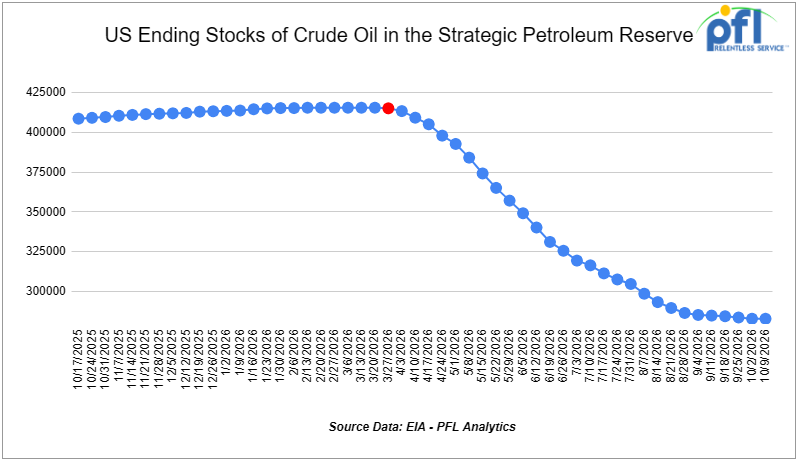
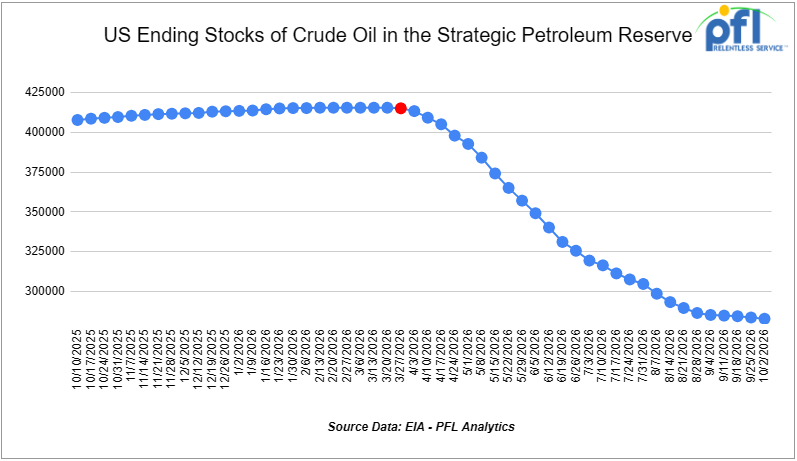
Inventories in the SPR have declined to 282.983 million barrels, down from 415.442 million barrels at the start of the conflict with Iran and reaching their lowest level since October 1982. The SPR showed no change during the week ending October 2nd. Since the first SPR drawdown began, the United States has withdrawn approximately 132.081 million barrels, equivalent to an average of roughly 652,507 barrels per day through the week ending October 9, 2026.
Global petroleum inventories have also tightened considerably. The IEA has reported substantial draws in commercial crude and refined-product stockpiles across major consuming nations, underscoring the strain that the conflict has placed on world energy markets. While oil flows through the Strait of Hormuz have partially recovered from their initial near-shutdown, the IEA continues to identify significant uncertainty surrounding the pace and durability of the recovery.
The Administration continues to emphasize that the current program consists primarily of exchange agreements, rather than outright sales. Under these arrangements, companies receiving crude oil today are required to return the borrowed barrels in the future along with additional volumes as a premium.
We Continue to Watch Canadian Crude by Rail
The differential has done the work. Western Canadian Select at Hardisty as mentioned above closed on Friday of last week at $26.95 below the WTI-CMA (West Texas Intermediate – Calendar Month Average) for November delivery the lowest level since November 2023. The Alberta to U.S. Gulf Coast unit train rate moved up 53 cents to $17.26 a barrel for November, and Enbridge’s Hardisty-to-Houston heavy toll sits at $9.86. At $26 under, a unit train to the Gulf clears our $18 hurdle by roughly $8 a barrel on paper, the widest rail window since the apportionment months of 2023. The latest Canada Energy Regulator export figure is July’s 72,300 barrels per day; August should be out by the 23rd of October and will not yet show any of this.
The constraints are the usual ones and they have not changed: there are not many 117J crude cars available for Canadian heavy, builds run one to two years, lessors and the Class I railroads both want five-year commitments, and Trans Mountain’s January tranche only takes 90,000 barrels per day off the system. Fourth-quarter production at a record 5.15 million barrels per day with both export systems rejecting nominations says the pressure continues. This could be the beginning of another crude by rail cycle if the differential holds through the January Trans Mountain tranche; time will tell, and it is geopolitically dependent.
We Are Watching Delek
Vice President Vance used a campaign stop in Tyler, Texas last Tuesday to announce that the administration will use the Defense Production Act to expand Delek’s 74,000 barrel per day Tyler refinery. No capacity figure, no timeline and no capital number came with it, only “millions of gallons” of commercial and military-spec fuel and “hundreds” of jobs. A White House official said afterward that Tyler is one of “many refineries” the administration is working with, and that the money would most likely come from the $1 billion fund Congress created in last year’s tax and energy law. Delek had not commented as of Friday of last week. The same law was used in March to force the restart of the Sable Offshore pipeline in California, so this is the second time the Act has been pointed at downstream infrastructure this year.
The rail angle is direct. Tyler has no product pipeline out of its local market; by Delek’s own annual report, everything the plant makes leaves by truck or rail. Any incremental distillate, gasoline or LPG from an expansion goes into tank cars or onto East Texas highways, and at current diesel prices the highway option is not the cheap one. Delek Logistics operates the terminal and pipeline assets around the plant.
Refiners hardly need financial encouragement right now. But, what they do need is less punitive regulation! The Gulf Coast 3-2-1 crack averaged a record $71.96 a barrel in the week ended October 8th and U.S. utilization hit 93.5% last week, up nearly eight points year over year. Debottlenecking at the margin is what a $1 billion fund buys; expansions of any size could take years to engineer and permit, and Delek’s last Tyler expansion, 10,000 barrels per day for about $70 million, took the better part of a year back in 2015. We need to see a lot more refining capacity here in the U.S. and we at PFL will be watching this one.
We Continue to Watch Left Wing Carney
Alberta votes today on ten referendum questions, the last of which asks whether the province should start the constitutional process toward a binding vote on separating from Canada. Prime Minister Carney spent Thursday of last week in Calgary urging Albertans to stay, official results come October 29th. Two weeks after standing in Fort McMurray to designate Pacific Link a project of national interest, the Prime Minister is campaigning on a pipeline that will not move a barrel before 2032. Métis leaders in the oil sands region said Tuesday of last week in Fort McMurray that they were never consulted and were not invited to the October 1st announcement, and the Cold Lake First Nations judicial review we flagged last week is still in front of the court.
Meanwhile the barrels are here now. Western Canadian Select at Hardisty finished last week at $26.95 under WTI, the widest discount since November 2023, with fourth-quarter western Canadian production forecast at a record 5.15 million barrels per day and both Enbridge’s Mainline and Trans Mountain recently rejecting nominations. Trans Mountain’s next 90,000 barrels per day of capacity arrives in January, and after that there is nothing until Pacific Link. Producers are not waiting on Ottawa: Cenovus agreed on October 5th to buy Athabasca Oil for C$5.7 billion, its second oil sands takeout in two years, Suncor sold it’s Atlantic Canada offshore interest to Ithaca for C$1.2 billion to refocus on the oil sands, and 65% of executives in ATB Capital Markets’ fall survey expect production to exceed pipeline capacity before 2030. PFL expects it sooner than 2030. Cenovus’s own sensitivity puts a $1 move in the WCS discount at C$80 million of cash flow, and the discount has widened roughly $12 since the third-quarter average, close to a billion dollars of annualized cash flow for one producer.
Industry is applauding the permitting overhaul in Bill C-39 and the immediate write-off in the Productivity Mega Deduction, and Enbridge’s chief executive said the reforms signal that Canada is serious about building again. That is the same Enbridge that spent $600 million on Northern Gateway before the same party in Ottawa killed it in 2016, and the price of the lost decade is being paid at Hardisty every day the discount sits in the twenties. Folks, a referendum on leaving the country is what you get after ten years of telling Alberta to wait; the pipeline announcement came a decade late. We are watching this one but consensus is Alberta will not vote to separate but polls have been wrong before as we all know.
We Continue to Watch Enbridge
The Wisconsin Department of Natural Resources issued Enbridge a formal Notice of Violation last Tuesday covering seven alleged violations on the $1 billion, 41-mile Line 5 reroute through Ashland and Iron counties between March 30th and September 21st: water quality, navigable waterways, wetlands, air, stormwater and endangered resources. The notice takes in the August 25th Saxon leak that put more than 1.3 million gallons of natural gas liquids into the air, the largest pipeline release in Wisconsin history, and the unpermitted bypass Enbridge built around the spill site afterward. The next step is an enforcement conference, after which the DNR can issue citations or refer the file to the Wisconsin Department of Justice.
The notice landed the morning after a second fire. Early last Monday a horizontal directional drill rig and its support equipment were destroyed in Ashland County; Enbridge called it vandalism and reported graffiti at the site, and the September 17th fire on the same project was already in the hands of the FBI and ATF. The September 28th groundwater release at the Marengo River crossing, flowing at 85 to 100 gallons a minute by Earthjustice’s account, remains under DNR investigation, and the Bad River Band has declared a disaster and renewed its call for a shutdown. Two-thirds built against a 2026 in-service target, the reroute now carries an open federal arson investigation, an aquifer breach and a state enforcement file at the same time.
Line 5 moves 540,000 barrels per day of light crude and natural gas liquids from Superior across Michigan to Sarnia, with propane coming off at Rapid River in the Upper Peninsula, and every month the reroute slips is another month the Bad River crossing stays in federal court. Our read is that a Line 5 interruption of any length would land first on propane and NGL supply in the Upper Midwest and Ontario, and the pressure car fleet is the only backstop that exists. Problem is – there are no pressure cars available! Enbridge is separately advancing the 150,000 barrel per day Mainline Optimization Project 1 while the Mainline itself turns away nominations, which is the clearest statement yet of where the capacity actually is. We are watching this one but dont believe as long as Trump is President line 5 isn’t going anywhere.
We Continue to Watch Diesel
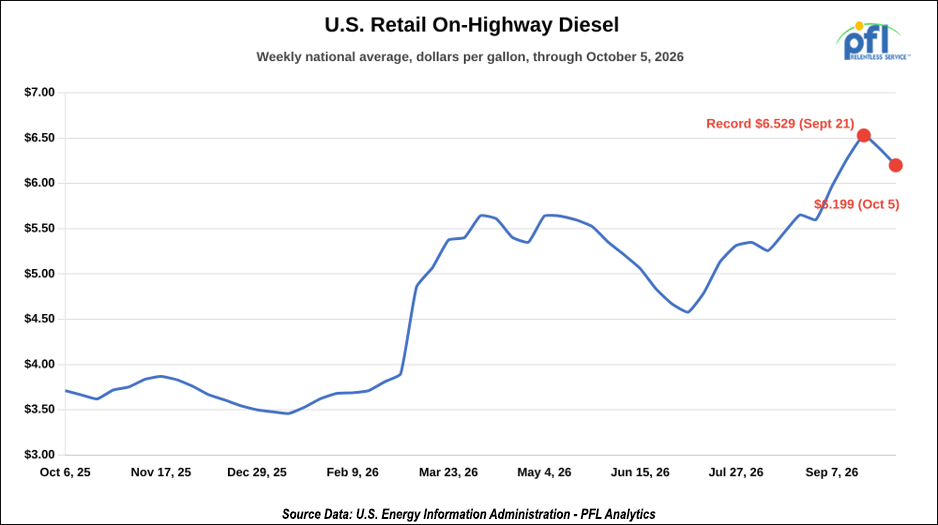
U.S. retail diesel averaged $6.179 a gallon in the week ended October 12th, down 2 cents on the week and 35 cents below the September 21st record of $6.529, but still $2.54 above a year ago. The relief is not coming from inventory. Last Thursday’s EIA report put distillate stocks at 102.6 million barrels, down 2.5 million on the week, 12% below the five-year average and the lowest level for this time of year on record. Atlantic Coast stocks were 32% below the seasonal average in September and EIA expects them to stay 20% to 30% below through the winter; Gulf Coast ULSD was back at $4.87 a gallon on Tuesday of last week, more than double a year ago.
Washington’s answer so far is a Russian diesel deal and a stock release. Russia agreed on October 9th to put 300,000 tonnes of diesel on the market immediately, another 500,000 in November and a million after that; Treasury issued a license good through April 2027, loadings resumed at Primorsk on Wednesday of last week with the first cargo headed to Morocco, and the President clarified on Tuesday of last week that the deal “is not for us.” The IEA said on Thursday of last week that members would accelerate the remainder of the March stock release, including more than 20 million barrels of diesel, with no firm timetable. Russia’s October tranche is less than a day of U.S. diesel consumption; what it can do is free up Gulf Coast barrels now going to Brazil, where the U.S. share of diesel imports jumped to 74% in September from 38% in June after Russia’s export ban.
None of it touches the cause. Two cargo ships were sunk in the Strait of Hormuz on Wednesday and Thursday of last week, more than 20 vessels have been attacked this month, and crude exports through the strait were running 8.5 million barrels per day, about 40% below pre-war. With refiners at 93.5% utilization and Hormuz flows 40% below pre-war, winter distillate inventories depend on exports and the weather, not on anything announced from a podium. The railroads’ own third-quarter review credited diesel, together with trucking’s driver shortage and insurance costs, for a record intermodal quarter, which is the one part of this story the rail industry is enjoying.
We Continue to Watch Rail Car Storage
The industry’s October 1st storage count fell again, to the lowest share of the North American fleet since the spring of 2023 and the fewest cars parked in close to four years, with another several thousand cars pulled out of storage over the month. Tank cars are the laggard: they are stored at a materially higher rate than the fleet as a whole and still account for roughly a third of everything parked in North America. Covered hoppers, by contrast, are coming out of storage faster than the average as harvest demand builds, and intermodal and vehicle flats are effectively fully deployed.
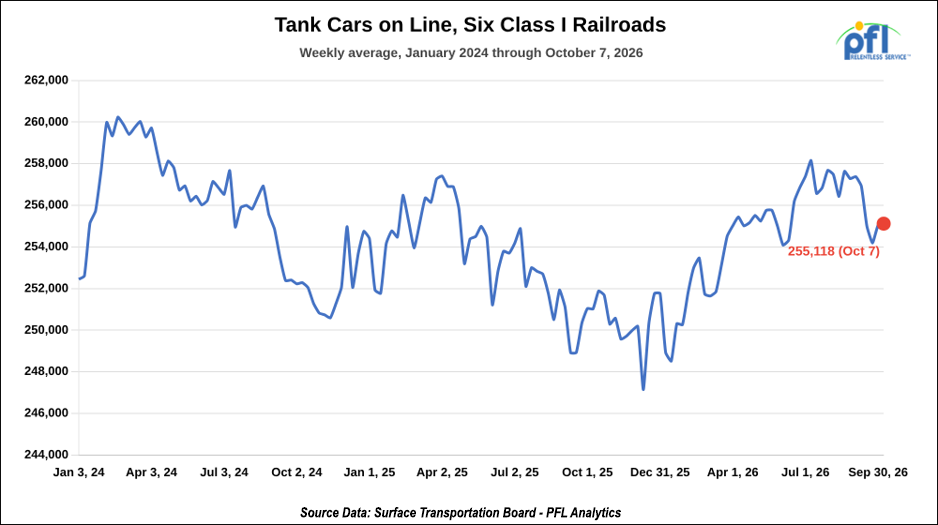
A strong petroleum carload run and a tank fleet stored above the fleet average are not in conflict, because the stored tank fleet is largely the wrong cars: non-jacketed DOT-111s and CPC-1232s that aged out of flammable liquids service, and crude cars idle since 2020. Tank cars on line across the six Class I railroads averaged 255,022 over the four weeks beginning September 12th, down 0.6% on the prior period.
The replacement math has not improved. The BTS fleet report of September 30th counted DOT-117s at 76% of the flammable liquids fleet with about 2,800 cars planned for 2026 against the 4,247 a year needed to meet the December 31st, 2027 cutoff, and the ITC holds its staff conference on UTLX’s antidumping petition against Mexican-built tank cars on Wednesday. If duties land on Mexican-built cars on top of the April Section 232 steel tariff, the 2,800-car build plan gets more expensive, not bigger, and the stored CPC-1232s do not come back into flammable service. Call PFL today if you have an aging fleet and storage costs continue to mount there are options. If you are long 117J’s we do have homes for these cars.
We Continue to Watch the Harvest
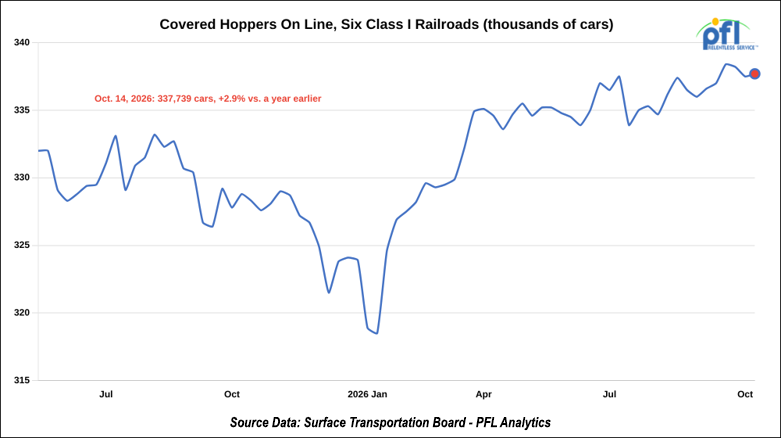
USDA’s crop progress report on Tuesday of last week put corn at 33% harvested as of October 11th against a 39% five-year average, and soybeans at 46% against a 50% five-year average. Iowa corn was only 14% in, Illinois was at 51% for corn and 48% for beans, and conditions held at 56% and 57% good-to-excellent. A dry week helped, but the wet second half of September is still in the numbers. Harvest is running roughly a week behind, which pushes peak covered hopper demand into November and stacks it on top of the unfilled grain car orders we flagged last week. Covered hoppers on line across the six Class I railroads were 337,739 in the week ended October 14th, 2.9% more than a year earlier and within a few hundred cars of the September peak. Grain is already the carload story of the year, with year-to-date volumes at levels not seen in three decades on the strength of exports, and the hoppers are going to be needed in the same six weeks everyone else needs them.
A late, wet crop is also a propane story. Mont Belvieu propane printed a four-year high last week, Houston-to-Chiba VLGC freight hit a five-month high of $345 a tonne, and Mideast Gulf LPG exports to Asia were 3 million barrels in September against 21 million a year earlier, which is why Asian buyers are back in the U.S. Gulf for November. A late corn harvest is the worst combination for Midwest propane: drying demand peaks exactly when export economics are pulling Gulf barrels to Asia.
We Are Watching Mexico
Mexico’s Chamber of Deputies voted last Tuesday to raise the federal duty on rail concessions to 3% of gross revenue from 1.25%, the first change since the 1990s privatizations and a 140% increase in one step. The higher rate applies only to concessions at least 16 years old, which is to say CPKC’s Mexican network and Grupo Mexico’s Ferromex, while the state-run Maya and Tehuantepec lines stay outside the 3% tier. The bill is part of the 2027 revenue package, the Senate has to finish the revenue side of the budget by October 31st, and the new rate takes effect January 1st. CPKC’s own filings describe the 1.25% duty as an operating expense on its Mexican franchise; the government’s position is that the duty is a trivial share of operator costs and will not move freight rates.
The railroads see it differently. The Mexican rail association says the sector has invested $16 billion over 28 years and that security and cargo protection already cost about 3% of revenue, and Grupo Mexico Transportes is lobbying for the same fuel-tax credit trucking receives in exchange, along with a phased, inflation-linked increase instead of 140% overnight. Rail carries 27% of Mexico’s land freight at roughly 4.4 cents a short ton-mile against 4 to 5 cents on a U.S. Class I. Our read is that the cost lands on cross-border shippers one way or another; CPKC did not pay $31 billion for Kansas City Southern to absorb a 1.75-point revenue levy on the Mexican piece of it.
The second Mexican item is regulatory. The energy regulator CNE published rules on Wednesday of last week, effective Thursday, capping permit terms for applications that were still pending when the new hydrocarbons law took effect: marketing permits for refined products, LPG and natural gas are capped at two years, non-pipeline transport at 15 years and storage at 30, and the regulator now has to justify the term it grants in each case. For a tank car shipper moving product or LPG south, a two-year marketing permit is a hard thing to match against a five-year lease. The demand is there: private importers took 101,900 barrels per day of diesel in January through August, up 10%, while Pemex’s own imports fell 8%, and Mexico’s LPG price cap sat at a three-year high last week with delivered propane up 6% in a week.
We Are Watching Key Economic Indicators
Producer Price Index
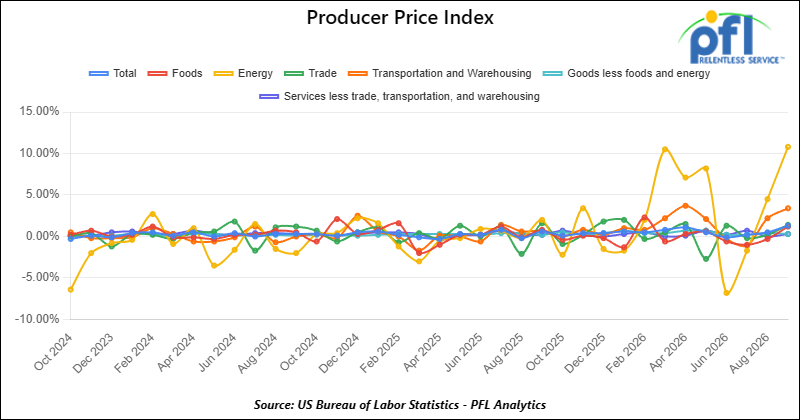
In September 2026, the Producer Price Index (PPI) for final demand increased 1.3% month-over-month, accelerating from a revised 0.5% increase in August, indicating a significant acceleration in producer price pressures. Core PPI (final demand less foods, energy, and trade services) increased 0.5% month over month, up from August’s 0.3% increase, indicating that underlying producer-price pressures also strengthened. The monthly increase was driven primarily by goods, which rose 2.6%, while services increased 0.8%. Within goods, energy prices surged 10.8%, while food prices rose 1.2% and goods less foods and energy increased 0.3%. Within services, trade margins and transportation costs contributed to higher prices, with transportation and warehousing services increasing 3.4%. Overall, the September data showed that rising energy costs drove a sharp increase in headline PPI, while higher prices across services also pointed to broader inflationary pressures. Final demand prices increased 6.3% over the 12 months ended in September, the largest annual increase since December 2022.
In September 2026, the Consumer Price Index (CPI) increased 0.6% month-over-month, accelerating from August’s 0.4% increase, while the index was up 3.7% year-over-year. Core CPI (all items less food and energy) increased 0.3% month-over-month, matching August’s pace, and was up 2.6% year over year. Energy prices were a major contributor to the monthly increase, with gasoline prices rising 9.1% and accounting for more than half of the overall monthly increase. The broader energy index increased 5.2% during the month, while shelter rose 0.4% and remained an important contributor to inflation. Food prices were unchanged overall, with food away from home increasing 0.2% and food at home declining 0.1%. Within core inflation, recreation, used cars and trucks, education, airline fares, medical care, and apparel increased, while communication prices declined. The September report showed renewed acceleration in headline inflation, driven largely by energy costs, while core inflation remained elevated, suggesting that broader price pressures persist alongside the renewed increase in fuel prices.
Industrial Output and Capacity Utilization
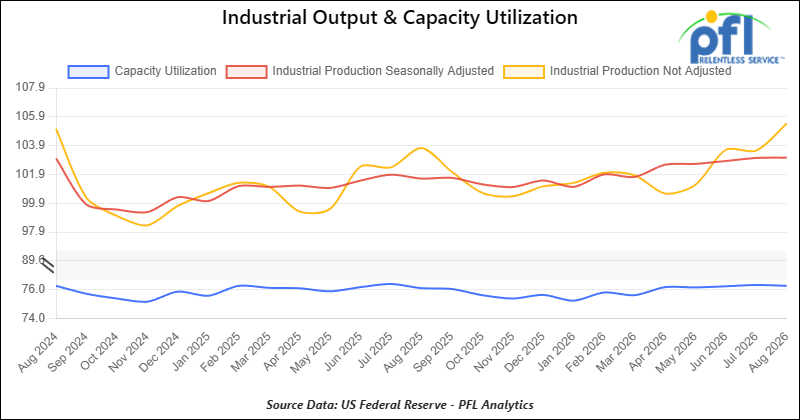
Manufacturing accounts for approximately 75% of total output. Industrial output in August increased 0.02% from July 2026.
Capacity utilization is a measure of how fully firms are using machinery and equipment. Capacity utilization in August decreased 0.08% from July 2026.
Lease Bids
- 300, 5200CF Covered Hoppers located off of CPKCS or CN in Canada. For use in Petcoke service. Period: 3 Year.
- 10-20, 3200 or 3281 Covered Hoppers located off of CN or CPKCS in Canada. For use in Sodium Sulphate service. Period: 3-5 years. Lined.
- 50-100, 29K 117, DOT 111, or CPC 1232 Tank located off of UP or BNSF in Minnesota, Kansas, or Oklahoma. For use in Fuel Oil service. Period: 6 Months. Nov-April.
Sales Bids
- 28, 3400CF Covered Hoppers located off of UP or BNSF in Texas. For use in Cement service. Cement Gates needed.
- 20, 17K DOT111 Tanks located off of various class 1s in various locations. For use in corn syrup service.
- 12, 21.5K-25K DOT 111 Tanks located off of various class 1s in Michigan. For use in Diesel, Asphalt, Crude service. Coiled and Insulated.
Lease Offers
- 15, 6200CF Covered Hoppers located off of all class 1s in Wisconsin. Last used in plastic. Cars are currently clean.
- 30, 6500CF Covered Hoppers located off of all class 1s in Wisconsin. Last used in plastic. Cars are currently clean.
- 50, 30K DOT117J Tanks located off of UP or BNSF in the South. Last used in ethanol.
- 93, 31.8K CPC 1232 Tanks located off of Various Class 1s in Texas. Last used in Diesel. Cars are currently clean.
- 30, 25.5K DOT 117J Tank located off of BNSF and UP in Texas. Last used in Benzene. NO BOV, NO LINER.
- 21, 20K DOT 111 Tank located off of BNSF and UP in Texas. Cars are currently clean. Cars are currently clean. C/I, NO Liner.
- 1000, 31.8K CPC 1232 Tank located off of BNSF and UP in Texas. Last used in Diesel.
Sales Offers
- 81, 31.8K CPC1232 Tanks located off of UP or BNSF in TX. Last used in Multiple Services. Requal Due in 2025.
- 15, 5750 CF Hopper located off of CSX, NS, CPKCS, CN, BNSF, UP in St Louis. Last used in Grain.
- 50, 30 DOT 111 Tank located off of multiple class 1s in multiple location. Last used in Fuels.
Call PFL today to discuss your needs and our availability and market reach. Whether you are looking to lease cars, lease out cars, buy cars, or sell cars call PFL today at 239-390-2885
Railcar for Sale or Lease
| CAT | Type | Capacity | GRL | QTY | LOC | Class | Prev. Use | Offer | Note |
|---|
| CAT | Type | Size | GRL | QTY | LOC | Class | Term | Commodity | Offer | Note |
|---|
| CAT | Type | Capacity | GRL | QTY | LOC | Class | Prev. Use | Clean | Offer | Note |
|---|
| CAT | Type | Capacity | GRL | QTY | LOC | Class | Commodity | Offer | Note |
|---|
PFL will be at the Following Conferences

- Where: The Westin Galleria Dallas
- Attending: David Cohen (954-729-4774), and Curtis Chandler (239-405-3365)
- Conference Website

- Where: The Westin Galleria Dallas
- Attending: Brian Baker (239.297.4519)
- Conference Website
The post PFL Railcar Report 10-19-2026 appeared first on PFL Petroleum Services LTD.
]]>The post PFL Railcar Report 10-12-2026 appeared first on PFL Petroleum Services LTD.
]]>Jobs Update
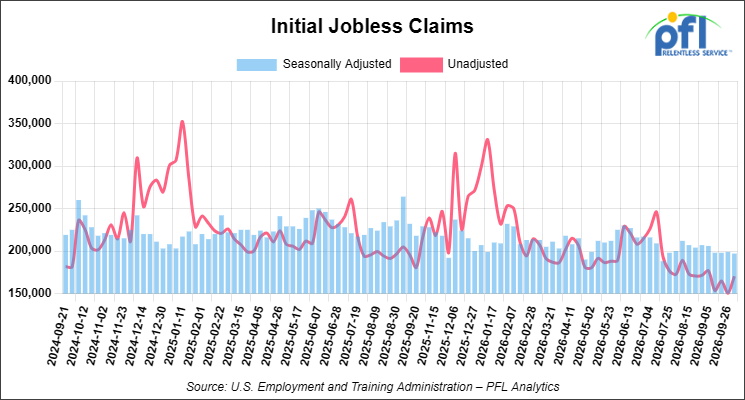
Initial jobless claims seasonally adjusted for the week ending October 3, 2026 came in at 197,000, versus the adjusted number of 199,000 people from the week prior, down 2,000 people week-over-week.
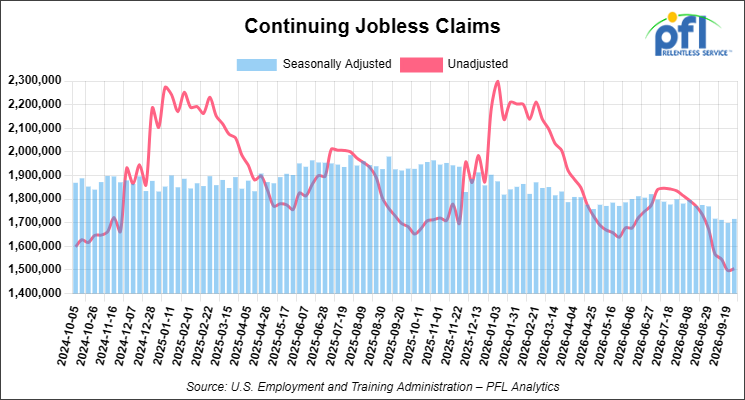
Continuing jobless claims came in at 1,716,000, versus the adjusted number of 1,699,000 people from the week prior, up 17,000 people week-over-week.
Stocks closed higher on Friday of last week and higher week-over-week
The DOW closed higher on Friday of last week, up 423.31 points (0.83%), closing out the week at 51,654.95, up 477.99 points week-over-week. The S&P 500 closed higher on Friday of last week, up 46.18 points (0.53%), and closed out the week at 7,811.54, up 88.82 points week-over-week. The NASDAQ closed higher on Friday of last week, up 172.83 points (0.64%), and closed out the week at 27,366.17, up 175.31 points week-over-week.
In overnight trading, DOW futures traded higher and are expected to open at 51,976 this morning, up 50 points from Friday’s close.
Crude oil closed higher on Friday of last week and higher week-over-week
West Texas Intermediate (WTI) crude closed up $0.36 per barrel (0.39%), to close at $91.85 on Friday of last week, and up $0.74 per barrel week-over-week. Brent crude closed up $0.44 per barrel (0.42%), to close at $104.72, and up $2.47 per barrel week-over-week.
One Exchange WCS (Western Canadian Select) for November delivery settled on Friday of last week at US$25.15 below the WTI-CMA (West Texas Intermediate – Calendar Month Average). The implied value was US$65.31 per barrel.
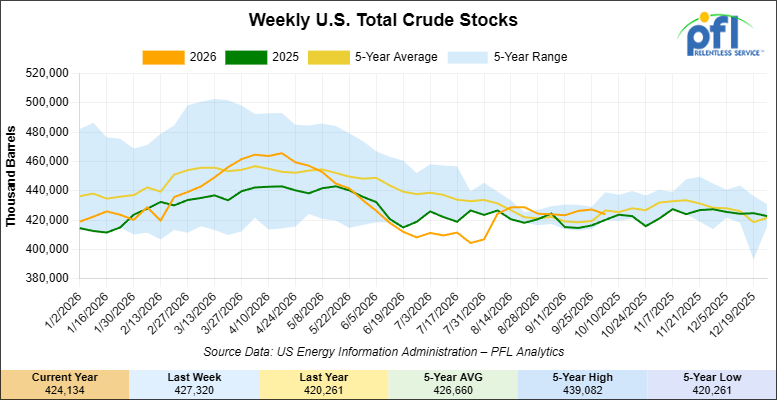
U.S. commercial crude oil inventories (excluding those in the Strategic Petroleum Reserve) decreased by 3.2 million barrels week-over-week. At 424.1 million barrels, U.S. crude oil inventories are 1% below the five-year average for this time of year.
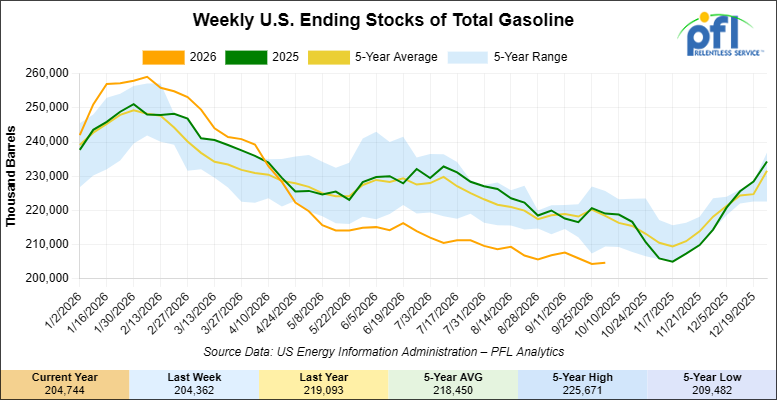
Total motor gasoline inventories increased by 382,000 barrels week-over-week. and are 6% below the five-year average for this time of year.
Distillate fuel inventories decreased by 42,000 barrels week-over-week. and are 11% below the five-year average for this time of year.
Propane/propylene inventories decreased by 1.8 million barrels week-over-week. and are 17% above the five-year average for this time of year.
Propane prices closed at 90.2 cents per gallon on Friday of last week, up 2.4 cents per gallon week-over-week, and up 22.5 cents year-over-year.
Overall, total commercial petroleum inventories decreased by 6.9 million barrels week-over-week during the week ending October 2, 2026.
U.S. crude oil imports averaged 6.8 million barrels per day during the week ending October 2, 2026, an increase of 1,142,000 barrels per day week-over-week. Total motor gasoline imports (including both finished gasoline and gasoline blending components) averaged 512,000 barrels per day, and distillate fuel imports averaged 118,000 barrels per day during the week ending October 2, 2026.
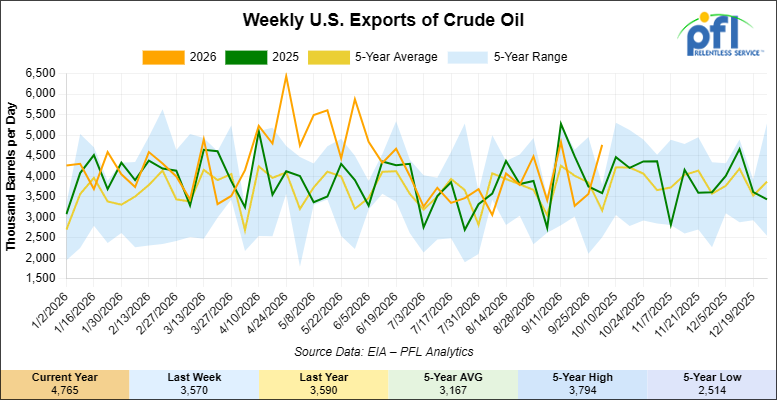
U.S. crude oil exports averaged 4.765 million barrels per day during the week ending October 2, 2026, an increase of 1.195 million barrels per day week-over-week. Over the past four weeks, crude oil exports averaged 4.112 million barrels per day.
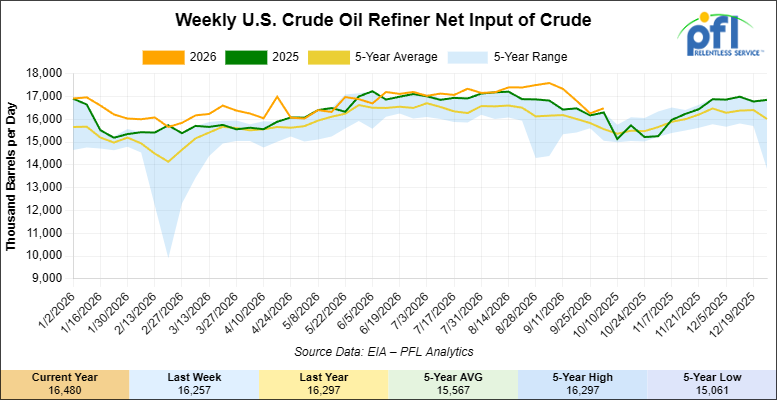
U.S. crude oil refinery inputs averaged 16.5 million barrels per day during the week ending October 2, 2026, which was 223,000 barrels per day more week-over-week.
WTI is poised to open at $92.64, up $0.79 per barrel from Friday’s close.
North American Rail Traffic
Week Ending October 7, 2026:
Total North American weekly rail volumes were up (+5.44%) in week 41, compared with the same week last year. Total Carloads for the week ending October 7, 2026 were 334,153, up (+3.56%) compared with the same week in 2025, while weekly Intermodal volume was 365,520, up (+7.21%) year over year. 9 of the AAR’s 11 major traffic categories posted year-over-year increases. The largest decrease came from Farm Products (-5.69%). The largest increase was Metallic Ores and Metals (+14.16%).
In the East, CSX’s total volumes were up (+2.04%), with the largest decrease coming from Farm Products (-9.89%), while the largest increase came from Metallic Ores and Metals (+19.21%). NS’s total volumes were up (+6.74%), with the largest increase coming from Coal (+32.53%), while the largest decrease came from Grain (-31.51%).
In the West, BNSF’s total volumes were up (+5.59%), with the largest increase coming from Metallic Ores and Metals (+18.63%), while the largest decrease came from Coal (-18.15%). UP’s total volumes were up (+10.74%), with the largest increase coming from Petroleum & Petroleum Products (+19.29%), while the largest decrease came from Other (-10.99%).
In Canada, CN’s total volumes were down (-4.35%), with the largest increase coming from Other (+28.55%), while the largest decrease came from Coal (-18.15%). CPKCS’s total volumes were up (+0.14%), with the largest increase coming from Metallic Ores and Metals (+47.95%), while the largest decrease came from Motor Vehicles and Parts (-29.25%).
Source Data: AAR – PFL Analytics
North American Rig Count Summary
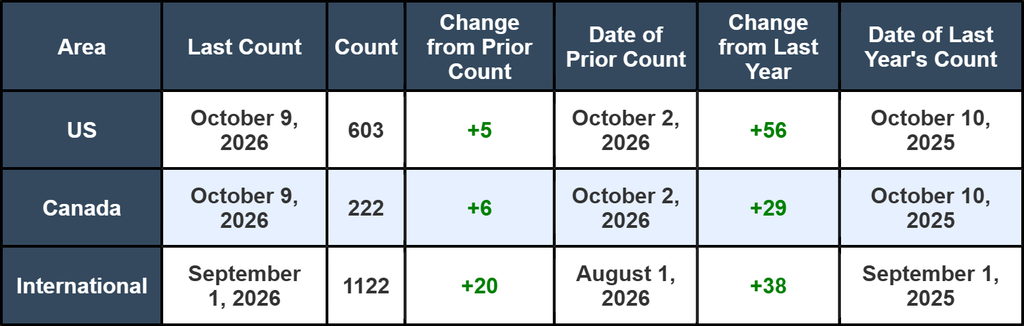
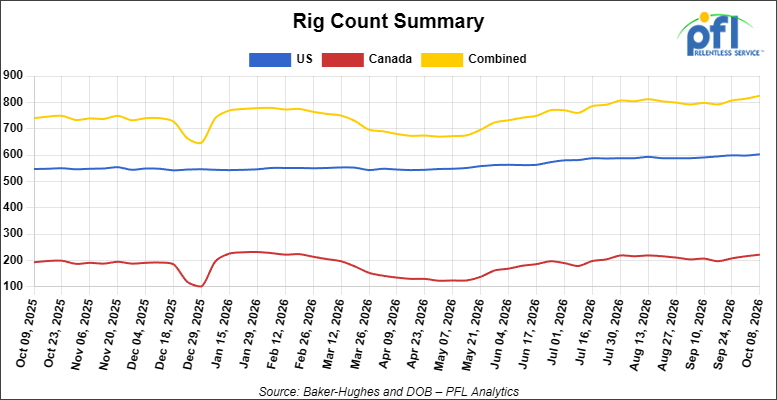
North American rig count was up by +11 rigs week-over-week. The U.S. rig count was up by +5 rigs week-over-week, and up by +56 rigs year-over-year. The U.S. currently has 603 active rigs. Canada’s rig count was up by +6 rigs week-over-week and up by +29 rigs year-over-year. Canada currently has 222 active rigs. Overall, year-over-year we are up by +85 rigs collectively.
We are watching a few things out there for you:
We Are Watching UTLX
UTLX Manufacturing, the Berkshire Hathaway unit that builds tank cars at Alexandria, Louisiana, filed antidumping and countervailing duty petitions on September 30 against tank cars and parts built in Mexico, and last Monday the U.S. International Trade Commission opened its preliminary investigation. Trinity and Greenbrier, the only two importers named, both said last Monday they will fight it at every stage. The petition alleges dumping margins of 12.70% to 32.58%, plus Mexican subsidies that UTLX has not yet put a number on. Readers will recall we covered the 25% Section 232 tariff on imported tank cars in April, which UTLX also asked for and got. Any new duties would be collected in addition to that tariff.
The scope is broad: pressure and general purpose cars, finished or unfinished, plus tank and underframe assemblies. Stainless DOT-111s, DOT-105 and DOT-112 cars rated at 499 psig or higher, and DOT-113 cryogenic cars are carved out. Mexican-built cars have historically crossed the border as instruments of international traffic and never showed up in the customs data, so UTLX counted them from Umler build records instead. By that count 4,531 Mexican-built tank cars entered the U.S. in 2024 and 3,302 in 2025, a 27% drop that Trinity and Greenbrier are sure to put in front of the Commission. The petition names Greenbrier’s plants at Tetla, Frontera and Sahagun and Trinity’s Coahuila operations, which Trinity dates to 1998 at Monclova. Both builders made a point of saying they ship U.S. steel south to build these cars. That is not just public relations: under the April order a derivative product made from U.S.-melted steel is tariffed at 10%, not 25%. Whether these cars actually qualify is something neither builder has said.
The calendar moves fast. Commerce decides whether to initiate by about October 20th, the Commission holds its staff conference on October 21st, and its preliminary injury vote is due on November 16th. If that vote is affirmative, trade counsel peg Commerce’s preliminary countervailing determination at December 24th and the preliminary antidumping determination at March 9, 2027, with final orders in the spring and summer. Cash deposits can be required from the preliminary determinations, which could put cars delivered early in 2027 inside the duty window. These dates routinely get extended, and UTLX’s own counsel is talking about final determinations near the end of 2027.
Trinity says it has built more than 73,000 tank cars in the U.S. over the past 15 years and Greenbrier points to its Marmaduke, Arkansas plant, but UTLX’s Neil Finn has put roughly 75% of his competitors’ tank car production in Mexico. The fleet is not growing into this. Tank cars on line at the six Class I railroads averaged 254,835 over the four weeks ended October 7, down 1.0% from the prior four weeks. Only 2,137 new DOT-117s were slated to be built in all of 2026. Trinity reports third quarter results on October 29th.
We Are Watching Petroleum Carloads
The four-week rolling average of petroleum carloads carried on the six largest North American railroads rose to 30,447 from 30,273 which was a increase of +174 rail cars week-over-week. Canadian volumes were mixed. CPKC’s shipments were higher by +3.0% week-over-week, CN’s volumes were lower by -12.0% week-over-week. U.S. shipments were also mixed. The BNSF had the largest percentage increase and was up by +9.0% week-over-week. The NS had the largest percentage decrease and was down by -13.0%
We Continue to Watch Our Strategic Petroleum Reserves
The ongoing emergency drawdown of the U.S. Strategic Petroleum Reserve (SPR) remains a major component of global efforts to offset crude oil supply disruptions stemming from the conflict involving Iran and the continued restrictions on oil shipments through the Strait of Hormuz. Since March, the Department of Energy (DOE) has awarded exchanges covering more than 133 million barrels of crude oil, with additional releases expected as part of a broader international response coordinated through the International Energy Agency (IEA).
The United States continues to execute its commitment to make available up to 172 million barrels from the SPR under the IEA’s collective plan to inject roughly 400 million barrels into global energy markets. Officials have argued that the releases are necessary to help stabilize crude supplies and limit further increases in fuel prices as refiners compete for replacement barrels amid ongoing transportation disruptions. The IEA’s coordinated action remains the largest emergency oil-stock release in the agency’s history.
Inventories in the SPR have declined to 282.983 million barrels, down from 415.442 million barrels at the start of the conflict with Iran and reaching their lowest level since October 1982. The SPR declined by a mere 784 thousand barrels during the week ending October 2nd. Since the first SPR drawdown began, the United States has withdrawn approximately 132.459 million barrels, equivalent to an average of roughly 675,811 barrels per day through the week ending October 2, 2026.
Global petroleum inventories have also tightened considerably. The IEA has reported substantial draws in commercial crude and refined-product stockpiles across major consuming nations, underscoring the strain that the conflict has placed on world energy markets. While oil flows through the Strait of Hormuz have partially recovered from their initial near-shutdown, the IEA continues to identify significant uncertainty surrounding the pace and durability of the recovery.
The Administration continues to emphasize that the current program consists primarily of exchange agreements, rather than outright sales. Under these arrangements, companies receiving crude oil today are required to return the borrowed barrels in the future along with additional volumes as a premium. DOE has stated that its exchange structure is designed to return the borrowed crude with additional premium barrels, with the stated objective of strengthening the SPR over time.
We Are Watching Isaias
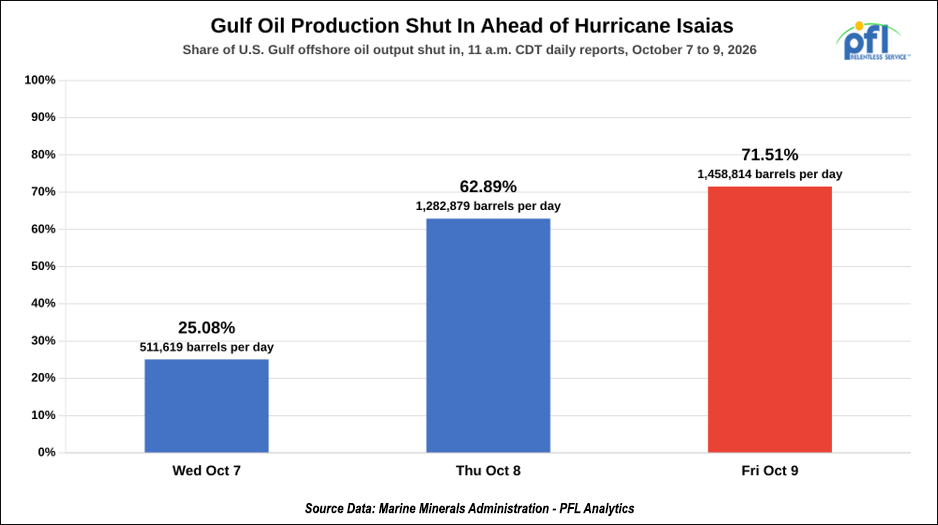
Isaias, the first hurricane of the 2026 Atlantic season, reached Category 3 with 120 mph winds last Friday and made landfall along Alabama’s coast at 8:30 central time as a category 2 hurricane knocking out power for 800,000 people. Offshore operators had shut in 1,458,814 barrels per day of oil, or 71.51% of Gulf output, and 58.84% of natural gas production on Friday of last week with 129 of 371 platforms evacuated. Ivan shut in 77.6% in 2004. Sally, which came ashore at Gulf Shores in 2020, shut in 26.9%.
CSX told customers last Thursday that it was pulling railcars out of low-lying areas, staging generators and lining up alternative routings along its Gulf Coast line. The Coast Guard set Condition Zulu at 2 a.m. Friday for Mobile, Pascagoula, Gulfport, Pensacola and Panama City, and the Port of Mobile closed to vessels and suspended cargo handling with no reopening date. Forecast surge was six to nine feet from the Alabama line east to Grayton Beach and three to five feet in Mobile Bay, with four to eight inches of rain and river flooding expected across southern Alabama as the storm moved inland over the weekend. Katrina took this same CSX line out for about five months in 2005, with more than 40 miles of track and six major bridges rebuilt at a cost above $250 million. Isaias came in well east of where Katrina did its damage, but nobody will know what the railroad looks like until inspectors can get out on it.
The track spared the big southeast Louisiana refining complex. Two plants sat squarely in the path: Chevron’s 356,000 barrel per day Pascagoula refinery and Vertex’s 88,000 barrel per day Mobile plant, where power loss is the main threat and a restart can take up to two weeks even without damage. Gulf Coast diesel was already up 25 cents per gallon on the week to $4.74 before landfall, and Mars sour traded as high as $3 per barrel over WTI on the offshore shut-ins. Shippers with tank cars billed to or through Mobile, Pascagoula or Pensacola should plan on embargoes, holds and out-of-route miles for at least the next week. PFL works with shippers on diversions, storage and replacement cars when a corridor goes down, and our phones are on.
We Continue to Watch Left Wing Carney
Prime Minister Mark Carney’s national interest designation for the Pacific Link pipeline, which we covered last week, lasted seven days before the first lawsuit landed. Cold Lake First Nations filed for judicial review in Federal Court last Thursday, asking the court to quash the October 1 designation and declare that Canada owes it consultation. The Assembly of First Nations says Ottawa made its decision only 12 days after the consultation deadline, and Chief Kelsey Jacko says more than 120 nations were consulted while his was left out. “All the oil comes from my traditional territories,” Jacko said. The Union of British Columbia Indian Chiefs has already promised a fight “in the court rooms, and if necessary, with boots on the ground.”
Cold Lake is not a random plaintiff. It sits on top of the storage site for the Pathways carbon capture project, which Ottawa’s own agreement with Alberta described as “mutually dependent” with the pipeline. Pathways has since been cut to six million tonnes per year in its first phase with a start somewhere between 2032 and 2035. Asked about the suit, the Privy Council Office said last week that these are “two distinct projects” and that consulting on Pathways “rests with the provincial authorities.” Ottawa tied the pipeline to the carbon project when it needed a climate fig leaf and is untying them now that somebody has to consult on it.
Arithmetic is worse than the politics. An ATB Cormark survey released last Friday found 77% of energy executives and investors expect Pacific Link to reach a positive investment decision, but 53% do not see construction before 2028, a year behind Mr. Carney’s September 2027 target. The same survey found 96% of producers plan to grow in 2027, with oil producers targeting about 10%. On a western Canadian base of roughly five million barrels per day, that is about 500,000 barrels per day of new supply in one year. Alberta’s own filing puts Pacific Link’s investment decision between December 2027 and late 2029 and completion between 2032 and 2034, with no committed shipper. Half of the one million barrels per day Pacific Link is supposed to carry could be spoken for by 2027 growth alone, five to seven years before the line moves a barrel. Western Canadian Select closed last Friday at $25.55 per barrel under WTI, the widest since November 2023.
Pacific Link has no shipper, no investment decision and its first lawsuit inside of a week: in our opinion Alberta’s producers should not hold their breath!
We Continue to Watch the Merger
Shintech, the largest PVC producer in the U.S., has broken with the chemical trade associations and told the Surface Transportation Board in a letter that surfaced last week that it supports Union Pacific’s acquisition of Norfolk Southern. “As a solely served customer, Union Pacific transports 100% of our rail traffic from each of our three production locations,” president Y. Saitoh wrote of the Plaquemine, Addis and Freeport plants. UP marketing chief Kenny Rocker followed last Tuesday with a customer letter titled “Silence Is Not Opposition,” claiming support letters from customers representing more than 30% of UP’s volume. “We move plastic from the chemical plant, not the American Chemistry Council,” he wrote. More than 500 of UP’s 10,000 customers are on the record in support, which leaves roughly 95% who have said nothing either way. Alliance for Chemical Distribution chief Eric Byer offered a reason for the quiet: “the fear of retaliation is real and small businesses won’t speak up.” UP’s answer: “We do not retaliate.”
Labor moved the other way. The International Brotherhood of Electrical Workers, with more than 10,000 rail members, came out against the deal last Tuesday, saying “Union Pacific declined to make meaningful commitments on virtually every significant issue.” The opposing unions say they already represented 26,402 of the two railroads’ 39,828 union employees, or 66%, before the electrical workers joined them. None of it dented chief executive Jim Vena, who told Fox Business the same day that he is “99.99%” confident of approval.
Two numbers from last Thursday say more about where shippers stand than any letter count. The Board found UP revenue adequate for 2025 with a 17.09% return on investment against a 9.79% industry cost of capital, the highest of the Class Is and well ahead of CSX at 11.4%, BNSF at 10.91% and Norfolk Southern at 10.29%. TD Cowen’s third quarter survey has rail shippers expecting 4.4% rate increases over the next six to twelve months, up 70 basis points and the biggest jump since 2021. That is before a single interchange disappears. Comments, protests, requests for conditions and responsive applications are due at the Board on November 18. Captive tank car shippers who want conditions have five weeks to get them in writing, because in Omaha quiet is being counted as consent!
We Continue to Watch Diesel
The U.S. average retail diesel price fell 18.3 cents to $6.199 per gallon for the week of October 5th, the second straight decline from the $6.529 record set September 21st, but still up $2.49 per gallon year over year. The relief may already be over. New York Harbor diesel futures jumped 5% last Thursday of last week to $4.85 per gallon. Distillate inventories were essentially unchanged at 105.1 million barrels in the week ended October 2, 12% below the five-year average, with refineries running at 92.7%.
Hormuz is the reason. At least 12 tankers were attacked between September 28 and October 5, the most in any week of the war, and on Tuesday of last week only seven tankers made the transit, the fewest since July 23rd. Brent settled last Thursday of last week at $104.28 and WTI at $91.49. The Energy Information Administration raised its fourth quarter Brent forecast by $14 to $105 on Tuesday of last week and now expects East Coast distillate stocks to run 20% to 30% below average all winter. Add Isaias there is no room for a miss.
Washington keeps reaching for small levers. An executive order last Monday allows red-dyed diesel to be used on the highway through year-end with the 24.4 cent federal tax deferred, and the Environmental Protection Agency waived Texas down to 500 ppm sulfur diesel through October 24. None of it shows up in rail fuel surcharges, which lag the pump. Union Pacific’s mileage-based fuel surcharge steps up from 68 cents per mile in October to 84 cents in November. The Class I average was 59 cents per mile in October, up 40 cents from a year ago, and the Department of Agriculture expects November to pass the record 61 cents set in July. Please budget your freight on the surcharge table, not on the retail headline. It is very easy to lose money in this environment and we do not want to see any PFL customer to do so – call PFL to trouble shoot.
We Are Watching the Harvest
We flagged Iowa’s slow start last week and it has not caught up. Corn was 23% harvested nationally as of October 4 against a five-year average of 27%, and soybeans were 25% against 33%. Iowa had 7% of its corn and 5% of its soybeans in the bin, against five-year averages of 20% and 38%. Nebraska soybeans were at 9% versus 34% and Minnesota at 25% versus 51%. Illinois, which stayed dry, is ahead of pace on both crops.
The rail numbers are split the same way. Grain carloads for the week ended September 26th were 29,862, up 13% from last year and 22% above the three-year average, and CN posted a third quarter record of 7.94 million tonnes out of Western Canada. Shuttle premiums went the other direction: October bids fell $350 in a week to $350 per car above tariff, with BNSF at $575 and UP at $125. Unfilled manifest grain car orders stood at 2,200, nearly three times last year’s average of 783, almost all of it on CPKC and BNSF. Dwell is worse than a year ago on CSX, NS, BNSF and UP, and the St. Louis barge rate of $28.85 per ton is 53% above last year. A late western Corn Belt harvest is going to land on that network all at once.
Wet corn has to be dried, and that is a pressure car story. One Iowa grower told Brownfield he expects to spend 15 to 18 cents per bushel on drying, and in Alberta and Saskatchewan the harvest was only 40% to 50% complete in late September against a typical 70%. U.S. propane and propylene stocks fell 1.8 million barrels to 107.8 million in the week ended October 2. Mont Belvieu propane traded as high as $1.01 per gallon last Friday, the highest since September 2022, after Iran claimed a strike on an LPG carrier in the Strait of Hormuz. Pressurized cars are quoted at $1,200 per month on one to five year terms. PFL has been taking calls from propane shippers looking for pressure cars for crop drying and winter fill. The time to ask was August, but call us anyway, as we have been able to get a couple of deals done here and there it is all about timing!
We Continue to Watch Crude by Rail
Western Canadian Select at Hardisty closed last Friday at $25.15 per barrel under WTI, up from $24.65 a week earlier, the widest since November 2023 and more than $7 through the $18 level where unit trains to the Gulf Coast start to work. The export pipelines are essentially full and record tanker freight has made re-exports off the Gulf Coast cost-prohibitive. The unit train rate from Alberta to the Gulf Coast for November is $17.26 per barrel, up 53 cents on the week.
Tidewater is not providing the relief it did a year ago. Heavy crude off Trans Mountain at Vancouver for December fell $4.55 on the week to $13.40 under WTI, the weakest since that market began trading in 2024, and an Aframax from Vancouver to China cost a record $14 million, or nearly $26 per barrel. The most recent federal data show crude by rail exports of 72,298 barrels per day in July, down 11% from June and 18% below May. August had not been posted as of last Friday.
The barrels are coming. Cenovus agreed last Monday to buy Athabasca Oil for $5.7 billion with plans to take Leismer and Corner to 115,000 barrels per day by 2032, and nearly every producer surveyed by ATB Cormark plans to grow next year. The cars are another matter. There are not many DOT-117J crude cars sitting idle, new ones take one to two years to build and now carry the duty question raised in our lead story, and leasing companies and car owners want five-year commitments, as do the Class Is. DOT-117s are quoted at $1,025 per month on one to five year terms. It seems to us at PFL that this could be the beginning of another crude by rail cycle if trends continue. Time will tell and it is geopolitical dependent. Raw bitumen moving non-haz in coiled and insulated cars remains competitive with pipeline tolls for stranded barrels, and PFL’s customers who locked up cars early are the ones with options now.
We Continue to Watch Enbridge
Enbridge notified Wisconsin regulators of a groundwater release at its Line 5 reroute after pulling pipe beneath the Marengo River. The Bad River Band’s attorney put the flow at 85 to 100 gallons per minute. The Wisconsin Department of Natural Resources said Tuesday of last week that it does not yet know whether an aquifer was breached and that the flow is about 5% of the rate seen in confirmed breaches on similar projects. Monitoring wells are going in, and Enbridge says the water “continues to be monitored and contained.” Tribal chairwoman Elizabeth Arbuckle has asked Governor Tony Evers and the department to revoke the reroute permits.
This is the same project where the largest pipeline release in Wisconsin history, four non-compliance notices and a federal investigation into work site fires have all landed since August, as we have covered. Enbridge’s experts testified last fall that the aquifer risk was zero, and Enbridge paid millions over four breaches on its Line 3 replacement in Minnesota. The 41-mile, $1 billion reroute is roughly two-thirds built and it is the only thing standing between Line 5 and a court order to get off the Bad River reservation. Line 5 moves up to 23 million gallons per day of light crude and natural gas liquids from Superior to Sarnia and is a main source of propane for Michigan and Ontario. PFL has been watching this one for years. Stay tuned to PFL for further updates.
We Are Watching Key Economic Indicators
Purchasing Managers Index (PMI)
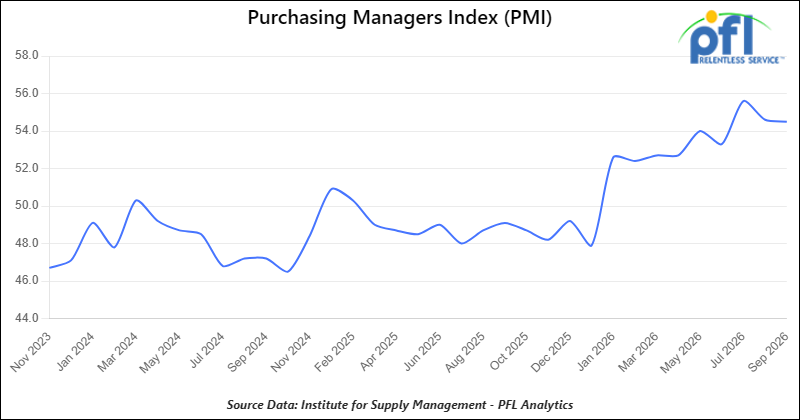
The Institute for Supply Management (ISM) releases two PMI reports each month—one covering manufacturing and the other covering services. These reports are based on surveys of supply managers across the country and measure changes in business activity. A reading above 50% indicates expansion, while a reading below 50% signals contraction, with the pace of change increasing as the index moves farther from 50.
The Manufacturing PMI registered 54.5% in September 2026, down slightly from 54.6% in August, but still marking the ninth consecutive month of expansion. Manufacturing activity remained solidly in expansion territory, with the New Orders Index rising to 55.3% from 53.7% in August, indicating continued growth in demand. Production remained strong at 56.7%, although it moderated from August’s 58.3%. Price pressures increased significantly, with the Prices Index rising to 77.9%, highlighting continued inflationary pressure from higher input costs.
The Services PMI registered 54.9% in September 2026, down from 55.4% in August, but marking the 27th consecutive month of expansion. Business activity and new orders continued to grow, with the Business Activity Index registering 56.5% and the New Orders Index reaching 59.8%. Employment returned to expansion territory at 50.1%, improving from 47.8% in August. However, the Prices Index increased to 74.0%, its highest level since July 2022, highlighting renewed and significant inflationary and operating cost pressures. Overall, the report indicates that the U.S. services sector continues to expand, although growth moderated slightly while price pressures intensified.
Consumer Confidence
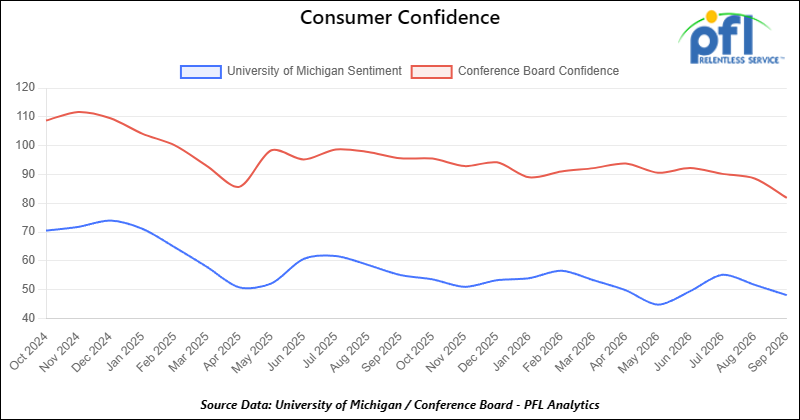
The Index of Consumer Sentiment from the University of Michigan decreased from 51.7 in August to 48.1 in September.
The Conference Board Consumer Confidence Index decreased from 88.6 in August to 81.9 in September.
Lease Bids
- 300, 5200CF Covered Hoppers located off of CPKCS or CN in Canada. For use in Petcoke service. Period: 3 Year.
- 10-20, 3200 or 3281 Covered Hoppers located off of CN or CPKCS in Canada. For use in Sodium Sulphate service. Period: 3-5 years. Lined.
Sales Bids
- 28, 3400CF Covered Hoppers located off of UP or BNSF in Texas. For use in Cement service. Cement Gates needed.
- 20, 17K DOT111 Tanks located off of various class 1s in various locations. For use in corn syrup service.
- 12, 21.5K-25K DOT 111 Tanks located off of various class 1s in Michigan. For use in Diesel, Asphalt, Crude service. Coiled and Insulated.
Lease Offers
- 15, 6200CF Covered Hoppers located off of all class 1s in Wisconsin. Last used in plastic. Cars are currently clean.
- 30, 6500CF Covered Hoppers located off of all class 1s in Wisconsin. Last used in plastic. Cars are currently clean.
- 50, 30K DOT117J Tanks located off of UP or BNSF in the South. Last used in ethanol.
- 93, 31.8K CPC 1232 Tanks located off of Various Class 1s in Texas. Last used in Diesel. Cars are currently clean.
- 22, 21K DOT 115 Stainless Steel Tank located off of BNSF in Texas. Cars are currently clean. Cars are currently clean.
- 30, 25.5K DOT 117J Tank located off of BNSF and UP in Texas. Last used in Benzene. NO BOV, NO LINER.
- 21, 20K DOT 111 Tank located off of BNSF and UP in Texas. Cars are currently clean. Cars are currently clean. C/I, NO Liner.
- 1000, 31.8K CPC 1232 Tank located off of BNSF and UP in Texas. Last used in Diesel.
Sales Offers
- 81, 31.8K CPC1232 Tanks located off of UP or BNSF in TX. Last used in Multiple Services. Requal Due in 2025.
- 15, 5750 CF Hopper located off of CSX, NS, CPKCS, CN, BNSF, UP in St Louis. Last used in Grain.
- 50, 30 DOT 111 Tank located off of multiple class 1s in multiple location. Last used in Fuels.
Call PFL today to discuss your needs and our availability and market reach. Whether you are looking to lease cars, lease out cars, buy cars, or sell cars call PFL today at 239-390-2885
Railcar for Sale or Lease
| CAT | Type | Capacity | GRL | QTY | LOC | Class | Prev. Use | Offer | Note |
|---|
| CAT | Type | Size | GRL | QTY | LOC | Class | Term | Commodity | Offer | Note |
|---|
| CAT | Type | Capacity | GRL | QTY | LOC | Class | Prev. Use | Clean | Offer | Note |
|---|
| CAT | Type | Capacity | GRL | QTY | LOC | Class | Commodity | Offer | Note |
|---|
PFL will be at the Following Conferences
- Where: The Westin Galleria Dallas
- Attending: David Cohen (954-729-4774), and Curtis Chandler (239-405-3365)
- Conference Website
- Where: The Westin Galleria Dallas
- Attending: Brian Baker (239.297.4519)
- Conference Website
The post PFL Railcar Report 10-12-2026 appeared first on PFL Petroleum Services LTD.
]]>The post PFL Railcar Report 10-5-2026 appeared first on PFL Petroleum Services LTD.
]]>Jobs Update
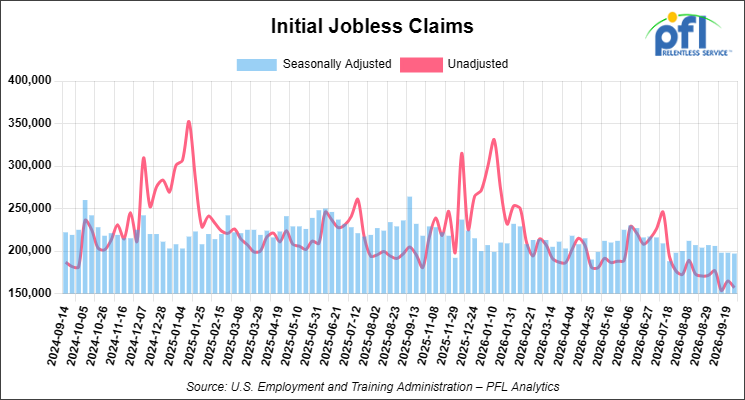
Initial jobless claims seasonally adjusted for the week ending September 26, 2026 came in at 197,000, versus the adjusted number of 198,000 people from the week prior, down 1,000 people week-over-week.
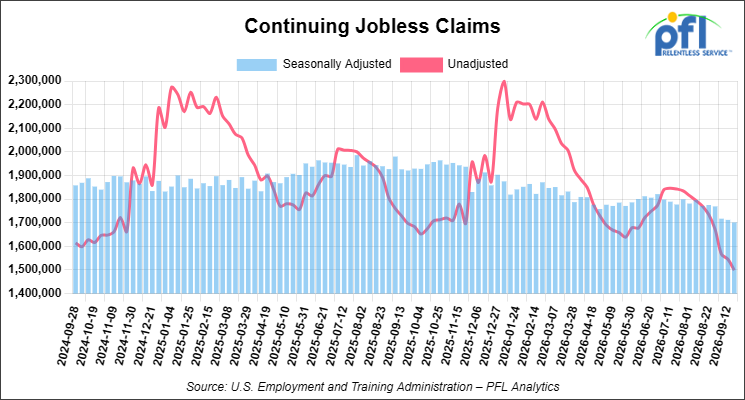
Continuing jobless claims came in at 1,701,000, versus the adjusted number of 1,712,000 people from the week prior, down 11,000 people week-over-week.
Stocks closed higher on Friday of last week, but mixed week-over-week
The DOW closed higher on Friday of last week, up 250.40 points (0.49%), closing out the week at 51,176.96, down -651.66 points week-over-week. The S&P 500 closed higher on Friday of last week, up 56.27 points (0.73%), and closed out the week at 7,722.72, down -20.69 points week-over-week. The NASDAQ closed higher on Friday of last week, up 319.27 points (1.19%), and closed out the week at 27,190.86, up 122.14 points week-over-week.
In overnight trading, DOW futures traded higher and are expected to open at 51,371 this morning, down 105 points from Friday’s close.
Crude oil closed lower on Friday of last week and lower week-over-week
West Texas Intermediate (WTI) crude closed down -$1.76 per barrel (-1.9%), to close at $91.11 on Friday of last week, and down $1.30 per barrel week-over-week. Brent crude closed down -$0.06 per barrel (-0.06%), to close at $102.25, and down $2.07 per barrel week-over-week.
One Exchange WCS (Western Canadian Select) for November delivery settled on Friday of last week at US$24.50 below the WTI-CMA (West Texas Intermediate – Calendar Month Average). The implied value was US$64.74 per barrel.
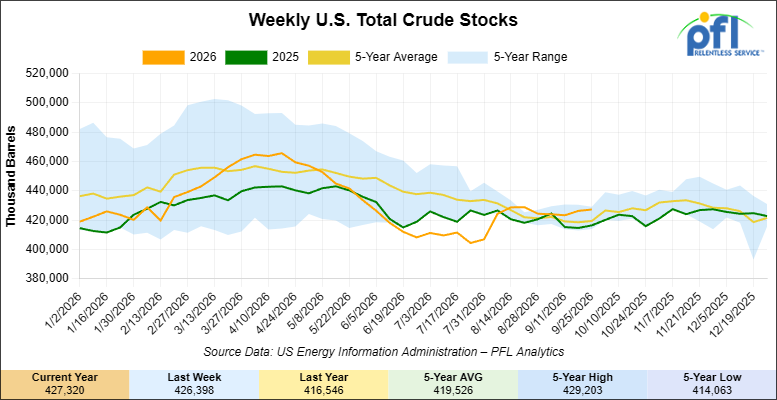
U.S. commercial crude oil inventories (excluding those in the Strategic Petroleum Reserve) increased by 922,000 barrels week-over-week. At 427.3 million barrels, U.S. crude oil inventories are 2% above the five-year average for this time of year.
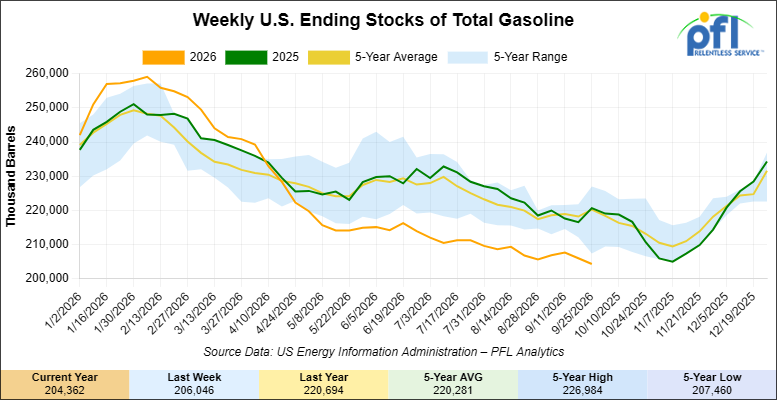
Total motor gasoline inventories decreased by 1.7 million barrels week-over-week. and are 7% below the five-year average for this time of year.
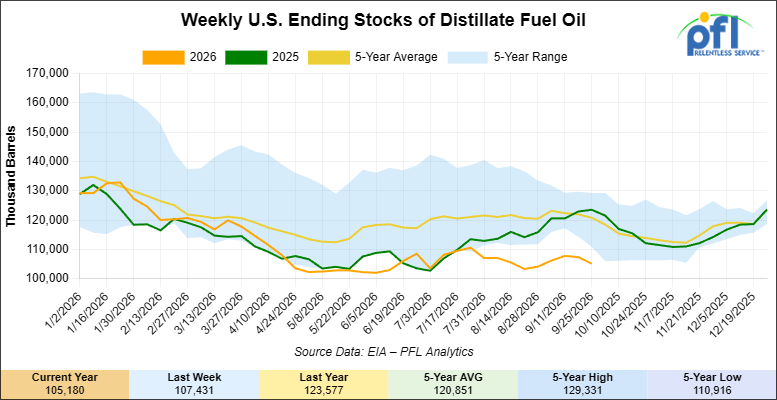
Distillate fuel inventories decreased by 2.3 million barrels week-over-week. and are 13% below the five-year average for this time of year.
Propane/propylene inventories increased by 1.8 million barrels week-over-week. and are 19% above the five-year average for this time of year.
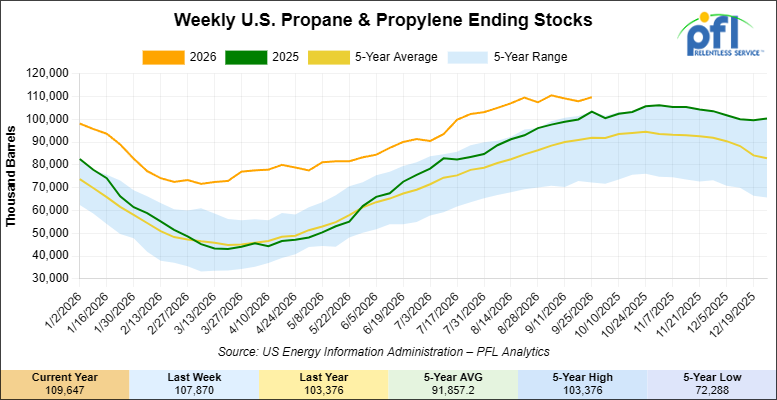
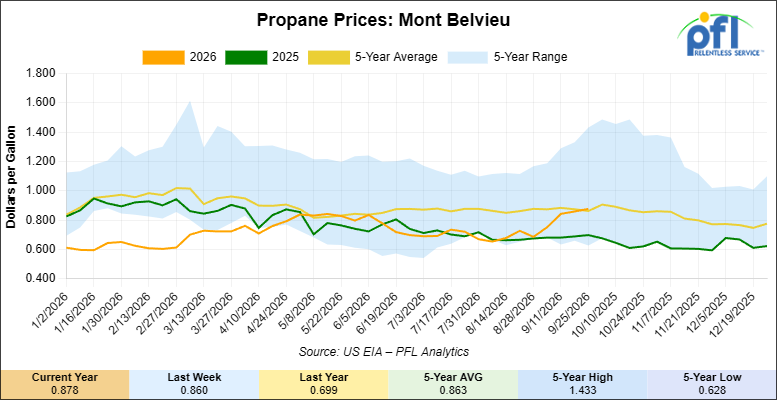
Propane prices closed at 87.8 cents per gallon on Friday of last week, up 1.8 cents per gallon week-over-week, and up 17.9 cents year-over-year.
Overall, total commercial petroleum inventories decreased by 7 million barrels week-over-week during the week ending September 25, 2026.
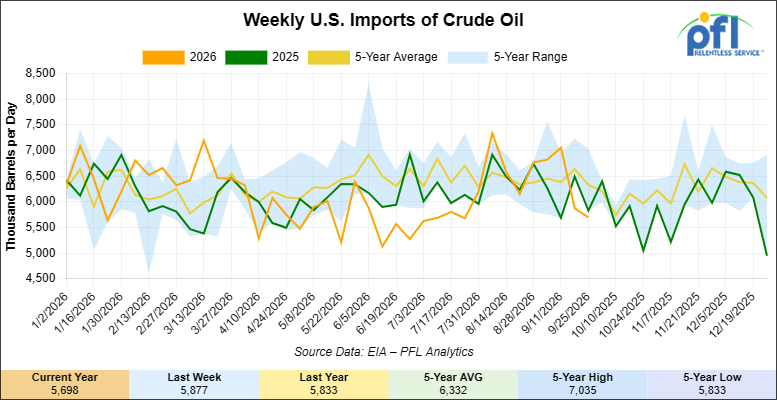
U.S. crude oil imports averaged 5.7 million barrels per day during the week ending September 25, 2026, a decrease of 179,000 barrels per day week-over-week. Total motor gasoline imports (including both finished gasoline and gasoline blending components) averaged 500,000 barrels per day, and distillate fuel imports averaged 153,000 barrels per day during the week ending September 25, 2026.
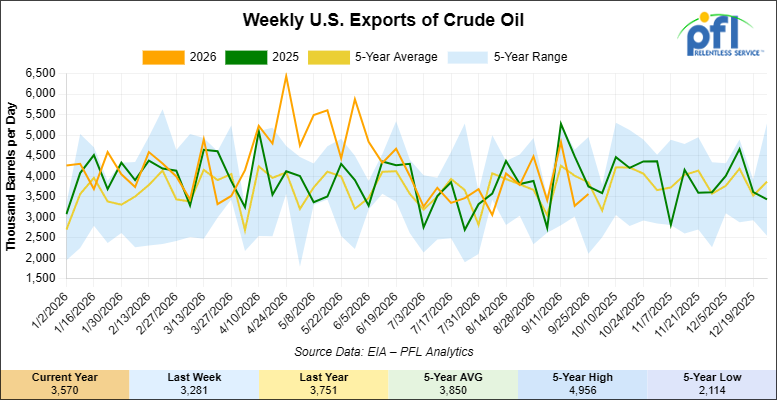
U.S. crude oil exports averaged 3.57 million barrels per day during the week ending September 25, 2026, an increase of 289,000 barrels per day week-over-week. Over the past four weeks, crude oil exports averaged 3.775 million barrels per day.
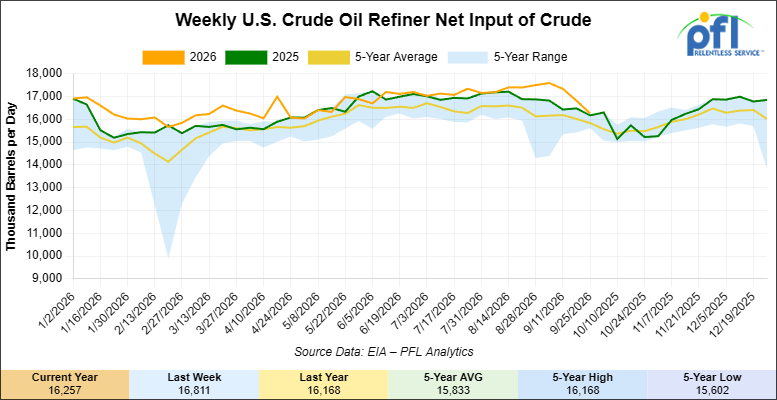
U.S. crude oil refinery inputs averaged 16.3 million barrels per day during the week ending September 25, 2026, which was 554,000 barrels per day less week-over-week.
WTI is poised to open at $90.61, down $0.50 per barrel from Friday’s close.
North American Rail Traffic
Week Ending September 30, 2026:
Total North American weekly rail volumes were up (+5.16%) in week 40, compared with the same week last year. Total Carloads for the week ending September 30, 2026 were 338,406, up (+3.62%) compared with the same week in 2025, while weekly Intermodal volume was 366,765, up (+6.62%) year over year. 9 of the AAR’s 11 major traffic categories posted year-over-year increases. The largest decrease came from Motor Vehicles and Parts (-5.66%). The largest increase was Grain (+13.08%).
In the East, CSX’s total volumes were up (+3.63%), with the largest decrease coming from Chemicals (-3.75%), while the largest increase came from Grain (+19.80%). NS’s total volumes were up (+6.51%), with the largest increase coming from Metallic Ores and Metals (+18.42%), while the largest decrease came from Farm Products (-9.64%).
In the West, BNSF’s total volumes were up (+4.42%), with the largest increase coming from Metallic Ores and Metals (+19.95%), while the largest decrease came from Coal (-9.87%). UP’s total volumes were up (+10.32%), with the largest increase coming from Grain (+19.92%), while the largest decrease came from Farm Products (-7.96%).
In Canada, CN’s total volumes were down (-5.21%), with the largest increase coming from Grain (+35.73%), while the largest decrease came from Intermodal Units (-18.66%). CPKCS’s total volumes were down (-1.92%), with the largest increase coming from Grain (+47.66%), while the largest decrease came from Motor Vehicles and Parts (-32.28%).
Source Data: AAR – PFL Analytics
North American Rig Count Summary
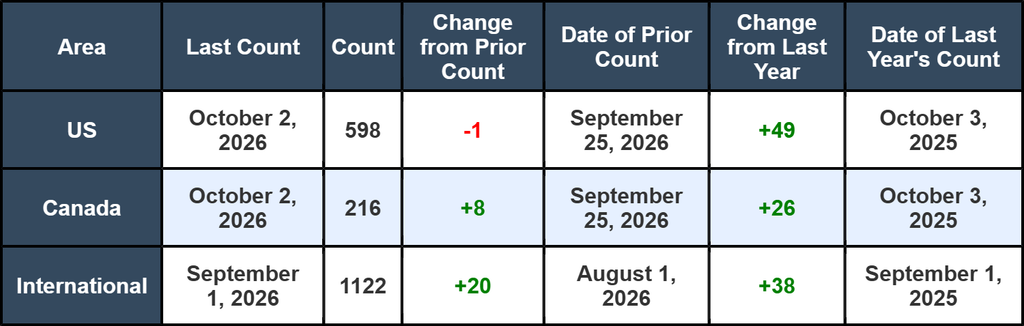
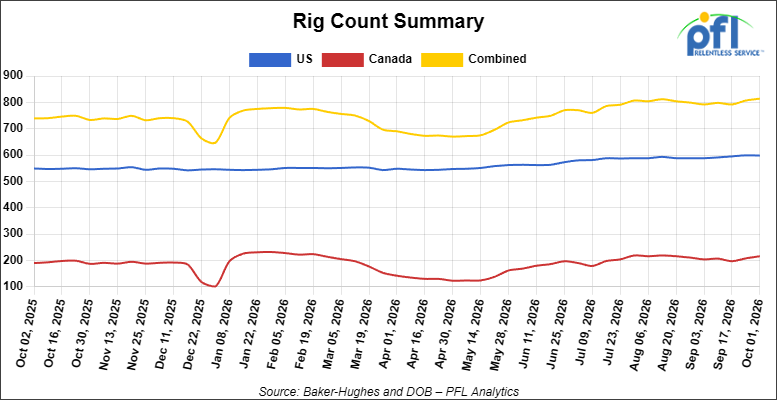
North American rig count was up by +7 rigs week-over-week. The U.S. rig count was down by -1 rig week-over-week, but up by +49 rigs year-over-year. The U.S. currently has 598 active rigs. Canada’s rig count was up by +8 rigs week-over-week and up by +26 rigs year-over-year. Canada currently has 216 active rigs. Overall, year-over-year we are up by +75 rigs collectively.
We are watching a few things out there for you:
We Are Watching Petroleum Carloads
The four-week rolling average of petroleum carloads carried on the six largest North American railroads rose to 30,273 from 30,125 which was a increase of +148 rail cars week-over-week. Canadian volumes were mixed. CPKC’s shipments were lower by -4.0% week-over-week, CN’s volumes were higher by +2.0% week-over-week. U.S. shipments were also mixed. The NS had the largest percentage increase and was up by +6.0% week-over-week. The BNSF had the largest percentage decrease and was down by -7.0%
We Continue to Watch Our Strategic Petroleum Reserves
The ongoing emergency drawdown of the U.S. Strategic Petroleum Reserve (SPR) remains a major component of global efforts to offset crude oil supply disruptions stemming from the conflict involving Iran and the continued restrictions on oil shipments through the Strait of Hormuz. Since March, the Department of Energy (DOE) has awarded exchanges covering more than 133 million barrels of crude oil, with additional releases expected as part of a broader international response coordinated through the International Energy Agency (IEA).
The United States continues to execute its commitment to make available up to 172 million barrels from the SPR under the IEA’s collective plan to inject roughly 400 million barrels into global energy markets. Officials have argued that the releases are necessary to help stabilize crude supplies and limit further increases in fuel prices as refiners compete for replacement barrels amid ongoing transportation disruptions. The IEA’s coordinated action remains the largest emergency oil-stock release in the agency’s history.
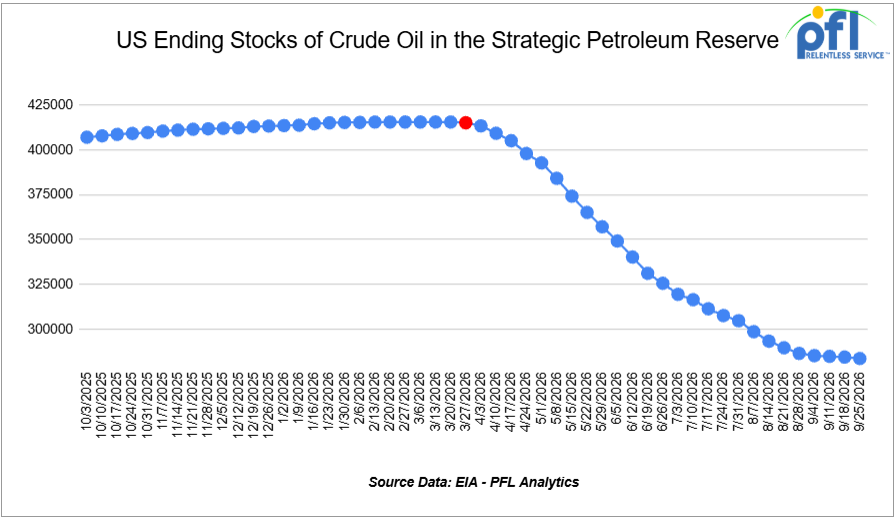
Inventories in the SPR have declined to 283.767 million barrels, down from 415.442 million barrels at the start of the conflict with Iran and reaching their lowest level since October 1982. The SPR declined by a mere 785 thousand barrels during the week ending September 25th (112,140 barrels per day). Since the first SPR drawdown began, the United States has withdrawn approximately 131.675 million barrels, equivalent to an average of roughly 696,693 barrels per day through the week ending September 25, 2026.
Global petroleum inventories have also tightened considerably. The IEA has reported substantial draws in commercial crude and refined-product stockpiles across major consuming nations, underscoring the strain that the conflict has placed on world energy markets. While oil flows through the Strait of Hormuz have partially recovered from their initial near-shutdown, the IEA continues to identify significant uncertainty surrounding the pace and durability of the recovery.
The Administration continues to emphasize that the current program consists primarily of exchange agreements, rather than outright sales. Under these arrangements, companies receiving crude oil today are required to return the borrowed barrels in the future along with additional volumes as a premium. DOE has stated that its exchange structure is designed to return the borrowed crude with additional premium barrels, with the stated objective of strengthening the SPR over time.
We Are Watching Tank Cars
The Bureau of Transportation Statistics (“BTS”) delivered its annual tank car report to Congress on Wednesday of last week, and the headline number is progress: 76,715 cars, or 76% of the 100,485-car Class 3 flammable liquids fleet, met the DOT-117 or DOT-117R specification at the end of 2025, up from 73,757 a year earlier. The compliant fleet splits 43,519 new builds and 33,196 retrofits. With the May 2025 crude and ethanol deadlines behind us, 13,832 non-DOT-117 (DOT -111’s – CPC 1232s) cars in Packing Group II and III service will need to be phased out by May 1, 2029.
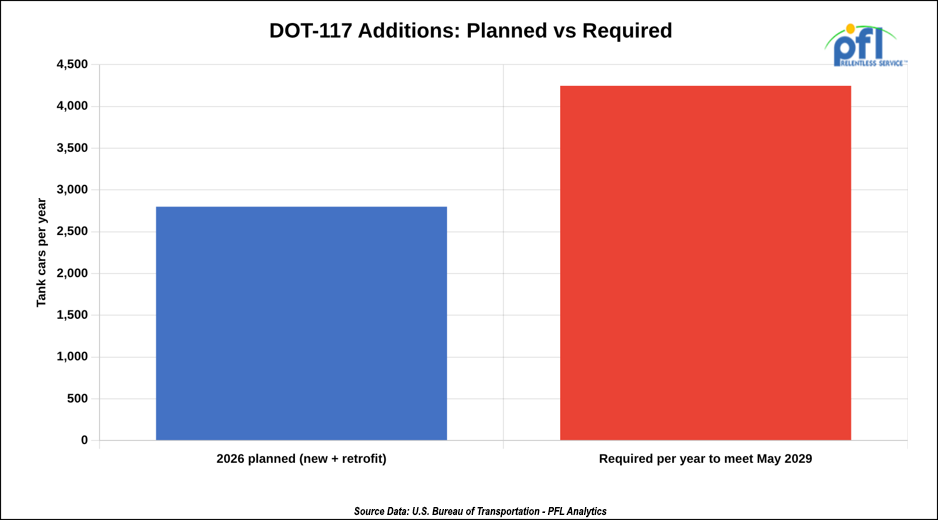
Now, the arithmetic that should get fleet owners’ attention. The shops BTS surveyed plan to build 2,137 new DOT-117s and retrofit 663 DOT-117Rs in 2026, 2,800 cars in total. BTS calculates the industry needs to add 4,247 compliant cars a year through 2029 to clear the deadline, a pace the report itself describes as exceeding current production capacity. The Senate’s Railway Safety Act of 2026 would make it tighter, pulling the cutoff forward to December 31, 2027, with a one-year extension only if the Secretary finds manufacturing capacity is insufficient. That bill is tied up in the surface transportation reauthorization, which lapsed last Wednesday with only a stopgap in prospect, so nobody should plan around it either way.
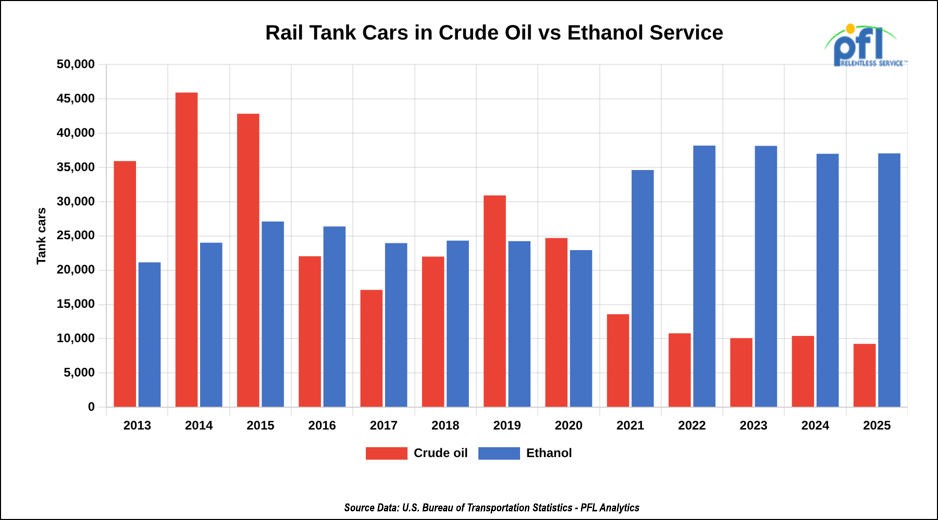
The service mix tells the rest of the story. Cars in crude service fell to 9,256 in 2025 from 10,410 in 2024, an 11% drop, and 80% below the 45,928 peak in 2014. Ethanol went the other way, up to 37,060 cars from 22,932 in 2020, and 99.9% of that fleet is already DOT-117. The retrofit queue is now a Packing Group II and III problem, and the 117J cars that a crude by rail revival would need are competing for the same shop slots. PFL’s advice to anyone holding legacy cars in general flammable service is simple: price the retrofit, the sale and the scrap option as soon as you can.
We Continue to Watch Left Wing Carney
Thursday of last week in Fort McMurray, with Premier Smith and Pembina’s CEO at his side, the Prime Minister listed Pacific Link, the renamed West Coast Oil Pipeline, as Canada’s first project of national interest under the Building Canada Act. The pitch is one million barrels per day from Bruderheim to a VLCC-capable terminal at Roberts Bank, costed by Alberta at C35.2 to C43.7 billion, with the Major Projects Office to deliver its conditions by September 1, 2027 and oil flowing somewhere between 2032 and 2034. Ownership is Alberta’s marketing commission at 45%, Trans Mountain at 45% and Pembina at 10%, and Pembina’s own filing says it has no at-risk capital before a final investment decision and full discretion on whether to invest. Not one shipper has committed a barrel, the first open season is not until next spring, and the Prime Minister’s answer to that was “the Canadian taxpayer is going to make a lot of money off this pipeline.”
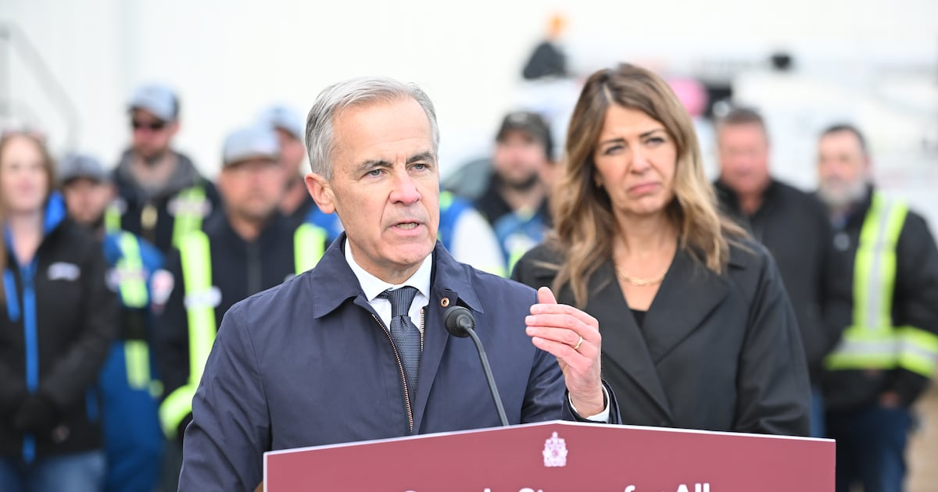
Source: Canadian Press – Prime Minister Mark Carney with Alberta Premier Danielle Smith in Fort McMurray, Thursday of last week. – PFL Analytics
The market spent the same week voting. Western Canadian Select for November delivery settled $24.50 under WTI at Hardisty on Friday of last week, out from $21.60 two days earlier, the widest discount in almost three years. The Alberta Energy Regulator’s outlook last Tuesday has bitumen output crossing four million barrels per day in 2027, three years earlier than it expected a year ago, and reaching 4.4 million by 2035. The CER approved the Trans Mountain toll settlement last Monday, lifting firm contracting to 90% of capacity on an open season that was two and a half times oversubscribed, which tells you how badly producers want pipe that exists. On roughly 3.5 million barrels per day of heavy output, the $3 of widening last week alone is worth about 3.8 billion a year to the people who do not get it.
Put the two announcements of the week side by side. Last Tuesday LNG Canada took a US$32 billion private final investment decision on Phase 2, twelve months from referral, with Coastal GasLink Phase 2 following the same day. Two days later, the oil pipeline got a provincial marketing commission, a Crown corporation that cannot sell the pipeline it already owns, and a partner with an option to walk. In our opinion, a pipeline with no shipper, no private proponent and a 2033 in-service date is a press release with a map, and Alberta’s barrels will keep paying the discount while Ottawa collects the applause.
We Continue to Watch Diesel
The export ban is dead. President Trump was “thinking very seriously” about it last Monday, threatened a targeted ban on France and Germany last Wednesday unless they released 120 million barrels of diesel, and on Friday of last week said “we’re not going to be doing the export ban, we were never going to do it.” What replaced it was a G7 agreement the same day to release up to 100 million barrels of crude and diesel from strategic stocks over four months, diesel first and substantial volumes within 20 days. Front-month ULSD futures fell to their lowest since August 28th on the news, trading as low as $4.40 per gallon, and WTI settled at $91.11.
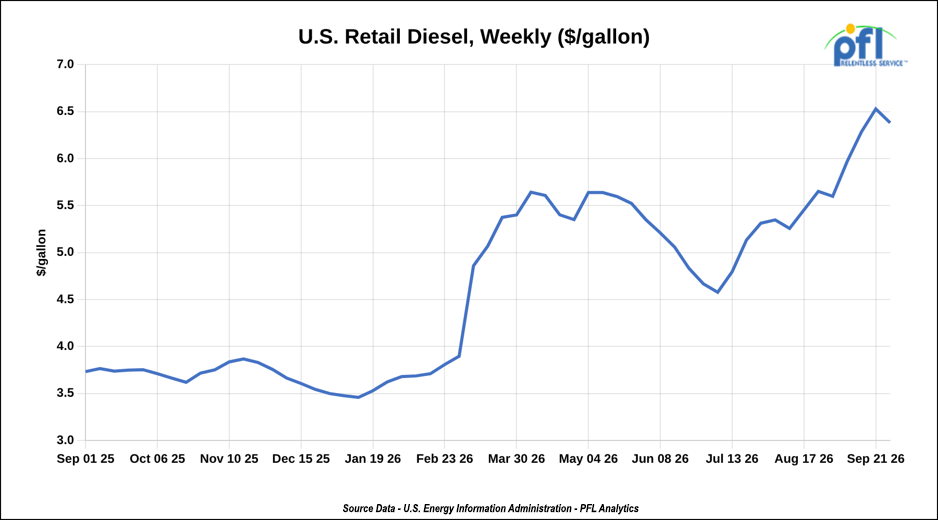
Washington is also back at the SPR. The DOE issued a request for proposals last Tuesday to loan out another 40 million barrels of sour crude from Bryan Mound and Big Hill for November and December delivery, with bids due October 6th. More than 133 million barrels of the 172 million the U.S. committed in March have been awarded, and the June attempt at this same tranche drew almost no interest because the premium barrels only pencil in steep backwardation. The retail side finally blinked: the EIA’s on-highway diesel average fell 14.7 cents to $6.382 for September 28th, the first weekly drop in a month, though still $2.63 above a year ago. Gasoline is now the tighter barrel, with U.S. stocks at 204.4 million barrels in the week ended September 25th, the lowest since November 2014, and refinery utilization down to 92.5%.
For the tank car fleet, the outcome is the one we flagged two weeks ago: exports get redirected, not stopped, and the Mexico-bound distillate cars keep running. The grain fuel surcharge stepped up 11 cents to $0.59 per mile on October 1st, and AAR petroleum carloads were up 9.4% in the week ended September 26th, with chemicals up 7.2%. Our read is that the bigger risk to distillate loadings from here is not policy but margin: if 100 million G7 barrels knock the diesel crack down hard enough, Gulf Coast refiners will trim runs, and the cars feel that before the pump does.
We Are Watching Grain
The railroads repriced harvest last Wednesday. BNSF raised corn tariffs to the Pacific Northwest by $200 per car from every origin effective October 1st, UP went up $225 per car, and the fuel surcharge rose 11 cents to $0.59 per mile, which on a CPKC Enderlin to Kalama corn move adds $1,075 to a $5,047 tariff. The secondary market had already told you demand was there: BNSF’s auction of 13 year-long shuttle contracts starting January 2027 cleared $17.2 million, an average of $1.3 million per set against $595,000 a year ago. October shuttle bids eased to $700 per car over tariff in the week ended September 24th, down $188 on the week, because the harvest itself stalled.
Iowa had 3% of its soybeans harvested as of September 27th against a five-year average of 17%, with rain across the western Corn Belt, and crushers were bidding a dollar over futures for prompt delivery, enough to pull rail shipments of soybeans into Iowa, which does not happen often. North of the border it is the opposite problem. CPKC reported last Friday a record September of 2.94 million tons and 30,324 carloads of Canadian grain plus 2.51 million tons in the U.S., and Port of Vancouver bulk grain ran 17.4 million tons in the first half, up 14%. Canpotex added C$500 million for Neptune Terminals the same week, including new railcar dumper pits, with completion in 2028.
Once the Corn Belt dries out, the U.S. shuttle premium comes back and the covered hopper is the car that matters for the next eight weeks. PFL is watching this one closely.
We Are Watching Tankers
Trafigura is buying ships. The trading house launched Volare Shipping last week with six very large crude carriers on the water and eight newbuilds due between 2026 and 2028, raising $500 million in a private placement ahead of a listing on Euronext Growth Oslo on or about October 5th under the ticker VLCC. Spot VLCC charter rates have touched $1 million a day since the Iran war began, more than a month of revenue for most charterers, and Trafigura’s head of shipping said the aim is simply “to maximize earnings of these vessels.”
Freight is now part of the heavy crude basis. Venezuela’s September exports fell about 9% to 1.08 million barrels per day as tanker costs bit, with Europe’s take collapsing to 86,000 barrels per day from 260,000 while the U.S. took 629,000 barrels per day, up from 553,000 in August. The EIA’s July monthly put Venezuelan imports at 701,000 barrels per day, the highest since May 2017, with Valero alone taking 282,000 at Corpus Christi, Port Arthur and St. Charles. Short-haul Caribbean barrels into Gulf Coast cokers are the direct competitor to Canadian heavy at Hardisty, and the WCS discount as a result widened.
The same freight market is the entire commercial case for Pacific Link, whose advantage over Westridge is a VLCC berth, instead of a draft-limited Aframax. A trading house putting fourteen VLCCs on its own balance sheet at the top of the cycle tells us tanker scarcity is being treated as structural, not seasonal. PFL has been watching the Hardisty to Gulf Coast rail lane for exactly this reason: when water freight is the problem, the unit train is the only leg of the heavy crude chain that does not float.
We Are Watching Permitting
Senators Capito, Lee, Whitehouse and Heinrich released the 417-page text of the Bipartisan American Affordability and Jobs Act last Wednesday, and the White House endorsed it on the same day. The bill sets a one-year clock on environmental assessments and two years on impact statements, caps lawsuits at 150 days after a permit, tells courts to remand rather than vacate, stretches Clean Water Act 404 permits from five years to ten, and limits state 401 certifications to water quality actually caused by the project. Permits would also survive a change of administration absent extraordinary circumstances, which is the provision the pipeline industry has wanted since Keystone XL. Capito wants the first vote when the Senate returns after the November 3rd midterms, with a cloture motion pencilled for November 9th, and the House passed its own version last December.
API called it a generational opportunity and INGAA a historic breakthrough, and it is not hard to see why from this desk. Every pipeline this report has tracked for two years has been stopped by a state 401 certificate or a lawsuit filed years after the permit: Line 5 in Michigan and Wisconsin, Bridger in Montana, the Mainline’s second optimization phase sitting on the shelf. If the 401 narrowing and the 150-day limit become law as written, that playbook ends, and the long-dated case for crude by rail gets shorter. That is a big if. Lame duck sessions have killed better bills than this one, Senate Democrats are still waiting for the administration to restart wind and solar permitting, and the 60-vote math has not changed. This one may have a path; it does not yet have a floor.
We Continue to Watch the Merger
Last Wednesday’s deadline for notices of intent to participate in the Union Pacific and Norfolk Southern proceeding came and went without a tally from the Surface Transportation Board, and the extension to September 30th was itself granted at the request of the National League of Cities so that 12,000 local governments could decide whether to file. The applicants spent the week before adding the SMART Mechanical Department to their jobs-for-life list, with Jim Vena saying “the momentum behind this transaction continues to build” on the back of more than 2,000 filed shipper statements. Comments and requests for conditions remain due November 18th, with replies February 16th, and nothing that happened last week moves the Gulf Coast switching question BNSF has put on the table.
Two staffing notes worth filing. The Board named Marty Schlenker, formerly of CSX finance and BNSF service planning, as Director of its Office of Economics, and Terrence McDermott, formerly Bunge’s North American rail supply chain director and a National Grain Car Council member, as senior advisor to Chairman Fuchs. A shipper-side railcar man advising the Chairman while the merits review is being staffed is, in our opinion, not nothing. Norfolk Southern reports third quarter results October 22nd, and PFL will be watching what management says about synergies with Kloster’s concurrence still fresh.
We Are Watching Safety
The NTSB issued a preliminary report Thursday of last week on the Norfolk Southern conductor seriously injured September 8th at Conway Yard, Pennsylvania. He was riding a tank car during a 219-car shoving move, was found about eight car lengths from where the shove began, and was airlifted to Pittsburgh. It is the first case file to land since the Board’s September 21st recommendation that crews stop riding equipment to protect shoving moves, and it involves a tank car. Separately, 19 cars of a BNSF train derailed in downtown Minot, North Dakota at 3:36 a.m. last Wednesday, four of them tipped, rupturing a gas line and closing streets and two medical buildings; BNSF said no hazmat was involved and both mains were back by Thursday.
The policy fight moved to the Senate last Thursday, when a coalition led by the Competitive Enterprise Institute wrote to oppose folding the Railway Safety Act into the surface transportation bill, aiming squarely at the two-person crew mandate and the wayside detector requirements. The AAR’s Joseph St. Peter made the same case earlier in the week: “a staffing mandate is not itself a safety standard.” The 11th Circuit upheld the FRA’s crew size rule in August, so the mandate stands regardless of what Congress does. Tank car owners have a direct stake here, because the same bill carries the DOT-117 acceleration to December 2027, and it will ride or die with the crew provision. Whatever happens on crew size, in our opinion is that the shoving-move recommendation is the one that changes yard practice at tank car facilities first.
We are Watching Key Economic Indicators
Unemployment
On October 2nd, the U.S. Bureau of Labor Statistics (BLS) reported that a preliminary 29,000 net new jobs were created in September 2026, marking a significant slowdown from the 162,000 jobs initially reported for August. The BLS also revised employment figures for the prior two months downward, subtracting a combined 60,000 jobs from July and August totals. July was revised from a gain of 21,000 jobs to a loss of 10,000 jobs, while August was revised down from 162,000 to 133,000.
According to the BLS, total nonfarm payroll employment has increased by approximately 152,000 jobs over the last three months (July through September 2026). The official unemployment rate increased to 4.2% in September from 4.1% in August, while employment in all major industries changed little during the month.
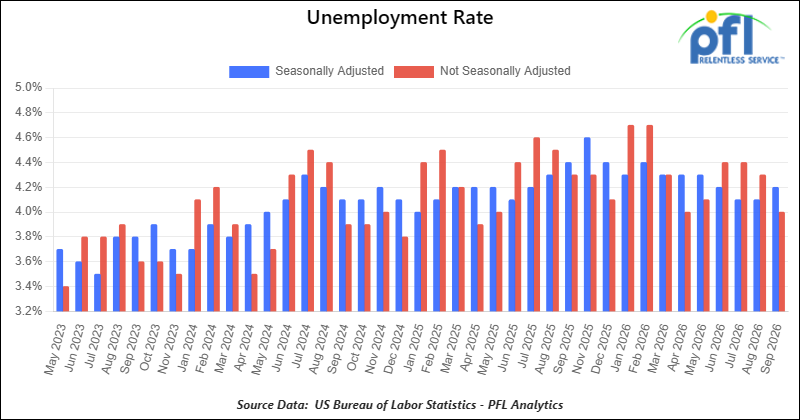
Consumer Spending
In August 2026, consumer spending continued to strengthen, with personal consumption expenditures (PCE) rising 0.9 percent month-over-month. In current-dollar terms, spending increased by approximately $190.8 billion, with gains across both goods and services, highlighting continued household demand. On an inflation-adjusted basis, real PCE rose 0.6 percent, indicating solid growth in underlying consumption.
The personal saving rate increased to 4.1 percent in August, up from 3.0 percent in July, as disposable personal income increased 0.3 percent while consumer spending rose at a faster pace in current-dollar terms.
On inflation, the PCE price index increased 0.3 percent month-over-month in August, with the year-over-year rate at 3.4%. Core PCE (excluding food and energy) rose 0.2% on the month and 3.0% year-over-year, indicating that underlying inflation remains above the Fed’s 2 percent target.
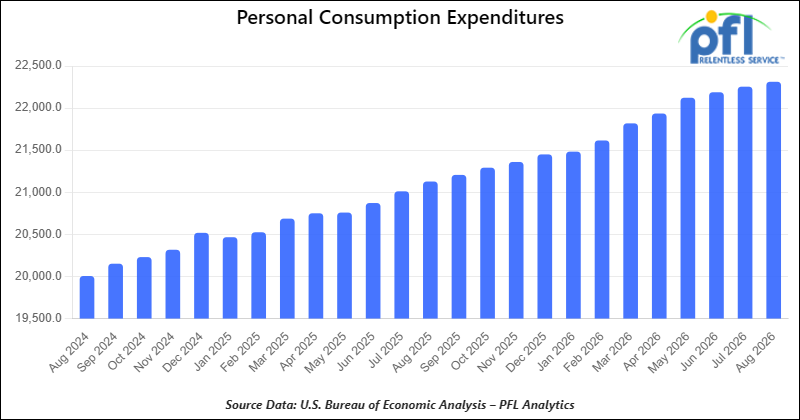
Lease Bids
- 20-50, 4000-5000 Covered Hoppers located off of UP or BNSF in Houston. For use in Urea, Potash, and Ammonium Sulfate service. Period: 6-12 Months.
- 300, 5200CF Covered Hoppers located off of CPKCS or CN in Canada. For use in Petcoke service. Period: 3 Year.
- 100, 340W Pressure Tank located off of CN or CPKCS in Canada. For use in Propane service. Period: 6 Months.
- 10-20, 3200 or 3281 Covered Hoppers located off of CN or CPKCS in Canada. For use in Sodium Sulphate service. Period: 3-5 years. Lined.
- 50, 340W Pressure Tanks located off of CN or CPKCS in Canada. For use in Propane service. Period: Winter.
- 30-50, 340W pressure Tanks located off of NS or CSX in Northeast U.S. For use in Propane service. Period: Winter.
- 25, 340W Pressure Tanks located off of UP or BN in US. For use in Propane service. Period: Winter.
- 50, 28.3K 117J Tanks located off of BNSF in Kansas/Oklahoma. For use in Fuel Oil service. Period: 6 Months.
- 100, 30K 117J Tanks located off of CN in Canada. For use in Diesel service. Period: 1 year.
- 150, 340W Pressure Tank located off of CN in Canada. For use in Propane service. Period: 3 Months.
Sales Bids
- 28, 3400CF Covered Hoppers located off of UP or BNSF in Texas. For use in Cement service. Cement Gates needed.
- 20, 17K DOT111 Tanks located off of various class 1s in various locations. For use in corn syrup service.
- 120, Various Open-Top Aluminum Rotary Gondolas located off of various class 1s in various locations. For use in Sulphur service. Built 2004 or later.
- 12, 21.5K-25K DOT 111 Tanks located off of various class 1s in Michigan. For use in Diesel, Asphalt, Crude service. Coiled and Insulated.
Lease Offers
- 15, 6200CF Covered Hoppers located off of all class 1s in Wisconsin. Last used in plastic. Cars are currently clean.
- 30, 6500CF Covered Hoppers located off of all class 1s in Wisconsin. Last used in plastic. Cars are currently clean.
- 100, 28.4K DOT 117J Tanks located off of UP or BNSF in Beaumont, TX. Cars are currently clean.
- 50, 30K DOT117J Tanks located off of UP or BNSF in the South. Last used in ethanol.
- 41, 30K DOT 111 Tanks located off of in Brownsville. Last used in Diesel. Cars are currently clean.
- 93, 31.8K CPC 1232 Tanks located off of Various Class 1s in Texas. Last used in Diesel. Cars are currently clean.
- 22, 21K DOT 115 Stainless Steel Tank located off of BNSF in Texas. Cars are currently clean. Cars are currently clean.
- 30, 25.5K DOT 117J Tank located off of BNSF and UP in Texas. Last used in Benzene. NO BOV, NO LINER.
- 21, 20K DOT 111 Tank located off of BNSF and UP in Texas. Cars are currently clean. Cars are currently clean. C/I, NO Liner.
- 1000, 31.8K CPC 1232 Tank located off of BNSF and UP in Texas. Last used in Diesel.
Sales Offers
- 81, 31.8K CPC1232 Tanks located off of UP or BNSF in TX. Last used in Multiple Services. Requal Due in 2025.
- 35, 3400CF Covered Hoppers located off of UP or BNSF in the Midwest. Last used in Sand.
- 15, 5750 CF Hopper located off of CSX, NS, CPKCS, CN, BNSF, UP in St Louis. Last used in Grain.
- 50, 30 DOT 111 Tank located off of multiple class 1s in multiple location. Last used in Fuels.
Call PFL today to discuss your needs and our availability and market reach. Whether you are looking to lease cars, lease out cars, buy cars, or sell cars call PFL today at 239-390-2885
Railcar for Sale or Lease
| CAT | Type | Capacity | GRL | QTY | LOC | Class | Prev. Use | Offer | Note |
|---|
| CAT | Type | Size | GRL | QTY | LOC | Class | Term | Commodity | Offer | Note |
|---|
| CAT | Type | Capacity | GRL | QTY | LOC | Class | Prev. Use | Clean | Offer | Note |
|---|
| CAT | Type | Capacity | GRL | QTY | LOC | Class | Commodity | Offer | Note |
|---|
PFL will be at the Following Conferences
- Where: The Westin Galleria Dallas
- Attending: David Cohen (954-729-4774), and Curtis Chandler (239-405-3365)
- Conference Website
- Where: The Westin Galleria Dallas
- Attending: Brian Baker (239.297.4519)
- Conference Website
The post PFL Railcar Report 10-5-2026 appeared first on PFL Petroleum Services LTD.
]]>The post PFL Railcar Report 9-28-2026 appeared first on PFL Petroleum Services LTD.
]]>Jobs Update
Initial jobless claims seasonally adjusted for the week ending September 19, 2026 came in at 197,000, versus the adjusted number of 198,000 people from the week prior, down 1,000 people week-over-week.
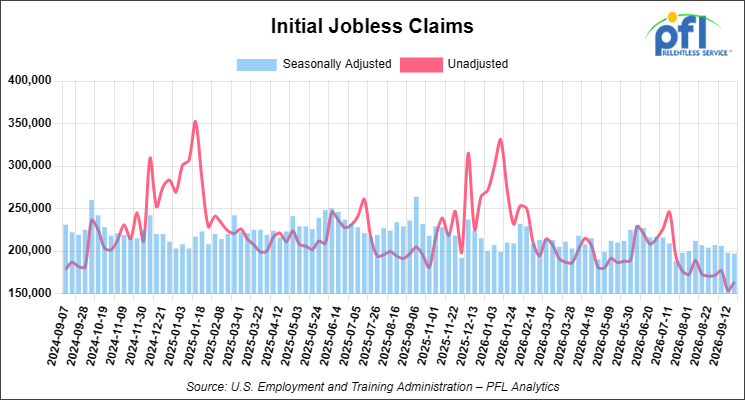
Continuing jobless claims came in at 1,719,000, versus the adjusted number of 1,717,000 people from the week prior, up 2,000 week-over-week.
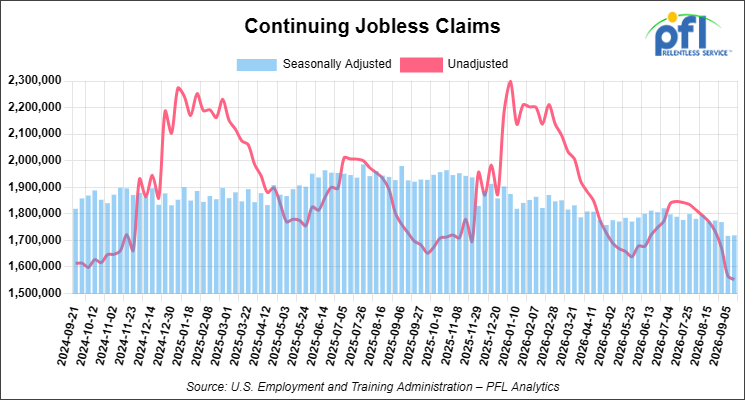
Stocks closed higher on Friday of last week and higher week-over-week
The DOW closed higher on Friday of last week, up 478.64 points (0.93%), closing out the week at 51,828.62, up 145.98 points week-over-week. The S&P 500 closed higher on Friday of last week, up 39.28 points (0.51%), and closed out the week at 7,743.41, up 92.91 points week-over-week. The NASDAQ closed higher on Friday of last week, up 129.34 points (0.48%), and closed out the week at 27,068.72, up 546.17 points week-over-week.
In overnight trading, DOW futures traded lower and are expected to open at 51,995 this morning, down -168 points from Friday’s close.
Crude oil closed lower on Friday of last week, but mixed week-over-week
West Texas Intermediate (WTI) crude closed down -$2.20 per barrel (-2.3%), to close at $92.41 on Friday of last week, but down $7.89 week-over-week. Brent crude closed down -$2.28 per barrel (-2.1%), to close at $104.32, but up $0.45 per barrel week-over-week.
One Exchange WCS (Western Canadian Select) for November delivery settled on Friday of last week at US$21 below the WTI-CMA (West Texas Intermediate – Calendar Month Average). The implied value was US$68.90 per barrel.
U.S. commercial crude oil inventories (excluding those in the Strategic Petroleum Reserve) increased by 3 million barrels week-over-week. At 426.4 million barrels, U.S. crude oil inventories are 2% above the five-year average for this time of year.
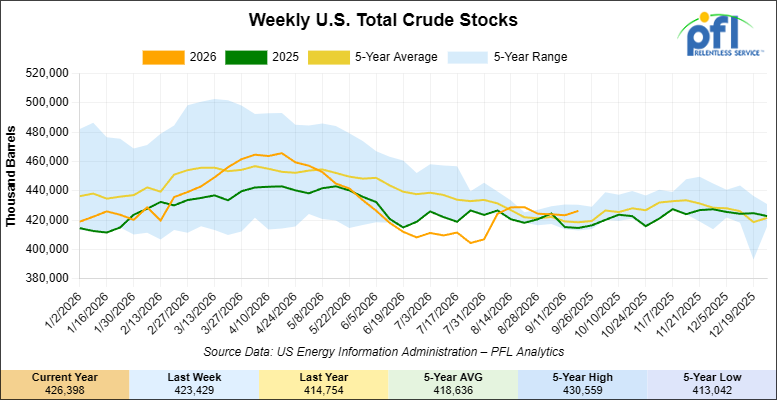
Total motor gasoline inventories decreased by 1.7 million barrels week-over-week and are 6% below the five-year average for this time of year.
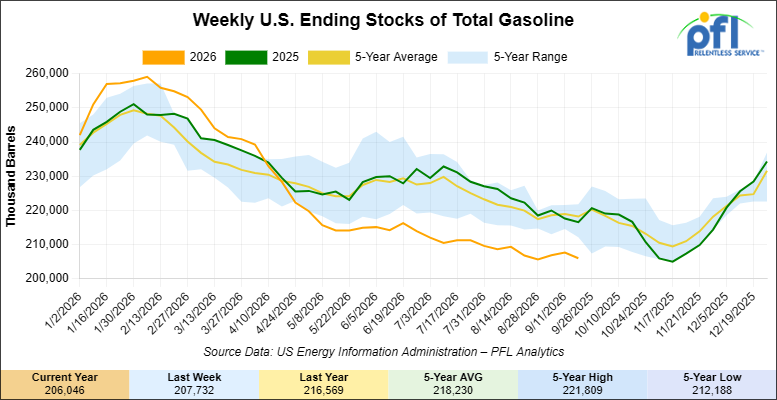
Distillate fuel inventories decreased by 428,000 barrels week-over-week and are 12% below the five-year average for this time of year.
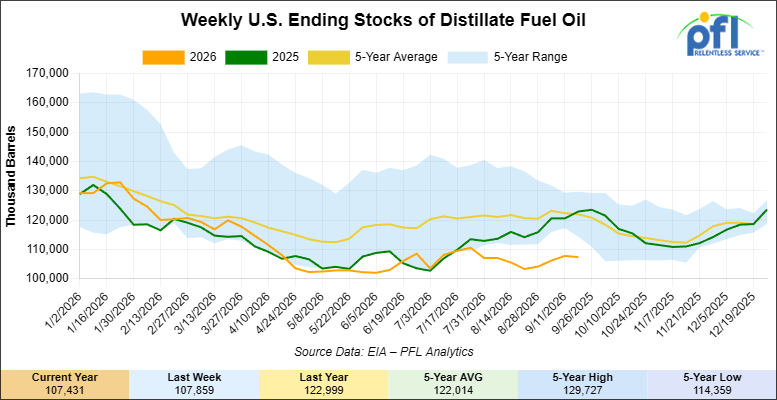
Propane/propylene inventories decreased by 1.2 million barrels week-over-week and are 19% above the five-year average for this time of year.
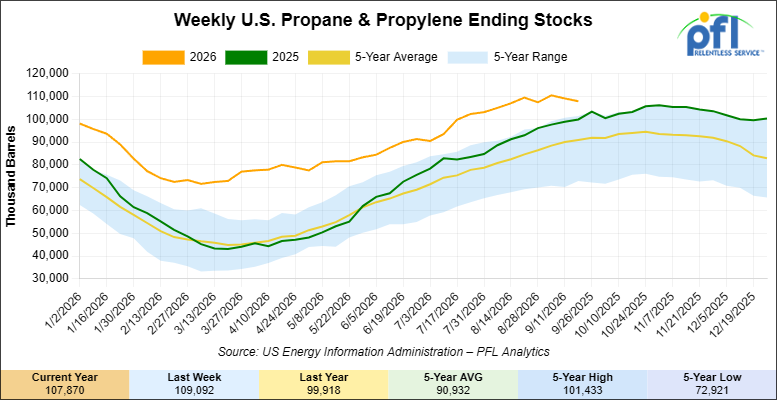
Propane prices closed at 86 cents per gallon on Friday of last week, up 1.6 cents per gallon week-over-week, and up 17 cents year-over-year.
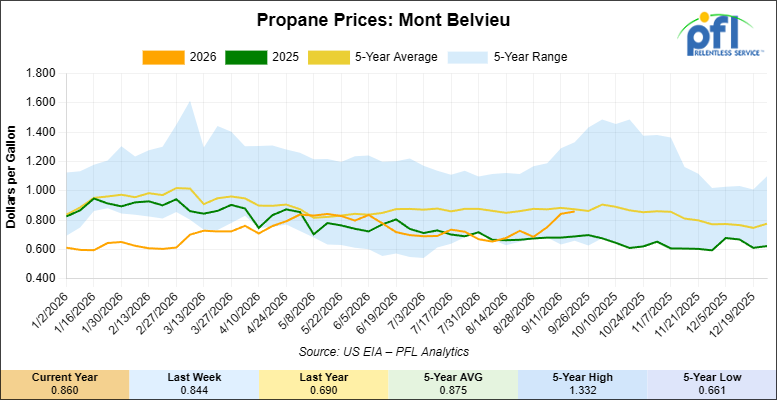
Overall, total commercial petroleum inventories increased by 108,000 barrels week-over-week during the week ending September 18, 2026.
U.S. crude oil imports averaged 5.9 million barrels per day during the week ending September 18, 2026, a decrease of 1,181,000 barrels per day week-over-week. Total motor gasoline imports (including both finished gasoline and gasoline blending components) averaged 401,000 barrels per day, and distillate fuel imports averaged 85,000 barrels per day during the week ending September 18, 2026.
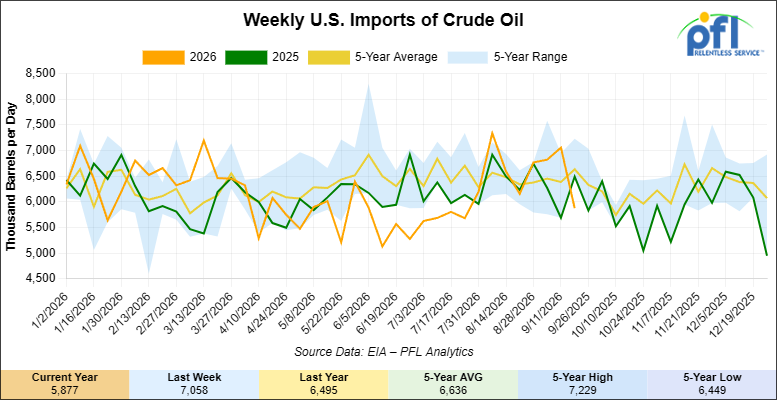
U.S. crude oil exports averaged 3.281 million barrels per day during the week ending September 18, 2026, a decrease of 1.550 million barrels per day week-over-week. Over the past four weeks, crude oil exports averaged 4.003 million barrels per day.
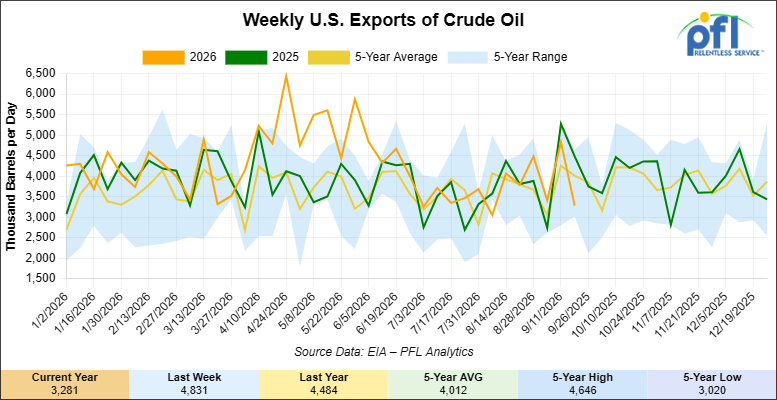
U.S. crude oil refinery inputs averaged 16.8 million barrels per day during the week ending September 18, 2026, which was 519,000 barrels per day less week-over-week.
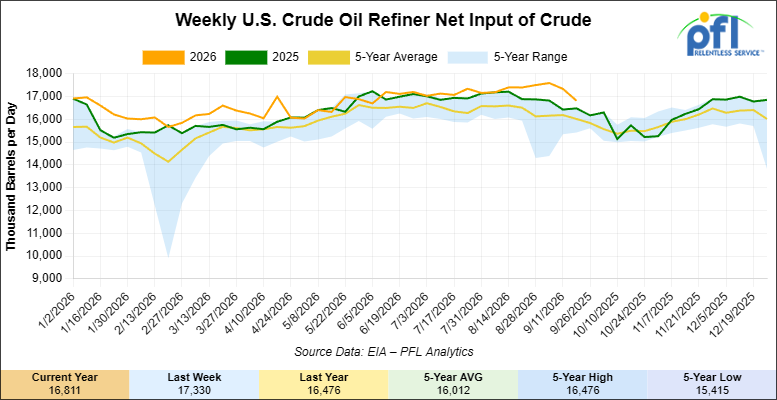
WTI is poised to open at $95.59, up $3.18 per barrel from Friday’s close.
North American Rail Traffic
Week Ending September 23, 2026:
Total North American weekly rail volumes were up (+4.53%) in week 39, compared with the same week last year. Total Carloads for the week ending September 23, 2026 were 333,150, up (+2.68%) compared with the same week in 2025, while weekly Intermodal volume was 362,415, up (+6.29%) year over year. 9 of the AAR’s 11 major traffic categories posted year-over-year increases. The largest decrease came from Motor Vehicles and Parts (-7.03%). The largest increase was Petroleum & Petroleum Products (+16.08%).
In the East, CSX’s total volumes were up (+3.72%), with the largest decrease coming from Motor Vehicles and Parts (-8.49%), while the largest increase came from Other (+20.88%). NS’s total volumes were up (+2.39%), with the largest increase coming from Coal (+31.53%), while the largest decrease came from Motor Vehicles and Parts (-6.42%).
In the West, BNSF’s total volumes were up (+5.27%), with the largest increase coming from Petroleum & Petroleum Products (+15.96%), while the largest decrease came from Coal (-27.24%). UP’s total volumes were up (+9.16%), with the largest increase coming from Nonmetallic Minerals (+18.84%), while the largest decrease came from Coal (-16.55%).
In Canada, CN’s total volumes were down (-4.21%), with the largest increase coming from Petroleum & Petroleum Products (+43.82%), while the largest decrease came from Coal (-27.24%). CPKCS’s total volumes were up (+1.51%), with the largest increase coming from Grain (+17.59%), while the largest decrease came from Motor Vehicles and Parts (-10.76%).
Source Data: AAR – PFL Analytics
North American Rig Count Summary
North American rig count was up by +15 rigs week-over-week. The U.S. rig count was up by +4 rigs week-over-week, and up by +50 rigs year-over-year. The U.S. currently has 599 active rigs. Canada’s rig count was up by +11 rigs week-over-week and up by +18 rigs year-over-year. Canada currently has 208 active rigs. Overall, year-over-year we are up by +68 rigs collectively.
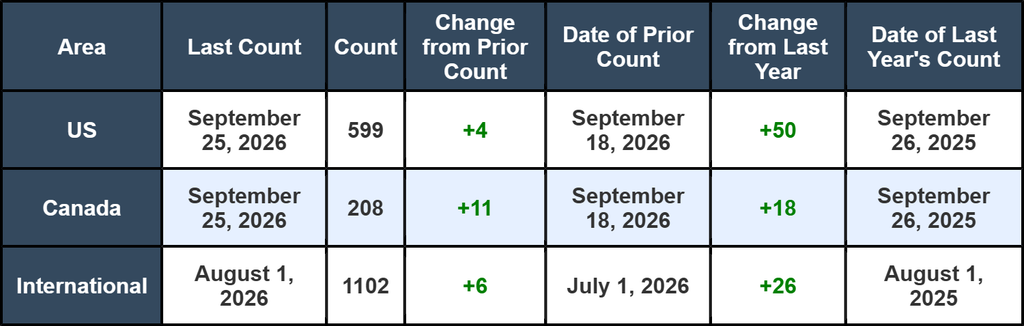
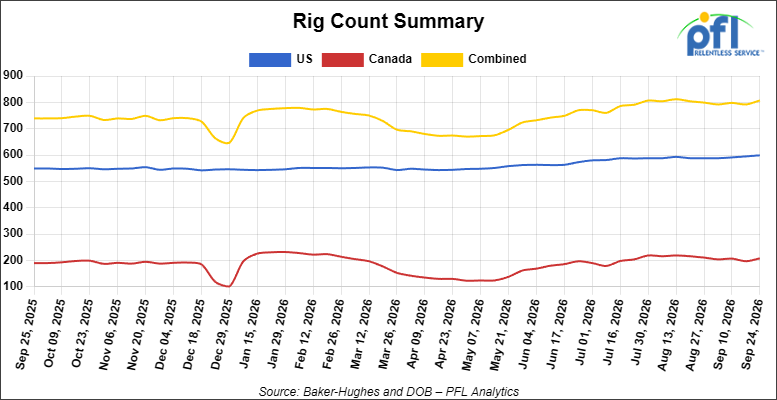
We are watching a few things out there for you:
We Are Watching Petroleum Carloads
The four-week rolling average of petroleum carloads carried on the six largest North American railroads rose to 30,125 from 29,930 which was a decrease of +95 rail cars week-over-week. Canadian volumes were higher. CPKC’s shipments were up by +15.0% week-over-week, CN’s volumes were higher by +3.0% week-over-week. U.S. shipments were higher across the board. The UP had the largest percentage increase and was up by +12.0% week-over-week.
We Continue to Watch Our Strategic Petroleum Reserves
The ongoing emergency drawdown of the U.S. Strategic Petroleum Reserve (SPR) remains a major component of global efforts to offset crude oil supply disruptions stemming from the conflict involving Iran and the continued restrictions on oil shipments through the Strait of Hormuz. Since March, the Department of Energy (DOE) has awarded exchanges covering more than 133 million barrels of crude oil, with additional releases expected as part of a broader international response coordinated through the International Energy Agency (IEA).
The United States continues to execute its commitment to make available up to 172 million barrels from the SPR under the IEA’s collective plan to inject roughly 400 million barrels into global energy markets. Officials have argued that the releases are necessary to help stabilize crude supplies and limit further increases in fuel prices as refiners compete for replacement barrels amid ongoing transportation disruptions. The IEA’s coordinated action remains the largest emergency oil-stock release in the agency’s history.
As releases have accelerated, inventories in the SPR have declined to 284.552 million barrels, down from 415.442 million barrels at the start of the conflict with Iran and reaching their lowest level since October 1982. The SPR declined by 405 thousand barrels during the week ending September 11th. Since the first SPR drawdown began, the United States has withdrawn approximately 130.890 million barrels, equivalent to an average of roughly 719,176 barrels per day through the week ending September 18, 2026.
Global petroleum inventories have also tightened considerably. The IEA has reported substantial draws in commercial crude and refined-product stockpiles across major consuming nations, underscoring the strain that the conflict has placed on world energy markets. While oil flows through the Strait of Hormuz have partially recovered from their initial near-shutdown, the IEA continues to identify significant uncertainty surrounding the pace and durability of the recovery.
The Administration continues to emphasize that the current program consists primarily of exchange agreements, rather than outright sales. Under these arrangements, companies receiving crude oil today are required to return the borrowed barrels in the future along with additional volumes as a premium. DOE has stated that its exchange structure is designed to return the borrowed crude with additional premium barrels, with the stated objective of strengthening the SPR over time.
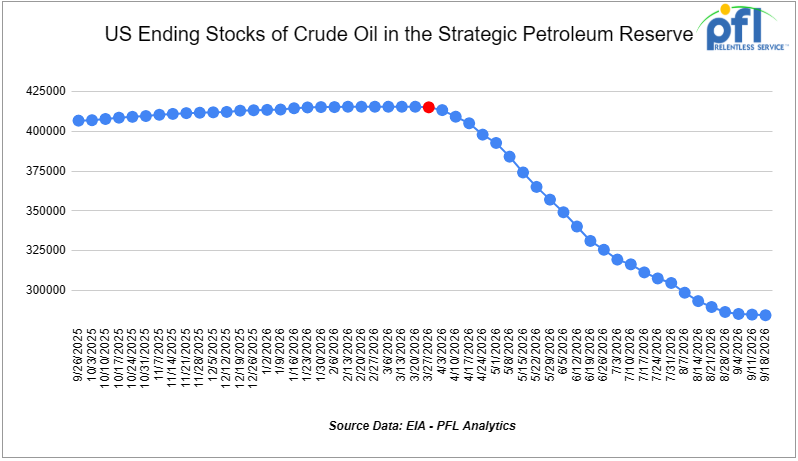
We Are Watching Canadian Crude by Rail
The Canadian Energy regulator reported on September 25, 2026, that 72,298 barrels per day were exported during the month of July 2026, down from 81,226 barrels per day in June of 2026, a decrease of 8,928 barrels per day month-over-month. This is the lowest level reported by CER since June of 2025 where only 62,847 barrels per day were exported.
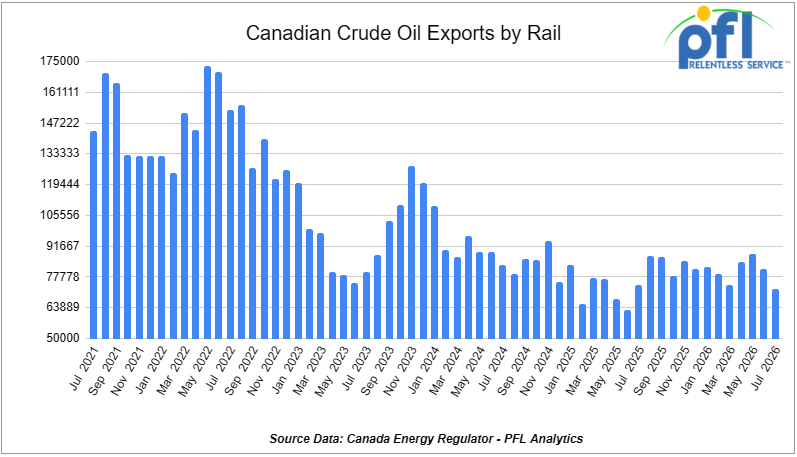
Crude by rail will always be necessary out of Canada for stranded oil not connected by pipelines. Raw bitumen, which is shipped as a non-haz product and is not able to flow in pipelines, is competitive with pipeline tolls and is a growing market to keep an eye on. In a normal predictable market, we really need to see basis WTI-CMA (West Texas Intermediate – Calendar Month Average) blowout to -18 per barrel for sustained periods of time to make economic sense. Current rail rates from Alberta to the U.S. Gulf Coast have averaged roughly $17 per-barrel, making rail competitive whenever WCS-WTI spreads exceed $18 per barrel, including quality adjustments.
This is not a fleet that switches overnight: car owners and lessors want five-year commitments, the Class 1’s expect similar terms, and new 117J cars carry one to two year build times.
Folks, what we are in now is not a normal and predictable market. Some would say nothing has been normal or predictable since COVID. With pipelines out of Alberta being full or nearly full, one consideration is the outright price of oil itself, with the conflict in Iran not seeming to go away anytime soon, some may step up, take on some cars to get barrels to market quickly. Mistreamers won’t do that, however, we may see the producer step up. For the producer, it is all about what their netback is, not how much it costs to get there. The producer can pay more than $18 per barrel at some point if that is their only outlet and pipelines are full. The risk reward ratio may make sense with elevated prices but the old saying – what goes up, must come down, and the outright price of oil will come down it is just a matter of when. We always have our eyes on this one please stay tuned to PFL or call the desk to trouble shoot.
We Continue to Watch Diesel
U.S. retail diesel averaged $6.529 per gallon in the EIA survey for Monday, September 21st, up 24.4 cents week over week and the third straight all-time record. Ultra-low sulphur diesel stocks stood at 96.4 million barrels in the week ended September 18th, 14% below a year ago, while distillate demand ran at 3.97 million barrels per day, up 6.3% on the year as the corn harvest gets going. California retail diesel is now above $8.
The politics caught up with the price on Tuesday of last week when President Trump told reporters at the UN, “let’s not send out the diesel.” Treasury Secretary Bessent said the administration was studying a full or partial ban, a Politico report last Wednesday of a 90-day plan knocked Valero and Marathon down roughly 7% and 6% on the week, and the White House then denied a plan existed. Energy Secretary Chris Wright said last Wednesday that a blanket ban “definitely doesn’t work” and that any restraint would most likely be voluntary, a tweak in where diesel flows, not whether it flows. More than 30 trade groups, including API, AFPM, NAM and the Chamber, wrote Trump the same day warning that refiners would fill their diesel tanks within weeks and cut runs across the board, taking gasoline and jet with them.
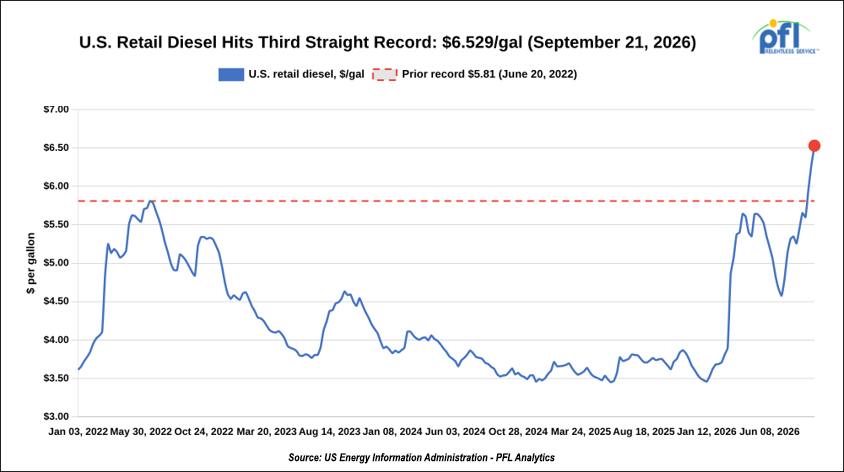
The U.S. net exported 1.1 million barrels per day of diesel last year, and Mexico takes about 220,000 barrels per day of U.S. distillate, roughly 185,000 of it from the Gulf Coast, a portion of which moves in tank cars to Monterrey and San Luis Potosi. Any export curb, voluntary or otherwise, lands first on the cross-border tank car fleet, and if refiners trim runs to keep tanks from topping out, domestic distillate loadings are right behind it. On a related note, Mexico’s organized crime prosecutor took over the investigation into 371,000 barrels of gasoline and diesel seized September 18th at a rail-served terminal in Guanajuato, so scrutiny of what is arriving by rail south of the border is only going up. Our read is that a voluntary redirection of exports is the most likely outcome, but shippers with cars in Mexico service should have a plan for both directions. PFL will be keeping an eye on this one.
We Continue to Watch the Merger
On Friday, September 18th the Surface Transportation Board unanimously denied the three motions filed August 6th by BNSF, CSX and five shipper associations, including the American Chemistry Council and AFPM, asking it to throw out the Union Pacific and Norfolk Southern application before a merits review. The 4-0 vote was procedural, and the Board went out of its way to say the decision reflects no view on the merits and is no endorsement of the railroads’ analysis. Notices of intent to participate are due Wednesday, comments and requests for conditions are due November 18th, and replies February 16th.
The news was in the concurrence. Richard Kloster, the Board’s newest member, sworn in June 5th, wrote separately that the applicants “still have a long way to go” to show the deal is in the public interest, criticized “a lack of transparency and depth in the application,” and said UP and NS lean heavily on intermodal benefits in a market that is “already competitive.” He described the applicants’ approach as “letting the line out slowly,” offering minor conditions first and waiting to see who complains before offering anything meaningful. In our opinion the concurrence matters more than the ruling: a sitting Board member has told the applicants their conditions package is too thin before the first shipper comment has been filed. UP and NS say they have presented an “unprecedented evidentiary case” backed by more than 2,000 shipper support statements.
This remains the first test of the 2001 rules requiring a major merger to enhance competition, not merely preserve it, and BNSF’s ask for a neutral switching carrier across the Gulf Coast chemical belt is still the item that matters most for tank car shippers. Kloster’s comments suggest the Board may be receptive to conditions with real teeth, which is exactly what UP has said it will not accept. PFL has been watching this one since the deal was announced, and the November filings are where the fight actually starts. Stay tuned.
We Continue to Watch Left Wing Carney
The Prime Minister told the New York Times in an interview published on Wednesday of last week that he has looked at the “extreme tail risk” of U.S. military action against Canada, calling it “not a base case” but saying it would be “irresponsible” not to prepare. On Thursday of last week he hosted Vietnam’s To Lam in Ottawa and signed a strategic partnership as part of the Indo-Pacific pivot. Meanwhile the Section 338 import bans on Canadian alcohol, dairy and motorcycles take effect Tuesday, replacing the 50% tariffs, Ottawa’s counter-tariffs on C$27.6 billion of U.S. goods have been in place since September 8th, and neither side is at the table. The threat to lift the auto tariff to 50% on January 1st still stands.
Now the energy superpower math. Trans Mountain, the only non-U.S. outlet for Alberta crude, ran 96% full in April and was apportioned in June and July. The federally owned pipeline’s answer this fall is a C$9 million drag reducing agent project that adds 90,000 barrels per day in October, less than 2% of the roughly 5.1 million barrels per day Canada is expected to produce in the fourth quarter. The next 210,000 barrels per day is an application, the West Coast Oil Pipeline cannot break ground before September 2027 at the earliest, and the Vancouver dredging that lets tankers load fully will not be done until February 2027. Western Canadian Select at Hardisty finished last week around $21 under WTI, the widest since late 2023, and on roughly 3.5 million barrels per day of heavy output every dollar of widening is about $1.3 billion U.S. a year that leaves Alberta and does not come back.
A Prime Minister war-gaming an American invasion while his energy exports go out the door at a $21 discount has, in our opinion, got his priorities upside down. The market is doing the diversification for him, one discounted barrel at a time.
We Are Watching Trans Mountain
Trans Mountain said Wednesday of last week that its drag reducing agent project will be “completed and commissioned in October,” taking nominal capacity on the dual pipeline system to 980,000 barrels per day from 890,000. The C$9 million job installs 16 injection units at 12 existing pump stations between Hinton and Hope; the CER approved it in June. All September nominations were accepted after apportionment in June and July, so the extra 90,000 barrels per day arrives just as fourth quarter production hits a record and fall maintenance wraps up.
The constraint has shifted to the water. Westridge’s three berths handled 510,000 barrels per day in the second quarter against a 630,000 barrels per day rating because Aframaxes are capped at about 550,000 to 600,000 barrels by tide and draft, versus 750,000 fully loaded. The Vancouver Fraser Port Authority started dredging the Second Narrows channel the same day Trans Mountain issued its update, with work running to February 2027, and Trans Mountain has applied for another 210,000 barrels per day of pumping capacity targeted for the end of 2028. August waterborne exports averaged 491,000 barrels per day, down 9% from July’s record, as Chinese buyers paused during the brief Hormuz reopening; China still took 288,000 barrels per day, and U.S. West Coast refiners picked up the slack at 166,000 barrels per day, up 34%. With Hormuz traffic down again since mid-July, the Asian pull is likely to return.
None of this changes the rail picture before 2027. Ninety thousand barrels per day buys Alberta a few months of breathing room, not a solution, and PFL will be watching Westridge loadings once the dredge is finished.
We Continue to Watch Enbridge
The FBI and ATF confirmed Wednesday of last week that they are investigating two fires at Enbridge properties in northern Wisconsin: a September 14th fire at the company’s Great Lakes office in Superior, where officers found graffiti, and a September 17th fire at a horizontal drilling site on the Line 5 reroute in the Ashland County town of Gingles that destroyed an equipment trailer and two boring machines. Enbridge called the incidents “neither legal nor peaceful,” said it will seek prosecution of the “criminal saboteurs” involved, and gave no damage estimate. The Wisconsin DOJ’s Division of Criminal Investigation and the State Fire Marshal are supporting the probe.
Line 5 has been running on a roughly 1,500 foot temporary bypass around the Saxon spill site since the weekend of September 12th. DNR Secretary Karen Hyun told the Natural Resources Board last Wednesday the agency is “deeply concerned” about the August 25th release, now confirmed at 1.3 million gallons of natural gas liquids and the largest pipeline spill in Wisconsin in more than 50 years, and a DNR spokesperson said the agency “continues to evaluate all options in response to unpermitted construction.” The damaged pipe has gone for metallurgical analysis under a PHMSA corrective action order, and excavation of about two tenths of an acre of contaminated soil begins the week of September 28th. Enbridge is now moving up to 540,000 barrels per day of light crude and NGLs to Sarnia on a bypass the state never permitted, while that same state decides whether the reroute permits it issued in 2024 still stand.
Tribes and environmental groups have asked the DNR to revoke the reroute permits outright, and the Bad River Band has issued a disaster declaration. PFL has been watching this one for years. Sabotage adds an ugly new dimension, but the bigger risk to Line 5 has always been political, and Wisconsin has now joined Michigan on that list. We’ll keep our eye on it.
We Are Watching Safety
The Transportation Safety Board of Canada released its final report Thursday of last week on the April 5th, 2023 derailment of 18 cars of a CN unit grain train near Uncas, Alberta, bound for Prince Rupert. The cause was a shattered rim on a wheel of FURX 841817, a lessor-owned covered hopper; the wheel was manufactured in 1991, twelve years before the AAR’s 2003 steel cleanliness standard, had passed every scheduled inspection, and had already been flagged by impact detector readings for removal in Edmonton when it failed. The TSB estimates about one million pre-2003 wheels are still in service across North America, roughly 250,000 of them coming due for reprofiling soon, and it wants them retired at the shop instead of turned and returned to service. Chair Yoan Marier: “We haven’t heard from the railways any sort of retirement strategy for these wheels.”
The formal recommendation goes to Transport Canada, asking for trend-based analysis of wheel impact load detector data the railways already collect, in place of the single-reading thresholds in use now. The wheel age point was recorded as a safety concern, not a recommendation, so nothing is mandatory yet. If the AAR turns retire-on-reprofile into an interchange rule, the bill lands on the car owner, and fleet owners should know how many pre-2003 wheels they are carrying before someone else tells them. Worth a look at your wheel data.
Two other safety items from last week. The NTSB issued a report last Monday on shoving movements, citing 16 accidents since October 2020 that killed 14 workers and seriously injured two, with two more investigations opened since August, and it recommends the FRA and the Class Is prohibit crews from riding equipment to provide point protection. Separately, the BMWED says CSX is abolishing 165 maintenance-of-way positions and furloughing as many as 1,062 workers, with system gangs off until late February; CSX calls it seasonal. A yard-switching ban and a thousand fewer track workers in the same week is the kind of pairing the FRA will notice, and the timing is not great for an industry promising the STB better service.
Lease Bids
- 20-50, 4000-5000 Covered Hoppers located off of UP or BNSF in Houston. For use in Urea, Potash, and Ammonium Sulfate service. Period: 6-12 Months.
- 300, 5200CF Covered Hoppers located off of CP or CM in Canada. For use in Petcoke service. Period: 3 Year.
- 100, 340W Pressure Tank located off of CN or CP in Canada. For use in Propane service. Period: 6 Months.
- 10-20, 3200 or 3281 Covered Hoppers located off of CN or CP in Canada. For use in Sodium Sulphate service. Period: 3-5 years. Lined.
- 50, 340W Pressure Tanks located off of CN or CP in Canada. For use in Propane service. Period: Winter.
- 30-50, 340W pressure Tanks located off of NS or CSX in Northeast U.S. For use in Propane service. Period: Winter.
- 25, 340W Pressure Tanks located off of UP or BN in US. For use in Propane service. Period: Winter.
- 50, 28.3K 117J Tanks located off of BNSF in Kansas/Oklahoma. For use in Fuel Oil service. Period: 6 Months.
- 100, 30K 117J Tanks located off of CN in Canada. For use in Diesel service. Period: 1 year.
- 150, 340W Pressure Tank located off of CN in Canada. For use in Propane service. Period: 3 Months.
Sales Bids
- 28, 3400CF Covered Hoppers located off of UP or BNSF in Texas. For use in Cement service. Cement Gates needed.
- 20, 17K DOT111 Tanks located off of various class 1s in various locations. For use in corn syrup service.
- 120, Various Open-Top Aluminum Rotary Gondolas located off of various class 1s in various locations. For use in Sulphur service. Built 2004 or later.
- 12, 21.5K-25K DOT 111 Tanks located off of Various Class 1s in Michigan. For use in Diesel, Asphalt, Crude service. Coiled and Insulated.
Lease Offers
- 15, 6200CF Covered Hoppers located off of all class 1s in Wisconsin. Last used in plastic. Cars are currently clean.
- 30, 6500CF Covered Hoppers located off of all class 1s in Wisconsin. Last used in plastic. Cars are currently clean.
- 100, 28.4K DOT 117J Tanks located off of UP or BNSF in Beaumont, TX. Cars are currently clean.
- 50, 30K DOT117J Tanks located off of UP or BNSF in the South. Last used in ethanol.
- 41, 30K DOT 111 Tanks located off of in Brownsville. Last used in Diesel. Cars are currently clean.
- 93, 31.8K CPC 1232 Tanks located off of Various Class 1s in Texas. Last used in Diesel. Cars are currently clean.
- 22, 21K DOT 115 Stainless Steel Tank located off of BNSF in Texas. Cars are currently clean. Cars are currently clean.
- 30, 25.5K DOT 117J Tank located off of BNSF and UP in Texas. Last used in Benzene. NO BOV, NO LINER.
- 21, 20K DOT 111 Tank located off of BNSF and UP in Texas. Cars are currently clean. Cars are currently clean. C/I, NO Liner.
- 1000, 31.8K CPC 1232 Tank located off of BNSF and UP in Texas. Last used in Diesel.
Sales Offers
- 81, 31.8K CPC1232 Tanks located off of UP or BNSF in TX. Last used in Multiple Services. Requal Due in 2025.
- 35, 3400CF Covered Hoppers located off of UP or BNSF in the Midwest. Last used in Sand.
- 15, 5750 CF Hopper located off of CSX, NS, CP, CN, BNSF, UP in St Louis. Last used in Grain.
- 50, 30 DOT 111 Tank located off of multiple class 1s in multiple location. Last used in Fuels.
Call PFL today to discuss your needs and our availability and market reach. Whether you are looking to lease cars, lease out cars, buy cars, or sell cars call PFL today at 239-390-2885
Railcar for Sale or Lease
| CAT | Type | Capacity | GRL | QTY | LOC | Class | Prev. Use | Offer | Note |
|---|
| CAT | Type | Size | GRL | QTY | LOC | Class | Term | Commodity | Offer | Note |
|---|
| CAT | Type | Capacity | GRL | QTY | LOC | Class | Prev. Use | Clean | Offer | Note |
|---|
| CAT | Type | Capacity | GRL | QTY | LOC | Class | Commodity | Offer | Note |
|---|
PFL will be at the Following Conferences
- Where: The Westin Galleria Dallas
- Attending: David Cohen (954-729-4774), and Curtis Chandler (239-405-3365)
- Conference Website
- Where: The Westin Galleria Dallas
- Attending: Brian Baker (239.297.4519)
- Conference Website
The post PFL Railcar Report 9-28-2026 appeared first on PFL Petroleum Services LTD.
]]>The post PFL Railcar Report 9-21-2026 appeared first on PFL Petroleum Services LTD.
]]>Jobs Update
Initial jobless claims seasonally adjusted for the week ending September 12, 2026 came in at 196,000, versus the adjusted number of 206,000 people from the week prior, down 10,000 people week-over-week.
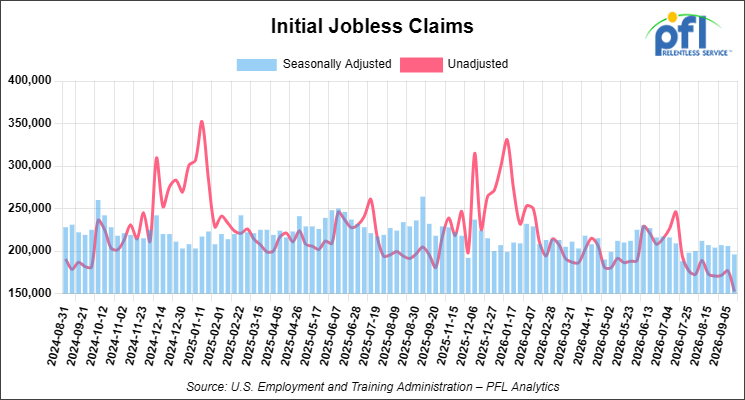
Continuing jobless claims came in at 1,730,000, versus the adjusted number of 1,769,000 people from the week prior, down 39,000 week-over-week.
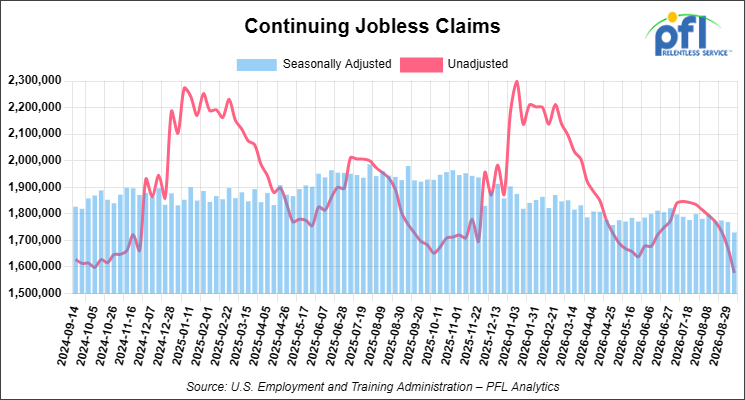
Stocks closed mixed on Friday of last week and mixed week-over-week
The DOW closed lower on Friday of last week, down -95.40 points (-0.18%), closing out the week at 51,682.64, down -890.65 points week-over-week. The S&P 500 closed higher on Friday of last week, up 12.74 points (0.17%), and closed out the week at 7,650.50, down -6.48 points week-over-week. The NASDAQ closed higher on Friday of last week, up 104.25 points (0.39%), and closed out the week at 26,522.55, up 189.51 points week-over-week.
In overnight trading, DOW futures traded higher and are expected to open at 52,462 this morning, up +383 points from Friday’s close.
Crude oil closed lower on Friday of last week, but mixed week-over-week
West Texas Intermediate (WTI) crude closed down -$1.61 per barrel (-1.58%), to close at $100.30 on Friday of last week, but up $0.25 per barrel week-over-week. Brent crude closed down -$0.95 per barrel (-0.93%), to close at $103.87, and down $0.74 per barrel week-over-week.
One Exchange WCS (Western Canadian Select) for November delivery settled on Friday of last week at US$19.75 below the WTI-CMA (West Texas Intermediate – Calendar Month Average). The implied value was US$71.60 per barrel.
U.S. commercial crude oil inventories (excluding those in the Strategic Petroleum Reserve) decreased by 640,000 barrels week-over-week at 423.4 million barrels, U.S. crude oil inventories are 1% above the five-year average for this time of year.
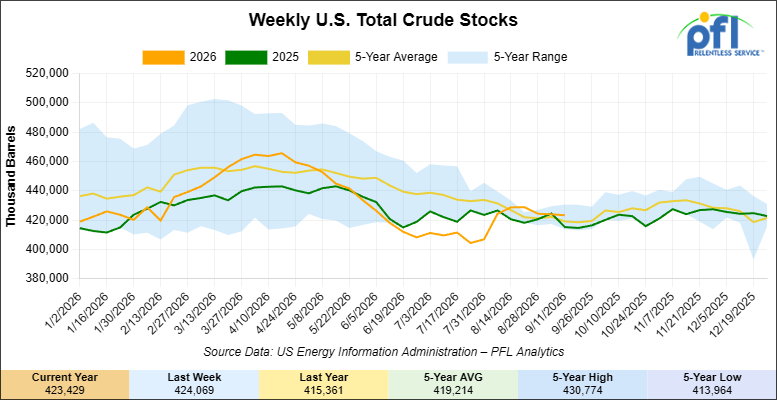
Total motor gasoline inventories increased by 794,000 barrels week-over-week and are 5% below the five-year average for this time of year.
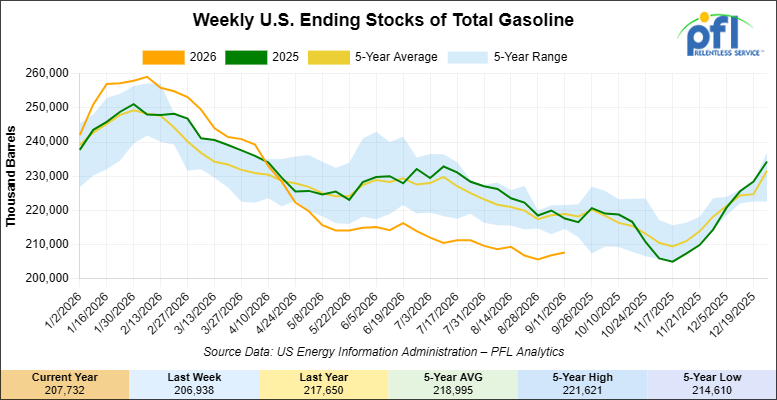
Distillate fuel inventories increased by 1.6 million barrels week-over-week and are 12% below the five-year average for this time of year.
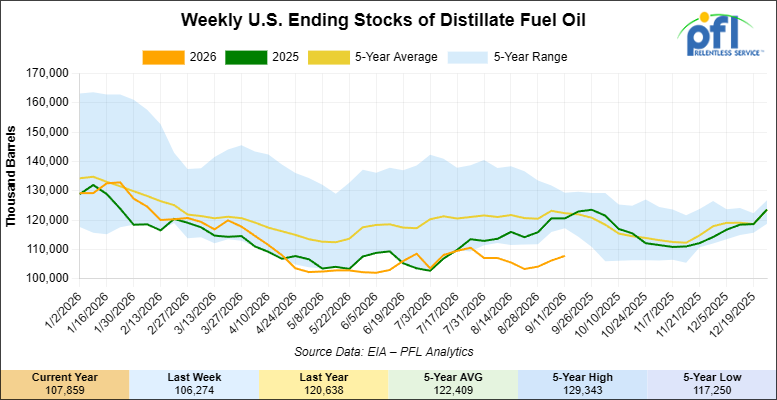
Propane/propylene inventories decreased by 1.4 million barrels week-over-week and are 21% above the five-year average for this time of year.
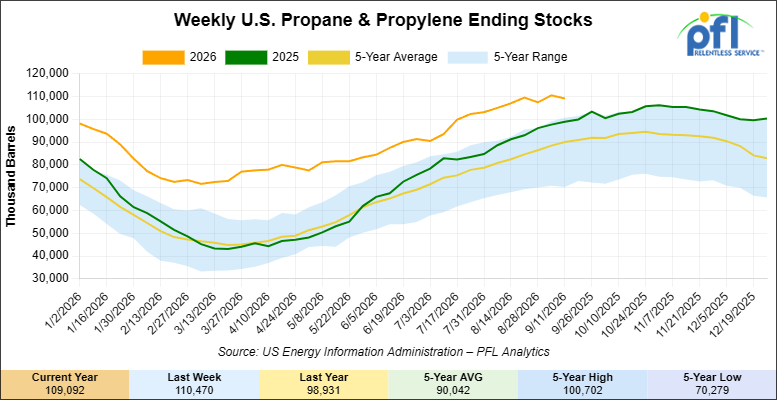
Propane prices closed at 84.4 cents per gallon on Friday of last week, up 9.1 cents per gallon week-over-week, and up 16.2 cents year-over-year.
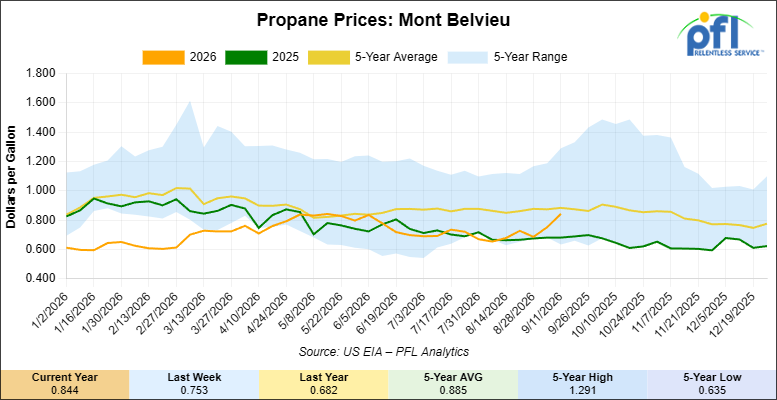
Overall, total commercial petroleum inventories increased by 2.6 million barrels week-over-week during the week ending September 11, 2026.
U.S. crude oil imports averaged 7.1 million barrels per day during the week ending September 11, 2026, an increase of 234,000 barrels per day week-over-week. Total motor gasoline imports (including both finished gasoline and gasoline blending components) averaged 537,000 barrels per day, and distillate fuel imports averaged 114,000 barrels per day during the week ending September 11, 2026.
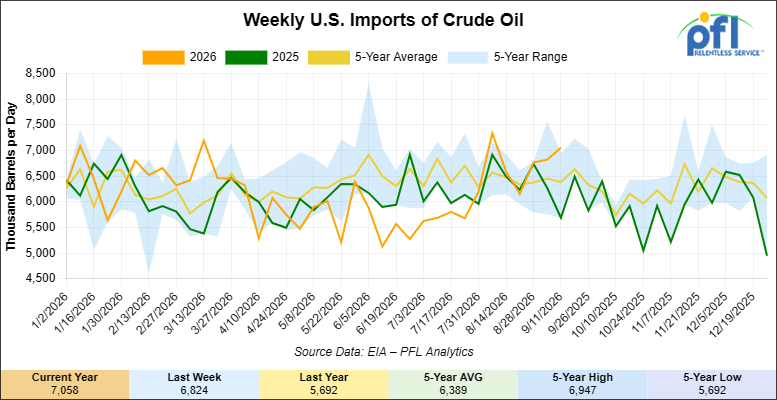
U.S. crude oil exports averaged 4.831 million barrels per day during the week ending September 11, 2026, an increase of 1.414 million barrels per day week-over-week. Over the past four weeks, crude oil exports averaged 4.131 million barrels per day.
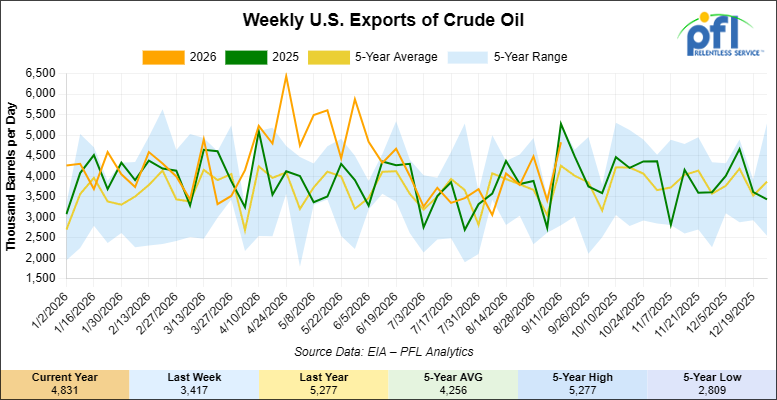
U.S. crude oil refinery inputs averaged 17.3 million barrels per day during the week ending September 11, 2026, which was 256,000 barrels per day less week-over-week.
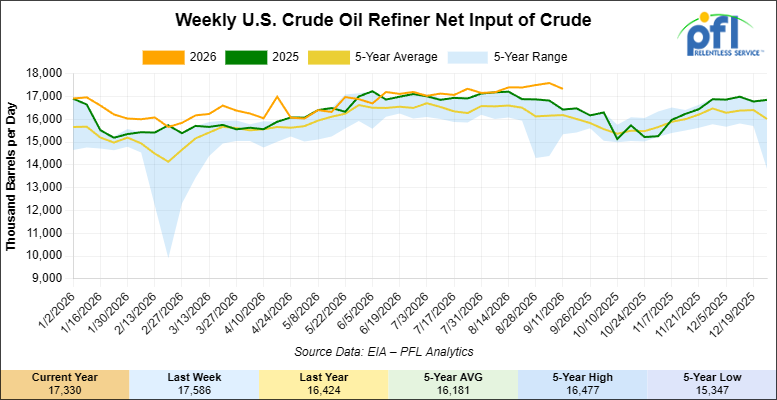
WTI is poised to open at $93.27, down $2.81 per barrel from Friday’s close.
North American Rail Traffic
Week Ending September 16, 2026:
Total North American weekly rail volumes were down (-2.14%) in week 38, compared with the same week last year. Total Carloads for the week ending September 16, 2026 were 324,563, down (-0.97%) compared with the same week in 2025, while weekly Intermodal volume was 331,123, down (-3.26%) year over year. 6 of the AAR’s 11 major traffic categories posted year-over-year increases. The largest decrease came from Motor Vehicles and Parts (-12.57%). The largest increase was Grain (+13.49%).
In the East, CSX’s total volumes were down (-5.68%), with the largest decrease coming from Nonmetallic Minerals (-17.17%), while the largest increase came from Forest Products (+9.39%). NS’s total volumes were down (-5.68%), with the largest increase coming from Grain (+17.38%), while the largest decrease came from Motor Vehicles and Parts (-16.19%).
In the West, BNSF’s total volumes were up (+1.42%), with the largest increase coming from Metallic Ores and Metals (+20.17%), while the largest decrease came from Other (-12.16%). UP’s total volumes were down (-0.62%), with the largest increase coming from Grain (+25.41%), while the largest decrease came from Other (-20.67%).
In Canada, CN’s total volumes were down (-0.74%), with the largest increase coming from Grain (+28.58%), while the largest decrease came from Motor Vehicles and Parts (-13.09%). CPKCS’s total volumes were down (-1.04%), with the largest increase coming from Farm Products (+27.75%), while the largest decrease came from Petroleum & Petroleum Products (-26.76%).
Source Data: AAR – PFL Analytics
North American Rig Count Summary
North American rig count was down by -6 rigs week-over-week. The U.S. rig count was up by +4 rigs week-over-week, and up by +53 rigs year-over-year. The U.S. currently has 595 active rigs. Canada’s rig count was down by -10 rigs week-over-week, but up by +8 rigs year-over-year. Canada currently has 197 active rigs. Overall, year-over-year we are up by +61 rigs collectively.
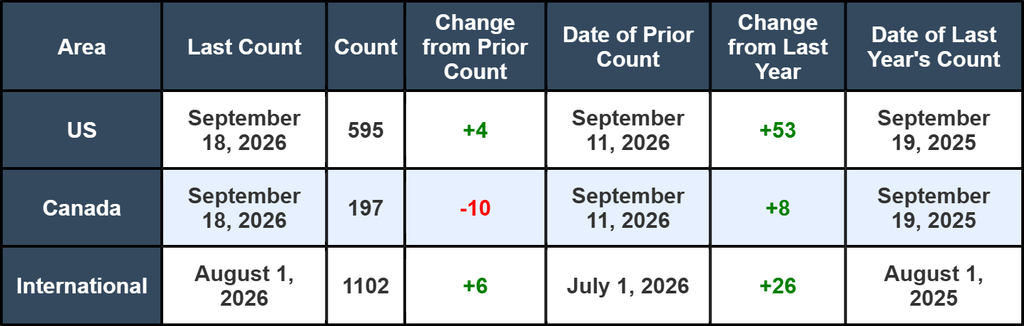
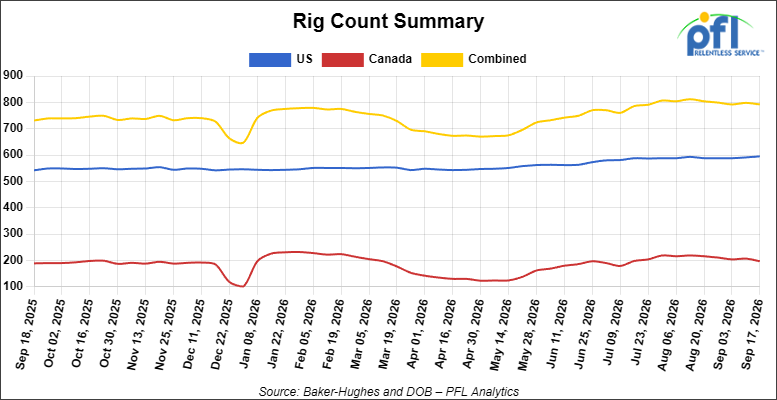
We are watching a few things out there for you:
We Are Watching Petroleum Carloads
The four-week rolling average of petroleum carloads carried on the six largest North American railroads fell to 29,930 from 30,123 which was a decrease of -193 rail cars week-over-week. Canadian volumes were mixed. CPKC’s shipments were up by +5.0% week-over-week, CN’s volumes were lower by -5.0% week-over-week. U.S. shipments were also mixed. The CSX had the largest percentage increase and was up by +5.0% week-over-week. The NS had the largest percentage decrease and was down by -9.0% week-over-week.
We Continue to Watch Our Strategic Petroleum Reserves
The ongoing emergency drawdown of the U.S. Strategic Petroleum Reserve (SPR) remains a major component of global efforts to offset crude oil supply disruptions stemming from the conflict involving Iran and the continued restrictions on oil shipments through the Strait of Hormuz. Since March, the Department of Energy (DOE) has awarded exchanges covering more than 133 million barrels of crude oil, with additional releases expected as part of a broader international response coordinated through the International Energy Agency (IEA).
The United States continues to execute its commitment to make available up to 172 million barrels from the SPR under the IEA’s collective plan to inject roughly 400 million barrels into global energy markets. Officials have argued that the releases are necessary to help stabilize crude supplies and limit further increases in fuel prices as refiners compete for replacement barrels amid ongoing transportation disruptions. The IEA’s coordinated action remains the largest emergency oil-stock release in the agency’s history.
As releases have accelerated, inventories in the SPR have declined to 284.957 million barrels, down from 415.442 million barrels at the start of the conflict with Iran and reaching their lowest level since October 1982. The SPR declined by 403,000 barrels during the week ending September 11th. Since the first SPR drawdown began, the United States has withdrawn approximately 130.485 million barrels, equivalent to an average of roughly 745,629 barrels per day through the week ending September 11, 2026.
Global petroleum inventories have also tightened considerably. The IEA has reported substantial draws in commercial crude and refined-product stockpiles across major consuming nations, underscoring the strain that the conflict has placed on world energy markets. While oil flows through the Strait of Hormuz have partially recovered from their initial near-shutdown, the IEA continues to identify significant uncertainty surrounding the pace and durability of the recovery.
The Administration continues to emphasize that the current program consists primarily of exchange agreements, rather than outright sales. Under these arrangements, companies receiving crude oil today are required to return the borrowed barrels in the future along with additional volumes as a premium. DOE has stated that its exchange structure is designed to return the borrowed crude with additional premium barrels, with the stated objective of strengthening the SPR over time.
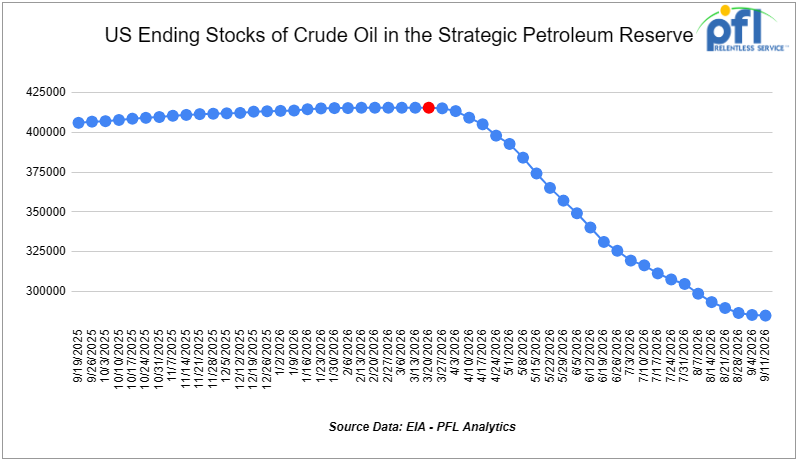
We Continue to watch Canadian Crude Dynamics
ExxonMobil’s 264,000 barrel per day Joliet refinery, built to run Canadian heavy, went down after a power outage on Sunday, September 13th. One Exchange WCS (Western Canadian Select) for October delivery settled on Monday of last week at US$17.35 below the WTI-CMA (West Texas Intermediate – Calendar Month Average) up from $16.75 the Friday before on the back of the outage. November barrels traded as wide as $20.15 under, the widest discount since December 2023. By Friday of last week that basis settled at US$19.75 below the WTI-CMA. The implied value was US$71.60 per barrel.
The pressure is coming from multiple directions. Upgrader turnarounds at Syncrude and Suncor’s Base Plant are pushing bitumen into the heavy pool into mid-October, and U.S. imports from Venezuela reached 782,000 barrels per day in the week ended September 11th, the highest since August 2017. Once maintenance wraps up, record production runs into full pipes, and the next relief is roughly 90,000 barrels per day of added Trans Mountain capacity expected in December or January.
Canadian crude exports by rail were 81,226 barrels per day in June, the latest CER data, down from 87,977 in May. With November trading close to, or at, $20 under, the spread has pushed through the level that has historically moved barrels by rail, but it has yet to hold there and the Venezuela factor is now at play. The higher Venezuela import numbers are having an impact on Canadian heavy barrels in the gulf itself. Crude by rail is not a swing: 117J coiled and insulated cars are scarce, new builds take one to two years, and car owners and Class Ones both want five-year commitments. It is just not a transportation play anymore.
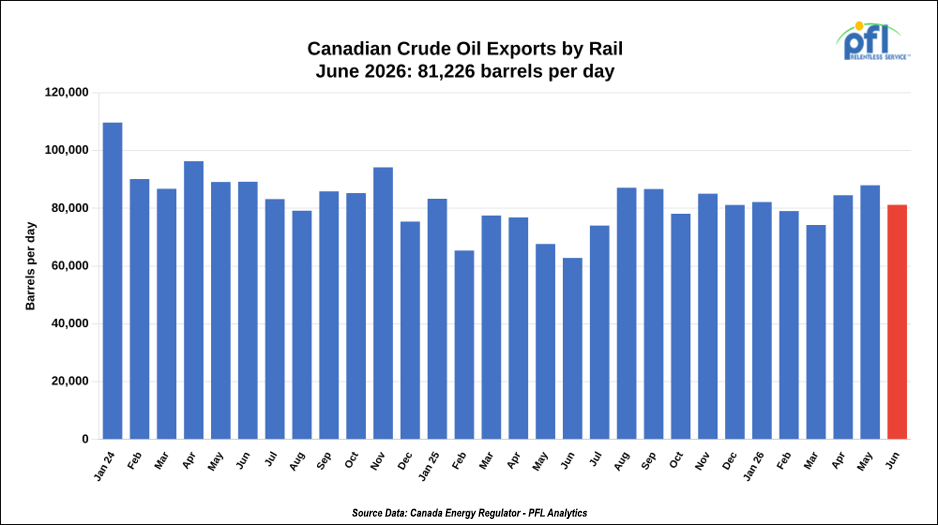
Updated Canadian crude by rail numbers for July 2026 are expected to be out sometime this week.
There is no question about it, set politics aside Canada does need a pipeline now. Biden canceling the Keystone was a huge mistake not only for the Canadian producer but the U.S. and the free world’s energy security. On basis alone, the volumes currently moving on other pipelines are costing Canadian producers $22 million dollars per day. Crude by rail is going to get interesting real soon – do barrels get moved on a railcar or do they get shut in? It’s a balancing act, folks.
We Are Watching Propane
U.S. propane inventories drew 1.4 million barrels in the week ended September 11th to 109.1 million barrels, and exports jumped to 2.213 million barrels per day. Fundamentals look soft, yet flat prices at Conway and Mont Belvieu are up roughly 10 cents per gallon since the start of September as propane trades off crude and the Middle East.
North of the border the picture is lopsided. Western Canadian propane stocks stood at 7.78 million barrels on September 1st, 13% above a year ago, while eastern Canada sat at 2.81 million barrels, about 11% below a year ago levels. That east-west gap heading into heating season is the kind of imbalance that tends to move by pressure car. We’ll keep our eye on this one; pressure car availability has tightened and if winter comes early it will be all hands on deck.
We Continue to Watch Enbridge
Enbridge put Line 5 back in service on Monday of last week, running product around the damaged section near Saxon, Wisconsin on a temporary bypass it finished two days earlier. The restart went ahead even though the Wisconsin Department of Natural Resources had issued Enbridge a notice of non-compliance the week before, ordering it to halt the bypass work. The line had been down since August 25th, when an unoccupied truck rolled into an open work area on the reroute and broke a valve, releasing roughly 1.3 million gallons of natural gas liquids.
Enbridge’s case for moving fast was propane. The company said three propane fractionators would have been left without feedstock heading into the heating season had Line 5 stayed down. On the crude side, Enbridge apportioned October heavy crude nominations on the Mainline by 4% and light by 8%, well under the double-digit rationing many shippers had braced for, but that seems to reflect oil sands turnarounds that run into mid-October more than any real slack in the system. November is the month to watch, when upgraders come back and fourth-quarter Alberta crude and condensate output heads toward 5.1 million barrels per day with no new egress in place.
Plains All American agreed last week to buy Silver Creek’s Powder River Basin crude assets for $585 million, including a 49% stake in the 240,000 barrel per day Powder River Gateway joint venture. That makes Plains Enbridge’s partner in Powder River Gateway, one week after Enbridge picked up Tallgrass’s 51% stake as part of its $2.55 billion deal. Enbridge also opened a non-binding open season for West Texas Express, a proposed 2 billion cubic feet per day Permian gas line to El Paso aimed at a late 2029 start. Enbridge is buying and building in Wyoming and Texas while the second phase of Mainline Optimization sits on the shelf. We’ll keep our eye on the November notice.
We Continue to Watch Left Wing Carney
Prime Minister Carney spent last week in Europe. Last Wednesday, European Commission President Ursula von der Leyen used her State of the Union address, with Carney in the room, to invite Canada to become the EU’s first associate member. President Trump answered the same day, calling the idea laughable and threatening “very serious tariffs” on Europe if he judged it a hostile act. Carney told the European Parliament on Thursday of last week that Canada welcomes the ambition and promised a vote in Parliament on the final structure.
Part of the pitch in Strasbourg was Canadian energy security for Europe through new port infrastructure in the High North and on the East Coast. None of that exists. What does exist, however, is a heavy barrel that seemingly can’t find a home.
The one project that could change that math is still on paper. Public comment on the West Coast Oil Pipeline closed last Friday, and the Implementation Agreement targets a national interest designation by October 1st. Even on that schedule construction would not start before September 2027, and a federal official has said oil may not flow until 2033 or 2034. That is most of a decade of Alberta heavy fighting Venezuela for the same Gulf Coast coking capacity. In our opinion, courting a new trading club in Brussels does nothing for a barrel stuck in Hardisty and does not do very much for Canada for that matter except stroke Carney’s ego.
We Continue to Watch Diesel
The EIA’s weekly U.S. on-highway diesel average jumped 31.8 cents to $6.285 per gallon for the week of September 14th, the highest in the survey’s history and 68% above a year ago. Every region now averages above $6, with the West Coast at $7.25 and California at $8.039. The prior record of $5.81, set in June 2022, has been cleared by almost 48 cents.
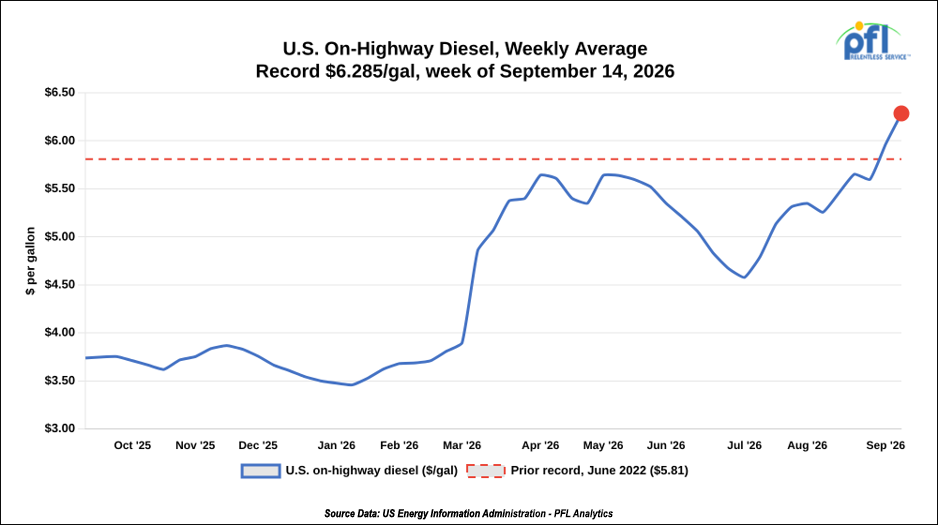
The railroads spent last week at Morgan Stanley’s Laguna conference calling it a double-edged sword. Norfolk Southern’s CFO Jason Zampi described elevated fuel for the rest of the year as a significant headwind, but said freight is coming to NS because of extraordinary truck costs, and not only intermodal: lumber, steel and metals are converting too. UP’s CFO Jennifer Hamann said UP’s traffic is up 5% quarter to date, and for the first time since 2018, UP has all of its domestic intermodal containers deployed. Spot truckload rates moved above contract rates earlier in September for the first time since 2021.
There is little relief coming from the supply side. U.S. refiners are running at the highest rates since 2004, Interior Secretary Doug Burgum said on Monday of last week that an export ban is not on the table, and Energy Secretary Chris Wright floated Defense Production Act money for refinery expansions. Saudi Arabia’s East-West pipeline, its only export route that bypasses Hormuz, has been shut since the drone strike of September 11th. The truck-to-rail shift is real, and carload shippers would do well to look at their car needs before equipment gets as tight as UP’s container pool. We are watching this one.
We Continue to Watch Renewables
Major Renewable Identification Number (RIN) credit values fell to three-week lows last week as the BOHO spread fell into negative territory for the first time since 2019. Prices for Ethanol-related D6 and biomass-based diesel D4 RINs were lower every day last week. BOHO measures the price differential between soybean oil (a key biofuels feedstock commonly known as bean oil, or BO) and ULSD (also known as heating oil, or HO). It affects the economics of biofuels blending and provides a gauge for the feasibility of producing a typical BO-derived gallon of biomass-based diesel versus traditional petroleum-based diesel.
D4 RINs closed out the day (and the week) on Friday of last week at $1.96 per RIN, down 10 cents per RIN day-over-day, and down 21 cents per RIN week-over-week. Meanwhile, D6 RINs closed out the day (and the week) at $1.90 per RIN, also down 10 cents per RIN day-over-day, and down 21 cents per RIN week-over-week.
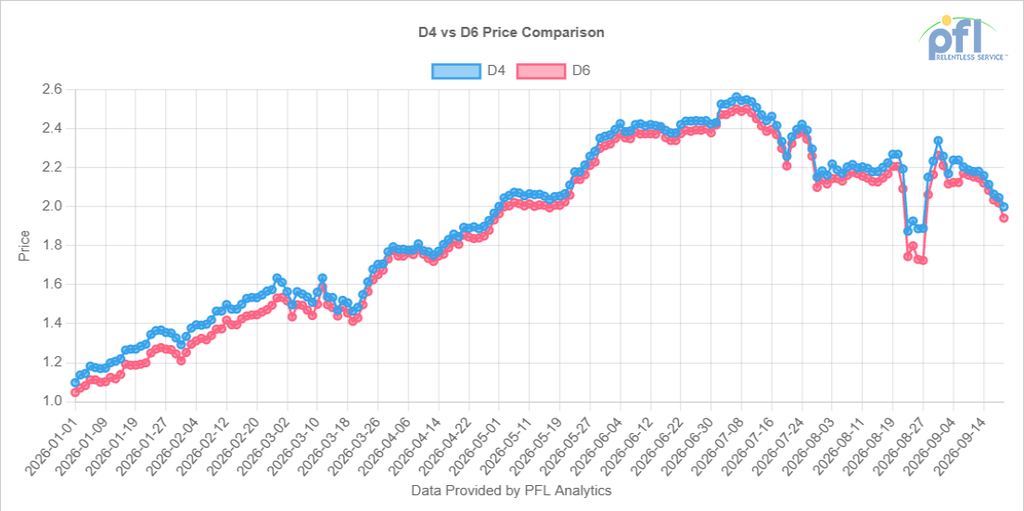
In Ethanol news. The Senate Committee on Agriculture, Nutrition and Forestry narrowly advanced the pending farm bill on Wednesday of last week, which includes a package to allow for year-round access to E15.
In a 12-11 vote, the committee passed the package along party lines following the return of Republican Sen. Mitch McConnell of Kentucky from a prolonged absence due to a fall in June.
Notably, the package includes a provision that would allow for year-round blending of E15 while also significantly constraining the small refinery exemption (SRE) program under the Renewable Fuel Standard (RFS).
We Continue to Watch the UP and NS Merger
Union Pacific CEO Jim Vena used his Laguna appearance last Wednesday to reject the trackage rights his competitors want as the price of approval, saying a long-distance rights deal does not “make a particle of sense in business.” UP’s merger agreement lets it walk away if the Surface Transportation Board attaches onerous conditions, at the cost of a $2.5 billion breakup fee to Norfolk Southern.
BNSF laid out its asks in a filing on September 9th: overhead trackage rights over about 824 miles of NS between Chicago and Bethlehem, Pennsylvania, and a neutral switching or terminal railroad serving every BNSF and UP-served facility on the Gulf Coast from Corpus Christi to the west bank of the Mississippi. CPKC wants more access to UP’s Gulf network between Robstown and Beaumont and around Baton Rouge. For tank car shippers, the Gulf Coast request is the one that matters, since BNSF argues many plants in the country’s largest chemical-producing region are captive to UP.
CN has already cut its deal with UP, and CEO Tracy Robinson said at Laguna that CN would provide competitive options at two-to-one and three-to-two points if the merger goes ahead. Notices of intent to participate are due September 30th, and comments and requests for conditions are due November 18th. Whether this deal survives may come down to how many conditions the STB is willing to attach. PFL’s Gulf Coast clients have the most at stake here, and we will keep our eye on the November filings.
We are Watching Class 1 Industry Headcount
Class I railroads employed 114,460 workers in the United States in August 2026, a -0.24% decrease from July 2026’s count of 114,738 and a -3.18% year-over-year decrease from August 2025’s total of 118,223, according to Surface Transportation Board data.
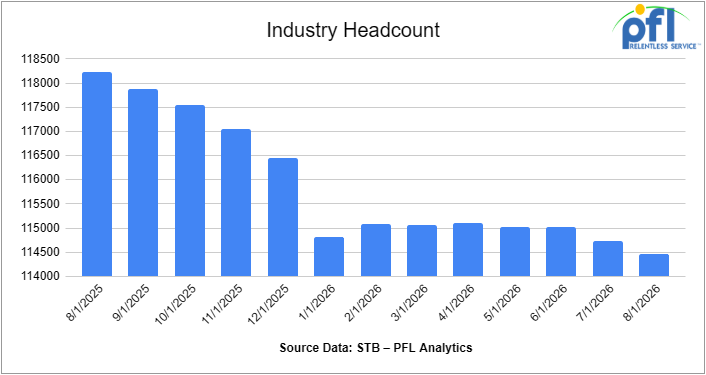
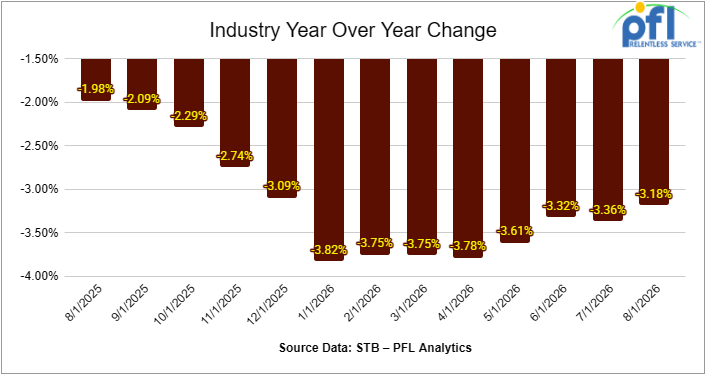
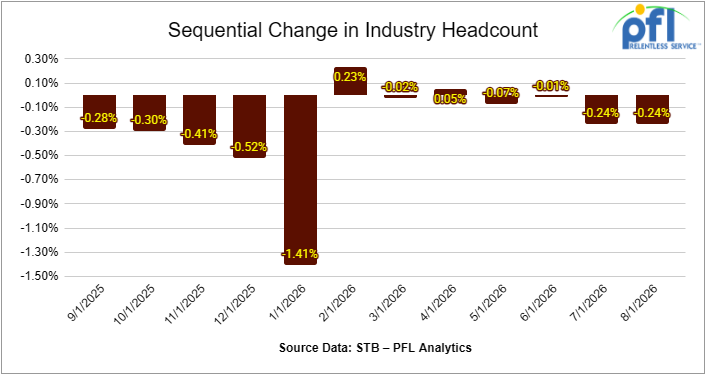
One of the six employment categories posted a month-over-month increase between July and August 2026. Transportation (train and engine) increased 0.13% to 49,020 workers.
The categories that posted month-over-month decreases were Executives, officials, and staff assistants, down -0.60% to 7,912 workers; Professional and Administrative, down -1.38% to 8,747 workers; Maintenance of Way and Structures, down -0.15% to 28,491 workers; Maintenance of Equipment and Stores, down -0.75% to 15,682 workers; and Transportation (other than train and engine), down -0.26% to 4,608 workers.
No employment categories posted a year-over-year gain in August 2026.
Categories that registered year-over-year decreases in August 2026 were Executives, officials, and staff assistants, down -2.93%; Professional and Administrative, down -4.72%; Maintenance of Way and Structures, down -1.79%; Maintenance of Equipment and Stores, down -5.31%; Transportation (other than train and engine), down -5.84%; and Transportation (train and engine), down -2.79%.
We are Watching Key Economic Indicators
Industrial Output and Capacity Utilization
Manufacturing accounts for approximately 75% of total output. Industrial output in August increased 0.02% from July 2026.
Capacity utilization is a measure of how fully firms are using machinery and equipment. Capacity utilization in August decreased 0.08% from July 2026.
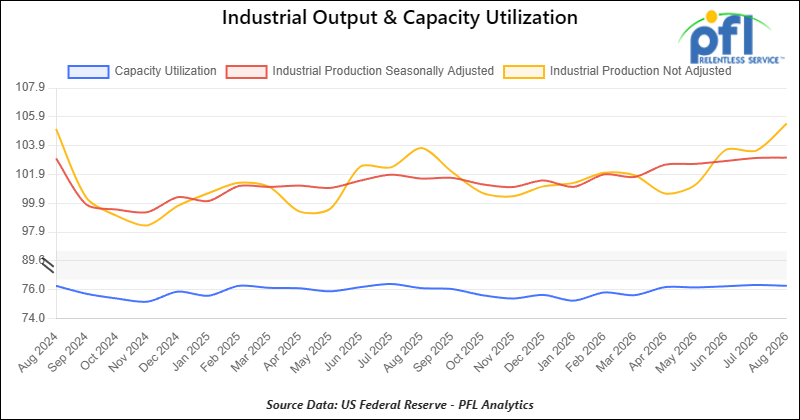
Lease Bids
- 20-50, 4000-5000 Covered Hoppers located off of UP or BNSF in Houston. For use in Urea, Potash, and Ammonium Sulfate service. Period: 6-12 Months.
- 300, 5200CF Covered Hoppers located off of CP or CM in Canada. For use in Petcoke service. Period: 3 Year.
- 100, 340W Pressure Tank located off of CN or CP in Canada. For use in Propane service. Period: 6 Months.
- 10-20, 3200 or 3281 Covered Hoppers located off of CN or CP in Canada. For use in Sodium Sulphate service. Period: 3-5 years. Lined.
- 50, 340W Pressure Tanks located off of CN or CP in Canada. For use in Propane service. Period: Winter.
- 30-50, 340W pressure Tanks located off of NS or CSX in Northeast U.S. For use in Propane service. Period: Winter.
- 25, 340W Pressure Tanks located off of UP or BN in US. For use in Propane service. Period: Winter.
- 50, 28.3K 117J Tanks located off of BNSF in Kansas/Oklahoma. For use in Fuel Oil service. Period: 6 Months.
- 100, 30K 117J Tanks located off of CN in Canada. For use in Diesel service. Period: 1 year.
- 150, 340W Pressure Tank located off of CN in Canada. For use in Propane service. Period: 3 Months.
Sales Bids
- 28, 3400CF Covered Hoppers located off of UP or BNSF in Texas. For use in Cement service. Cement Gates needed.
- 20, 17K DOT111 Tanks located off of various class 1s in various locations. For use in corn syrup service.
- 120, Various Open-Top Aluminum Rotary Gondolas located off of various class 1s in various locations. For use in Sulphur service. Built 2004 or later.
- 12, 21.5K-25K DOT 111 Tanks located off of Various Class 1s in Michigan. For use in Diesel, Asphalt, Crude service. Coiled and Insulated.
Lease Offers
- 21, 6351 Covered Hoppers located off of CN in Wisconsin. Last used in DDG. Available until February 2027.
- 29, 6500 Covered Hoppers located off of CN in Wisconsin. Last used in DDG. Available until February 2027.
- 15, 6200CF Covered Hoppers located off of all class 1s in Wisconsin. Last used in plastic. Cars are currently clean.
- 30, 6500CF Covered Hoppers located off of all class 1s in Wisconsin. Last used in plastic. Cars are currently clean.
- 100, 28.4K DOT 117J Tanks located off of UP or BNSF in Beaumont, TX. Cars are currently clean.
- 50, 30K DOT117J Tanks located off of UP or BNSF in the South. Last used in ethanol.
- 41, 30K DOT 111 Tanks located off of in Brownsville. Last used in Diesel. Cars are currently clean.
- 93, 31.8K CPC 1232 Tanks located off of Various Class 1s in Texas. Last used in Diesel. Cars are currently clean.
- 22, 21K DOT 115 Stainless Steel Tank located off of BNSF in Texas. Cars are currently clean. Cars are currently clean.
Sales Offers
- 81, 31.8K CPC1232 Tanks located off of UP or BNSF in TX. Last used in Multiple Services. Requal Due in 2025.
- 35, 3400CF Covered Hoppers located off of UP or BNSF in the Midwest. Last used in Sand.
- 15, 5750 CF Hopper located off of CSX, NS, CP, CN, BNSF, UP in St Louis. Last used in Grain.
- 50, 30 DOT 111 Tank located off of multiple class 1s in multiple location. Last used in Fuels.
Call PFL today to discuss your needs and our availability and market reach. Whether you are looking to lease cars, lease out cars, buy cars, or sell cars call PFL today at 239-390-2885
Railcar for Sale or Lease
| CAT | Type | Capacity | GRL | QTY | LOC | Class | Prev. Use | Offer | Note |
|---|
| CAT | Type | Size | GRL | QTY | LOC | Class | Term | Commodity | Offer | Note |
|---|
| CAT | Type | Capacity | GRL | QTY | LOC | Class | Prev. Use | Clean | Offer | Note |
|---|
| CAT | Type | Capacity | GRL | QTY | LOC | Class | Commodity | Offer | Note |
|---|
PFL will be at the Following Conferences
- Where: The Westin Galleria Dallas
- Attending: David Cohen (954-729-4774), and Curtis Chandler (239-405-3365)
- Conference Website
- Where: The Westin Galleria Dallas
- Attending: Brian Baker (239.297.4519)
- Conference Website
The post PFL Railcar Report 9-21-2026 appeared first on PFL Petroleum Services LTD.
]]>The post PFL Railcar Report 9-14-2026 appeared first on PFL Petroleum Services LTD.
]]>Jobs Update
Initial jobless claims seasonally adjusted for the week ending September 5, 2026 came in at 206,000, versus the adjusted number of 207,000 people from the week prior, down 1,000 people week-over-week.
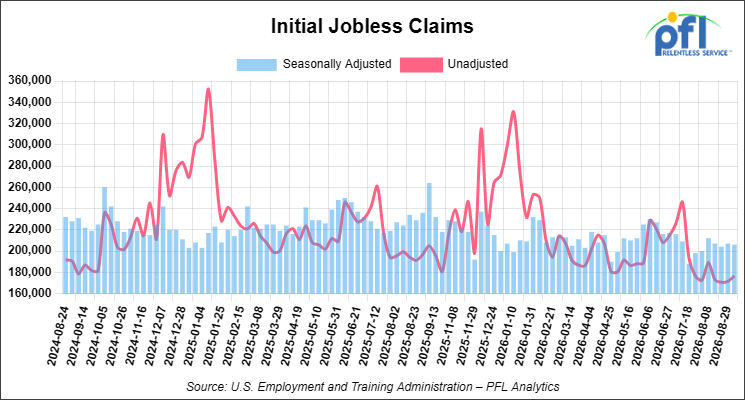
Continuing jobless claims came in at 1,774,000, versus the adjusted number of 1,775,000 people from the week prior, down 1,000 week-over-week.
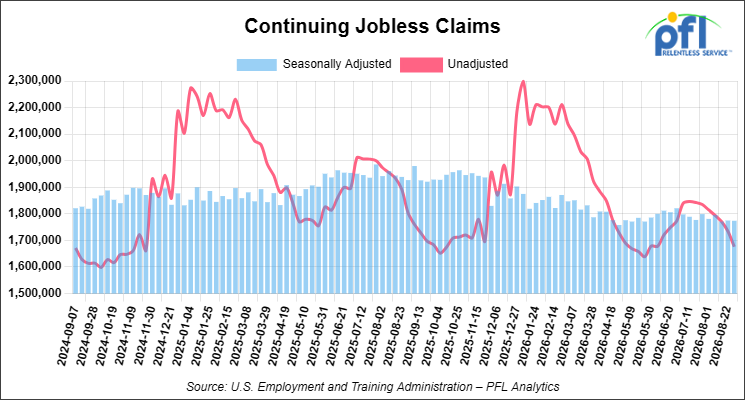
Stocks closed higher on Friday of last week, but lower week-over-week
The DOW closed higher on Friday of last week, up 509.19 points (0.98%), closing out the week at 52,573.29, down -840.96 points week-over-week. The S&P 500 closed higher on Friday of last week, up 65.28 points (0.86%), and closed out the week at 7,656.98, down -61.62 points week-over-week. The NASDAQ closed higher on Friday of last week, up 251.31 points (0.96%), and closed out the week at 26,333.04, down -173.95 points week-over-week.
In overnight trading, DOW futures traded lower and are expected to open at 52,871 this morning, down -131 points from Friday’s close.
Crude oil closed lower on Friday of last week, but higher week-over-week
West Texas Intermediate (WTI) crude closed down -2.43 per barrel (-2.37%), to close at $100.05 on Friday of last week, but up $8.57 per barrel week-over-week. Brent crude closed down -3.02 per barrel (-2.81%), to close at $104.61, but up $11.93 per barrel week-over-week.
One Exchange WCS (Western Canadian Select) for October delivery settled on Friday of last week at US$16.40 below the WTI-CMA (West Texas Intermediate – Calendar Month Average). The implied value was US$80.51 per barrel.
U.S. commercial crude oil inventories (excluding those in the Strategic Petroleum Reserve) decreased by 391,000 barrels week-over-week. At 424.1 million barrels, U.S. crude oil inventories are at the five-year average for this time of year.
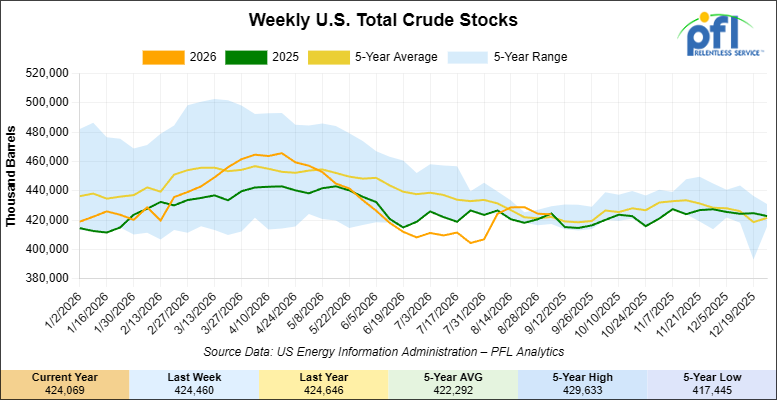
Total motor gasoline inventories increased by 1.3 million barrels week-over-week. and are 5% below the five-year average for this time of year.
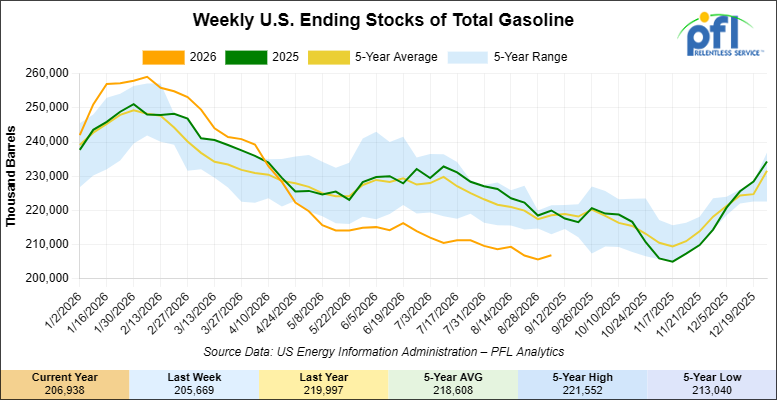
Distillate fuel inventories increased by 2.1 million barrels week-over-week. and are 14% below the five-year average for this time of year.
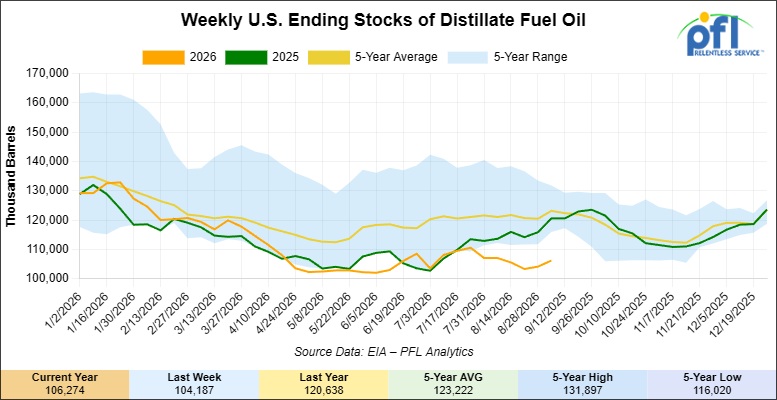
Propane/propylene inventories increased by 3.1 million barrels week-over-week. and are 25% above the five-year average for this time of year.
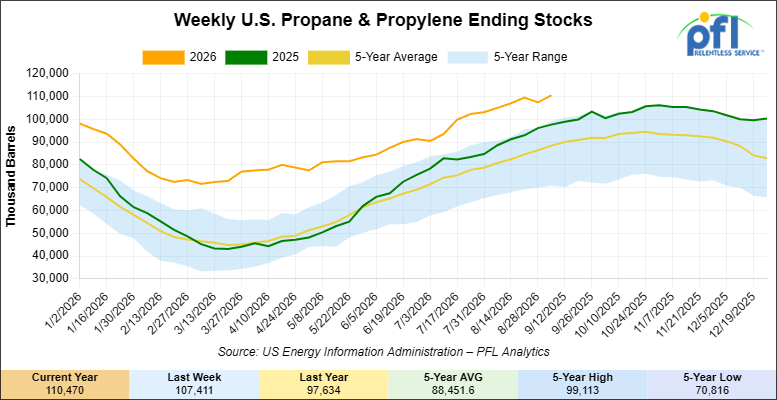
Propane prices closed at 75.3 cents per gallon on Friday of last week, up 6.6 cents per gallon week-over-week, and up 7.1 cents year-over-year.
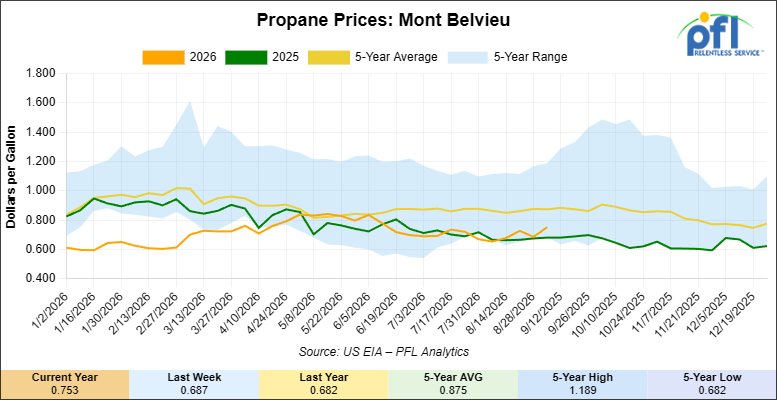
Overall, total commercial petroleum inventories increased by 6.3 million barrels week-over-week during the week ending September 4, 2026.
U.S. crude oil imports averaged 6.8 million barrels per day during the week ending September 4, 2026, an increase of 54,000 barrels per day week-over-week. Total motor gasoline imports (including both finished gasoline and gasoline blending components) averaged 464,000 barrels per day, and distillate fuel imports averaged 185,000 barrels per day during the week ending September 4, 2026.
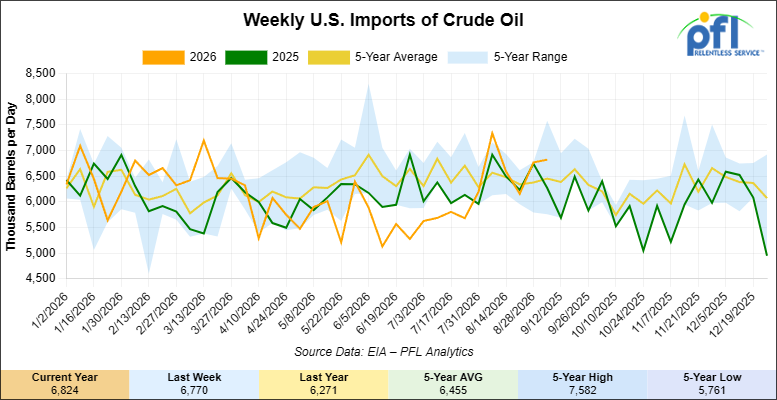
U.S. crude oil exports averaged 3.417 million barrels per day during the week ending September 4, 2026, a decrease of 1.066 million barrels per day week-over-week. Over the past four weeks, crude oil exports averaged 3.94 million barrels per day.
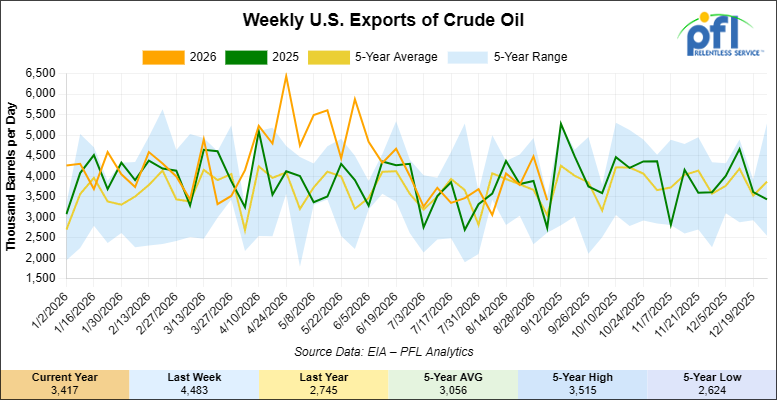
U.S. crude oil refinery inputs averaged 17.6 million barrels per day during the week ending September 4, 2026, which was 90,000 barrels per day more week-over-week.
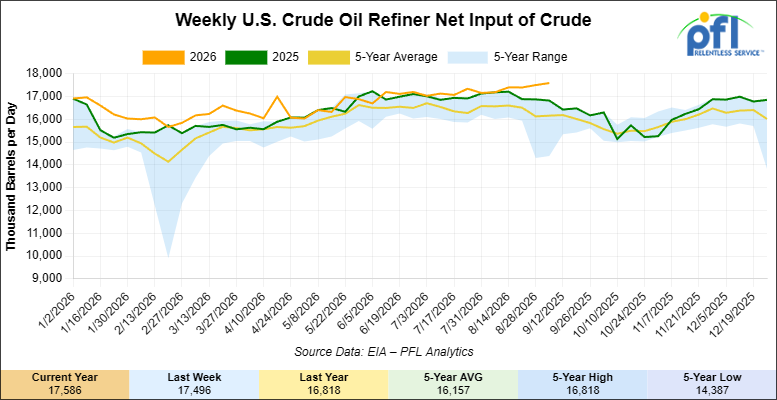
WTI is poised to open at $102.63, up $2.58 per barrel from Friday’s close.
North American Rail Traffic
Week Ending September 9, 2026:
Total North American weekly rail volumes were up (+12.34%) in week 37, compared with the same week last year. Total Carloads for the week ending September 9, 2026 were 336,311, up (+8.39%) compared with the same week in 2025, while weekly Intermodal volume was 362,779, up (+16.26%) year over year. 11 of the AAR’s 11 major traffic categories posted year-over-year increases. The largest increase was Grain (+21.05%).
In the East, CSX’s total volumes were up (+10.65%), with the largest decrease coming from Petroleum & Petroleum Products (-13.31%), while the largest increase came from Metallic Ores and Metals (+35.22%). NS’s total volumes were up (+8.85%), with the largest increase coming from Petroleum & Petroleum Products (+24.90%), while the largest decrease came from Coal (-12.67%).
In the West, BNSF’s total volumes were up (+15.24%), with the largest increase coming from Grain (+28.93%), while the largest decrease came from Chemicals (-3.04%). UP’s total volumes were up (+18.06%), with the largest increase coming from Intermodal Units (+26.36%), while the largest decrease came from Farm Products (-3.50%).
In Canada, CN’s total volumes were up (+4.74%), with the largest increase coming from Other (+35.22%), while the largest decrease came from Intermodal Units (-18.15%). CPKCS’s total volumes were up (+0.86%), with the largest increase coming from Grain (+23.09%), while the largest decrease came from Other (-31.22%).
Source Data: AAR – PFL Analytics
North American Rig Count Summary
North American rig count was up by +6 rigs week-over-week. The U.S. rig count was up by +3 rigs week-over-week, and up by +52 rigs year-over-year. The U.S. currently has 591 active rigs. Canada’s rig count was up by +3 rigs week-over-week and up by +21 rigs year-over-year. Canada currently has 207 active rigs. Overall, year-over-year we are up by +73 rigs collectively.
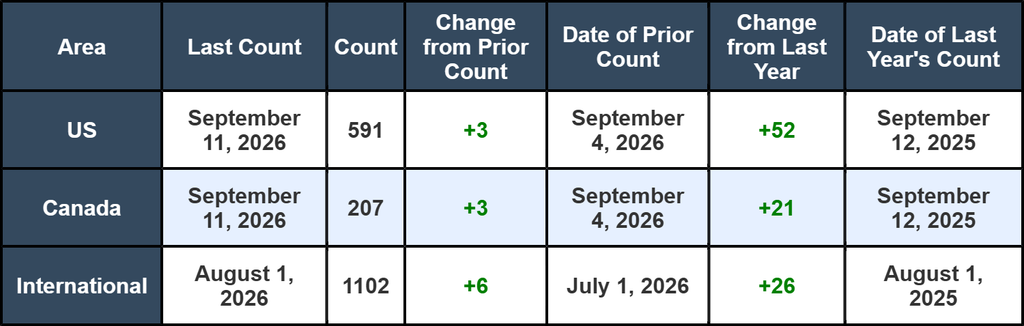
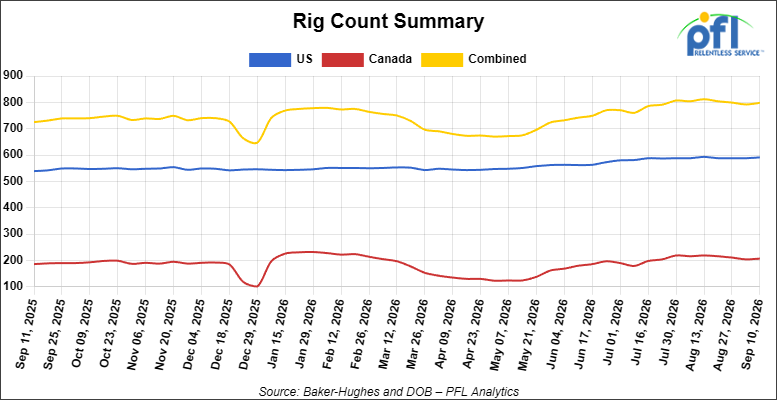
We are watching a few things out there for you:
We Are Watching Petroleum Carloads
The four-week rolling average of petroleum carloads carried on the six largest North American railroads fell to 30,123 from 30,487 which was a decrease of -364 rail cars week-over-week. Canadian volumes were mixed. CN’s shipments were up by +6.0% week-over-week, CPKC’s volumes were lower by -14.0% week-over-week. U.S. shipments were also mixed. The UP had the largest percentage increase and was up by +7.0% week-over-week. The CSX had the largest percentage decrease and was down by -9.0% week-over-week.
We Continue to Watch Our Strategic Petroleum Reserves
The ongoing emergency drawdown of the U.S. Strategic Petroleum Reserve (SPR) remains a major component of global efforts to offset crude oil supply disruptions stemming from the conflict involving Iran and the continued restrictions on oil shipments through the Strait of Hormuz. Since March, the Department of Energy (DOE) has awarded exchanges covering more than 133 million barrels of crude oil, with additional releases expected as part of a broader international response coordinated through the International Energy Agency (IEA).
The United States continues to execute its commitment to make available up to 172 million barrels from the SPR under the IEA’s collective plan to inject roughly 400 million barrels into global energy markets. Officials have argued that the releases are necessary to help stabilize crude supplies and limit further increases in fuel prices as refiners compete for replacement barrels amid ongoing transportation disruptions. The IEA’s coordinated action remains the largest emergency oil-stock release in the agency’s history.
As releases have accelerated, inventories in the SPR have declined to 285.306 million barrels, down from 415.442 million barrels at the start of the conflict with Iran and reaching their lowest level since October 1982. The SPR declined by 1.244 million barrels during the week ending September 4th. Since the first SPR drawdown began, the United States has withdrawn approximately 130.082 million barrels, equivalent to an average of roughly 774,298 barrels per day through the week ending September 4, 2026.
Global petroleum inventories have also tightened considerably. The IEA has reported substantial draws in commercial crude and refined-product stockpiles across major consuming nations, underscoring the strain that the conflict has placed on world energy markets. While oil flows through the Strait of Hormuz have partially recovered from their initial near-shutdown, the IEA continues to identify significant uncertainty surrounding the pace and durability of the recovery.
The Administration continues to emphasize that the current program consists primarily of exchange agreements, rather than outright sales. Under these arrangements, companies receiving crude oil today are required to return the borrowed barrels in the future along with additional volumes as a premium. DOE has stated that its exchange structure is designed to return the borrowed crude with additional premium barrels, with the stated objective of strengthening the SPR over time.
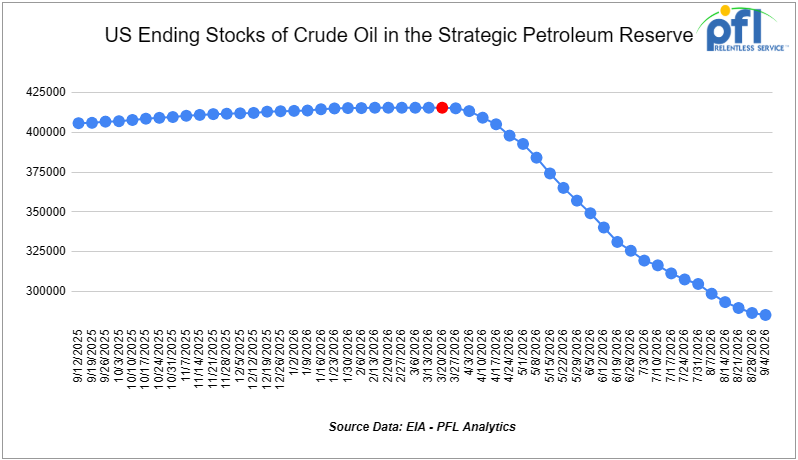
We Continue to Watch Enbridge
Line 5 was still shut on Friday of last week, seventeen days after a parked flatbed rolled into an open trench near Saxon, Wisconsin, and the restart date has now slipped twice, from September 5th, to September 12th, to nothing firm. On Wednesday of last week, the Wisconsin Department of Natural Resources asked Enbridge to halt construction of the 1,500 foot temporary bypass the company started building on Monday of last week without state permits, issued a notice of noncompliance, and Secretary Karen Hyun put the phrase “pattern of noncompliance” in writing. The regulator wants 1.3 million gallons of released natural gas liquids cleaned up before the line goes back in service, and Enbridge says it is doing both jobs at once. DNR staff on site Tuesday of last week found matting laid in wetlands, three unpermitted bridges over a tributary of Spoon Creek and thin erosion controls, and PHMSA has separately ordered the failed pipe section to a third-party lab for metallurgical testing. Enbridge says it is working with the DNR on the permits while remediation continues, but the outage is at least a week longer than anyone planned, and it may be considerably more.
The market consequence arrived before the regulatory one. Enbridge imposed 25% mid-month apportionment on light crude nominations downstream of Griffith, Indiana on the Mainline last week, two weeks after telling shippers September would run unapportioned, because Line 5 is the leg that carries light barrels east to Sarnia and there is nowhere else on the system to put them. Bakken at Clearbrook, Minnesota surged to as much as $8 per barrel over October Nymex, the strongest since April, and Bakken at Patoka, Illinois climbed $1.55 on the week to better than $9 over. Light Canadian grades are backing up on the other side of the constraint, with Mixed Sweet at Edmonton losing $2.25 on the week to roughly $1.75 over Nymex. Great Lakes and Ontario refiners that normally draw on Line 5 are bidding for Bakken that would otherwise ride the pipe to the Gulf or a unit train to the east coast, and with North Dakota to Philadelphia unit train rates sitting under $11 per barrel, the rail lane east has not looked this competitive against a Patoka premium in a long time.
The heating season problem we flagged last week has not gone away. Propane comes off Line 5 at Superior and at Rapid River, Michigan, and every week the line stays down moves the Upper Peninsula and northern Wisconsin closer to a winter supplied by Edmonton product in pressure cars to Escanaba. Governor Gretchen Whitmer and Attorney General Dana Nessel have said nothing new on the Straits, and they do not need to; Wisconsin is doing the work for them this month. It seems to us at PFL that pressure car availability in the upper Midwest for December is the number worth watching here, because that fleet is the tightest corner of the tank car market and the substitute supply chain runs straight through it.
Enbridge also spent last week buying. On Wednesday of last week the company announced US$2.55 billion in cash for Tallgrass Energy’s crude transportation business: a 75% interest in the 1,050 mile, 460,000 barrel per day Pony Express Pipeline from Guernsey, Wyoming to Cushing, a 51% interest in the 240,000 barrel per day Powder River Gateway system, 8.4 million barrels of storage across nine terminals, a 60.3% interest in the Deep rock terminal at Cushing and Stanchion Energy, a crude marketing business. Enbridge intends to add the $300 million PXP2 expansion, taking Pony Express to roughly 515,000 barrels per day in late 2027 on take-or-pay contracts, and it financed the deal with a C$2.6 billion bought deal. The same day it named Michele Harradence, currently head of gas distribution and storage, to succeed Greg Ebel as chief executive on January 1st. Between the Salt Creek Permian gathering purchase two weeks ago and Pony Express last week, Enbridge has spent more than US$3 billion in a month buying U.S. pipe that moves light and Rockies barrels to Cushing and the Gulf, while its own Canadian Mainline is rationing light crude because one line in Wisconsin is down. Powder River and DJ producers reaching Cushing by pipe at 515,000 barrels per day is one more basin where the rail terminal’s job shifts from base load to backstop, and the deal is expected to close before year end subject to regulatory approval.
We Continue to Watch Left Wing Carney
Ottawa published a regulatory change in the Canada Gazette (liberal left wing paper) on Wednesday of last week that removes interprovincial and international pipelines, cross-border transmission lines, offshore renewables, certain oil sands extraction projects and fossil fuel power plants from the Impact Assessment Act and hands their review to the Canada Energy Regulator (“CER”) alone, under a “one project, one review” banner. Consultations wrapped in July and the notice landed one week before the Prime Minister hosts an investment summit in Toronto with a stated target of $1 trillion in new investment over five years. The change removes a second reviewer from a queue that, to our knowledge, contains no proposed oil export pipeline for it to review. Since Trans Mountain’s expansion, no proponent has filed for a new line to tidewater, the northern British Columbia tanker ban is still on the books, and the only new Alberta egress with a filing date is Trans Mountain’s own 210,000 barrel per day optimization for 2028. Industry told the government it strongly supported a CER-only review, which is true and beside the point; the left wing Prime Minister has still not said whether he would approve a pipeline to the west coast if someone proposed one.
The trade war with Canada got worse last week. Canada’s counter-tariffs on roughly C$28 billion of U.S. goods took effect Monday of last week, covering steel, appliances, agricultural equipment and pulp and paper, and on Tuesday of last week President Trump signed executive orders banning imports of Canadian motorcycles, alcohol and dairy effective September 29th. Finance Minister Champagne answered with $7.5 billion of liquidity support for small and medium businesses, Ontario widened a $1 billion relief program. The left wing Prime Minister, in Calgary on Thursday of last week, signed a hundred-year partnership and a drone deal with President Zelenskyy, he went on to tell reporters, “we’re an energy superpower, and we’re putting that into place.” Every counter-tariffed category is a carload commodity, and the steel line lands on every Canadian repair shop that buys U.S. built components, at a moment when the tank car and hopper fleets in Canada are ageing regardless of who is in office. The economy in Canada shed 42,000 jobs in August, the government’s answer is $8.5 billion of public liquidity and a Gazette notice, Canada’s U.S. ambassador spent the week asking Canadian politicians to tone down the rhetoric.
In our opinion, an energy superpower is measured in barrels per day of egress, not in Gazette notices. Trans Mountain is full, the Mainline is apportioned, and the marginal Alberta barrel is looking at a rail car. Until a proponent files for a pipe to tidewater and the Prime Minister says out loud that he would approve it, last week’s reform is regulatory housekeeping dressed up for an investor conference.
We Are Watching Railcar Storage
The AAR’s Rail Industry Overview published Wednesday of last week put the storage fleet in numbers. Freight cars in storage fell by another 6,700 in August, bringing the total pulled out of storage since January to more than 59,000, and cars in storage as a share of the fleet in service dropped from 21.7% in January to 18.1% in August. A 3.6 – point drop in the stored share in eight months on a fleet of roughly 1.6 million cars is close to 59,000 cars that were paying storage rent in January and are receiving lease rent now. The traffic behind it is broad: total carloads averaged more than 235,000 per week in August, the most since October 2019, intermodal set a monthly record at nearly 297,000 per week, 15 of 20 carload categories rose year over year, chemicals are on pace for an annual record, and grain carloads are up 12% year to date on exports. Coal fell for a sixth straight month, and motor vehicles were down sharply.
Put that beside what Trinity told the market two weeks ago, roughly 200,000 cars reaching the end of their service lives over the next few years against deliveries near 25,000 this year, and the storage pool is the fleet’s only real slack. It is being drawn at about 7,000 cars a month. What comes out of storage is, by definition, the oldest and least specialized equipment in the fleet; the 117J and pressure fleets are not in storage in size, which is why they were already tight before the storage drawdown started. Tank cars on line across the six reporting Class I railroads averaged 257,109 in the four weeks to September 4, flat on the prior four weeks and about 5,000 above a year earlier, the tank fleet is not coming out of storage; it is already out there working.
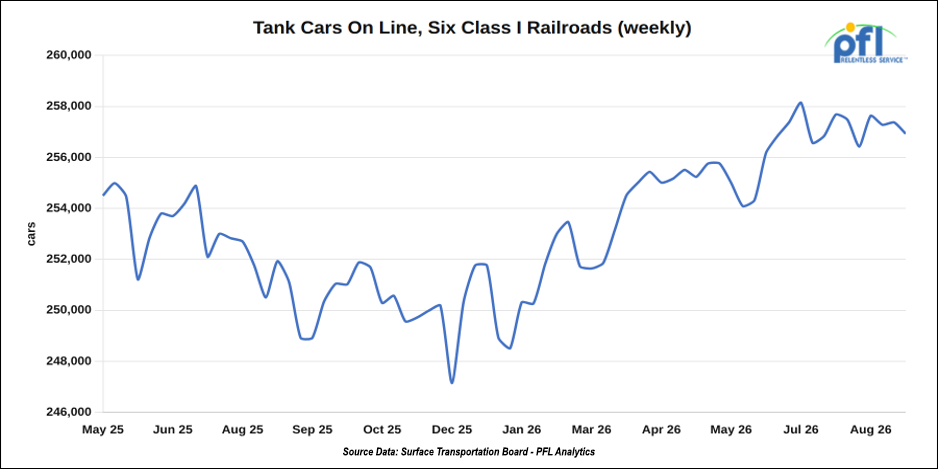
PFL has been busy on both sides of this trade at once: return-on-lease programs that park cars in storage instead of sending them through a shop, and cars coming out of storage that need cleaning, requalification and a lease before they earn anything. It seems to us at PFL that the storage yard is where the 2027 lease market is being decided, one train at a time, and the owners who know exactly what they have sitting there are the ones who will get paid for it.
We Continue to Watch Diesel
The U.S. average retail diesel price crossed $6.00 per gallon on Friday of last week for the first time on record, at $6.056 per gallon on the AAA survey, less than a week after setting the previous record at $5.85 per gallon and $2.35 per gallon above a year ago. The EIA raised its diesel forecasts in the Short-Term Energy Outlook on Wednesday of last week to an average of $5.07 for 2026 and $4.40 for 2027, up 22 cents and 33 cents from the August outlook; the 2027 number stood at $3.47 in February. The EIA now expects distillate inventories to drop below 100 million barrels this month and to sit below the five-year low through most of 2027, which makes this a structural shortage, not a spike. Refiners ran at 97.8% in the week ended September 4th and averaged 17.6 million barrels per day barrels per day of input. Gulf coast ultra-low sulfur diesel set a record above $4.80 per gallon on Wednesday of last week, and Gulf Coast conventional gasoline topped four-year highs on Thursday of last week as WTI traded through $100 during the session. The agency’s reasons have not changed: Ukraine’s drone campaign against Russian refineries, lost Middle East and Chinese supply, high U.S. net exports of distillate, and fall maintenance arriving on top of harvest demand.
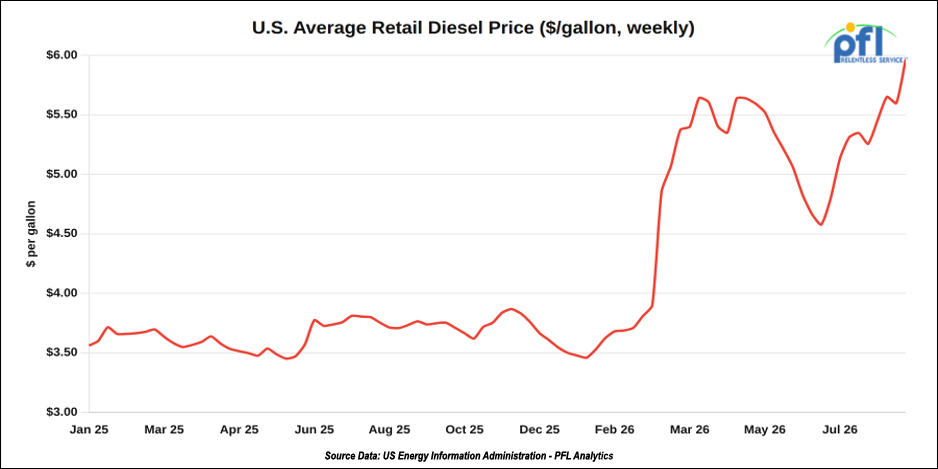
For rail, this is a cost line and a demand line at the same time, and the cost line is about to reset. Class I fuel surcharges key off lagged monthly averages, so a September retail print above $6.00 lands on October and November freight bills, in the middle of harvest and the fall product peak. On the demand side, every refinery running flat out and exporting a third of its distillate is a refinery pulling product tank cars into blendstock and distillate service that were idle a year ago. A $107 crack does not stay a $107 crack, but the refining system has no spare capacity to bring it down quickly, and the EIA is now telling shippers to plan for a low inventory environment through 2027. PFL’s client base moving refined products and blend stocks is being asked the same question every week, and our answer has not changed: in a market like this fleet timing matters more than fleet size, and the cars you need for the first quarter should already be under contract.
We Continue to Watch Hormuz
On Monday of last week, U.S. Central Command destroyed five Iranian tankers linked to the Revolutionary Guard, four in the Gulf of Oman and one off Kharg Island, after unsuccessful Iranian missile attacks on a U.S. warship, following three more tankers hit the weekend before. The Houthis answered on Tuesday of last week with strikes on Abha airport, King Khalid air base and Aramco facilities in Saudi Arabia, wounding 73, and Riyadh counterstruck the same day. Iran’s Supreme National Security Council then said it will declare a maritime exclusion zone outside the strait, in which vessels transiting without permission will be stopped, “in the coming days and weeks.” Transits through the strait fell to about 10 ships a day on Monday of last week, the lowest since May, against a prewar baseline of 130, and a strait passing ten ships a day is closed for practical purposes whatever its legal status.
The freight market is pricing the closure harder than the flat price is. The U.S. Gulf to China VLCC rate hit a record $29.5 million lump sum on Friday of the week before last, up 21.6% in a week, with owners talking $30 million, as Chinese buyers who lost Saudi cargoes to the Houthi campaign in the Bab el-Mandeb turned to Brazil and the U.S. Gulf in masse. On the west coast, Trans Mountain accepted all September nominations without apportionment on the 890,000 barrel per day system, and market sources expect flows to keep rising on Chinese and U.S. west coast demand after the system ran at 96% in April. Trans Mountain running unapportioned at full nominations with Chinese buyers paying record freight for Atlantic basin barrels means the west coast egress is spoken for, and the marginal Alberta barrel is looking at an apportioned Mainline or a rail car. We wrote last week that this could be the start of another crude by rail cycle if the trends hold, and the trend is holding for now. We at PFL believe that the conversation about 117J availability for 2027 has already started in Calgary, and we were not the ones who started it.
We Are Watching Venezuela
U.S. Gulf coast imports of Venezuelan crude reached nearly 630,000 barrels per day in June from 200,000 barrels per day at the start of the year, and Venezuela has been the top overseas supplier to the Gulf coast every month since March, with Valero, Citgo, Phillips 66 and Chevron taking the bulk of it. Chevron agreed on September 2 to invest more than $7 billion over five years to double its Venezuelan production, on top of the August deal under which Washington takes a 35% stake in a Barbados-registered vehicle planning to develop 17 Venezuelan fields in exchange for 20% of future output at cost. Canadian heavy crude into the Gulf coast has fallen to 337,000 barrels per day in the first half of 2026 from 416,000 in 2025, and heavy Western Canadian Select at Houston has averaged more than $13 under WTI Houston for October trade against a $5.50 discount a year ago. Merey at the U.S. Gulf Coast is offered at roughly $15 under Ice Brent and touched a $20 discount at the end of August, Colombian and Mexican heavy exports to the Gulf lost about 75,000 barrels per day between January and June, and Gulf coast coker inputs hit 1.29 million barrels per day in May, the highest since December 2024. June’s Venezuelan imports averaged 15 API against 23 for Canadian imports, which is exactly the barrel a Gulf coast coker was built for.
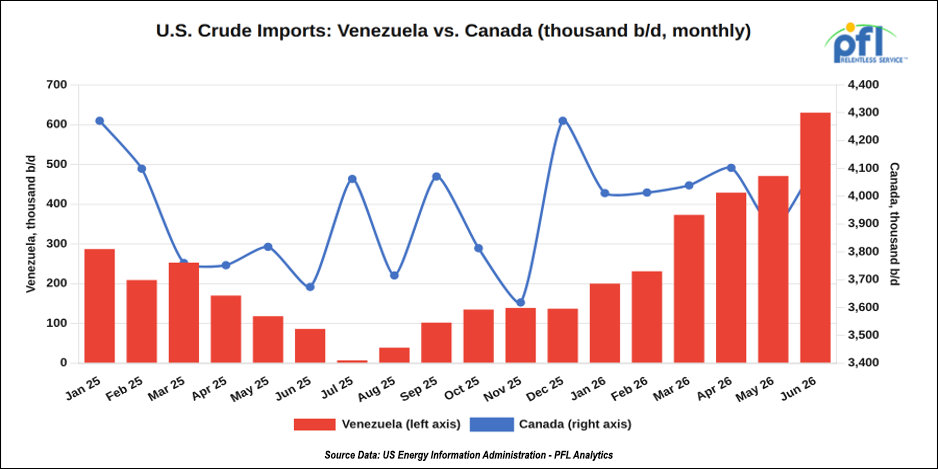
This is the story that decides whether Alberta to Gulf coast crude by rail works, and right now it does not. One Exchange WCS for October settled at $16.40 under WTI calendar month average on Friday of last week, which is roughly the all-in unit train cost from Alberta to the Gulf, so rail to Houston clears at break-even on paper while Venezuelan barrels sit at the dock at $15 under Brent after a four-day voyage. When the Gulf Coast is being fed 15 API Merey at that discount, Alberta bitumen on a 3,000 mile rail trip is competing for the coker slot on price alone, and losing. Canadian heavy is going where the Venezuelan barrel is not: the Midwest took 2.92 million barrels per day in the first half against 2.75 million last year, Westridge is loading for China, and Enbridge opened its Houston terminal in July with 2.5 million barrels of tankage and plans for 15 million. The rail lanes with a live bid this fall are Bakken east while Line 5 is down and Bakken west to Puget Sound, not Hardisty to the Gulf. PFL is watching this one closely and is working with shippers on the lanes that do pencil, because a heavy crude market this lopsided rarely stays that way for long.
We Are Watching the Panama Canal
The Panama Canal Authority cut the Neopanamax draft to 48.0 feet on September 2 and will cut it again to 47.5 feet on October 1st, trimmed Neopanamax transits to nine a day from September 3 and Panamax transits from 25 to 23 a day from September 15th, all on below-normal rainfall in the Gatun Lake watershed with El Niño conditions expected to run into next year. On September 1 SK Gas paid $5.3 million at auction for a single transit slot for the LPG carrier G. Spirit, the highest price ever reported for the waterway. A $5.3 million slot on a 45,000 ton propane cargo is roughly $118 a ton before the freight, which is most of the delivered margin on a Houston to Asia cargo, and it is being paid because the alternative is a Cape route that adds weeks. U.S. seaborne LPG exports to Mexico fell 30% year over year in August to 270,600 tons on ship-tracking data, and volumes to Mexico’s Pacific coast, which cross the canal from the Gulf, fell 46% to about 47,200 tons.
Mexico’s Pacific coast runs on U.S. Gulf Coast propane, and when the canal cannot pass it the importers look north by land. Canadian cargoes into Mexico, rare historically at 12,000 tons or so in a good year, are already at 17,000 tons this year, and the overland substitute for a Pacific coast import is a pressure car out of Conway or Edmonton. Mexico’s safety regulator Asea also opened a 60-day consultation on Monday of last week on a new LPG distribution standard, PROY-NOM-030-ASEA-2026, covering equipment inspection, emergency shut-off valves on tank trucks and operator training. Pressure cars are the tightest corner of the tank car market heading into winter on both sides of the border, and a canal that cannot pass LPG to Mexico’s Pacific coast adds a southbound rail bid to a fleet that has nothing to spare. PFL already has winter propane inquiries for 340W pressure cars off CN, CP, NS, CSX, UP and BNSF on the books, and we suspect the Mexican ones are next.
We Are Watching PHMSA
PHMSA used its federal preemption authority twice last week. On Thursday of last week it published a determination that California’s 2028 mandate requiring all propane cylinders sold in the state to be reusable or refillable is preempted by the Hazardous Materials Transportation Act, on a petition from Worthington Enterprises backed by the National Propane Gas Association, because the state rule effectively sets design and manufacturing requirements for DOT-39 cylinders that federal rules already authorize. In a separate administrative notice it blocked a New Jersey state lawsuit by a former tanker truck driver against multiple refiners over benzene exposure from gasoline, finding that state claims on marking, training, loading and unloading and hazmat classification are preempted, with similar suits pending in Pennsylvania, New York and Louisiana. Transportation Secretary Sean Duffy’s line was that the department is “stopping this nonsense in its tracks,” and the doctrine he is stopping it with is the same one the tank car industry leans on every time a state legislature reaches for rail hazmat rules of its own.
The practical read for car owners is that Washington is willing to spend preemption authority on fairly small state actions, which may make it less likely that a state-level tank car speed limit, crew size rule or hazmat routing restriction survives a challenge, though we would not predict an outcome in any specific case. A uniform federal hazmat regime is the reason a DOT-117 built in Texas can load in Alberta and unload in New Jersey without three sets of paperwork, and last week was a reminder that the current administration intends to keep it that way. PFL will keep an eye on this one and is happy to work with shippers who need specialty designs that have to travel across more than one jurisdiction.
We Are Watching Key Economic Indicators
Producer Price Index
In August 2026, the Producer Price Index (PPI) increased 0.4% month-over-month, following a 0.1% increase in July, indicating a renewed acceleration in producer price pressures. Core PPI (final demand less foods, energy, and trade services) increased 0.3% month over month, moderating from July’s 0.4% increase, but continuing to indicate elevated underlying price pressures. The monthly increase was driven primarily by goods, which rose 1.1%, following a 0.4% decline in July. Within goods, energy prices increased sharply by 4.2%, while food prices rose 0.1%. Goods less foods and energy increased 0.4%, suggesting that core goods prices also remained firm. Within services, prices increased 0.1%, with trade margins declining 0.2% and transportation and warehousing increasing 2.3%. Services less trade, transportation, and warehousing were unchanged, pointing to relatively stable underlying service-sector prices despite the increase in overall PPI.
In August 2026, the Consumer Price Index (CPI) increased 0.4% month-over-month, accelerating from July’s 0.1% increase, while the index was up 3.4% year over year. Core CPI (all items less food and energy) increased 0.3% month-over-month and was up 2.4% year-over-year. Energy prices were a major contributor to the monthly increase, with gasoline prices rising sharply amid continued energy-market pressures. Food prices increased 0.1% during the month, while shelter increased 0.3% and remained an important contributor to the overall increase. Within core inflation, several service categories increased, while some areas of consumer spending showed more moderate price growth. The August report showed a clear pickup in monthly inflation, although the year-over-year core rate continued to moderate, suggesting that underlying inflation pressures remain persistent while headline inflation is being pushed higher by energy costs.
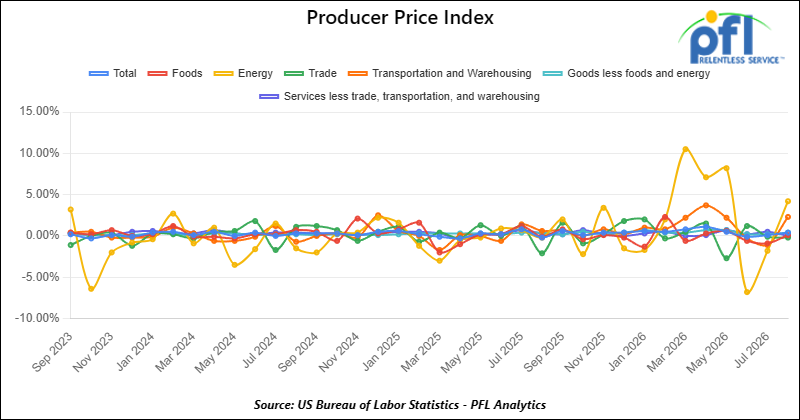
Consumer Confidence
The Index of Consumer Sentiment from the University of Michigan decreased from 55.2 in July to 51.7 in August.
The Conference Board Consumer Confidence Index decreased from 90.2 in July to 89.4 in August.
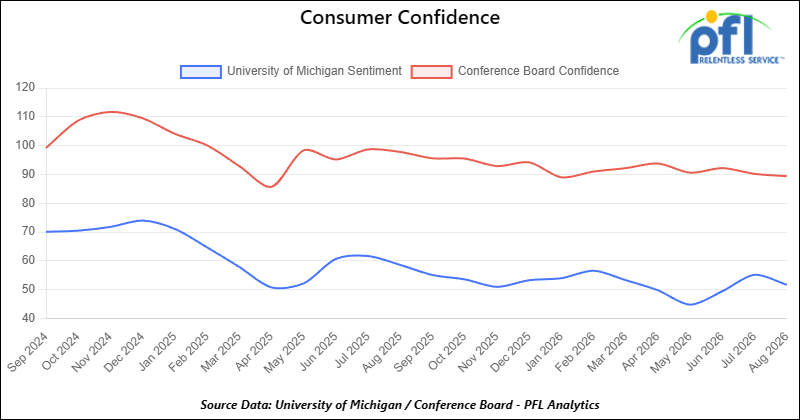
Lease Bids
- 20-50, 4000-5000 Covered Hoppers located off of UP or BNSF in Houston. For use in Urea, Potash, and Ammonium Sulfate service. Period: 6-12 Months.
- 300, 5200CF Covered Hoppers located off of CP or CM in Canada. For use in Petcoke service. Period: 3 Year.
- 100, 340W Pressure Tank located off of CN or CP in Canada. For use in Propane service. Period: 6 Months.
- 10-20, 3200 or 3281 Covered Hoppers located off of CN or CP in Canada. For use in Sodium Sulphate service. Period: 3-5 years. Lined.
- 50, 340W Pressure Tanks located off of CN or CP in Canada. For use in Propane service. Period: Winter.
- 30-50, 340W pressure Tanks located off of NS or CSX in Northeast U.S. For use in Propane service. Period: Winter.
- 25, 340W Pressure Tanks located off of UP or BN in US. For use in Propane service. Period: Winter.
- 50, 28.3K 117J Tanks located off of BNSF in Kansas/Oklahoma. For use in Fuel Oil service. Period: 6 Months.
- 100, 30K 117J Tanks located off of CN in Canada. For use in Diesel service. Period: 1 year.
- 150, 340W Pressure Tank located off of CN in Canada. For use in Propane service. Period: 3 Months.
Sales Bids
- 28, 3400CF Covered Hoppers located off of UP or BNSF in Texas. For use in Cement service. Cement Gates needed.
- 20, 17K DOT111 Tanks located off of various class 1s in various locations. For use in corn syrup service.
- 120, Various Open-Top Aluminum Rotary Gondolas located off of various class 1s in various locations. For use in Sulphur service. Built 2004 or later.
- 12, 21.5K-25K DOT 111 Tanks located off of Various Class 1s in Michigan. For use in Diesel, Asphalt, Crude service. Coiled and Insulated.
Lease Offers
- 21, 6351 Covered Hoppers located off of CN in Wisconsin. Last used in DDG. Available until February 2027.
- 29, 6500 Covered Hoppers located off of CN in Wisconsin. Last used in DDG. Available until February 2027.
- 15, 6200CF Covered Hoppers located off of all class 1s in Wisconsin. Last used in plastic. Cars are currently clean.
- 30, 6500CF Covered Hoppers located off of all class 1s in Wisconsin. Last used in plastic. Cars are currently clean.
- 100, 28.4K DOT 117J Tanks located off of UP or BNSF in Beaumont, TX. Cars are currently clean.
- 50, 30K DOT117J Tanks located off of UP or BNSF in the South. Last used in ethanol.
- 10, 29K DOT 117R Tanks located off of BNSF and UP in Texas. Last used in gasoline additive. Coiled and Insulated.
- 39, 31K CPC1232 Tanks located off of All Class 1s in Iowa. Last used in diesel.
- 2, 30K DOT 117R Tanks located off of BNSF and UP in Texas. Last used in Diesel.
- 1, 30K DOT 117R Tanks located off of BNSF and UP in Texas. Last used in gas blend stock.
- 3, 30K DOT 117R Tanks located off of BNSF and UP in Texas. Last used in gasoline.
- 41, 30K DOT 111 Tanks located off of in Brownsville. Last used in Diesel. Cars are currently clean.
- 93, 31.8K CPC 1232 Tanks located off of Various Class 1s in Texas. Last used in Diesel. Cars are currently clean.
- 22, 21K DOT 115 Stainless Steel Tank located off of BNSF in Texas. Cars are currently clean. Cars are currently clean.
Sales Offers
- 81, 31.8K CPC1232 Tanks located off of UP or BNSF in TX. Last used in Multiple Services. Requal Due in 2025.
- 35, 3400CF Covered Hoppers located off of UP or BNSF in the Midwest. Last used in Sand.
- 15, 5750 CF Hopper located off of CSX, NS, CP, CN, BNSF, UP in St Louis. Last used in Grain.
- 50, 30 DOT 111 Tank located off of multiple class 1s in multiple location. Last used in Fuels..
Call PFL today to discuss your needs and our availability and market reach. Whether you are looking to lease cars, lease out cars, buy cars, or sell cars call PFL today at 239-390-2885
Railcar for Sale or Lease
| CAT | Type | Capacity | GRL | QTY | LOC | Class | Prev. Use | Offer | Note |
|---|
| CAT | Type | Size | GRL | QTY | LOC | Class | Term | Commodity | Offer | Note |
|---|
| CAT | Type | Capacity | GRL | QTY | LOC | Class | Prev. Use | Clean | Offer | Note |
|---|
| CAT | Type | Capacity | GRL | QTY | LOC | Class | Commodity | Offer | Note |
|---|
PFL will be at the Following Conferences
- Where: The Westin Galleria Dallas
- Attending: David Cohen (954-729-4774), and Curtis Chandler (239-405-3365)
- Conference Website
- Where: The Westin Galleria Dallas
- Attending: Brian Baker (239.297.4519)
- Conference Website
The post PFL Railcar Report 9-14-2026 appeared first on PFL Petroleum Services LTD.
]]>The post PFL Railcar Report 9-8-2026 appeared first on PFL Petroleum Services LTD.
]]>– E.M. Forster
Jobs Update
Initial jobless claims seasonally adjusted for the week ending August 29, 2026 came in at 206,000, versus the adjusted number of 204,000 people from the week prior, up 2,000 people week over week.
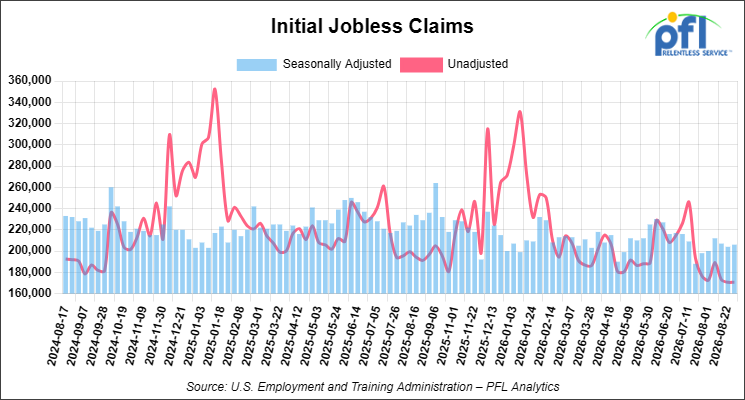
Continuing jobless claims came in at 1,779,000, versus the adjusted number of 1,771,000 people from the week prior, up 8,000 week-over-week.
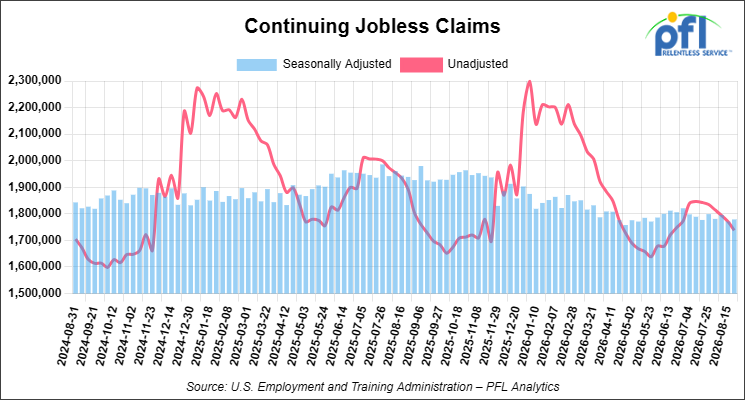
Stocks closed lower on Friday of last week, but mixed week-over-week
The DOW closed lower on Friday of last week, down -271.86 points (-0.51%), closing out the week at 53,414.25, down -145.74 points week-over-week. The S&P 500 closed lower on Friday of last week, down -29.11 points (-0.38%), and closed out the week at 7,718.60, up 6.84 points week-over-week. The NASDAQ closed lower on Friday of last week, down -77.07 points (-0.29%), and closed out the week at 26,506.99, up 104.57 points week-over-week.
In overnight trading, DOW futures traded higher and are expected to open at 53,063 this morning, down -377 points from Friday’s close.
Crude oil closed higher on Friday of last week and higher week-over-week
West Texas Intermediate (WTI) crude closed up 0.18 per barrel (0.2%), to close at $91.48 on Friday of last week, and up $8.08 per barrel week-over-week. Brent crude closed up $0.76 per barrel (0.8%), to close at $92.68, and up $3.37 per barrel week-over-week.
One Exchange WCS (Western Canadian Select) for October delivery settled on Friday of last week at US$16.75 below the WTI-CMA (West Texas Intermediate – Calendar Month Average). The implied value was US$70.20 per barrel.
U.S. commercial crude oil inventories (excluding those in the Strategic Petroleum Reserve) decreased by 4.5 million barrels week-over-week. At 424.5 million barrels, U.S. crude oil inventories are 1% above the five-year average for this time of year.
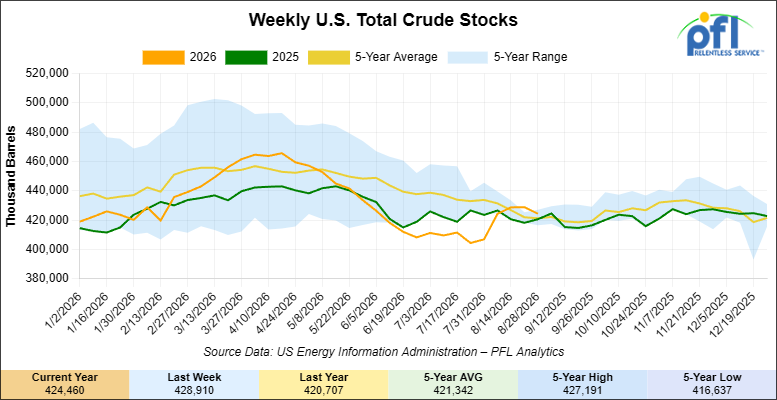
Total motor gasoline inventories decreased by 1.2 million barrels week-over-week. and are 5% below the five-year average for this time of year.
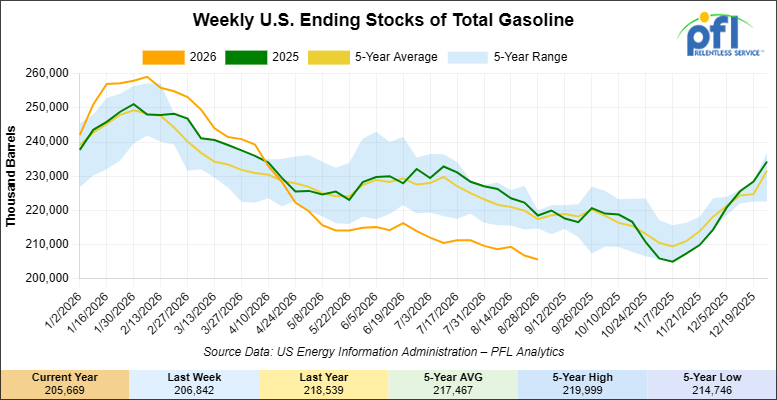
Distillate fuel inventories increased by 796,000 barrels week-over-week. and are 14% below the five-year average for this time of year.
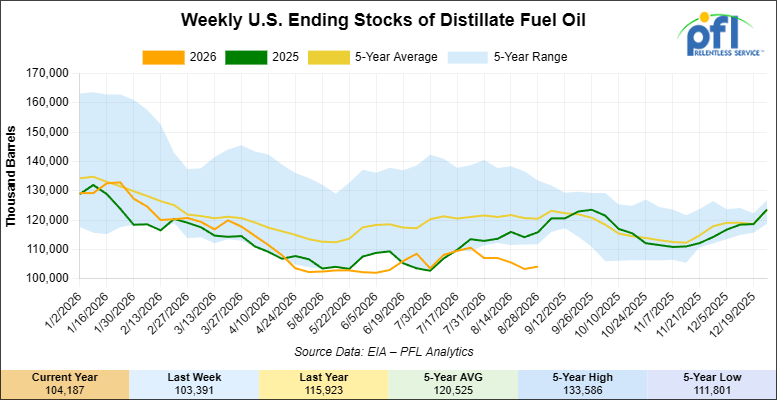
Propane/propylene inventories decreased by 2.1 million barrels week-over-week. and are 24% above the five-year average for this time of year.
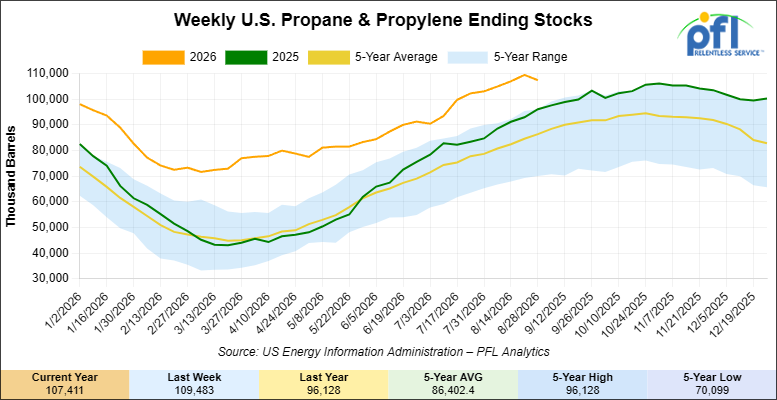
Propane prices closed at 68.7 cents per gallon on Friday of last week, down 4.1 cents per gallon week-over-week, but up 1.1 cents year-over-year.
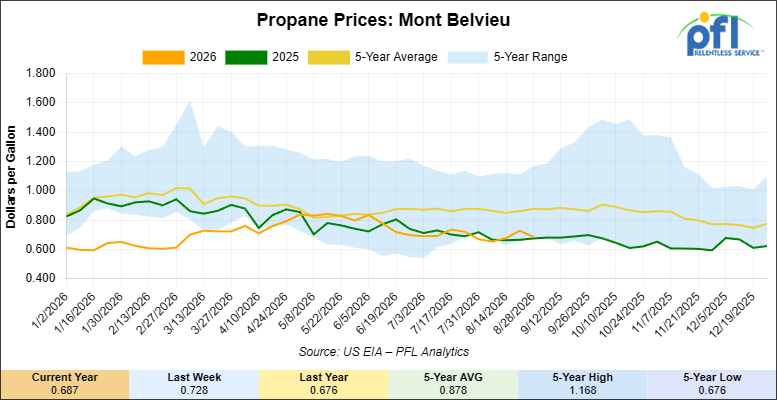
Overall, total commercial petroleum inventories decreased by 3 million barrels week-over-week during the week ending August 28, 2026.
U.S. crude oil imports averaged 6.8 million barrels per day during the week ending August 28, 2026, an increase of 612,000 barrels per day week-over-week. Total motor gasoline imports (including both finished gasoline and gasoline blending components) averaged 370,000 barrels per day, and distillate fuel imports averaged 113,000 barrels per day during the week ending August 28, 2026.
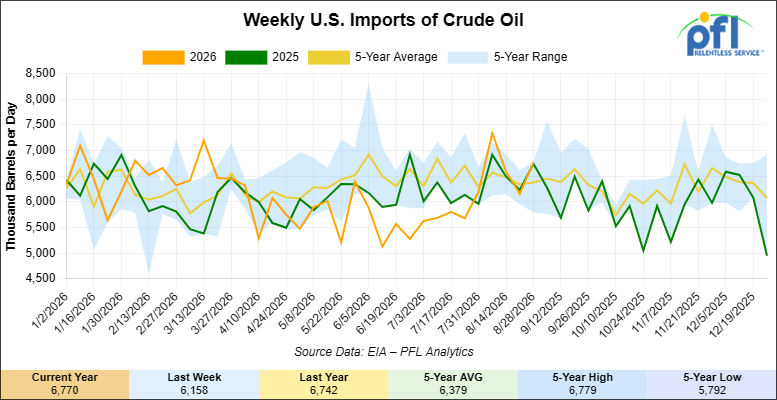
U.S. crude oil exports averaged 4.483 million barrels per day during the week ending August 28, 2026, an increase of 691,000 barrels per day week-over-week. Over the past four weeks, crude oil exports averaged 3.85 million barrels per day.
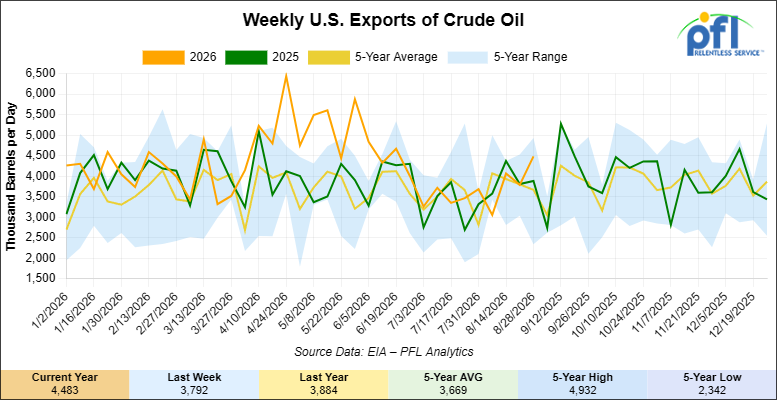
U.S. crude oil refinery inputs averaged 17.5 million barrels per day during the week ending August 28, 2026, which was 103,000 barrels per day more week-over-week.
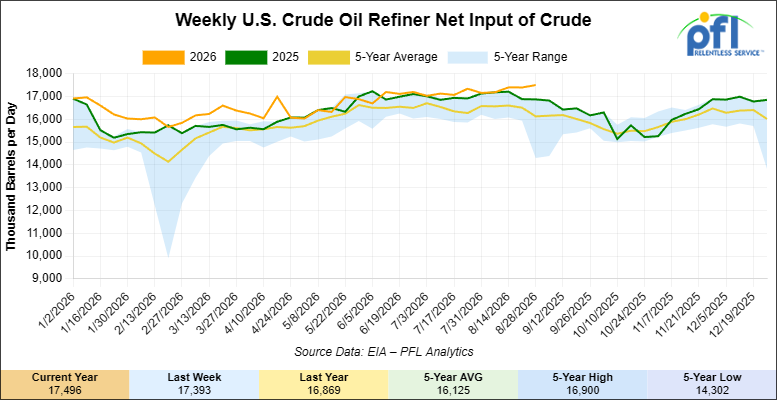
WTI is poised to open at $93.96, up $2.48 per barrel from Friday’s close.
North American Rail Traffic
Week Ending September 2, 2026:
Total North American weekly rail volumes were up (+4.51%) in week 36, compared with the same week last year. Total Carloads for the week ending September 2, 2026 were 342,483, up (+3.65%) compared with the same week in 2025, while weekly Intermodal volume was 368,096, up (+5.33%) year over year. 9 of the AAR’s 11 major traffic categories posted year-over-year increases. The largest decrease came from Chemicals (-5.71%). The largest increase was Metallic Ores and Metals (+14.41%).
In the East, CSX’s total volumes were up (+7.44%), with the largest decrease coming from Motor Vehicles and Parts (-8.39%), while the largest increase came from Grain (+26.00%). NS’s total volumes were up (+0.54%), with the largest increase coming from Petroleum & Petroleum Products (+14.18%), while the largest decrease came from Motor Vehicles and Parts (-8.58%).
In the West, BNSF’s total volumes were up (+5.98%), with the largest increase coming from Metallic Ores and Metals (+16.74%), while the largest decrease came from Other (-12.18%). UP’s total volumes were up (+4.53%), with the largest increase coming from Grain (+16.11%), while the largest decrease came from Other (-17.64%).
In Canada, CN’s total volumes were up (+2.28%), with the largest increase coming from Nonmetallic Minerals (+23.73%), while the largest decrease came from Grain (-30.07%). CPKCS’s total volumes were up (+6.29%), with the largest increase coming from Grain (+38.06%), while the largest decrease came from Chemicals (-14.62%).
Source Data: AAR – PFL Analytics
North American Rig Count Summary
North American rig count was down by -7 rigs week-over-week. The US rig count was unchanged week-over-week, but up by +51 rigs year-over-year. The US currently has 588 active rigs. Canada’s rig count was down by -7 rigs week-over-week but up by +23 rigs year-over-year. Canada currently has 204 active rigs. Overall, year-over-year we are up by +74 rigs collectively.
International rig count which is reported monthly was up by +6 rigs month-over-month and up by +26 rigs year-over-year. Internationally there are 1102 active rigs.
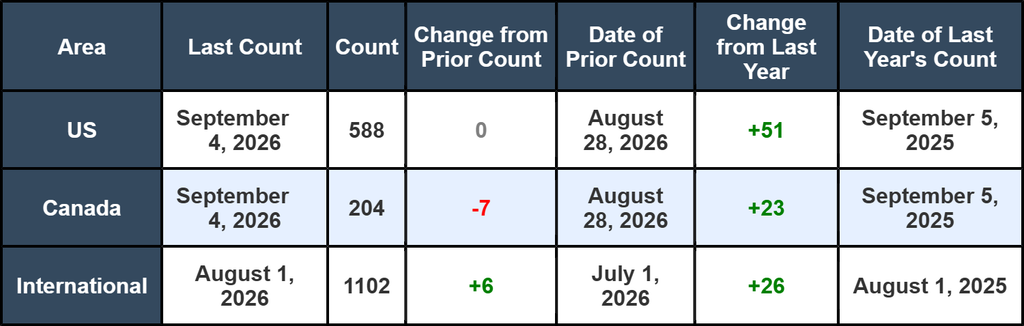
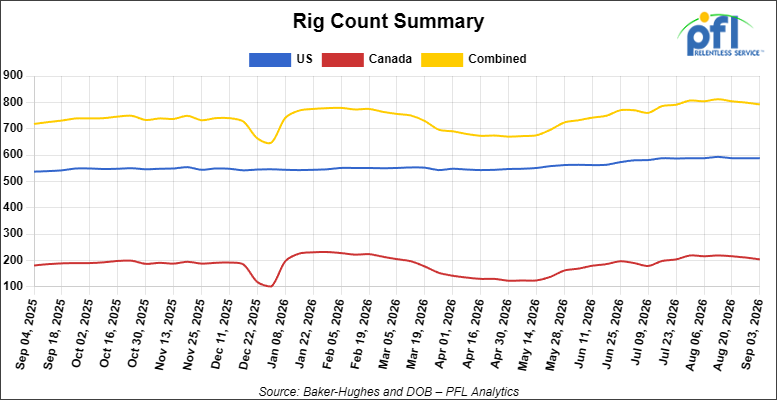
We are watching a few things out there for you:
We Are Watching Petroleum Carloads
The four-week rolling average of petroleum carloads carried on the six largest North American railroads rose to 30,487 from 30,480 which was an increase of +7 rail cars week-over-week. Canadian volumes were lower. CN’s shipments were lower by -1.0% week-over-week, CPKC’s volumes were lower by -4.0% week-over-week. U.S. shipments were mostly higher. The UP was the sole decliner and was down by -11.0% week-over-week. The NS had the largest percentage increase and was up by +11.0% week-over-week.
We Continue to Watch Our Strategic Petroleum Reserves
The ongoing emergency drawdown of the U.S. Strategic Petroleum Reserve (SPR) remains a major component of global efforts to offset crude oil supply disruptions stemming from the conflict involving Iran and the continued restrictions on oil shipments through the Strait of Hormuz. Since March, the Department of Energy (DOE) has awarded exchanges covering more than 133 million barrels of crude oil, with additional releases expected as part of a broader international response coordinated through the International Energy Agency (IEA).
The United States continues to execute its commitment to make available up to 172 million barrels from the SPR under the IEA’s collective plan to inject roughly 400 million barrels into global energy markets. Officials have argued that the releases are necessary to help stabilize crude supplies and limit further increases in fuel prices as refiners compete for replacement barrels amid ongoing transportation disruptions. The IEA’s coordinated action remains the largest emergency oil-stock release in the agency’s history.
As releases have accelerated, inventories in the SPR have declined to 289.726 million barrels, down from 415.442 million barrels at the start of the conflict with Iran and reaching their lowest level since November 1982. The SPR declined by 3.122 million barrels during the week ending August 28, 2026. Since the first SPR drawdown began, the United States has withdrawn approximately 128.838 million barrels, equivalent to an average of roughly 800,236 barrels per day through the week ending on August 28, 2026.
Global petroleum inventories have also tightened considerably. The IEA has reported substantial draws in commercial crude and refined-product stockpiles across major consuming nations, underscoring the strain that the conflict has placed on world energy markets. While oil flows through the Strait of Hormuz have partially recovered from their initial near-shutdown, the IEA continues to identify significant uncertainty surrounding the pace and durability of the recovery.
The Administration continues to emphasize that the current program consists primarily of exchange agreements, rather than outright sales. Under these arrangements, companies receiving crude oil today are required to return the borrowed barrels in the future along with additional volumes as a premium. DOE has stated that its exchange structure is designed to return the borrowed crude with additional premium barrels, with the stated objective of strengthening the SPR over time.
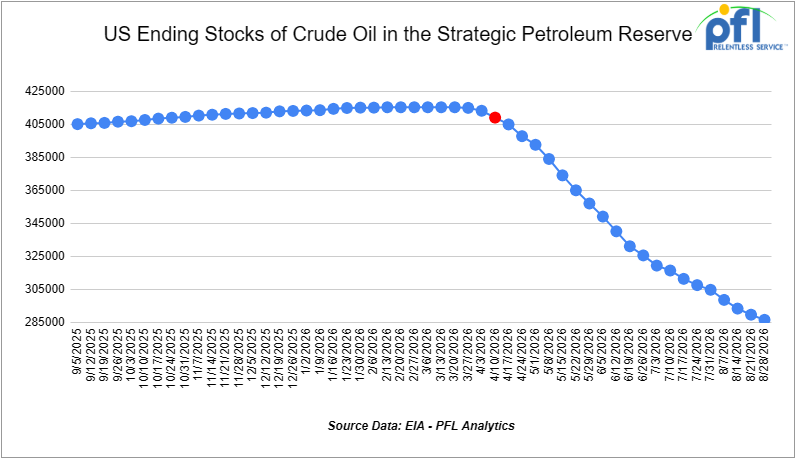
We Are Watching Railcars
TrinityRail Chief Commercial Officer Charley Moore put roughly 200,000 North American railcars at the end of their service lives over the next few years, against a total fleet of about 1.6 million. Public lessor utilization is running in the high 90s. Deliveries are tracking near 25,000 cars this year and Moore sees 30,000 to 35,000 in 2027. Even at the top of that 2027 range, a full year of production replaces about a sixth of the retirement wave. The fleet does not have to shrink dramatically for the market to tighten. It only has to stop being replaced on schedule, which is where we are.
Tariffs are doing most of the damage to the build rate. Moore pointed to higher steel input costs and unresolved Section 232 treatment of cars crossing the U.S. – Mexico border as the reason customers keep pushing capital decisions to the right. Trinity maintains its Mexico – built cars qualify under USMCA and is working the question with Customs and Border Protection. Until that gets settled, every quote on a new car carries a duty, a question the builder cannot price and the lessee will not wear.
The tank car side is tighter than the headline number suggests. Railinc counted about 8.5% of the national fleet, roughly 135,000 cars, reaching maximum interchange life within five years, and tank cars were one of only two subfleets that grew in 2025. Shop capacity has not expanded to meet either the retirement schedule or the retrofit work already on the books. Renewals show: non-pressurized DOT-117s are clearing in the low four figures per car per-month on one-to-five-year terms, pressurized equipment carries a premium of several hundred dollars a month on top of that, and short-term deals are pricing above long-term ones across every car type, which is what a market without spare equipment looks like. It seems to us at PFL that anyone with cars rolling off lease in 2027 or 2028, is better served having that conversation now than discovering the market next year.
The network data says the same thing from the other direction. Tank cars on line across the six reporting Class I railroads averaged 257,281 in the week ended August 26th, up from 251,931 a year earlier and within a whisker of the July high. Cars are working, not sitting.
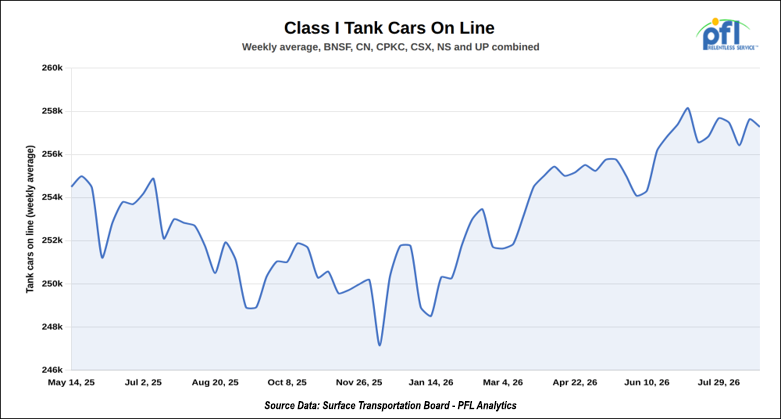
We Are Watching Crude by Rail
Harvest Midstream cut the tariff on its Sacagawea pipeline into the Palermo rail terminal to $1.05 a barrel effective September 1st, a reduction of 25% to 28% from the uncommitted rate, available to shippers averaging more than 10,000 barrels per day out of Keene or Johnson’s Corner and running through December 31st unless extended. A midstream operator does not discount a pipeline to defend a rail terminal unless the rail terminal is worth defending. Palermo moved about 46,000 barrels per day of Bakken crude west in June to Phillips 66’s Ferndale, BP’s Cherry Point and Marathon’s Anacortes refineries, close to 30% of typical Bakken rail volumes.
The reason for the discount is diesel. On-highway prices feed straight into Class I fuel surcharges, and up 50% on the year they have pushed North Dakota to Puget Sound rail economics toward the edge against Canadian light barrels arriving on Trans Mountain’s Puget Sound line and against waterborne imports. What Harvest has done is subsidize a rail lane with the pipeline that feeds it, and that is not a decision anyone makes about a business they expect to lose.
The Alberta side is the longer story. Trans Mountain filed with the Canada Energy Regulator on August 27 for a 210,000 barrels per day Mainline Optimization project at an estimated C$3.97 billion, targeting in-service in the fourth quarter of 2028, on top of a 90,000 barrels per day drag-reducing agent expansion already approved. The system ran at a record 94% of capacity in the second quarter, averaging 840,000 barrels per day, and Enbridge has been apportioning the Mainline. Egress running at 94% with a three year construction runway in front of it is precisely the condition that put crude by rail on the map the first time.
WCS at Hardisty is holding a discount north of $16.75 to WTI at Houston, which clears the level where Alberta to Gulf coast rail works on paper. Paper is not the constraint. There are not many 117J crude cars sitting idle, build slots run one to two years out, and car owners and leasing companies want five year commitments before they will place equipment, with the Class Ones looking for something comparable. This could be the beginning of another crude by rail cycle if the trends hold. Time will tell and it is geopolitically dependent.
We Continue to Watch Enbridge
Line 5 was still shut down on Friday of last week, more than a week after a parked and unoccupied subcontractor flatbed rolled into an open excavation at a valve project near Saxon, Wisconsin and struck the pipe. About 31,000 barrels of propane and butane vaporized into the atmosphere and another 2,000 barrels of liquid remained contained in the excavation. Enbridge has held to a September 5 restoration goal but on Wednesday of last week a new date for line start up would be Thursday of this week. The line moves up to 23 million gallons per day of light crude and natural gas liquids from Superior to Sarnia and feeds ten refineries and propane plants.
The Wisconsin Department of Natural Resources asked Enbridge to halt work on the $1 billion, 41 mile reroute around the Bad River reservation and put more than 20 questions to the company on release volume, air modelling and groundwater depth. Enbridge took a 48-hour safety stand down on the relocation project starting Monday of last week and resumed construction Wednesday. Four notices of non-compliance have already been issued on the reroute and at least four drilling fluid releases have occurred, one of them up to 1,900 gallons in late June. Governor Gretchen Whitmer and Attorney General Dana Nessel have not softened on the Straits either.
The freight question is seasonal. Propane comes off the stream at Superior and at Rapid River, Michigan, and Rapid River supplies a large share of Upper Peninsula distributors. Ten days down in early September is an inconvenience. The same outage in December is a rail problem, because the substitute is Edmonton product moving in pressure cars to Escanaba and trucking from there, and pressure cars are the tightest corner of the tank car market right now. No public evidence has surfaced of a propane allocation, a terminal restriction or a refinery run cut, and until it does this stays an incident. It is not a supply event yet. We will keep our eye on this one as the heating season fast approaches.
We Continue to Watch Diesel
The Gulf Coast ultra-low sulfur diesel crack against WTI settled at $107.35 a barrel on Tuesday of last week, a record on Energy Information Administration spot prices. Ten weeks earlier it was $58. Refiners ran at 98.0% utilization in the week ended August 28th, the highest since August 2018, and it still was not enough. Distillate stocks finished the month at 104.2 million barrels, down 10.1% from a year ago and the lowest August level since 1982. East Coast inventories sat at a record low 19.3 million barrels.
Exports are the reason the domestic barrel keeps disappearing. U.S. diesel and gasoil shipments hit a record 54.2 million barrels in August, roughly 34% of distillate production against about 25% a year ago, as the Gulf Coast covered for a Russian export ban running through September 30th and constrained Persian Gulf loadings. Retail diesel averaged $5.599 a gallon on Monday of last week, up $1.865 from a year earlier, a 50% increase in twelve months.
For rail this is a cost line and a demand line at the same time. Fuel surcharges reset higher into the fall freight peak and the harvest, and the same tightness pulls product tank cars into refined product and blendstock service that would otherwise be idle. A crack this wide does not stay this wide, but the refining system has no spare capacity to bring it down quickly, and that is a supply-side problem no drawdown fixes. PFL works with shippers moving refined products and blendstocks, and this is the sort of market where fleet timing matters more than fleet size.
The northeast walks into heating season short. Lower Atlantic coast ULSD inventories fell to roughly 6.3 million barrels last week, the lowest in more than 13 years, and New York area stocks at 9.9 million sat more than 27% below a year ago. Irving Oil’s 320,000 barrels per day Saint John refinery, the largest in Canada and the biggest single source of diesel imports into the U.S. Atlantic coast, comes down on September 8th with mechanical work running to November 8th and a restart targeted for November 18th. New York Harbor barge ULSD reached $4.76 per gallon on Wednesday of last week, the highest since November 2022.
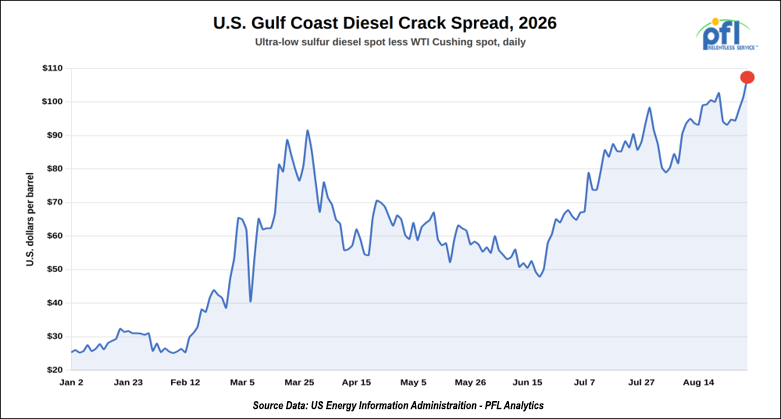
We Continue to Watch Left Wing Carney
Ottawa committed C$4.7 billion on Thursday of last week to build and maintain 313 VIA Rail passenger cars, announced by the Prime Minister in Thunder Bay alongside Alstom, the French manufacturer doing the work. The release put direct employment at 700 jobs in Ontario and Quebec. That is C$15.0 million per passenger car and C$6.7 million per job. Alstom will “maximize” the use of Canadian steel, a word carrying a great deal of weight in a week when steel on both sides of the border is about to get more expensive.
Statistics Canada reported the following morning that the economy shed 42,000 jobs in August. Counter-tariffs on close to C$28 billion of U.S. goods take effect today, covering steel, appliances, agricultural equipment and pulp and paper, every one of them a carload commodity. The Prime Minister spent last week telling Washington to “start being serious,” which is a curious posture from the side that suspended the negotiations. Seven hundred assembly jobs in Thunder Bay do not offset 42,000 lost in a month, and the announcement was timed as though somebody hoped nobody would run the numbers.
Freight railroads in Canada get none of this. They get tariffed steel, a tank car and hopper fleet that ages regardless of who holds office, and counter-tariffs that raise the cost of every American-built component sitting in a Canadian repair shop. At the average price FreightCar America realized on its 2025 deliveries, C$4.7 billion buys close to 27,600 freight cars, roughly 90 for every passenger car in the VIA order and more equipment than the entire North American industry expects to build this year. Passenger cars in Thunder Bay make for a better photograph than a freight network that actually moves the economy. In our opinion, C$15 million a car is not industrial strategy. It is a press release with a purchase order attached:
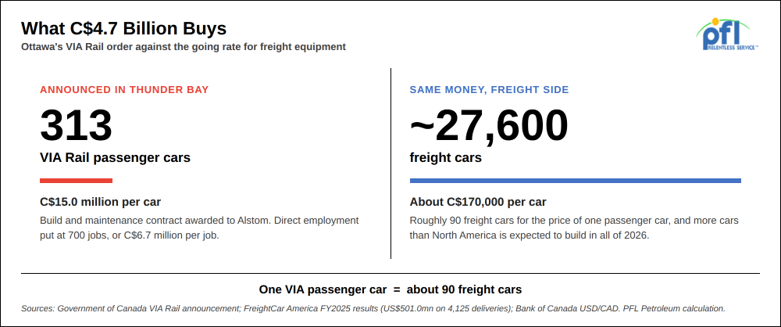
We Continue to Watch the Merger
The Surface Transportation Board’s chief counsel granted the National League of Cities an extension on Monday of last week, moving the deadline for local governments to file a notice of intent to participate in the Union Pacific and Norfolk Southern proceeding from September 4th to September 30th. Every extension pushes the procedural schedule further right, and the applicants are the only party in the docket paying for delay.
Union Pacific is not treating it as a setback. Chief executive Jim Vena told a Bernstein event on Tuesday of last week that the Board accepted the application on May 28th, starting the statutory twelve month clock, and that the railroad is now in the merits review. Chief financial officer Jennifer Hamann put a possible close in the third or fourth quarter of 2027. The schedule has opposing evidence due November 18th, final briefs on May 28, 2027, and a final decision within 90 days of the record closing. Vena’s line on the extension, that they wanted it faster but would take the win, is the most revealing thing either applicant has said about this process in months.
The opposition has not thinned. Seven state attorneys general have moved to block, BNSF, CSX and CPKC are seeking outright dismissal, and a joint motion from AFPM, ACC, TFI, NITL and ACD remains live. The applicants told the Board in late August they had easily satisfied the prima facie threshold. Nothing filed since has made that a shorter argument.
Separately, the Eighth Circuit vacated the Board’s Metra trackage rights decision against Union Pacific on the same Monday, finding that the Board properly determined the award served the public interest but erred by failing to set compensation terms. The panel remanded and gave the parties 180 days. The holding is narrow and it is about pricing, not authority. It is still a reminder that a reviewing court will look hard at how the Board prices what it hands out, and conditions are exactly what shippers will be demanding in a UP-NS approval. September 30 is the date we have circled.
We Are Watching the EPA
The EPA finalized its 2025 small refinery exemption decisions last Monday, granting full or partial relief to 29 of 34 petitioners and exempting 1.76 billion RINs from retirement. The 2025 compliance deadline moved from September 1st to October 1st, and the agency said it will propose reallocating 100% of the difference between projected and actual exempted volumes into the 2026 and 2027 obligations before the end of October. A 70% reallocation had been the working assumption, so the move to 100% puts roughly 770 million additional RINs of demand back into the next two compliance years.
Credits rallied hard on the announcement and then pulled back. D4 RINs closed out the day (and the week) at $2.19 per RIN, up 7 cents per RIN day-over-day, and up 4 cents per RIN week-over-week. Meanwhile, D6 RINs closed out the day (and the week) at $2.12 per RIN, up 4 cents per RIN day-over-day, and up 6 cents per RIN week-over-week.The relationship between D4 values and processing economics has broken down this year, with policy setting the price and crush margins along for the ride.
Finalized volumes stand at 26.81 billion RINs for 2026 and 27.02 billion for 2027, the highest in the program’s history. Higher obligations mean more physical gallons, and physical gallons move in tank cars. The October reallocation proposal, not the daily RIN print, is what sets ethanol and biodiesel tank car demand through the 2027 compliance year. We work with shippers on ethanol and biodiesel fleets and this is the calendar item we have marked.
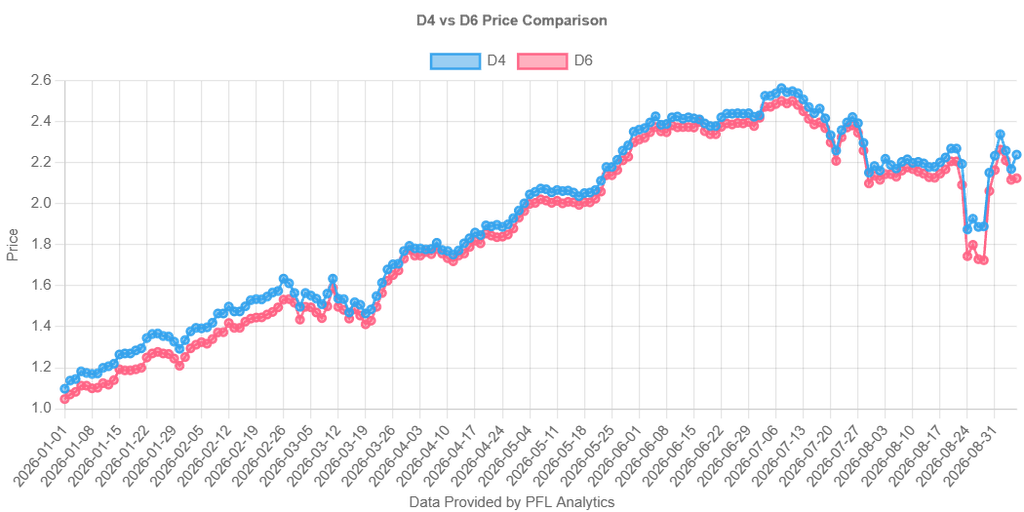
We Are Watching Key Economic Indicators
Purchasing Managers Index (PMI)
The Institute for Supply Management (ISM) releases two PMI reports each month—one covering manufacturing and the other covering services. These reports are based on surveys of supply managers across the country and measure changes in business activity. A reading above 50% indicates expansion, while a reading below 50% signals contraction, with the pace of change increasing as the index moves farther from 50.
The Manufacturing PMI registered 54.6% in August 2026, down from 55.6% in July, but still marking the eighth consecutive month of expansion. While the pace of growth moderated from July’s strongest reading since May 2022, manufacturing activity remained solidly in expansion territory. The New Orders Index declined to 53.7% from 56.7% in July, indicating slower yet continued growth in demand, while elevated input costs and supply-chain pressures remained ongoing concerns for manufacturers.
The Services PMI registered 55.4% in August 2026, up from 54.1% in July and marking the 26th consecutive month of expansion. Growth accelerated across the sector, with the Business Activity Index rising to 61.7% and the New Orders Index jumping to 60.9%, its highest reading since February 2023. However, employment remained in contraction territory at 47.8%, while the Prices Index increased to 72.6%, highlighting continued inflationary and operating cost pressures. Overall, the report indicates that the U.S. services sector continues to expand at an accelerating pace despite persistent hiring and cost challenges.
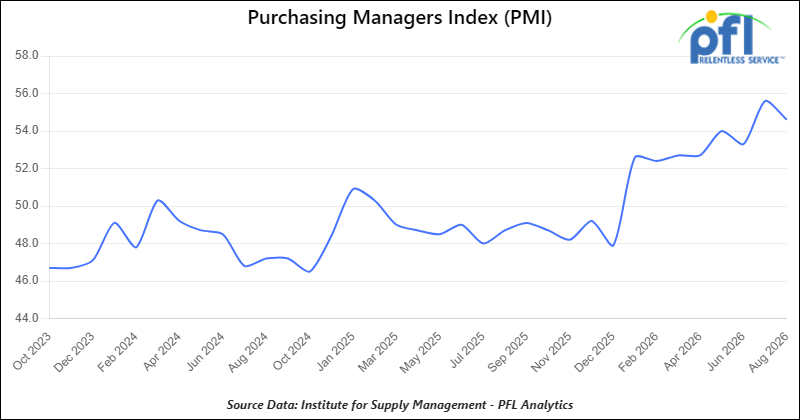
U.S. Unemployment
On September 4, the U.S. Bureau of Labor Statistics (BLS) reported that a preliminary 162,000 net new jobs were created in August 2026, marking a significant rebound from the weak job growth reported earlier in the summer. The BLS also revised employment figures for the prior two months upward, adding a combined 55,000 jobs to June and July totals. June was revised up from 20,000 to 31,000 new jobs, while July was revised from a loss of 23,000 jobs to a gain of 21,000 jobs.
According to the BLS, total nonfarm payroll employment has increased by approximately 214,000 jobs over the last three months (June through August 2026). The official unemployment rate remained unchanged at 4.1% in August, while the labor force participation rate edged up to 61.6%, indicating that the labor market strengthened considerably following the slowdown seen earlier in the summer.
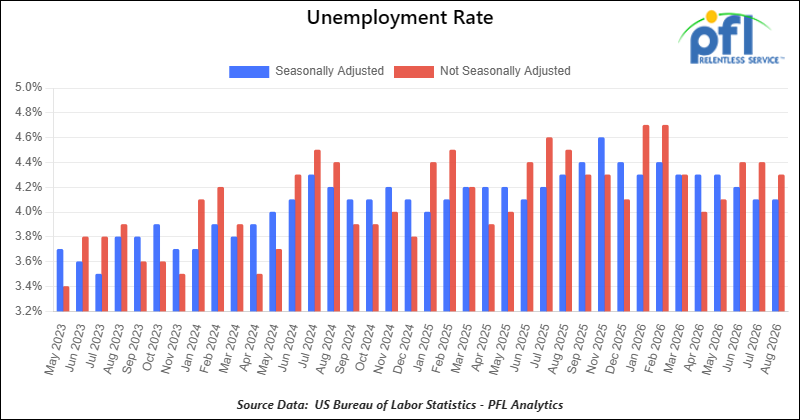
Lease Bids
- 20-50, 4000-5000 Covered Hoppers located off of UP or BNSF in Houston. For use in Urea, Potash, and Ammonium Sulfate service. Period: 6-12 Months.
- 300, 5200CF Covered Hoppers located off of CP or CM in Canada. For use in Petcoke service. Period: 3 Year.
- 100, 340W Pressure Tank located off of CN or CP in Canada. For use in Propane service. Period: 6 Months.
- 10-20, 3200 or 3281 Covered Hoppers located off of CN or CP in Canada. For use in Sodium Sulphate service. Period: 3-5 years. Lined.
- 50, 340W Pressure Tanks located off of CN or CP in Canada. For use in Propane service. Period: Winter.
- 30-50, 340W pressure Tanks located off of NS or CSX in Northeast U.S. For use in Propane service. Period: Winter.
- 25, 340W Pressure Tanks located off of UP or BN in US. For use in Propane service. Period: Winter.
- 50, 28.3K 117J Tanks located off of BNSF in Kansas/Oklahoma. For use in Fuel Oil service. Period: 6 Months.
- 100, 30K 117J Tanks located off of CN in Canada. For use in Diesel service. Period: 1 year.
- 150, 340W Pressure Tank located off of CN in Canada. For use in Propane service. Period: 3 Months.
Sales Bids
- 28, 3400CF Covered Hoppers located off of UP or BNSF in Texas. For use in Cement service. Cement Gates needed.
- 20, 17K DOT111 Tanks located off of various class 1s in various locations. For use in corn syrup service.
- 120, Various Open-Top Aluminum Rotary Gondolas located off of various class 1s in various locations. For use in Sulphur service. Built 2004 or later.
- 12, 21.5K-25K DOT 111 Tanks located off of Various Class 1s in Michigan. For use in Diesel, Asphalt, Crude service. Coiled and Insulated.
Lease Offers
- 21, 6351 Covered Hoppers located off of CN in Wisconsin. Last used in DDG. Available until February 2027.
- 29, 6500 Covered Hoppers located off of CN in Wisconsin. Last used in DDG. Available until February 2027.
- 15, 6200CF Covered Hoppers located off of all class 1s in Wisconsin. Last used in plastic. Cars are currently clean.
- 30, 6500CF Covered Hoppers located off of all class 1s in Wisconsin. Last used in plastic. Cars are currently clean.
- 100, 28.4K DOT 117J Tanks located off of UP or BNSF in Beaumont, TX. Cars are currently clean.
- 50, 30K DOT117J Tanks located off of UP or BNSF in the South. Last used in ethanol.
- 10, 29K DOT 117R Tanks located off of BNSF and UP in Texas. Last used in gasoline additive. Coiled and Insulated.
- 39, 31K CPC1232 Tanks located off of All Class 1s in Iowa. Last used in diesel.
- 2, 30K DOT 117R Tanks located off of BNSF and UP in Texas. Last used in Diesel.
- 1, 30K DOT 117R Tanks located off of BNSF and UP in Texas. Last used in gas blend stock.
- 3, 30K DOT 117R Tanks located off of BNSF and UP in Texas. Last used in gasoline.
- 41, 30K DOT 111 Tanks located off of in Brownsville. Last used in Diesel. Cars are currently clean.
- 17, 31.7K DOT 111 Tanks located off of Various Class 1s in Texas. Last used in Diesel. Cars are currently clean.
- 76, 31.8K DOT 111 Tanks located off of Various Class 1s in Texas. Last used in Diesel. Cars are currently clean.
- 22, 21K DOT 115 Stainless Steel Tank located off of BNSF in Texas. Cars are currently clean. Cars are currently clean.
Sales Offers
- 81, 31.8K CPC1232 Tanks located off of UP or BNSF in TX. Last used in Multiple Services. Requal Due in 2025.
- 35, 3400CF Covered Hoppers located off of UP or BNSF in the Midwest. Last used in Sand.
- 15, 5750 CF Hopper located off of CSX, NS, CP, CN, BNSF, UP in St Louis. Last used in Grain.
- 50, 30 DOT 111 Tank located off of multiple class 1s in multiple location. Last used in Fuels..
Call PFL today to discuss your needs and our availability and market reach. Whether you are looking to lease cars, lease out cars, buy cars, or sell cars call PFL today at 239-390-2885
Railcar for Sale or Lease
| CAT | Type | Capacity | GRL | QTY | LOC | Class | Prev. Use | Offer | Note |
|---|
| CAT | Type | Size | GRL | QTY | LOC | Class | Term | Commodity | Offer | Note |
|---|
| CAT | Type | Capacity | GRL | QTY | LOC | Class | Prev. Use | Clean | Offer | Note |
|---|
| CAT | Type | Capacity | GRL | QTY | LOC | Class | Commodity | Offer | Note |
|---|
PFL will be at the Following Conferences
- Where: The Westin Galleria Dallas
- Attending: David Cohen (954-729-4774), and Curtis Chandler (239-405-3365)
- Conference Website
- Where: The Westin Galleria Dallas
- Attending: Brian Baker (239.297.4519)
- Conference Website
The post PFL Railcar Report 9-8-2026 appeared first on PFL Petroleum Services LTD.
]]>The post PFL Railcar Report 8-31-2026 appeared first on PFL Petroleum Services LTD.
]]>Jobs Update
Initial jobless claims seasonally adjusted for the week ending August 22, 2026 came in at 203,000, versus the adjusted number of 207,000 people from the week prior, down 4,000 people week-over-week.
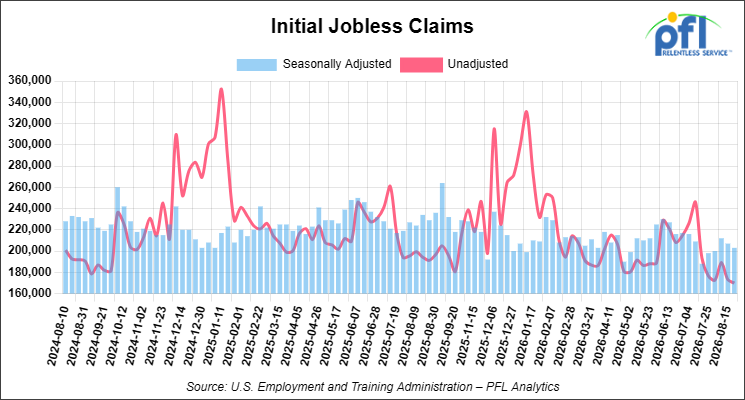
Continuing jobless claims came in at 1,778,000, versus the adjusted number of 1,796,000 people from the week prior, down 18,000 week-over-week.
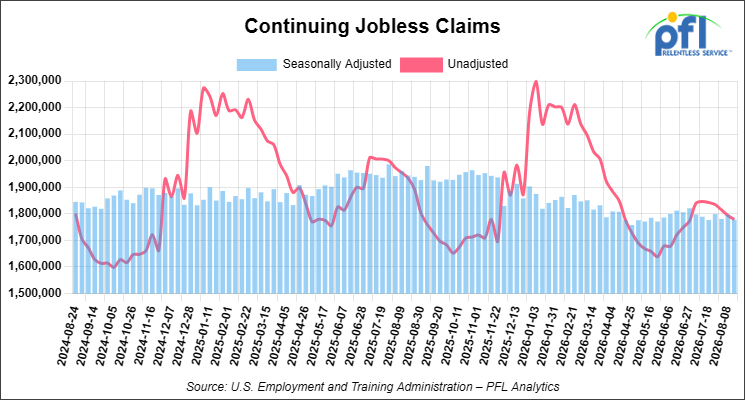
Stocks closed lower on Friday of last week, but higher week-over-week
The DOW closed lower on Friday of last week, down -9.45 points (-0.02%), closing out the week at 53,559.99, up 282.98 points week-over-week. The S&P 500 closed lower on Friday of last week, down -19.23 points (-0.25%), and closed out the week at 7,711.76, up 37.39 points week-over-week. The NASDAQ closed lower on Friday of last week, down -138.93 points (-0.52%), and closed out the week at 26,402.42, up 221.97 points week-over-week.
In overnight trading, DOW futures traded lower and are expected to open at 53,489 this morning, down 95 points from Friday’s close.
Crude oil closed lower on Friday of last week and lower week-over-week
West Texas Intermediate (WTI) crude closed down -$0.13 per barrel (-0.2%), to close at $83.40 on Friday of last week, and down -$3.66 per barrel week-over-week. Brent crude closed down -$0.39 per barrel (-0.4%), to close at $89.31, and down -$5.08 per barrel week-over-week.
One Exchange WCS (Western Canadian Select) for October delivery settled on Friday of last week at US$16.45 below the WTI-CMA (West Texas Intermediate – Calendar Month Average). The implied value was US$64.80 per barrel.
U.S. commercial crude oil inventories (excluding those in the Strategic Petroleum Reserve) increased by 100,000 barrels week-over-week. At 428.9 million barrels, U.S. crude oil inventories are 1% above the five-year average for this time of year.
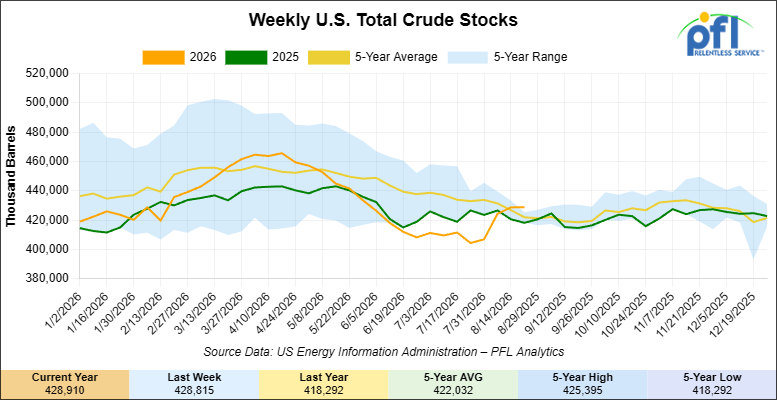
Total motor gasoline inventories decreased by 2.5 million barrels week-over-week and are 6% below the five-year average for this time of year.
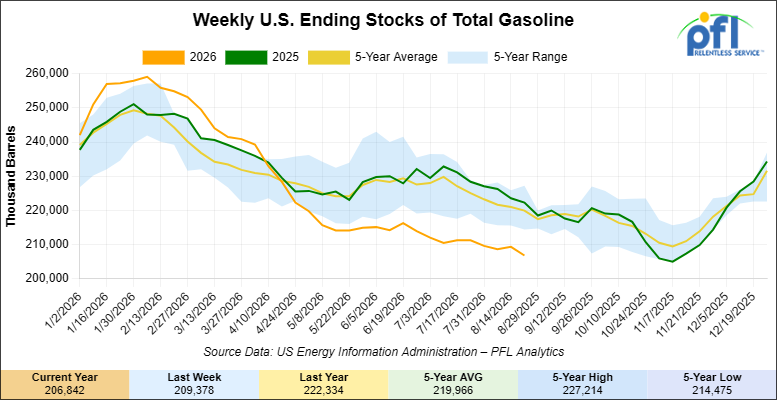
Distillate fuel inventories decreased by 2.2 million barrels week-over-week and are 14% below the five-year average for this time of year.
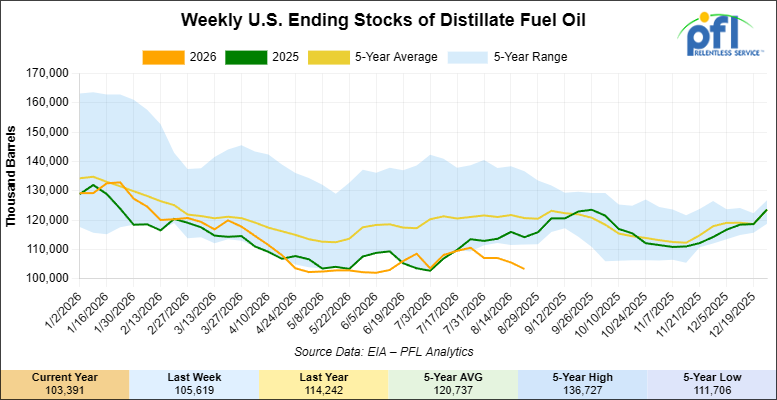
Propane/propylene inventories increased by 2.5 million barrels week-over-week and are 32% above the five-year average for this time of year.
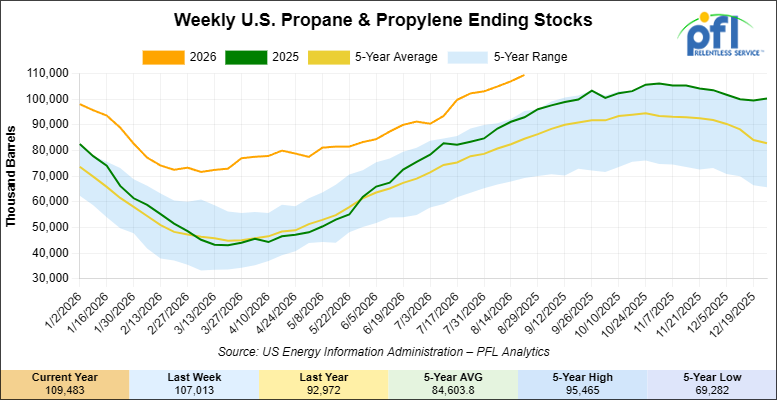
Propane prices closed at 72.8 cents per gallon on Friday of last week, up 4.9 cents per gallon week-over-week, and up 6.1 cents year-over-year.
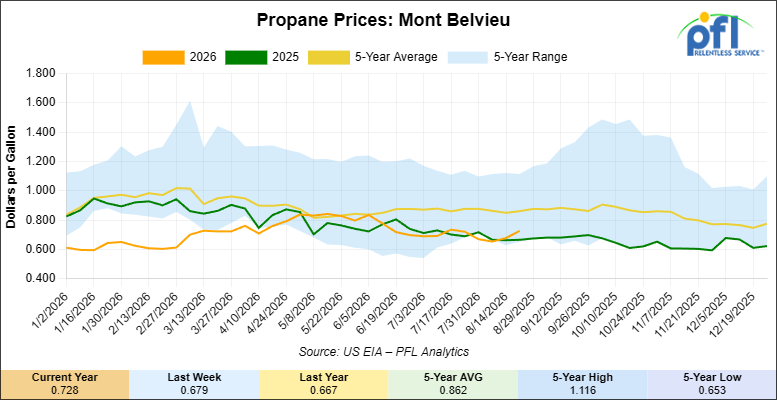
Overall, total commercial petroleum inventories increased by 100,000 barrels week-over-week during the week ending August 21, 2026.
U.S. crude oil imports averaged 6.2 million barrels per day during the week ending August 21, 2026, a decrease of 435,000 barrels per day week-over-week. Total motor gasoline imports (including both finished gasoline and gasoline blending components) averaged 565,000 barrels per day, and distillate fuel imports averaged 176,000 barrels per day during the week ending August 21, 2026.
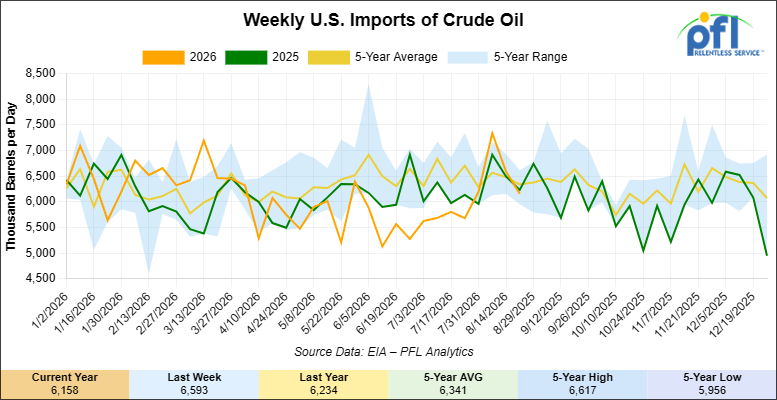
U.S. crude oil exports averaged 3.792 million barrels per day during the week ending August 21, 2026, a decrease of 274,000 barrels per day week-over-week. Over the past four weeks, crude oil exports averaged 3.65 million barrels per day.
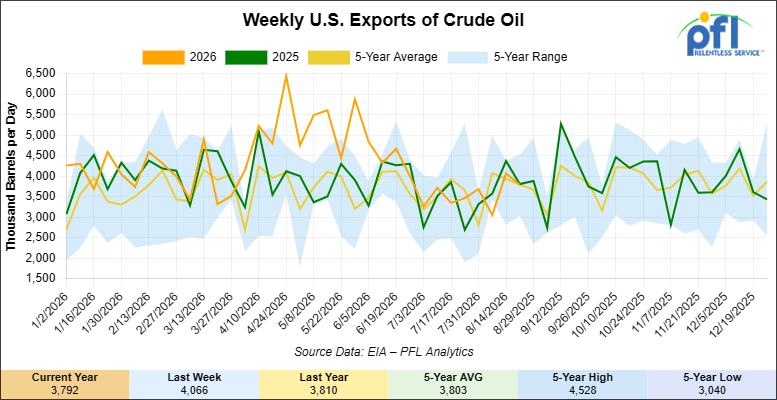
U.S. crude oil refinery inputs averaged 17.4 million barrels per day during the week ending August 21, 2026, which was 1,000 barrels per day less week-over-week.
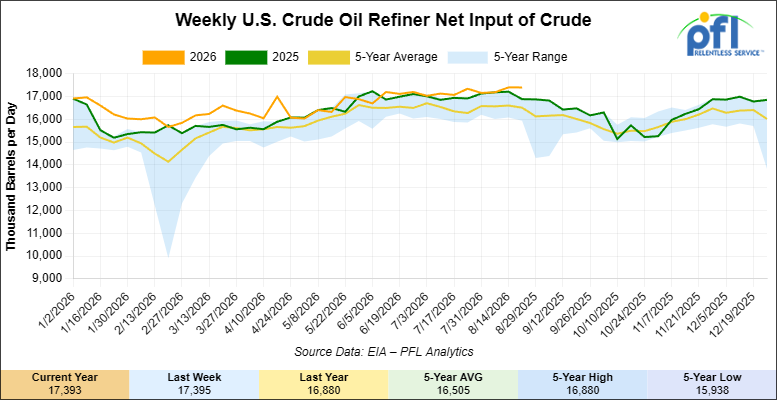
WTI is poised to open at $86.62, up $3.24 per barrel from Friday’s close.
North American Rail Traffic
Week Ending August 26, 2026:
Total North American weekly rail volumes were up (+4.35%) in week 35, compared with the same week last year. Total Carloads for the week ending August 26, 2026 were 337,309, up (+4.41%) compared with the same week in 2025, while weekly Intermodal volume was 361,052, up (+4.29%) year over year. 8 of the AAR’s 11 major traffic categories posted year-over-year increases. The largest decrease came from Coal (-6.16%). The largest increase was Metallic Ores and Metals (+23.47%).
In the East, CSX’s total volumes were up (+5.15%), with the largest decrease coming from Motor Vehicles and Parts (-7.95%), while the largest increase came from Other (+17.83%). NS’s total volumes were up (+2.79%), with the largest increase coming from Grain (+28.06%), while the largest decrease came from Motor Vehicles and Parts (-4.63%).
In the West, BNSF’s total volumes were up (+3.56%), with the largest increase coming from Forest Products (+28.56%), while the largest decrease came from Coal (-14.73%). UP’s total volumes were up (+5.09%), with the largest increase coming from Metallic Ores and Metals (+29.04%), while the largest decrease came from Coal (-8.01%).
In Canada, CN’s total volumes were up (+6.81%), with the largest increase coming from Metallic Ores and Metals (+40.95%), while the largest decrease came from Coal (-14.73%). CPKCS’s total volumes were up (+5.48%), with the largest increase coming from Metallic Ores and Metals (+54.27%), while the largest decrease came from Farm Products (-20.68%).
Source Data: AAR – PFL Analytics
North American Rig Count Summary
North American rig count was down by -5 rigs week-over-week. The U.S. rig count was unchanged week-over-week, but up by +52 rigs year-over-year. The U.S. currently has 588 active rigs. Canada’s rig count was down by -5 rigs week-over-week, but up by +36 rigs year-over-year. Canada currently has 211 active rigs. Overall, year-over-year we are up by +88 rigs collectively.
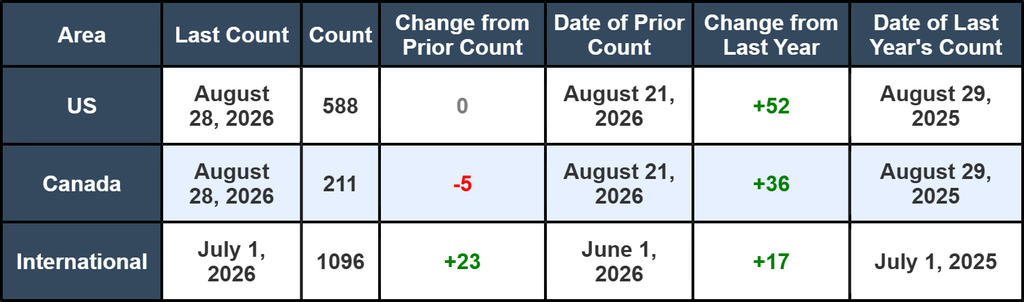
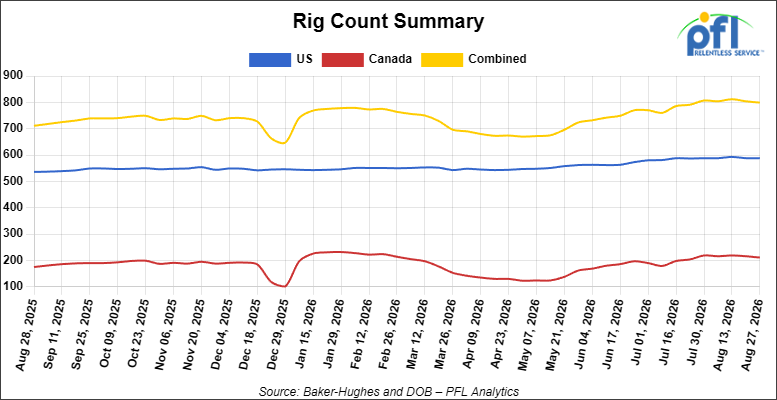
We are watching a few things out there for you:
We Are Watching Petroleum Carloads
The four-week rolling average of petroleum carloads carried on the six largest North American railroads rose to 30,480 from 30,201 which was an increase of +279 rail cars week-over-week. Canadian volumes were higher. CN’s shipments were higher by +5.0% week-over-week, CPKC’s volumes were also higher by +5.0% week-over-week. U.S. shipments were mixed. The UP had the largest percentage increase and was up by +3.0% week-over-week. The NS had the largest percentage decrease and was down by -8.0% week-over-week.
We Continue to Watch Our Strategic Petroleum Reserves
The ongoing emergency drawdown of the U.S. Strategic Petroleum Reserve (SPR) remains a major component of global efforts to offset crude oil supply disruptions stemming from the conflict involving Iran and the continued restrictions on oil shipments through the Strait of Hormuz. Since March, the Department of Energy (DOE) has awarded exchanges covering more than 133 million barrels of crude oil, with additional releases expected as part of a broader international response coordinated through the International Energy Agency (IEA). DOE’s most recent publicly documented award total remains more than 133 million barrels, while the department has continued executing the broader 172-million-barrel commitment.
The United States continues to execute its commitment to make available up to 172 million barrels from the SPR under the IEA’s collective plan to inject roughly 400 million barrels into global energy markets. Officials have argued that the releases are necessary to help stabilize crude supplies and limit further increases in fuel prices as refiners compete for replacement barrels amid ongoing transportation disruptions. The IEA’s coordinated action remains the largest emergency oil-stock release in the agency’s history.
As releases have accelerated, inventories in the SPR have declined to 289.726 million barrels, down from 415.442 million barrels at the start of the conflict with Iran and reaching their lowest level since December 1982. The SPR declined by 3.7 million barrels during the week ending August 21, 2026. Since the first SPR drawdown began, the United States has withdrawn approximately 123.599 million barrels, equivalent to an average of roughly 882,850 barrels per day through the week ending August 21, 2026.
Global petroleum inventories have also tightened considerably. The IEA has reported substantial draws in commercial crude and refined-product stockpiles across major consuming nations, underscoring the strain that the conflict has placed on world energy markets. While oil flows through the Strait of Hormuz have partially recovered from their initial near-shutdown, the IEA continues to identify significant uncertainty surrounding the pace and durability of the recovery.
The Administration continues to emphasize that the current program consists primarily of exchange agreements, rather than outright sales. Under these arrangements, companies receiving crude oil today are required to return the borrowed barrels in the future along with additional volumes as a premium. DOE has stated that its exchange structure is designed to return the borrowed crude with additional premium barrels, with the stated objective of strengthening the SPR over time.
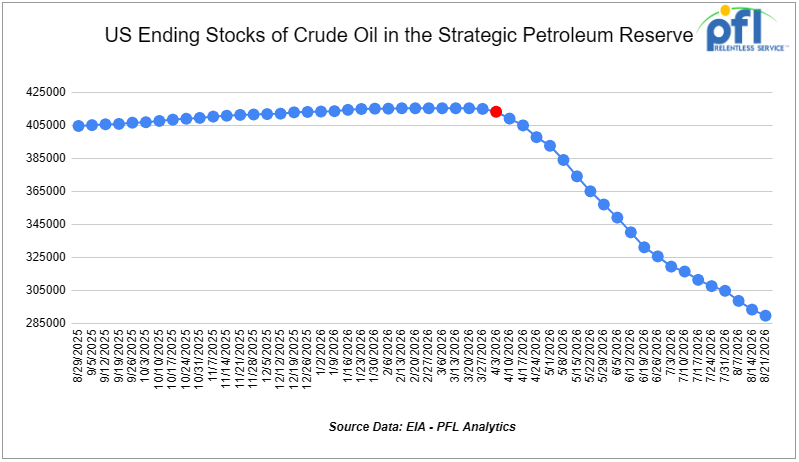
We Are Watching Canadian Crude by Rail
The Canadian Energy regulator reported on August 26, 2026, that 81,226 barrels per day were exported during the month of June 2026, down from 87,977 barrels per day in May of 2026, a decrease of 6,751 barrels per day month-over-month.
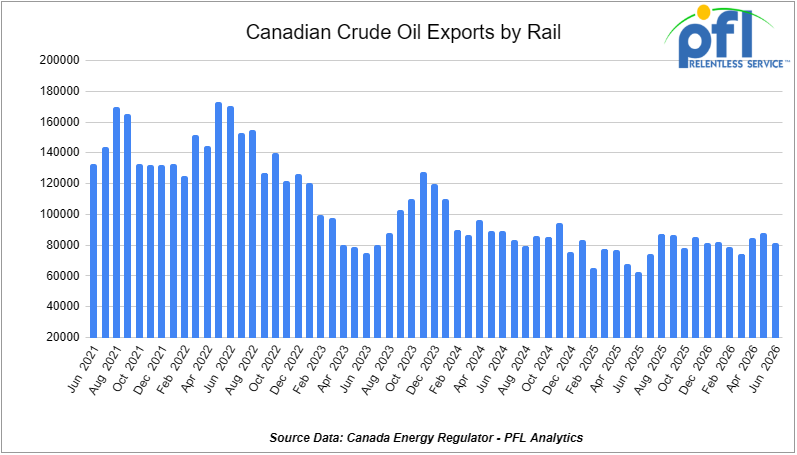
Crude by rail will always be necessary out of Canada for stranded oil not connected by pipelines. Raw bitumen, which is shipped as a non-haz product and is not able to flow in pipelines, is competitive with pipeline tolls and is a growing market to keep an eye on. In a normal predictable market, we really need to see basis WTI-CMA (West Texas Intermediate – Calendar Month Average) blowout to -18 per barrel for sustained periods of time to make economic sense. Current rail rates from Alberta to the U.S. Gulf Coast have averaged roughly $17 per-barrel, making rail competitive whenever WCS-WTI spreads exceed $18 per barrel, including quality adjustments.
This is not a fleet that switches overnight: car owners and lessors want five-year commitments, the Class Ones expect similar term, and new 117J cars carry one to two year build times.
Folks, what we are in now is not a normal and predictable market. Some would say nothing has been normal or predictable since COVID. With pipelines out of Alberta full or nearly full one consideration is the outright price of oil itself, with the conflict in Iran not seeming to go away anytime soon, some may step up, take on some cars to get barrels to market quickly. Mistreamers won’t do that, however, we may see the producer step up. For the producer it is all about what their netback is, not how much it costs to get there. The producer can pay more than $18 per barrel at some point if that is their only outlet and pipelines are full. The risk reward ratio may make sense with elevated prices but the old saying – what goes up, must come down, it is just a matter of when. We always have our eyes on this one please stay tuned to PFL or call the desk to trouble shoot.
We Continue to Watch Line 5
A parked, unoccupied semi truck rolled into an open excavation at an Enbridge Line 5 valve project near Saxon, in Iron County, Wisconsin, at about 10 a.m. last Tuesday, striking the pipe and releasing natural gas liquids into the air. Nearby rural homes were evacuated, power was cut to 55 customers inside the evacuation zone to eliminate ignition sources, and a temporary no-fly zone went up over the site. Line 5 has been shut since, taking 540,000 barrels per day of light crude and natural gas liquids out of service between Superior, Wisconsin and Sarnia, Ontario. Enbridge said Wednesday of last week that it expects to return the line to service on Saturday September 5.
Line 5 Incident – Posted August 29th 2026

Source: Enbridge – PFL Analytics
Line 5 Incident – Posted August 29th 2026
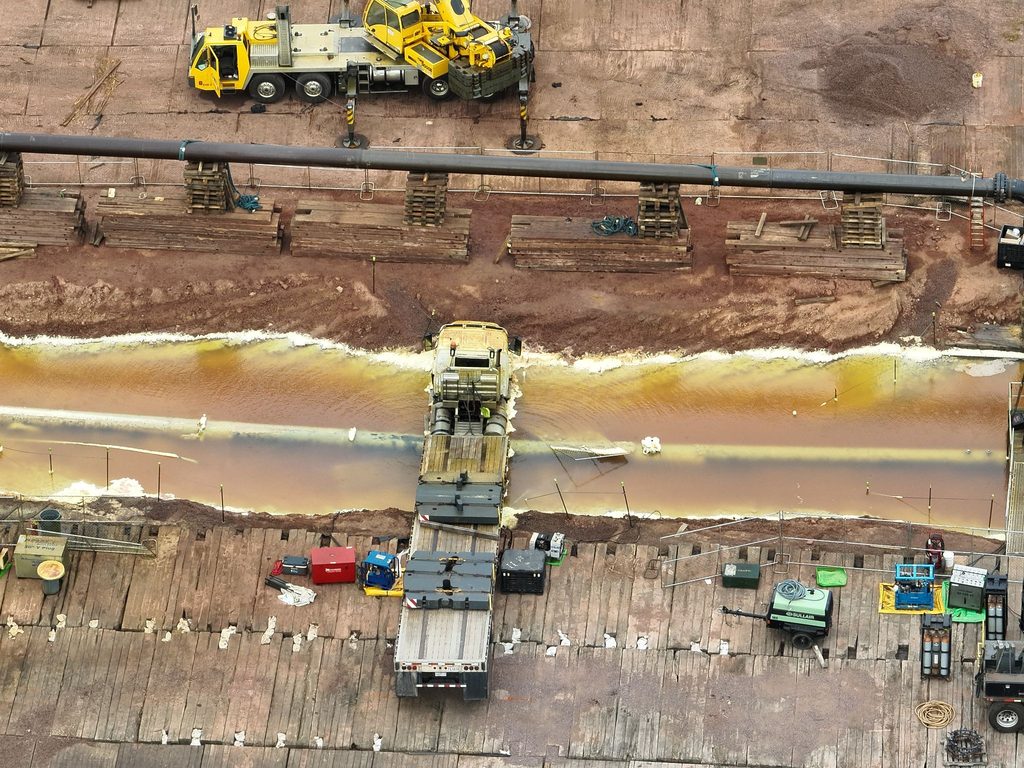
Source: Enbridge – PFL Analytics
The Wisconsin Department of Natural Resources sent Enbridge a letter on Thursday of last week asking the company to halt work on the $1 billion, 41-mile reroute around the Bad River Band reservation until the incident on the existing line is resolved. Secretary Karen Hyun wrote that the agency is deeply concerned about the spill and immensely frustrated by other recent noncompliance events and attached more than 20 questions covering the volume released, the worst case release of propane and butane vapors, and the timeline for controlling it. The frustration has a paper trail: the DNR has issued four notices of non-compliance on the reroute project, and there have been at least four releases of drilling fluid, the largest running as high as 1,900 gallons in late June. Governor Tony Evers said the state is exceedingly concerned about recent events involving Enbridge and wants answers expeditiously. The state has also noted that Enbridge took an hour and 15 minutes to call the spills hotline.
Michigan moved in the same week. Governor Gretchen Whitmer filed a response brief last Friday in the federal suit Enbridge brought in 2020 after she and the Department of Natural Resources revoked the 1953 Straits of Mackinac easement, arguing that the Straits belong to the people of Michigan and not to oil companies or the federal government. The reference to the federal government is pointed: Judge Robert Jonker sided with Enbridge on the shutdown question in December, the state appealed to the Sixth Circuit in January, and the Trump administration filed an amicus brief in July supporting Enbridge.
Attorney General Dana Nessel’s separate closure case sits in Ingham County Circuit Court, paused pending the shutdown appeal. The Michigan Supreme Court vacated the Public Service Commission permit for the Straits tunnel on July 31st and sent the analysis back to the commission, and the Seventh Circuit upheld the Bad River trespass ruling the day before that, though it gave Enbridge more time to finish the reroute Wisconsin now wants stopped. Every one of these files has been arguing about hypothetical failure modes, and last Tuesday one of them stopped being hypothetical.
Sarnia and the Ontario and Michigan propane market can absorb a one week outage without much drama – lots of propane in storage right now, and Enbridge has roughly 150 people on the response. We expect Enbridge to get the incident cleaned up and operations to resume quickly but the ongoing legal battle seemingly will continue. We will continue to watch enbridge line 5
We Continue to Watch Left Wing Carney
Finance Minister François-Philippe Champagne published Canada’s counter-tariff list last Tuesday, running close to 100 pages and more than 700 line items. Duties of 15%, 25% and 50% land on C$27.6 billion of U.S. imports at 12:01 a.m. on September 8, with existing steel and aluminum rates doubling to 50%. Ottawa paired the list with a C$7.5 billion support package for exposed businesses and workers, and Industry Minister Mélanie Joly said the targets were selected with U.S. midterm races in mind.
Steel, dairy, appliances, agricultural equipment, pulp and paper and electronics are the named sectors, which is to say most of the list rides on a flatcar, a boxcar or a centerbeam in one direction or the other. The U.S. duties cover roughly 5.5% of Canadian exports south and the Canadian counter covers roughly 6% of U.S. exports north, so both governments have chosen to tax about one dollar in seventeen and leave the rest of the flow alone. Energy, potash and critical minerals remain carved out on both sides, so crude, refined products and fertilizer keep moving on current terms.
Alberta Premier Danielle Smith spent the week arguing against the one lever that would actually bite. Curtailing or surcharging hydrocarbon exports, she said, invites an equal and more forceful response, reciprocal curtailment of U.S. crude and refined product into central Canada would bring Ontario and Quebec to a grinding halt, and Washington can backfill Canadian heavy with Venezuelan barrels by reversing existing lines, at which point Canada may lose the customer entirely and maybe forever. Ontario’s Doug Ford says that everything is on the table and Quebec’s Christine Frechette will not exclude anything, which is how a country ends up with an energy export policy set by whichever premier is nearest a microphone.
Carney walked from the table on August 21st, promised dollar for dollar, delivered dollar for dollar four days later, and attached C$7.5 billion of domestic support to cushion a hit his own negotiators triggered. The counter-tariffs will not move Washington, and the support package is a transfer from Canadian taxpayers to Canadian firms for the privilege of paying more for American steel. In our opinion, the tell is the carve-out. The one file where Canada holds real leverage is the one file both sides quietly agreed not to touch, and everything else is theatre with a September 8th curtain.
We Continue to Watch the UP and the NS
Union Pacific and Norfolk Southern filed their reply Wednesday of last week, telling the Surface Transportation Board they have presented an unprecedented evidentiary case and easily satisfied the prima facie threshold. Chief Executive Jim Vena said the applicants have more than cleared the threshold to move review forward and that opponents’ efforts to kill the deal do not change the facts.
The opposition is unusually broad. BNSF, CSX and Canadian Pacific Kansas City want the application rejected outright, seven state attorneys general are on record, and the Alliance for Chemical Distribution, American Chemistry Council, American Fuel and Petrochemical Manufacturers, The Fertilizer Institute and the National Industrial Transportation League filed a joint motion earlier this month arguing the applicants have not cleared the public interest bar. That coalition is essentially the tank car shipper base, and its central complaint is the reduction of Class I options at customer facilities from two to one and three to two. Canadian National left the opposition column earlier in the proceeding in exchange for haulage rights across the Midwest and southern U.S. and access to the affected facilities.
The Natural Resources Defense Council asked the Board last Tuesday to require public disclosure of the carbon emissions data behind the applicants’ claim of nearly 3.8 million tons per year of avoided CO2, which the railroads designated highly confidential. The NRDC pointed out that the railroads had already filed supplemental information correcting earlier nitrogen oxide figures, which is an awkward fact to carry while arguing the rest of the environmental case should stay sealed. The headline claims are unchanged: a 55,000 mile network handling about half of U.S. rail freight, coast to coast transit a day or two faster, an estimated $3.5 billion a year in shipper savings and 2.1 million trucks off the road.
Nothing in this proceeding moves until the Board rules on the prima facie question, and that ruling is the only date on the calendar worth marking. For shippers with cars routed over the affected interchanges, the planning assumption has not changed. This is a 2027 question at the earliest, and the service disruption risk sits on the far side of approval. We will be keeping our eye on this one.
We Are Watching Diesel
The U.S. Gulf coast ultra low sulfur diesel crack against Cushing WTI closed at $102.67 per barrel Thursday of last week. That is the first close above $100 since October 2022, on a spread that averaged $28.60 in January and $91.80 across August. Distillate inventories fell another 2.2 million barrels in the week ended August 21 and sit about 14% under the five-year average.
The shortage is in refining capacity, not in crude. Middle East refining took damage during the Iran conflict, Hormuz is still a chokepoint, Russian refining and exports keep absorbing drone strikes, and the permanent closures of the COVID years has left no slack anywhere in the system to absorb any of it. U.S. refiners ran flat out at 97.4% of operable capacity in the week ending August 21st, with crude inputs at 17.4 million barrels per day.
A 97.4% run rate means deferred turnarounds, maximum crude receipts and maximum clean product outbound, sustained on margins nobody is willing to walk away from. Roughly 500,000 barrels per day of crude distillation capacity is already scheduled offline in September with more expected as individual refineries update their schedules, which puts a ceiling on how long this run rate holds. Distillate this tight pulls product into inland markets by tank car wherever pipeline space is already committed, and clean product car utilization has been the quiet beneficiary all summer.
The fall turnaround calendar matters more here than the crack itself. A crack over $100 tells you the market has already repriced. September and October maintenance tells you whether it holds. Either way, a clean product car in serviceable condition is worth more than lease rates suggest.
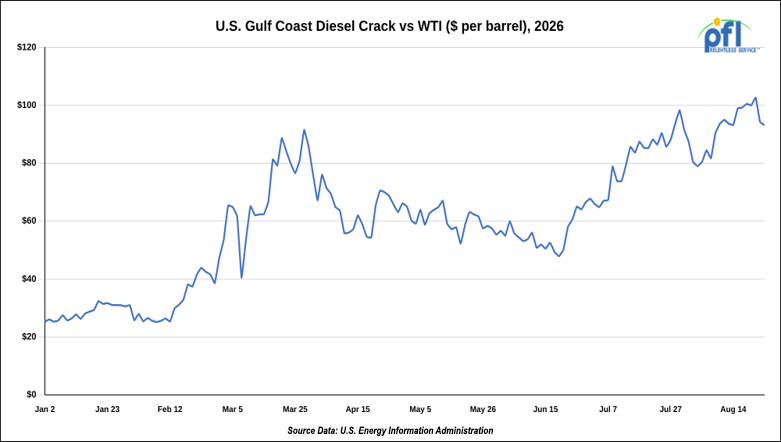
We Are Watching Rail Corridors
Transportation Secretary Sean Duffy launched America’s Great Corridors of Commerce last Wednesday, a voluntary program that lets railroads and state transportation departments lease their rights of way for transmission lines, fiber optic cable, water pipelines and other utilities. Right of way owners partner with private sector corridor managers on design, development, operation and maintenance, and the lease revenue is meant to fund track, bridge and tunnel work along the same corridor. The Build America Bureau published a request for information on August 18th and will follow with a request for expressions of interest.
The procedural piece is where the value sits. Using land the railroad already controls avoids assembling private property and lets projects lean on categorical environmental exclusions instead of full reviews. DOT expects to designate up to five corridors in the first round, with those corridors getting priority federal permitting coordination and access to funding and financing programs. Owners that are not designated can still pursue the same partnership structure on their own.
Lease income on otherwise idle right of way is the smaller half of this. Transmission capacity running alongside a rail line makes the adjacent property viable for data centers, manufacturing and processing plants, and those facilities generate construction inbound, feedstock inbound and finished product outbound for as long as they operate. The first five selections will say more about how serious the program is than the announcement did. Worth watching where they land.
We Are Watching Methanol
Methanex is idling its Titan plant in Trinidad and Tobago as the facility’s natural gas contract expires this quarter, pulling 860,000 tonnes per year out of the Atlantic basin and putting the unit into preservation. Titan follows the 1.82 million tonne per year Atlas plant, idled since September 2024, which leaves Methanex with nothing running at Point Lisas. Trinidad has historically supplied the majority of the methanol imported through U.S. east coast ports.
The east coast is an import market with no meaningful local production, so the replacement barrels come out of the U.S. Gulf coast. There is no direct rail provider from the Gulf Coast to the East Coast, which is why the northeast truck and rail premium over the Gulf Coast has widened from roughly 8 cents per gallon across 2003 to 2023 to about 32 cents since 2024. Venezuela has taken share this year, capturing about 31% of total U.S. imports through June, though that is a supply source with its own political calendar.
The structural shift from waterborne import to domestic rail movement is the kind of demand that turns up in lease renewals two quarters out. It does not turn up in the spot market. Methanol moves in general purpose non-pressurized service, so this is not a specialty build problem. It is a car availability and routing problem in a lane that has not needed the cars before. PFL’s customers in chemical service should plan on the northeast being a harder lane to cover this winter than last.
We are watching Copper
A major U.S. copper project received additional federal backing last week as the Export-Import Bank of the United States (EXIM) indicated up to $1.1 billion in potential debt financing for Ivanhoe Electric’s Santa Cruz Copper Project in Arizona.
Ivanhoe Electric announced the Preliminary Project Letter last week, increasing the potential EXIM financing from the $825 million contemplated last year. While the financing remains subject to further due diligence, underwriting and final approvals, the increase represents another significant step toward development of a new domestic source of refined copper.
Located near Casa Grande, Arizona, Santa Cruz is being developed as a large-scale underground copper mine designed to process approximately 20,000 tonnes of material per day. Current plans call for average annual production of approximately 72,000 tonnes of 99.99% pure copper cathode during the first 15 years of operation, with an expected mine life of 23 years.
The project is particularly significant as the U.S. looks to expand domestic supplies of critical minerals used in electrical infrastructure, power generation and transmission, manufacturing, technology and national defense. Rather than shipping concentrate elsewhere for processing, Santa Cruz is designed to produce finished copper cathode onsite.
Development activity is also beginning to move closer to construction. Ivanhoe has already received approval for its Site Development Plan and the necessary permits for initial construction activities. Excavation associated with the mine-access system is scheduled to begin in the third quarter of 2026, followed by additional mine and surface infrastructure development through 2027 and 2028. First copper cathode production is currently targeted for the second quarter of 2029.
For the freight and rail industries, projects of this scale extend well beyond the finished commodity. Mine construction and operation require significant volumes of steel, machinery, construction materials, chemicals and other industrial inputs, while eventual production creates another domestic supply source feeding U.S. manufacturing and infrastructure markets.
The increased financing consideration for Santa Cruz is another indication of the broader push to develop critical-mineral supply chains within the United States. As billions of dollars move into new mines, processing facilities, power infrastructure and manufacturing capacity, those investments can create new freight demand throughout the supply chain.
We are watching Class 1 Industrial Headcount
Class I railroads employed 115,013 workers in the United States in July 2026, a -0.01% decrease from June 2026’s count of 115,030 and a -3.32% year-over-year decrease from July 2025’s total of 118,965, according to Surface Transportation Board data.
Three of the six employment categories posted month-over-month increases between June and July 2026. These were Executives, officials, and staff assistants, up 0.49% to 7,992 workers; Professional and Administrative, which increased 1.67% to 8,872 workers; and Transportation (train and engine), which increased 0.06% to 48,993 workers.
The categories that posted month-over-month decreases were Maintenance of Way and Structures, down -0.53% to 28,641 workers; Maintenance of Equipment and Stores, down -0.36% to 15,888 workers; and Transportation (other than train and engine), down -0.39% to 4,627 workers.
No employment categories posted a year-over-year gain in July 2026.
Categories that registered year-over-year decreases in July 2026 were Executives, officials, and staff assistants, down -0.11%; Professional and Administrative, down -4.62%; Maintenance of Way and Structures, down -1.50%; Maintenance of Equipment and Stores, down -6.62%; Transportation (other than train and engine), down -6.69%; and Transportation (train and engine), down -3.20%.
We Are Watching Key Economic Indicators
Consumer Spending
In July 2026, total consumer spending adjusted for inflation was essentially unchanged from June 2026, rising less than 0.1% and marking a sharp slowdown from the 0.4% increase recorded in June. The slowdown suggests that rising consumer prices absorbed much of the modest increase in household spending, limiting growth in the volume of goods and services purchased.
Inflation-adjusted consumer spending showed little overall growth in July. Current-dollar spending on services increased by $86.2 billion, while spending on goods declined by $49.9 billion, indicating a continued shift toward services as consumers reduced spending on goods.
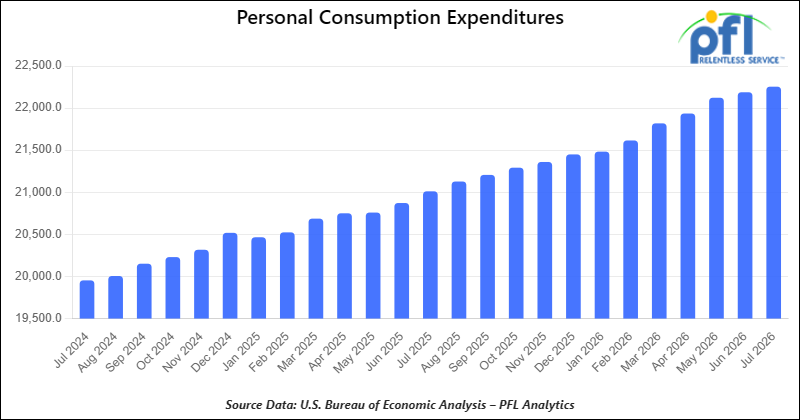
Lease Bids
- 20-50, 4000-5000 Covered Hoppers located off of UP or BNSF in Houston. For use in Urea, Potash, and Ammonium Sulfate service. Period: 6-12 Months.
- 30-50, 25.5K DOT 111 Tanks located off of All Class 1s in various locations. For use in Asphalt service. Period: 1-3 Years.
- 40, 29K DOT 111 Tanks located off of UP or BNSF in the Midwest. For use in Veg Oil service. Period: 5 Year.
- 20, DOT 117J Tanks located off of NS, CSX, CN, or CPKC in various locations. For use in C5 service. Period: 1 year. Need gauge rods.
- 300, 5200CF Covered Hoppers located off of CP or CM in Canada. For use in Petcoke service. Period: 3 Year.
- 10, 30K 117J Tanks located off of BNSF in Canada. For use in Propane or Butane service. Period: 3 Year.
- 20, 28K or larger 117J Tanks located off of BNSF or UP in California. For use in Crude service. Period: 6 months.
- 75, 30K DOT 117 Tanks located off of NS in Ohio. For use in Condensate service. Period: 6-12 Months. Mag Rods Not Needed.
- 100, 28.3K DOT 111 or 117 Tanks located off of CP or CN in Canada. For use in VGO service. Period: 1-3 Years.
- 5, 28.3K DOT 111 or 117 Tanks located off of CN in Canada. For use in Bitumen service. Period: Trip Lease.
- 5-10, 25.5K DOT 111 Tanks located off of CN in Canada. For use in Caustic service. Period: 3-6 Months.
- 100, 340W Pressure Tank located off of CN or CP in Canada. For use in Propane service. Period: 6 Months.
- 10-20, 3200 or 3281 Covered Hoppers located off of CN or CP in Canada. For use in Sodium Sulphate service. Period: 3-5 years. Lined.
- 50, 340W Pressure Tanks located off of CN or CP in Canada. For use in Propane service. Period: Winter.
- 30-50, 340W pressure Tanks located off of NS or CSX in Northeast U.S. For use in Propane service. Period: Winter.
- 25, 340W Pressure Tanks located off of UP or BN in US. For use in Propane service. Period: Winter.
- 50, 28.3K 117J Tanks located off of BNSF in Kansas/Oklahoma. For use in Fuel Oil service. Period: 6 Months.
- 100, 30K 117J Tanks located off of CN in Canada. For use in Diesel service. Period: 1 year.
Sales Bids
- 28, 3400CF Covered Hoppers located off of UP or BNSF in Texas. For use in Cement service. Cement Gates needed.
- 20, 17K DOT111 Tanks located off of various class 1s in various locations. For use in corn syrup service.
- 120, Various Open-Top Aluminum Rotary Gondolas located off of various class 1s in various locations. For use in Sulphur service. Built 2004 or later.
- 12, 21.5K-25K DOT 111 Tanks located off of Various Class 1s in Michigan. For use in Diesel, Asphalt, Crude service. Coiled and Insulated.
Lease Offers
- 21, 6351 Covered Hoppers located off of CN in Wisconsin. Last used in DDG. Available until February 2027.
- 29, 6500 Covered Hoppers located off of CN in Wisconsin. Last used in DDG. Available until February 2027.
- 15, 6200CF Covered Hoppers located off of all class 1s in Wisconsin. Last used in plastic. Cars are currently clean.
- 30, 6500CF Covered Hoppers located off of all class 1s in Wisconsin. Last used in plastic. Cars are currently clean.
- 100, 28.4K DOT 117J Tanks located off of UP or BNSF in Beaumont, TX. Cars are currently clean.
- 50, 30K DOT117J Tanks located off of UP or BNSF in the South. Last used in ethanol.
- 10, 29K DOT 117R Tanks located off of BNSF and UP in Texas. Last used in gasoline additive. Coiled and Insulated.
- 39, 31K CPC1232 Tanks located off of All Class 1s in Iowa. Last used in diesel.
- 2, 30K DOT 117R Tanks located off of BNSF and UP in Texas. Last used in Diesel.
- 1, 30K DOT 117R Tanks located off of BNSF and UP in Texas. Last used in gas blend stock.
- 3, 30K DOT 117R Tanks located off of BNSF and UP in Texas. Last used in gasoline.
- 41, 30K DOT 111 Tanks located off of in Brownsville. Last used in Diesel. Cars are currently clean.
Sales Offers
- 81, 31.8K CPC1232 Tanks located off of UP or BNSF in TX. Last used in Multiple Services. Requal Due in 2025.
- 35, 3400CF Covered Hoppers located off of UP or BNSF in the Midwest. Last used in Sand.
- 25, 30K 117J Tanks located off of CSX in Jackson, TN. Last used in Fuels. Newly Requalified.
- 15, 5750 CF Hopper located off of CSX, NS, CP, CN, BNSF, UP in St Louis. Last used in Grain.
- 50, 30 DOT 111 Tank located off of multiple class 1s in multiple location. Last used in Fuels.
Call PFL today to discuss your needs and our availability and market reach. Whether you are looking to lease cars, lease out cars, buy cars, or sell cars call PFL today at 239-390-2885
Railcar for Sale or Lease
| CAT | Type | Capacity | GRL | QTY | LOC | Class | Prev. Use | Offer | Note |
|---|
| CAT | Type | Size | GRL | QTY | LOC | Class | Term | Commodity | Offer | Note |
|---|
| CAT | Type | Capacity | GRL | QTY | LOC | Class | Prev. Use | Clean | Offer | Note |
|---|
| CAT | Type | Capacity | GRL | QTY | LOC | Class | Commodity | Offer | Note |
|---|
PFL will be at the Following Conferences
- Where: The Westin Galleria Dallas
- Attending: David Cohen (954-729-4774), and Curtis Chandler (239-405-3365)
- Conference Website
- Where: The Westin Galleria Dallas
- Attending: Brian Baker (239.297.4519)
- Conference Website
The post PFL Railcar Report 8-31-2026 appeared first on PFL Petroleum Services LTD.
]]>The post PFL Railcar Report 8-24-2026 appeared first on PFL Petroleum Services LTD.
]]>Jobs Update
Initial jobless claims seasonally adjusted for the week ending August 15, 2026 came in at 206,000, versus the adjusted number of 212,000 people from the week prior, down 6,000 people week-over-week.
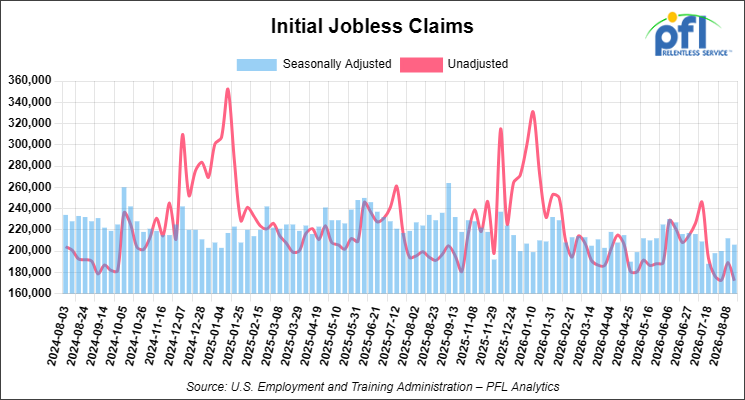
Continuing jobless claims came in at 1,799,000, versus the adjusted number of 1,781,000 people from the week prior, up 18,000 week-over-week.
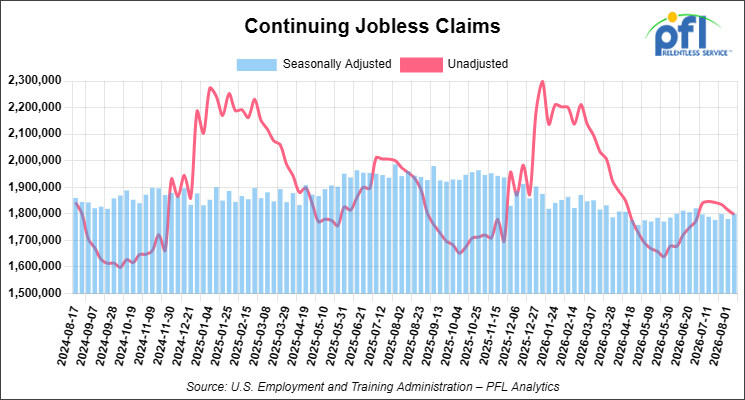
Stocks closed higher on Friday of last week, but lower week-over-week
The DOW closed higher on Friday of last week, up 517.8 points (0.98%), closing out the week at 53,277.01, down -455.40 points week-over-week. The S&P 500 closed higher on Friday of last week, up 33.21 points (0.43%), and closed out the week at 7,674.37, down -111.39 points week-over-week. The NASDAQ closed higher on Friday of last week, up 113.29 points (0.43%), and closed out the week at 26,180.45, down -548.71 points week-over-week.
In overnight trading, DOW futures traded lower and are expected to open at 53,335 this morning, down 18 points from Friday’s close.
Crude oil closed higher on Friday of last week and higher week-over-week
West Texas Intermediate (WTI) crude closed up $0.23 per barrel (0.26%), to close at $87.06 on Friday of last week, and up $4.66 per barrel week-over-week. Brent crude closed up $0.61 per barrel (0.65%), to close at $94.39, up $5.87 per barrel week-over-week.
One Exchange WCS (Western Canadian Select) for October delivery settled on Friday of last week at US$16.50 below the WTI-CMA (West Texas Intermediate – Calendar Month Average). The implied value was US$67.63 per barrel.
U.S. commercial crude oil inventories (excluding those in the Strategic Petroleum Reserve) increased by 4.4 million barrels week-over-week. At 428.8 million barrels, U.S. crude oil inventories are at the five-year average for this time of year.
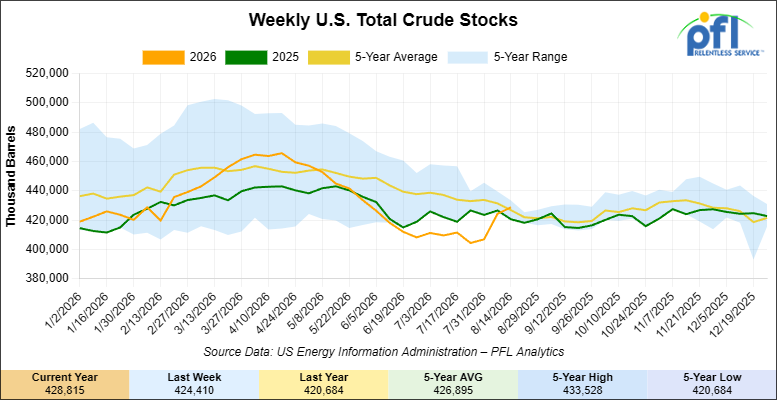
Total motor gasoline inventories increased by 700,000 barrels week-over-week and are 5% below the five-year average for this time of year.
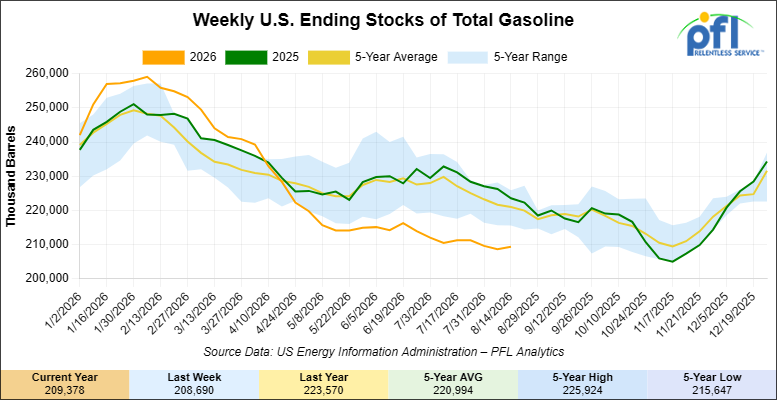
Distillate fuel inventories decreased by 1.5 million barrels week-over-week and are 13% below the five-year average for this time of year.
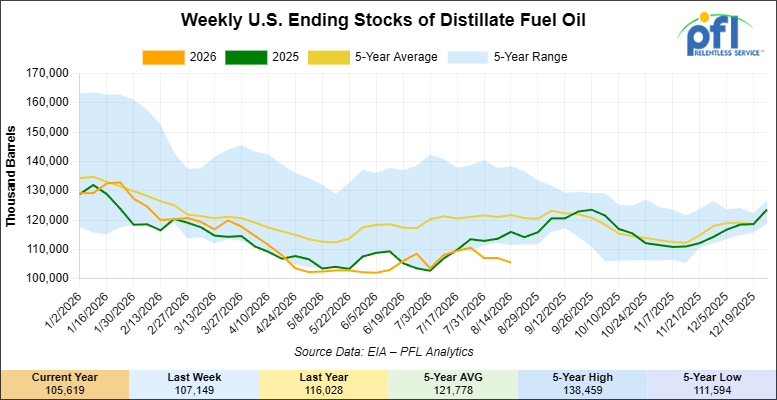
Propane/propylene inventories increased by 2 million barrels week-over-week and are 31% above the five-year average for this time of year.
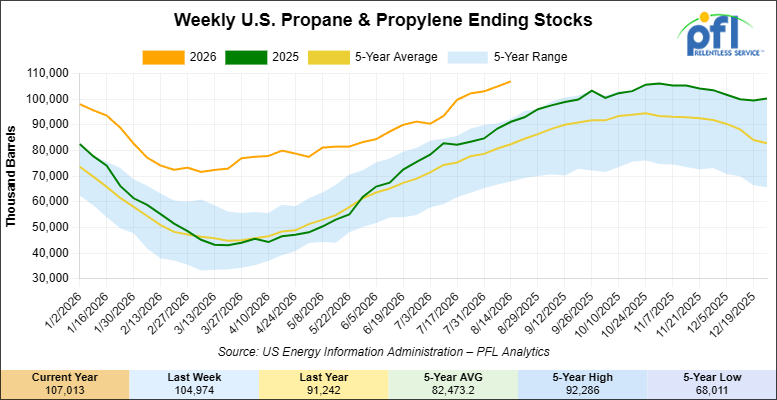
Propane prices closed at 67.9 cents per gallon on Friday of last week, up 2.4 cents per gallon week-over-week, and up 1.5 cents year-over-year.
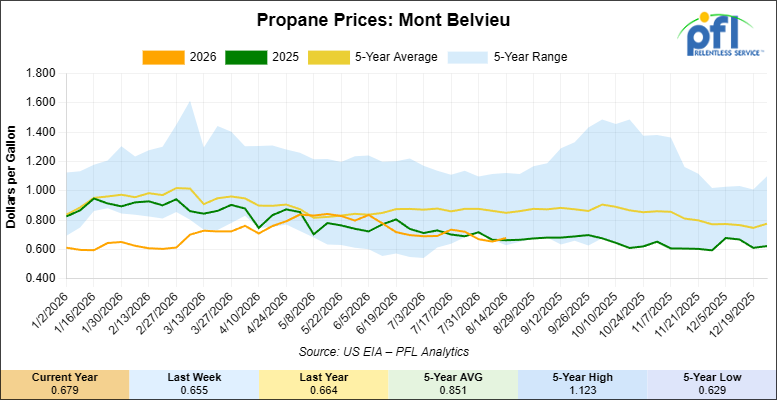
Overall, total commercial petroleum inventories increased by 8.8 million barrels week-over-week during the week ending August 14, 2026.
U.S. crude oil imports averaged 6.6 million barrels per day during the week ending August 14, 2026, a decrease of 746,000 barrels per day week-over-week. Over the past four weeks, crude oil imports averaged 6.5 million barrels per day, 1.2% more than the same four-week period last year. Total motor gasoline imports (including both finished gasoline and gasoline blending components) averaged 366,000 barrels per day, and distillate fuel imports averaged 109,000 barrels per day during the week ending August 14, 2026.
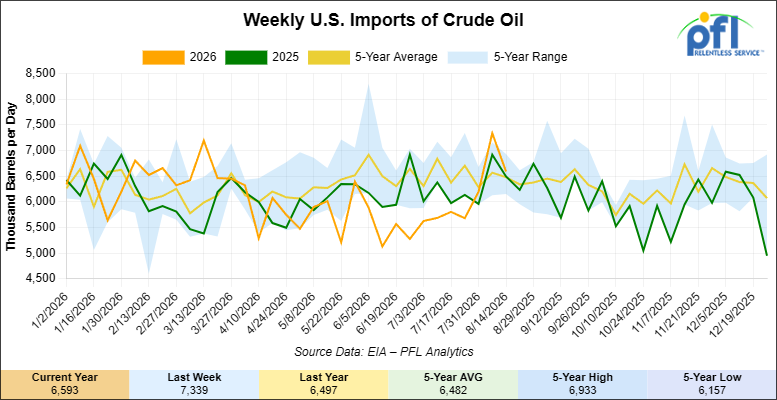
U.S. crude oil exports averaged 4.066 million barrels per day during the week ending August 14, 2026, an increase of 1.008 million barrels per day week-over-week. Over the past four weeks, crude oil exports averaged 3.569 million barrels per day.
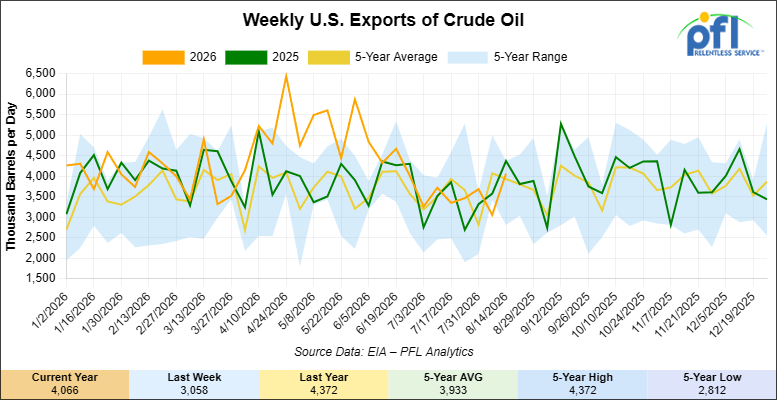
U.S. crude oil refinery inputs averaged 17.4 million barrels per day during the week ending August 14, 2026, which was 215,000 barrels per day more week-over-week.
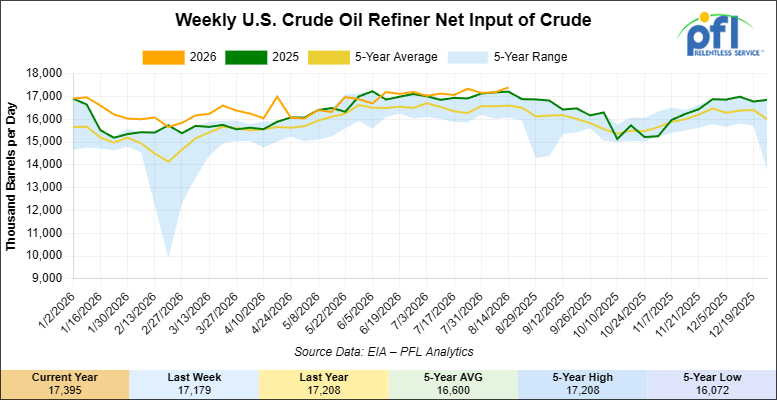
WTI is poised to open at $85.23, down -$1.83 per barrel from Friday’s close.
North American Rail Traffic
Week Ending August 19, 2026:
Total North American weekly rail volumes were up (+2.10%) in week 34, compared with the same week last year. Total Carloads for the week ending August 19, 2026 were 331,062, up (+2.48%) compared with the same week in 2025, while weekly Intermodal volume was 352,258, up (+1.75%) year over year. 8 of the AAR’s 11 major traffic categories posted year-over-year increases. The largest decrease came from Motor Vehicles and Parts (-10.25%). The largest increase was Other (+12.01%).
In the East, CSX’s total volumes were up (+1.87%), with the largest decrease coming from Motor Vehicles and Parts (-10.19%), while the largest increase came from Other (+23.01%). NS’s total volumes were down (-0.28%), with the largest increase coming from Petroleum & Petroleum Products (+14.08%), while the largest decrease came from Motor Vehicles and Parts (-17.58%).
In the West, BNSF’s total volumes were up (+3.04%), with the largest increase coming from Coal (+27.86%), while the largest decrease came from Other (-6.29%). UP’s total volumes were up (+4.09%), with the largest increase coming from Other (+10.97%), while the largest decrease came from Coal (-7.83%).
In Canada, CN’s total volumes were up (+2.70%), with the largest increase coming from Coal (+27.86%), while the largest decrease came from Other (-18.63%). CPKCS’s total volumes were down (-3.21%), with the largest increase coming from Metallic Ores and Metals (+38.17%), while the largest decrease came from Motor Vehicles and Parts (-18.16%).
Source Data: AAR – PFL Analytics
North American Rig Count Summary
North American rig count was down by -8 rigs week-over-week. The US rig count was down by -5 rigs week-over-week, but up by +50 rigs year-over-year. The US currently has 588 active rigs. Canada’s rig count was down by -3 rigs week-over-week but up by +36 rigs year-over-year. Canada currently has 216 active rigs. Overall, year-over-year we are up by +86 rigs collectively.
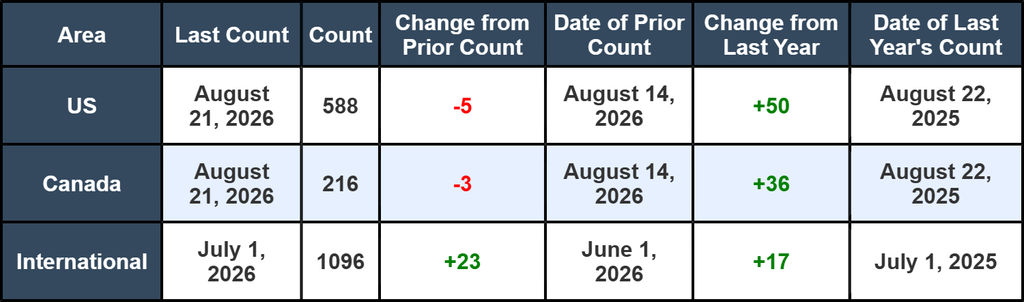
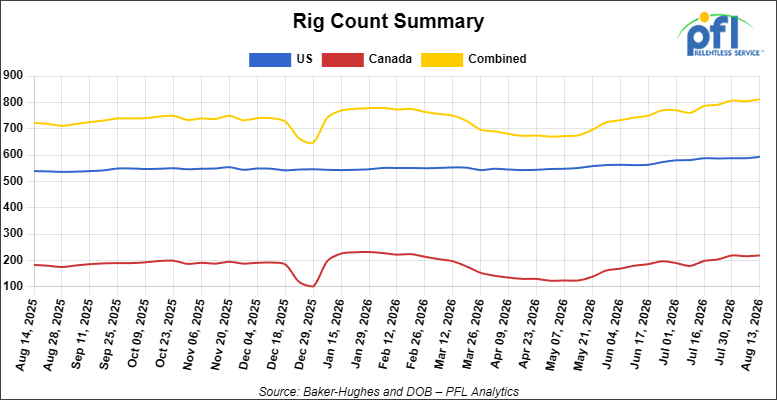
We are watching a few things out there for you:
We Are Watching Petroleum Carloads
The four-week rolling average of petroleum carloads carried on the six largest North American railroads rose to 30,201 from 29,912 which was an increase of +289 rail cars week-over-week. Canadian volumes were lower. CN’s shipments were lower by -5.0% week-over-week, CPKC’s volumes were lower by -7.0% week-over-week. U.S. shipments were mostly lower. The UP was the sole gainer and was up by +1.0% week-over-week. The BNSF had the largest percentage decrease and was down by -7.0% week-over-week.
We Continue to Watch Our Strategic Petroleum Reserves
The ongoing emergency drawdown of the U.S. Strategic Petroleum Reserve (SPR) remains a major component of global efforts to offset crude oil supply disruptions stemming from the conflict involving Iran and the continued restrictions on oil shipments through the Strait of Hormuz. Since March, the Department of Energy (DOE) has awarded exchanges covering more than 133 million barrels of crude oil, with additional releases expected as part of a broader international response coordinated through the International Energy Agency (IEA). DOE’s most recent publicly documented award total remains more than 133 million barrels, while the department has continued executing the broader 172-million-barrel commitment.
The United States continues to execute its commitment to make available up to 172 million barrels from the SPR under the IEA’s collective plan to inject roughly 400 million barrels into global energy markets. Officials have argued that the releases are necessary to help stabilize crude supplies and limit further increases in fuel prices as refiners compete for replacement barrels amid ongoing transportation disruptions. The IEA’s coordinated action remains the largest emergency oil-stock release in the agency’s history.
As releases have accelerated, inventories in the SPR have declined to 293.426 million barrels, down from 415.442 million barrels at the start of the conflict with Iran and reaching their lowest level since December 1982. The SPR declined by 5.268 million barrels during the week ending August 14, 2026. Since the first SPR drawdown began, the United States has withdrawn approximately 121.638 million barrels, equivalent to an average of roughly 868,843 barrels per day through the week ending August 14, 2026.
Global petroleum inventories have also tightened considerably. The IEA has reported substantial draws in commercial crude and refined-product stockpiles across major consuming nations, underscoring the strain that the conflict has placed on world energy markets. While oil flows through the Strait of Hormuz have partially recovered from their initial near-shutdown, the IEA continues to identify significant uncertainty surrounding the pace and durability of the recovery.
The Administration continues to emphasize that the current program consists primarily of exchange agreements, rather than outright sales. Under these arrangements, companies receiving crude oil today are required to return the borrowed barrels in the future along with additional volumes as a premium. DOE has stated that its exchange structure is designed to return the borrowed crude with additional premium barrels, with the stated objective of strengthening the SPR over time.
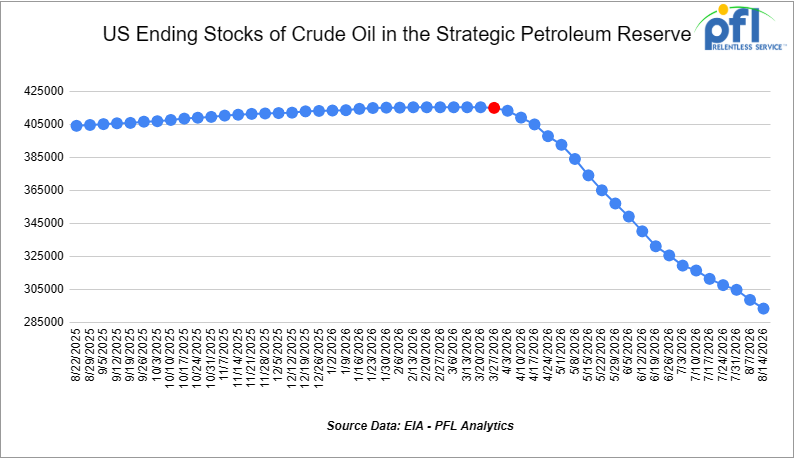
We Continue to Watch Tariffs
Trade talks collapsed between Canada and the United States late last Friday night. Left wing Prime Minister Carney suspended negotiations and recalled Canada’s negotiators minutes before the deadline, saying last-minute changes to the U.S. terms were unfair, uneconomic and called into question the reliability of any deal. U.S. Trade Representative Jamieson Greer countered that new Canadian demands and walk-backs had upended a package that included tariff reductions on steel, aluminum, autos and lumber. 50% Section 338 duties took effect in the early hours of last Saturday on roughly $20 billion of Canadian goods, and no further talks are scheduled.
What is not on the list matters more to this readership than what is. Energy, potash and critical minerals were carved out, so crude, refined products and fertilizer continue to move on current terms. The duties hit motor vehicles, alcohol, dairy, cement and building materials, clothing, furniture and hockey equipment, amounting to something over 5% of Canadian exports to the U.S. Carney has committed to match dollar for dollar, and the composition of that retaliation is the number worth waiting for, because Ottawa’s counter-tariffs in the last round reached well beyond the sectors Washington had targeted.
The Keystone XL revival the President floated Tuesday of last week goes back in the drawer alongside everything else. TC Energy cancelled the project in 2021 and wrote it off, no sponsor has put its name to a rebuild, and South Bow is already repurposing about 150 km of unused Keystone XL pipe into the proposed 550,000 b/d Prairie Connector. Most of the Canadian-side capacity being celebrated midweek was already in a queue under a different name, with a different owner, at roughly two thirds the volume. Any pipeline that was a bargaining chip midweek and gone by the weekend, was never a fleet planning input.
For rail the direct exposure is limited today, since the carve-out covers the commodities that fill tank cars and most covered hoppers. The second-order exposure is real enough: manifest volumes moving autos, lumber and building products across the border, and whatever Ottawa selects for retaliation. It seems to us at PFL, that the durable lesson from the week is that Washington will now put pipeline approvals on the table as tariff currency, and Ottawa will walk away rather than take the trade. That is a different negotiating world than the one Canadian shippers planned around two years ago, and we will be keeping our eye on this one.
We Continue to Watch the UP – NS Merger
The Surface Transportation Board removed the Union Pacific and Norfolk Southern proceedings from abeyance last Tuesday and adopted a procedural schedule, having held the case since May pending supplemental filings the applicants delivered on July 7th and July 27th. Notices of intent to participate are due September 4th, comments and protests on the merits are due November 18th, preliminary comments from the Departments of Justice and Transportation are due December 3rd, and responses are due February 16, 2027. The schedule carries the evidentiary record past of May 28, 2027, with a final decision due within 90 days of the close of record.
The Board was careful to say that resuming the review reflects no view on the merits. It was less careful in its treatment of the applicants’ workpapers, finding that Union Pacific and Norfolk Southern had filtered out data they considered immaterial before submission, in several instances stripping substantial portions of the underlying analysis, and directing them to resubmit with unfiltered data. The Board also denied the request to sever the Terminal Railroad Association of St. Louis divestiture into an expedited side proceeding, keeping it inside the main case.
BNSF, CSX, the Freight Rail Customer Alliance and the National Grain and Feed Association had asked for the longest evidentiary period the statute allows, and they got most of it. This is the first Class I combination to be judged under the tougher 2001 rules requiring applicants to show a merger enhances competition, rather than merely preserving it, and the Board has now signalled it intends to take the full statutory runway to do so.
For shippers the practical consequence is another eighteen months of planning against two possible networks. PFL is working with customers whose lease renewals and routing assumptions now straddle a decision date that keeps moving out, and we would rather build that optionality in at signing than negotiate it later.
We are Watching the Bakken
North Dakota Mineral Resources Director Nathan Anderson delivered the Director’s tale on crude oil production in North Dakota on Thursday of last week. June output averaged 1.153 million b/d, up 28,000 b/d in May and the highest since November. The state’s market price for June was $80.56 against a revenue forecast built on $59, with WTI trading near $86 at the time of the briefing. Wells waiting on completion fell to 290 from 328, the lowest since early 2025, which tells you operators are converting inventory, rather than waiting on price.
The rig count is the number that matters for 2027 volumes. North Dakota was running 33 rigs in mid-August against 26 in mid-July, and five of the additions came from operators that had no rig in the state a month earlier, among them Eben Operating, Firebird Services, Iron Oil Operating, Murex Petroleum and Zavanna Energy Operating. Producing wells hit an all-time high of 19,961. First-half output still runs roughly 25,000 b/d below the same period of 2025, so this is a recovery, rather than a boom.
Pipeline takes the marginal barrel first, and it will keep doing so until it is full. Bakken unit train economics to the Gulf Coast sit near $10.40 a barrel and to Philadelphia near $10.80, which is a rate that clears only when a coastal refiner is short or when a differential opens wide enough to pay for it. Seven more rigs, a shrinking uncompleted well inventory and a state price above $80 all push in the same direction over the next several quarters.
The fleet is the constraint, not the demand. There are not many DOT-117J crude cars sitting idle, build slots run one to two years out, and leasing companies and car owners are asking five-year commitments before they will commit equipment, with the Class Ones echoing similar long-term terms. It seems to us at PFL, that shippers who wait for the differential to confirm a trade may find the cars already spoken for. Time will tell, and it remains geopolitically dependent, but this is the closest the Bakken has looked to a rail cycle in some time. Call PFL before you need the cars, not after.
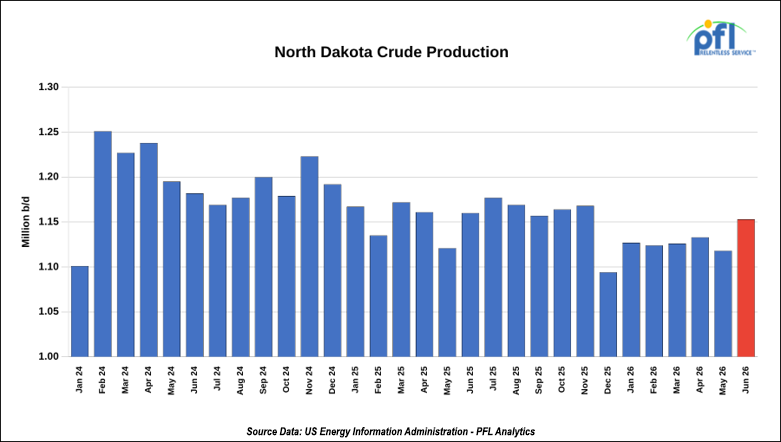
We Continue to Watch Left Wing Carney
Alberta Premier Danielle Smith spent Thursday of last week at the Canadian Energy Executive Association conference in Banff defending the “grand bargain,” the trilateral memorandum that ties the Pathways carbon capture project and a revamped carbon pricing scheme to federal approval of a West Coast pipeline. Smith argued the memorandum gives industry flexibility and removes the timeline-driven approach of the previous Liberal government.
The arithmetic deserves an airing. Pathways as announced in 2021 targeted 22 million tonnes per year of emissions reductions by 2030, with oil sands operators committing to capture 10 to 12 million tonnes. Under the memorandum the carbon capture target is 6 million tonnes per year by the mid-2030s, with a further 10 million tonnes by 2045 not tied to any specific technology. That is a 73% cut to the 2030 capture target and roughly a decade of slippage, and Ottawa is presenting it as a breakthrough.
Producers are not behaving as though a breakthrough occurred. Canadian Natural has 340,000 b/d of growth on hold pending definitive agreements, specifically the 30,000 b/d Jackfish expansion, 70,000 b/d Pike 2, a 150,000 b/d Jackpine mine and 90,000 b/d of extraction and froth treatment at Horizon. The governments set themselves a November 15th deadline to convert the memorandum into definitive agreements. Suncor has said it is not yet willing to accelerate, and Enbridge postponed its Mainline second phase in the same fortnight.
The Prime Minister spent a year defending an emissions cap and now asks for credit for a non-binding document that the country’s largest oil sands operators will not yet spend against. In our opinion, a memorandum that leaves a quarter of a million barrels a day of announced projects parked is not policy success, it is policy postponement, and the November deadline is the only part of it worth marking on a calendar.
We are Watching the CPKC
Members of IBEW Canadian Signals and Communications System Council 11 rejected CPKC’s latest offer earlier this month, with 256 of 287 voting against on a 97% turnout. That is an 89% rejection twelve weeks into a strike that began May 31st and involves roughly 300 signals and communications employees between Vancouver and Montreal.
The dispute is over wages, on-call obligations, employee expenses and scheduling. CPKC has pointed to the seven-days-on, seven-days-off rotation already used by its Calgary workers as a template, while the union argues it does not transfer to communities such as Revelstoke. The railway says its contingency plans remain in place and operations continue, and it is separately relocating 123 Revelstoke railroaders to Kamloops. The union has filed 19 complaints with the Canada Industrial Relations Board.
The timing is what gives this a freight consequence rather than a labour-page consequence. CPKC closed the 2025-2026 crop year with a record 30.66 million tonnes of Canadian grain, 11% above the prior year, and the new crop year opened August 1st. The railway’s service plan contemplates up to 700,000 tonnes a week while the Port of Thunder Bay is open, supported by newly leased high-capacity hopper cars coming on line this month. Signals and communications work is invisible right up until the moment it constrains train spacing, and harvest peak is six to eight weeks out.
We are Watching Refining
U.S. refineries ran at 97.2% of operable capacity in the week ending on August 14th, up a full percentage point on the week, with crude inputs averaging 17.4 million b/d. Distillate inventories fell 1.5 million barrels to 105.6 million and sit about 13% below the five-year average, the tightest part of the barrel. Crude inputs through the first seven months of 2026, have been the highest since 2019, and the EIA expects crack spreads to keep runs near the top of the five-year range through year-end.
A refining system running flat out bids aggressively for every heavy barrel it can cover, and that bid is what keeps the Western Canadian Select discount narrow. Narrow discounts are the enemy of crude by rail economics. The rail move needs a wide spread to pay for itself, and refiners at 97% utilization are actively working against that spread by competing for the same barrels that would otherwise be stranded.
The offset is that a system with no spare capacity has no tolerance for an outage. A fire, a turnaround that runs long or a lightning strike on a products terminal removes barrels the market has no cushion to replace, and the arbitrage windows that open in those moments are short and steep. PFL has watched enough to know that these events do happen and happen without notice. Having spare equipment as a contingency is not a bad idea call PFL today to trouble shoot all your rail car needs,
We Continue to Watch Enbridge
Building on our coverage of the Mainline over the past several weeks, the postponement of Mainline Optimization Phase 2 is hardening into something closer to a shelving. The Line 26 Optimization project page came off Enbridge’s website on July 31st, and the landowner open houses that had been planned across southeast Saskatchewan for this fall are no longer scheduled. Line 26 was to be reversed to carry Canadian crude south from Cromer to connect with Dakota Access, which made it the single most direct competitor to Bakken and Alberta rail volumes.
Capital is going to the U.S. end of the system instead. Enbridge is advancing a 100,000 b/d Flanagan South expansion and a 50,000 b/d Southern Access Extension through open season, and Mainline Optimization Phase 1, worth 150,000 b/d on the Mainline and 100,000 b/d on Flanagan South, remains on track for 2027. Liquids pipelines president Colin Gruending has said producers will not make commitments capable of supporting a final investment decision until the regulatory framework is settled, and has flagged a small system imbalance around 2028.
There is a structural reason Enbridge cannot solve this the way its competitors can. The Mainline is a common carrier with capacity nominated monthly, so it cannot underwrite an expansion with the long-term take-or-pay contracts available to Trans Mountain, the proposed West Coast line or Prairie Connector. The 250,000 b/d that Phase 2 would have carried, does not disappear from the basin. It sits in the ground, in storage, or on a train.
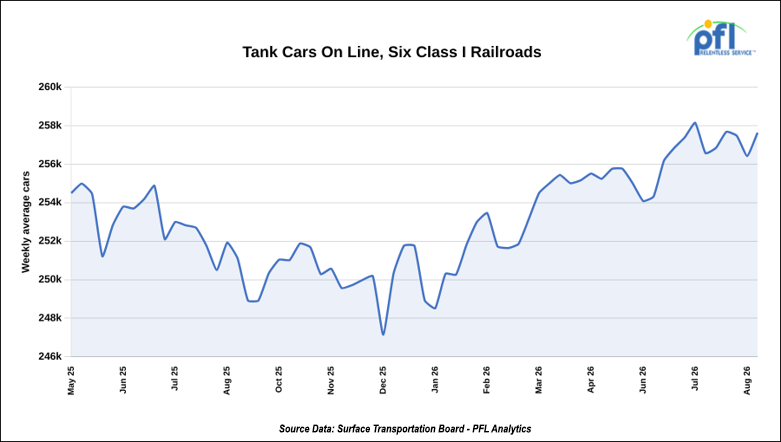
Tank cars on line across the six largest North American railroads averaged 257,637 in the week ended August 19th, against a trough near 247,000 last December. That is roughly 10,000 additional tank cars absorbed into the network in eight months, and the fleet is not being rebuilt at anything close to that pace. PFL has been saying for some time that egress delays end up on rail, and the equipment market is already pricing what the pipeline announcements have not yet admitted. Give us a call while there are still cars out there to talk about. After saying that on a geopolitical basis the dynamics could change over night with the opening of the strait.
We are watching Key Economic Indicators
Industrial Output and Capacity Utilization
Manufacturing accounts for approximately 75% of total output. Manufacturing output in July increased 0.20% from June 2026.
Capacity utilization is a measure of how fully firms are using machinery and equipment. Capacity utilization increased by 0.08% from June in July.
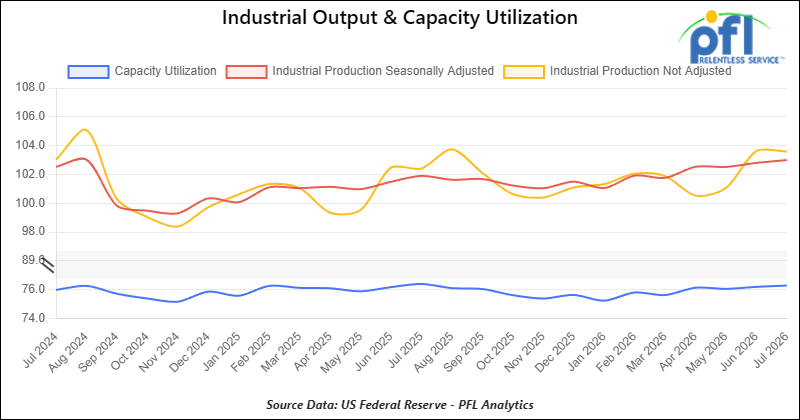
Lease Bids
- 20-50, 4000-5000 Covered Hoppers located off of UP or BNSF in Houston. For use in Urea, Potash, and Ammonium Sulfate service. Period: 6-12 Months.
- 30-50, 25.5K DOT 111 Tanks located off of All Class 1s in various locations. For use in Asphalt service. Period: 1-3 Years.
- 40, 29K DOT 111 Tanks located off of UP or BNSF in the Midwest. For use in Veg Oil service. Period: 5 Year.
- 20, DOT 117J Tanks located off of NS, CSX, CN, or CPKC in various locations. For use in C5 service. Period: 1 year. Need gauge rods.
- 300, 5200CF Covered Hoppers located off of CP or CM in Canada. For use in Petcoke service. Period: 3 Year.
- 10, 30K 117J Tanks located off of BNSF in Canada. For use in Propane or Butane service. Period: 3 Year.
- 20, 28K or larger 117J Tanks located off of BNSF or UP in California. For use in Crude service. Period: 6 months.
- 75, 30K DOT 117 Tanks located off of NS in Ohio. For use in Condensate service. Period: 6-12 Months. Mag Rods Not Needed.
- 100, 28.3K DOT 111 or 117 Tanks located off of CP or CN in Canada. For use in VGO service. Period: 1-3 Years.
- 5, 28.3K DOT 111 or 117 Tanks located off of CN in Canada. For use in Bitumen service. Period: Trip Lease.
- 5-10, 25.5K DOT 111 Tanks located off of CN in Canada. For use in Caustic service. Period: 3-6 Months.
- 100, 340W Pressure Tank located off of CN or CP in Canada. For use in Propane service. Period: 6 Months.
- 10-20, 3200 or 3281 Covered Hoppers located off of CN or CP in Canada. For use in Sodium Sulphate service. Period: 3-5 years. Lined.
- 50, 340W Pressure Tanks located off of CN or CP in Canada. For use in Propane service. Period: Winter.
- 30-50, 340W pressure Tanks located off of NS or CSX in Northeast U.S. For use in Propane service. Period: Winter.
- 25, 340W Pressure Tanks located off of UP or BN in US. For use in Propane service. Period: Winter.
- 50, 28.3K 117J Tanks located off of BNSF in Kansas/Oklahoma. For use in Fuel Oil service. Period: 6 Months.
- 100, 30K 117J Tanks located off of CN in Canada. For use in Diesel service. Period: 1 year.
Sales Bids
- 28, 3400CF Covered Hoppers located off of UP or BNSF in Texas. For use in Cement service. Cement Gates needed.
- 20, 17K DOT111 Tanks located off of various class 1s in various locations. For use in corn syrup service.
- 120, Various Open-Top Aluminum Rotary Gondolas located off of various class 1s in various locations. For use in Sulphur service. Built 2004 or later.
- 12, 21.5K-25K DOT 111 Tanks located off of Various Class 1s in Michigan. For use in Diesel, Asphalt, Crude service. Coiled and Insulated.
Lease Offers
- 21, 6351 Covered Hoppers located off of CN in Wisconsin. Last used in DDG. Available until February 2027.
- 29, 6500 Covered Hoppers located off of CN in Wisconsin. Last used in DDG. Available until February 2027.
- 15, 6200CF Covered Hoppers located off of all class 1s in Wisconsin. Last used in plastic. Cars are currently clean.
- 30, 6500CF Covered Hoppers located off of all class 1s in Wisconsin. Last used in plastic. Cars are currently clean.
- 100, 28.4K DOT 117J Tanks located off of UP or BNSF in Beaumont, TX. Cars are currently clean.
- 50, 30K DOT117J Tanks located off of UP or BNSF in the South. Last used in ethanol.
- 10, 29K DOT 117R Tanks located off of BNSF and UP in Texas. Last used in gasoline additive. Coiled and Insulated.
- 39, 31K CPC1232 Tanks located off of All Class 1s in Iowa. Last used in diesel.
- 2, 30K DOT 117R Tanks located off of BNSF and UP in Texas. Last used in Diesel.
- 1, 30K DOT 117R Tanks located off of BNSF and UP in Texas. Last used in gas blend stock.
- 3, 30K DOT 117R Tanks located off of BNSF and UP in Texas. Last used in gasoline.
- 41, 30K DOT 111 Tanks located off of in Brownsville. Last used in Diesel. Cars are currently clean.
Sales Offers
- 81, 31.8K CPC1232 Tanks located off of UP or BNSF in TX. Last used in Multiple Services. Requal Due in 2025.
- 35, 3400CF Covered Hoppers located off of UP or BNSF in the Midwest. Last used in Sand.
- 25, 30K 117J Tanks located off of CSX in Jackson, TN. Last used in Fuels. Newly Requalified.
- 15, 5750 CF Hopper located off of CSX, NS, CP, CN, BNSF, UP in St Louis. Last used in Grain.
- 50, 30 DOT 111 Tank located off of multiple class 1s in multiple location. Last used in Fuels.
Call PFL today to discuss your needs and our availability and market reach. Whether you are looking to lease cars, lease out cars, buy cars, or sell cars call PFL today at 239-390-2885
Railcar for Sale or Lease
| CAT | Type | Capacity | GRL | QTY | LOC | Class | Prev. Use | Offer | Note |
|---|
| CAT | Type | Size | GRL | QTY | LOC | Class | Term | Commodity | Offer | Note |
|---|
| CAT | Type | Capacity | GRL | QTY | LOC | Class | Prev. Use | Clean | Offer | Note |
|---|
| CAT | Type | Capacity | GRL | QTY | LOC | Class | Commodity | Offer | Note |
|---|
PFL will be at the Following Conferences
- Where: The Westin Galleria Dallas
- Attending: David Cohen (954-729-4774), and Curtis Chandler (239-405-3365)
- Conference Website
- Where: The Westin Galleria Dallas
- Attending: Brian Baker (239.297.4519)
- Conference Website
The post PFL Railcar Report 8-24-2026 appeared first on PFL Petroleum Services LTD.
]]>The post PFL Railcar Report 8-17-2026 appeared first on PFL Petroleum Services LTD.
]]>Jobs Update
Initial jobless claims seasonally adjusted for the week ending August 8, 2026 came in at 209,000, versus the adjusted number of 200,000 people from the week prior, up 9,000 people week over week.
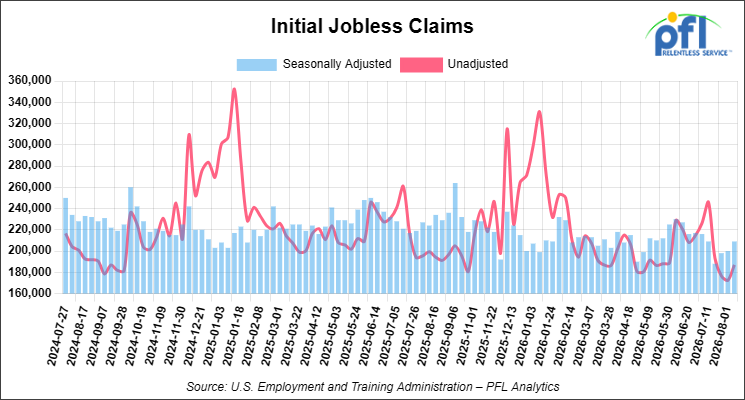
Continuing jobless claims came in at 1,777,000, versus the adjusted number of 1,799,000 people from the week prior, down 22,000 week-over-week.
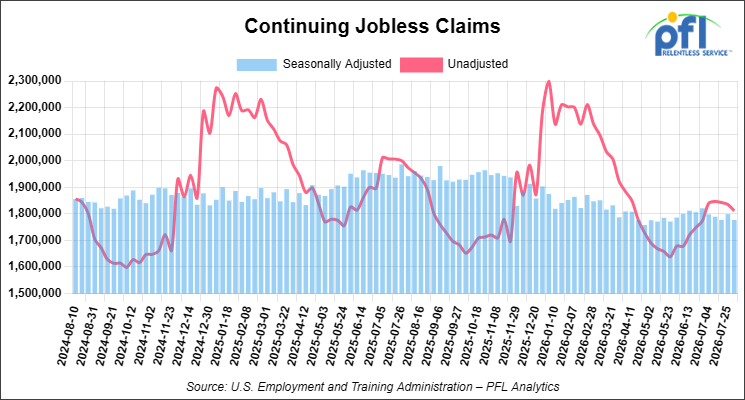
Stocks closed lower on Friday of last week, but mixed week-over-week
The DOW closed lower on Friday of last week, down -107.58 points (-0.2%), closing out the week at 53,732.41, down -304.52 points week-over-week. The S&P 500 closed lower on Friday of last week, down -13.23 points (-0.17%), and closed out the week at 7,785.76, up 28.12 points week-over-week. The NASDAQ closed lower on Friday of last week, down -73.86 points (-0.28%), and closed out the week at 26,729.16, up 38.54 points week-over-week.
In overnight trading, DOW futures traded lower and are expected to open at 53,712 this morning, down -95 points from Friday’s close.
WTI Crude oil closed higher on Friday of last week, and higher week-over-week
West Texas Intermediate (WTI) crude closed up $1.15 per barrel (1.42%), to close at $82.40 on Friday of last week, and up $4.22 per barrel week-over-week. Brent crude closed up $1.45 per barrel (1.67%), to close at $88.52, up $4.97 per barrel week-over-week.
One Exchange WCS (Western Canadian Select) for September delivery settled on Friday of last week at US$16.55 below the WTI-CMA (West Texas Intermediate – Calendar Month Average). The implied value was US$63.43 per barrel.
U.S. commercial crude oil inventories (excluding those in the Strategic Petroleum Reserve) increased by 17.4 million barrels week-over-week. At 424.4 million barrels, U.S. crude oil inventories are 2% below the five-year average for this time of year.
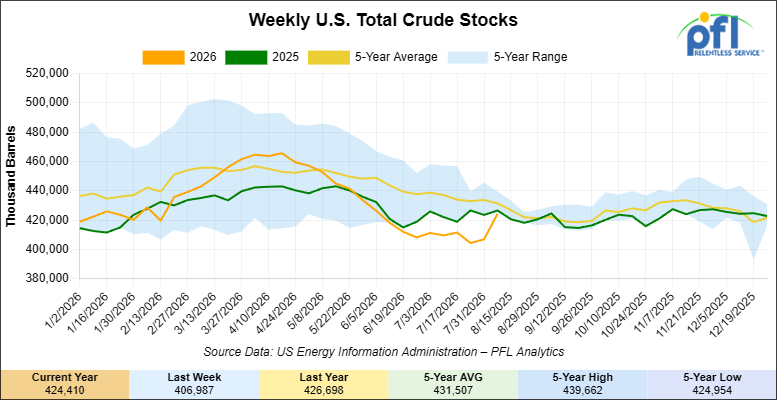
Total motor gasoline inventories decreased by 1 million barrels week-over-week and are 6% below the five-year average for this time of year.
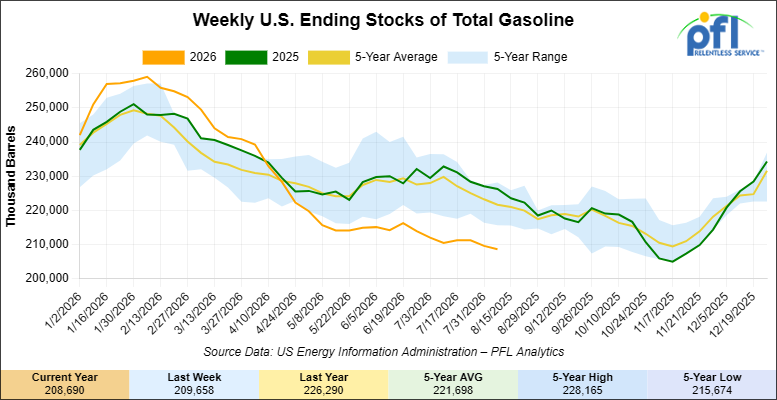
Distillate fuel inventories decreased by 100,000 barrels week-over-week and are 12% below the five-year average for this time of year.
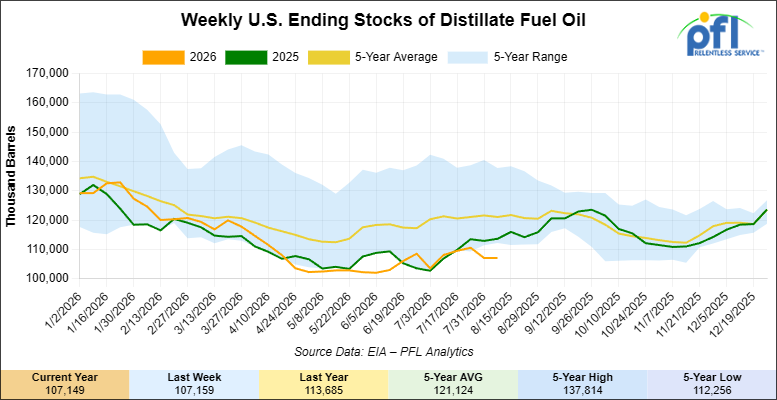
Propane/propylene inventories increased by 1.9 million barrels week-over-week and are 31% above the five-year average for this time of year.
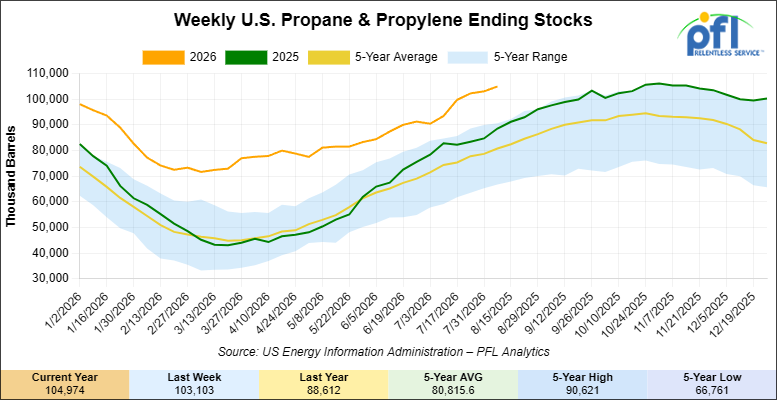
Propane prices closed at 65.5 cents per gallon on Friday of last week, down 1.6 cents per gallon week-over-week, and down 1.2 cents year-over-year.
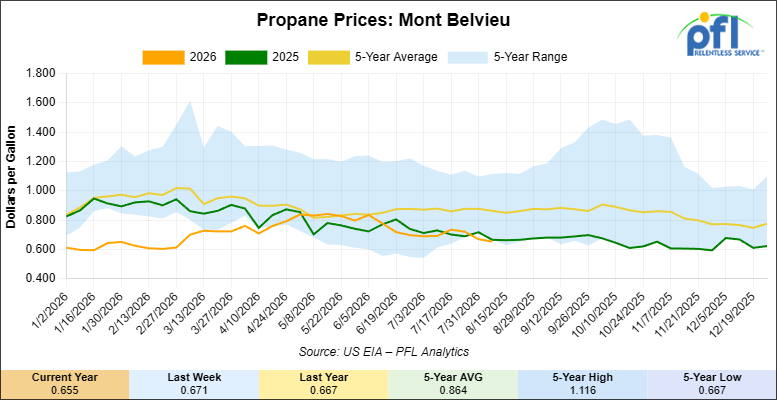
Overall, total commercial petroleum inventories increased by 15.7 million barrels week-over-week during the week ending August 7, 2026.
U.S. crude oil imports averaged 7.3 million barrels per day during the week ending August 7, 2026, an increase of 1.1 million barrels per day week-over-week. U.S. crude oil imports averaged 7.3 million barrels per day during the week ending August 7, 2026, increased by 1.14 million barrels per day week-over-week. Over the past four weeks, crude oil imports averaged 6.3 million barrels per day, 0.1% more than the same four-week period last year. Total motor gasoline imports (including both finished gasoline and gasoline blending components) averaged 583,000 barrels per day, and distillate fuel imports averaged 111,000 barrels per day during the week ending August 7, 2026
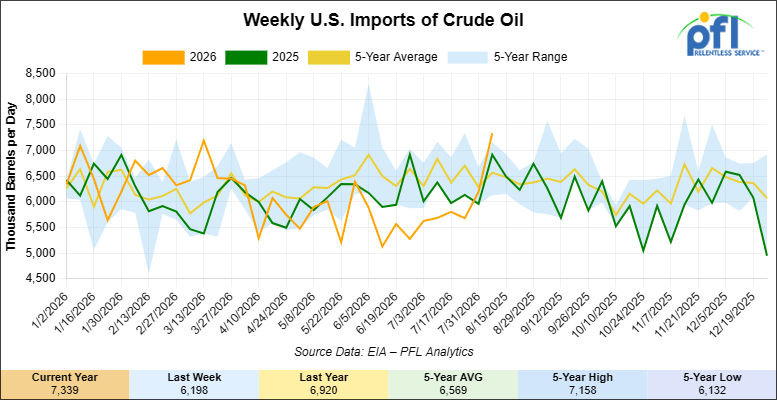
U.S. crude oil exports averaged 3.058 million barrels per day during the week ending August 7, 2026, a decrease of 627,000 barrels per day week-over-week. Over the past four weeks, crude oil exports averaged 3.391 million barrels per day.
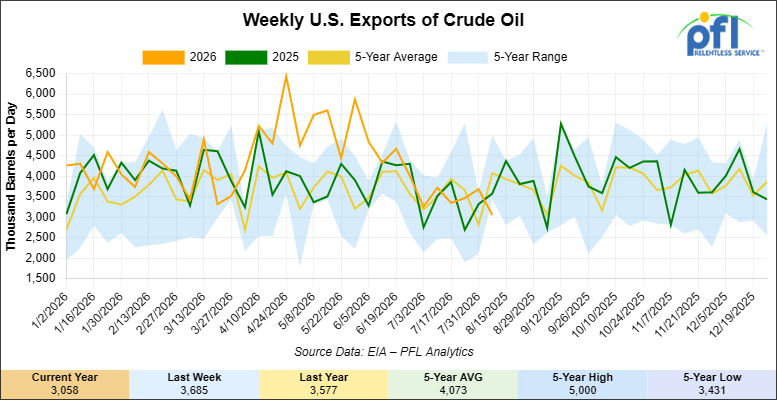
U.S. crude oil refinery inputs averaged 17.2 million barrels per day during the week ending August 7, 2026, which was 26,000 barrels per day more week-over-week.
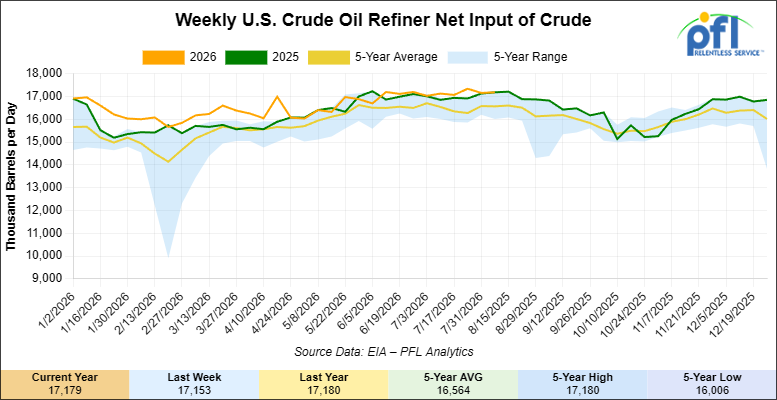
WTI is poised to open at $82.93, up $0.53 per barrel from Friday’s close.
North American Rail Traffic
Week Ending August 12, 2026:
Total North American weekly rail volumes were up (+4.90%) in week 33, compared with the same week last year. Total Carloads for the week ending August 12, 2026 were 339,555, up (+5.52%) compared with the same week in 2025, while weekly Intermodal volume was 359,464, up (+4.31%) year over year. 9 of the AAR’s 11 major traffic categories posted year-over-year increases. The largest decrease came from Motor Vehicles and Parts (-4.35%). The largest increase was Metallic Ores and Metals (+14.49%).
In the East, CSX’s total volumes were up (+6.83%), with the largest decrease coming from Forest Products (-2.08%), while the largest increase came from Metallic Ores and Metals (+19.51%). NS’s total volumes were up (+3.54%), with the largest increase coming from Petroleum & Petroleum Products (+25.84%), while the largest decrease came from Motor Vehicles and Parts (-9.50%).
In the West, BNSF’s total volumes were up (+4.27%), with the largest increase coming from Metallic Ores and Metals (+34.02%), while the largest decrease came from Motor Vehicles and Parts (-15.77%). UP’s total volumes were up (+6.89%), with the largest increase coming from Other (+20.55%), while the largest decrease came from Coal (-2.19%).
In Canada, CN’s total volumes were up (+1.07%), with the largest increase coming from Grain (+20.31%), while the largest decrease came from Intermodal Units (-21.85%). CPKCS’s total volumes were up (+1.98%), with the largest increase coming from Metallic Ores and Metals (+47.32%), while the largest decrease came from Motor Vehicles and Parts (-24.39%).
Source Data: AAR – PFL Analytics
North American Rig Count Summary
North American rig count was up by +8 rigs week-over-week. The US rig count was up by +5 rigs week-over-week, and up by +54 rigs year-over-year. The US currently has 593 active rigs. Canada’s rig count was up by +3 rigs week-over-week and up by +36 rigs year-over-year. Canada currently has 219 active rigs. Overall, year-over-year we are up by +90 rigs collectively.
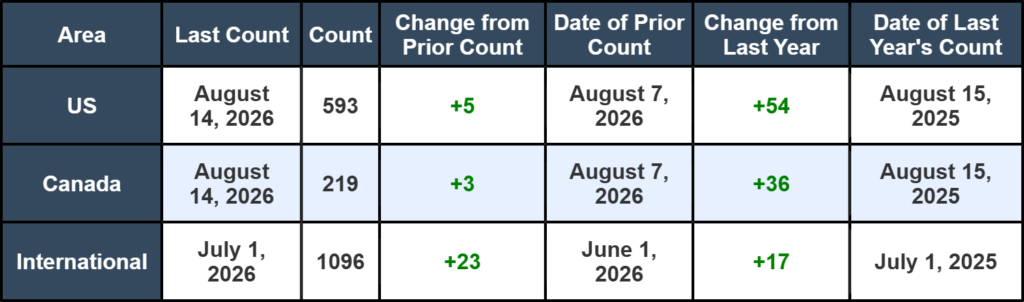
We are watching a few things out there for you:
We Are Watching Petroleum Carloads
The four-week rolling average of petroleum carloads carried on the six largest North American railroads rose to 29,912 from 29,770 which was an increase of +142 rail cars week-over-week. Canadian volumes were higher. CN’s shipments were higher by +7.0% week-over-week, CPKC’s volumes were higher by +3.0% week-over-week. U.S. shipments were mostly higher. The CSX was the sole decliner and was down by -9.0% week-over-week. The UP had the largest percentage increase and was up by +6.0% week-over-week.
We Continue to Watch Our Strategic Petroleum Reserves
The ongoing emergency drawdown of the U.S. Strategic Petroleum Reserve (SPR) remains a major component of global efforts to offset crude oil supply disruptions stemming from the conflict involving Iran and the continued restrictions on oil shipments through the Strait of Hormuz. Since March, the Department of Energy (DOE) has awarded exchanges covering more than 133 million barrels of crude oil, with additional releases expected as part of a broader international response coordinated through the International Energy Agency (IEA). DOE’s most recent publicly documented award total remains more than 133 million barrels, while the department has continued executing the broader 172-million-barrel commitment.
The United States continues to execute its commitment to make available up to 172 million barrels from the SPR under the IEA’s collective plan to inject roughly 400 million barrels into global energy markets. Officials have argued that the releases are necessary to help stabilize crude supplies and limit further increases in fuel prices as refiners compete for replacement barrels amid ongoing transportation disruptions. The IEA’s coordinated action remains the largest emergency oil-stock release in the agency’s history.
As releases have accelerated, inventories in the SPR have declined to 298.694 million barrels, down from 415.442 million barrels at the start of the conflict with Iran and reaching their lowest level since January 1983. The SPR declined by approximately 6.1 million barrels during the week ending August 7, which is one of the largest weekly withdrawals of the current emergency drawdown. Since the first SPR drawdown began, the United States has withdrawn approximately 116.748 million barrels, equivalent to an average of roughly 833,914 barrels per day through the week ending August 7, 2026.
Global petroleum inventories have also tightened considerably. The IEA has reported substantial draws in commercial crude and refined-product stockpiles across major consuming nations, underscoring the strain that the conflict has placed on world energy markets. While oil flows through the Strait of Hormuz have partially recovered from their initial near-shutdown, the IEA continues to identify significant uncertainty surrounding the pace and durability of the recovery.
The Administration continues to emphasize that the current program consists primarily of exchange agreements, rather than outright sales. Under these arrangements, companies receiving crude oil today are required to return the borrowed barrels in the future along with additional volumes as a premium. DOE has stated that its exchange structure is designed to return the borrowed crude with additional premium barrels, with the stated objective of strengthening the SPR over time.
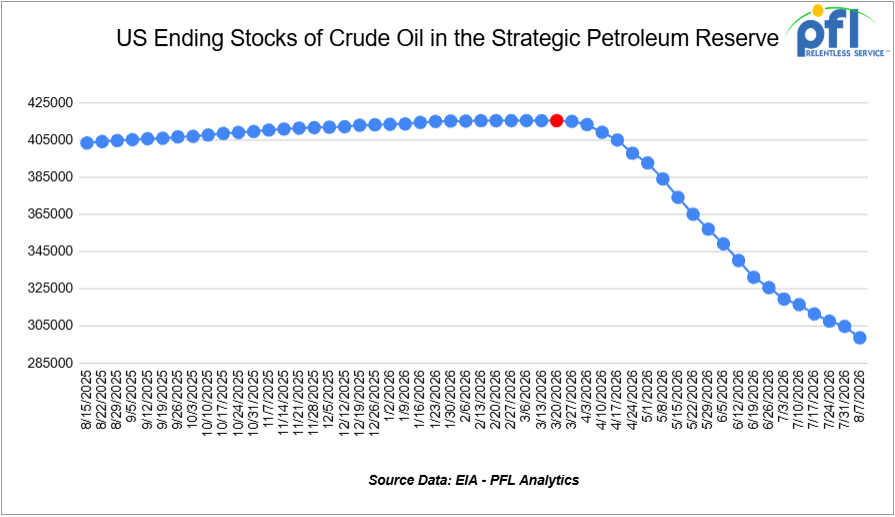
We Are Watching Rail Car Storage
Weekly service data, filed with the Surface Transportation Board, shows the same tightening. Tank cars on line across the six Class I railroads stood near 257,000 in the week ending Wednesday of last week, up roughly 7,700 since January and about 4,700 higher than a year ago. Velocity is not helping matters: five of the six Class I’s have run slower over the past eight weeks than their 2026 averages, and slower railroads soak up cars.
The supply side is not keeping a steady pace. Industry orders in the second quarter came in around 5,800 cars against roughly 6,200 a year earlier, and build slots for new tank cars stretch well into 2027. A DOT-117J’s coiled and isolated car now commands $1,000 (+/-) per car per month for a one-to-five-year term. It seems to us at PFL that the easy capacity is starting to come back to come back to work, and much of what remains in storage as it relates to tank cars is a fleet nobody really wants (DOT 111, CPC 1238’s, 117R’s). We will be keeping our eye on this one. Call PFL today for available tank cars.
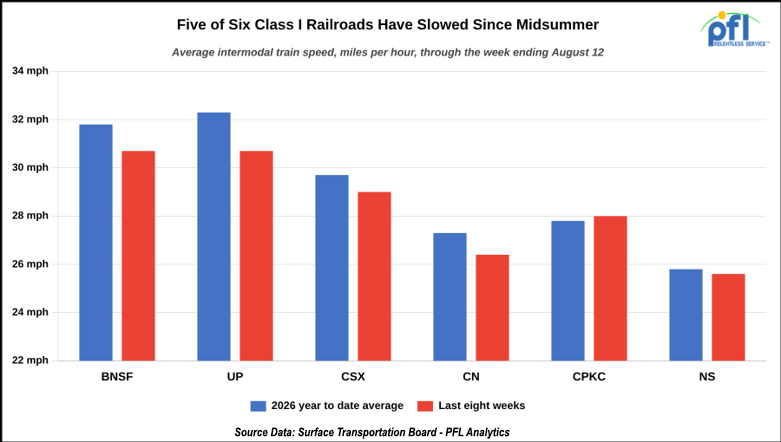
We Continue to Watch Crude by Rail
Canadian crude by rail exports averaged 87,977 barrels per-day in May, up 4% from April, 30% higher than a year earlier, and the highest monthly volume since November 2024. Volumes have climbed steadily off the March low of about 74,200 barrels per-day. Last year averaged roughly 77,000 barrels per-day, a 13-year low, so the direction of travel has changed.
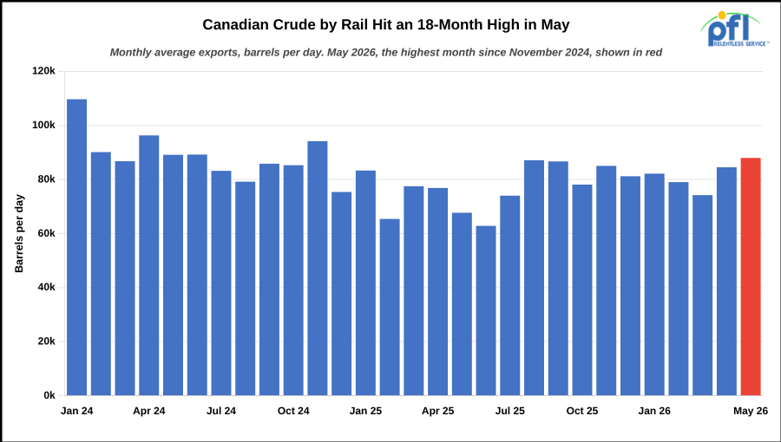
The push is coming from the pipelines. Enbridge apportioned heavy crude nominations on the Mainline by 14% for May flow, and Trans Mountain ran near effective capacity through springtime before accepting all nominations for August. Western Canadian Select at Hardisty closed at $16.55 per barrel under WTI at Houston last week for September delivery, at the edge of the range where rail works for shippers without commitments, against an Alberta to Gulf coast unit train rate near $16.80 per barrel.
CPKC said second quarter crude volumes grew in both conventional service and undiluted bitumen out of the Hardisty diluent recovery unit, though Gibson has left its expansion of that facility on the back burner while pipeline space lasts. Producers keep adding barrels: Cenovus expects to run above 1 million barrels of oil equivalent per day, with new in-situ volumes at Leismer and Blackrod ramping through 2027. Not many 117J crude cars are available, build times could run one to two years, and car owners still want five-year commitments to build new cars, so any move back to rail will be slow. It seems to us at PFL that the lease commitments, and not the arbitrage, will set the pace of whatever comes next. Time will certainly tell!
We Continue to Watch Enbridge
The U.S. Army Corps of Engineers approved the Line 5 tunnel Wednesday of last week, finding the project “not contrary to the public interest” in its record of decision. The review was fast-tracked under the January 2025 energy emergency order. The tunnel would carry a new 30-inch segment of the 540,000 barrel per day line beneath the Straits of Mackinac, replacing the two aging 20-inch pipes that sit exposed on the lakebed.
Construction still cannot begin. The Michigan Supreme Court vacated the state permit at the end of July, ruling that the Public Service Commission ran to narrow of a review, and Governor Whitmer and Attorney General Nessel continue to press for a full shutdown of the line. Six years into permitting, the project now holds a federal blessing but no state path.
Alberta and Ontario, for their part, keep studying the Northern Shield corridor, a 2,050-mile line from Hardisty to Sarnia that would bypass Michigan and the U.S. entirely. We have said before that we doubt Line 5 ever gets shut down, and nothing last week changed our view. Stay tuned to PFL.
We Continue to Watch Left Wing Carney
Ottawa launched a CA$100 million rebate program last week covering half the cost of moving Canadian steel between provinces by rail or water. Applications under the Commodities Sectoral Support Program opened August 10th, and the money runs to summer 2027 or until it is claimed. Only steel with a Canadian origin and destination qualifies, in carload service for rail.
The arithmetic is simple enough. A 50% rebate means the fund covers about CA$4,000 in line-haul, the program is good for roughly 50,000 subsidized carloads, call it 1,000 cars a week for a year. Gondola and coil car demand gets a real bump, and the carriers will take it. But, the program exists because the U.S. tariff wall took away the export market, and the government is now paying to redirect steel it can no longer sell south.
Meanwhile, the Canada Gazette comment period on the national interest designation for a West Coast pipeline closes September 18. A subsidy for domestic steel movements and a comment period for a pipeline: seemingly that is the industrial strategy. It’s just a program for now; time will tell. Where is the money coming from is what we ask!
We Are Watching Grain
CN closed the 2025-26 crop year with a record 33.8 million metric tonnes of grain out of western Canada, announced last Tuesday, beating the prior record of 31.2 million tonnes set a year earlier. July alone came in at 2.62 million tonnes, past a July record that had stood since 2020. The railroad’s new grain plan calls for 30 to 33 million tonnes in 2026-27, which pushes toward the top of what its network can sustain.
CPKC set its own record: 30.66 million tonnes of Canadian grain and grain products for the crop year, with second quarter grain carloads up 18% to a record 168,000. Here in the U.S., grain carloads are up 13% through July, nearly 81,000 cars, the biggest absolute gain of any commodity group.
The equipment is following the crop. Covered hoppers on line across the Class I’s are up about 13,400 since January and are back near the highs of last spring. Two record crop years back to back, both Canadian railroads planning for a third, and the covered hopper fleet already working hard. Harvest will tell us the rest!
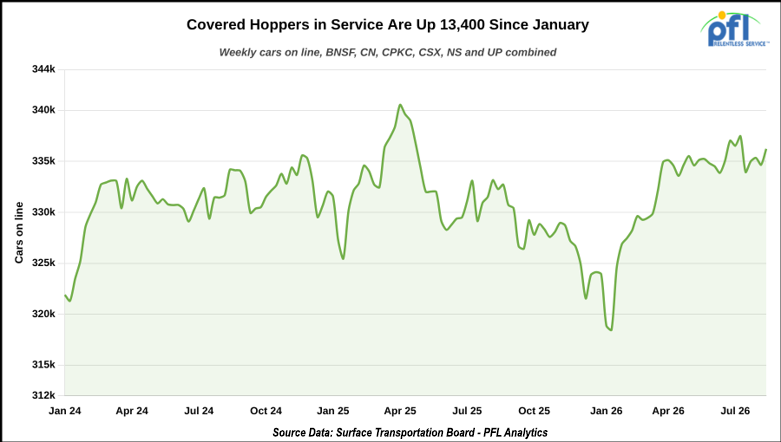
We Are Watching Tariffs
The Commerce Department proposed adding another 14 product categories to the Section 232 steel and aluminum tariffs on August 6th, with comments due August 27th. Rail cars have been inside the tariff wall since last year’s derivative expansion, and tank cars have been assessed on full value since April.
GATX flagged unresolved tariff exposure on new cars during its second quarter call. Between tariffed steel, tariffed components, and a builder backlog stretching into 2027, replacement cost on a new tank car keeps moving in one direction. Lease rates are holding firm, and renewals get priced off replacement cost.
It seems to us at PFL that fleet decisions made over the next few quarters will be made against a structurally higher cost base, and the comment docket closes in under two weeks. We will be keeping our eye on this one!
We Continue to Watch the UP and NS Merger
Seven Republican State Attorney Generals have asked the Surface Transportation Board to reject the $85 billion Union Pacific and Norfolk Southern combination in a letter entered into the record on Tuesday of last week. Montana’s Austin Knudsen led the filing, joined by the attorneys general of Florida, Iowa, Kansas, North Dakota, South Dakota and Tennessee. It is the third such letter from the group since the application was filed.
This round takes aim at the railroads’ proposed Committed Gateway Pricing arrangement, which would protect rates on certain existing interline moves with BNSF and CSX through Chicago, St. Louis, Memphis and New Orleans. The states argue the remedy preserves a narrow slice of what shippers already have and creates no new routing option for anyone. Two days later, the same group asked the Justice Department’s Antitrust Division to weigh in on the deal.
The board may still find a path to approval with conditions, and the railroads continue to argue the combination improves service by taking out interchange points. For shippers, the outcome will shape routing options, cycle times and car utilization on every east-west move for a generation. We will keep following the docket.
We Are Watching the Gulf Coast
Williams agreed to acquire Momentum Midstream for up to $5.5 billion earlier this month, adding more than 4,000 miles of Haynesville gathering pipe, 6 Bcf per day of capacity and two expansion projects pointed at Gulf Coast LNG and power demand. The deal includes the $1.5 billion Delta Access expansion along the Transco corridor, targeted for 2029.
Cheniere, for its part, said first LNG from the seventh and final train of its Corpus Christi Stage 3 expansion is expected imminently, and raised 2026 production guidance to 53 to 54 million tonnes. Trains 8 and 9 are already under construction next door. The buildout has run ahead of schedule the whole way.
Every incremental Bcf that flows into Gulf Coast liquefaction and the crackers beside it pulls plastics, LPGs and chemicals into rail-served supply chains. Plastic hopper and pressure car demand follows this buildout, with a lag measured in quarters. Worth watching as the projects come online.
We Are Watching Key Economic Indicators
Producer Price Index
In July 2026, the Producer Price Index (PPI) for final demand was unchanged month-over-month, following a 0.1% decline in June, indicating that overall producer price pressures stabilized after the sharp increases earlier in the year. Core PPI (final demand less foods, energy, and trade services) increased 0.4% month over month, accelerating from June’s 0.1% increase and indicating that underlying producer-price pressures remained elevated despite the stability in headline PPI. The monthly results reflected a 0.7% decline in final demand goods, which followed a 1.4% decline in June, while final demand services increased 0.2%. Within goods, energy prices declined 3.1%, led by a 5.7% drop in gasoline prices, while food prices fell 0.9%. Goods less foods and energy increased 0.1%. Within services, prices rose 0.2%, with services less trade, transportation, and warehousing increasing 0.6%, while transportation and warehousing declined 1.8% and trade services fell 0.1%. Overall, the July data showed that lower energy and goods prices continued to restrain headline PPI, while underlying service-sector and core producer prices remained firm.
In July 2026, the Consumer Price Index (CPI) increased 0.1% month-over-month, reversing June’s 0.4% decline, while the index was up 3.4% year-over-year. Core CPI (all items less food and energy) increased 0.2% month-over-month and was up 2.5% year over year. Shelter increased 0.1% and accounted for roughly two-thirds of the monthly increase, while food prices also increased 0.1%. Energy prices declined 1.5% during the month, helping to limit the overall increase in headline inflation. Within core inflation, medical care, airline fares, communication, education, and recreation increased, while motor vehicle insurance declined. The July report showed a modest reacceleration in monthly inflation after June’s decline, although the 12-month headline and core measures both continued to ease, suggesting that underlying inflation pressures remain elevated, but are gradually moderating.
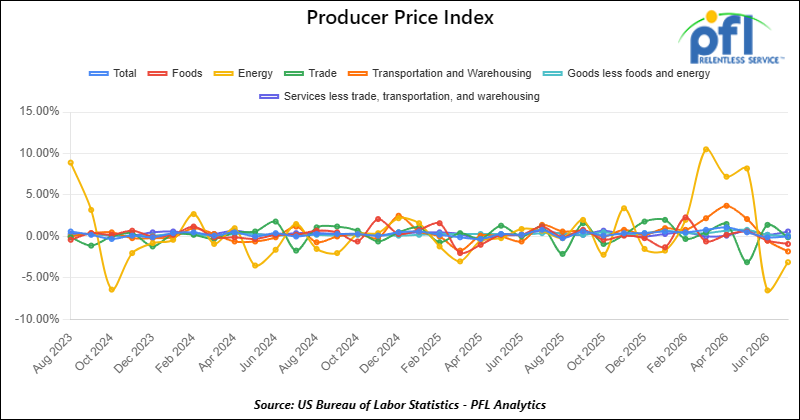
Lease Bids
- 20-50, 4000-5000 Covered Hoppers located off of UP or BNSF in Houston. For use in Urea, Potash, and Ammonium Sulfate service. Period: 6-12 Months.
- 30-50, 25.5K DOT 111 Tanks located off of All Class 1s in various locations. For use in Asphalt service. Period: 1-3 Years.
- 40, 29K DOT 111 Tanks located off of UP or BNSF in the Midwest. For use in Veg Oil service. Period: 5 Year.
- 20, DOT 117J Tanks located off of NS, CSX, CN, or CPKC in various locations. For use in C5 service. Period: 1 year. Need gauge rods.
- 300, 5200CF Covered Hoppers located off of CP or CM in Canada. For use in Petcoke service. Period: 3 Year.
- 10, 30K 117J Tanks located off of BNSF in Canada. For use in Propane or Butane service. Period: 3 Year.
- 20, 28K or larger 117J Tanks located off of BNSF or UP in California. For use in Crude service. Period: 6 months.
- 75, 30K DOT 117 Tanks located off of NS in Ohio. For use in Condensate service. Period: 6-12 Months. Mag Rods Not Needed.
- 100, 28.3K DOT 111 or 117 Tanks located off of CP or CN in Canada. For use in VGO service. Period: 1-3 Years.
- 5, 28.3K DOT 111 or 117 Tanks located off of CN in Canada. For use in Bitumen service. Period: Trip Lease.
- 5-10, 25.5K DOT 111 Tanks located off of CN in Canada. For use in Caustic service. Period: 3-6 Months.
- 100, 340W Pressure Tank located off of CN or CP in Canada. For use in Propane service. Period: 6 Months.
- 10-20, 3200 or 3281 Covered Hoppers located off of CN or CP in Canada. For use in Sodium Sulphate service. Period: 3-5 years. Lined.
- 50, 340W Pressure Tanks located off of CN or CP in Canada. For use in Propane service. Period: Winter.
- 30-50, 340W pressure Tanks located off of NS or CSX in Northeast U.S. For use in Propane service. Period: Winter.
- 25, 340W Pressure Tanks located off of UP or BN in US. For use in Propane service. Period: Winter.
- 50, 28.3K 117J Tanks located off of BNSF in Kansas/Oklahoma. For use in Fuel Oil service. Period: 6 Months.
- 100, 28.3K 117J Tanks located off of CN in Canada. For use in Diesel service. Period: 1 year.
Sales Bids
- 28, 3400CF Covered Hoppers located off of UP or BNSF in Texas. For use in Cement service. Cement Gates needed.
- 20, 17K DOT111 Tanks located off of various class 1s in various locations. For use in corn syrup service.
- 120, Various Open-Top Aluminum Rotary Gondolas located off of various class 1s in various locations. For use in Sulphur service. Built 2004 or later.
- 12, 21.5K-25K DOT 111 Tanks located off of Various Class 1s in Michigan. For use in Diesel, Asphalt, Crude service. Coiled and Insulated.
Lease Offers
- 21, 6351 Covered Hoppers located off of CN in Wisconsin. Last used in DDG. Available until February 2027.
- 29, 6500 Covered Hoppers located off of CN in Wisconsin. Last used in DDG. Available until February 2027.
- 29, 25.5K DOT117J Tanks located off of UP or BNSF in Texas. Cars are currently clean.
- 200, 340W DOT 112J Tanks located off of all class 1s in Multiple Locations. Last used in propane and butane. Cars are currently clean.
- 15, 6200CF Covered Hoppers located off of all class 1s in Wisconsin. Last used in plastic. Cars are currently clean.
- 30, 6500CF Covered Hoppers located off of all class 1s in Wisconsin. Last used in plastic. Cars are currently clean.
- 6, 21K Stainless Steel Tanks located off of UP in Texas / Mexico Border. Last used in surfactant. Cars are currently clean.
- 100, 28.4K DOT 117J Tanks located off of UP or BNSF in Beaumont, TX. Cars are currently clean.
- 50, 30K DOT117J Tanks located off of UP or BNSF in the South. Last used in ethanol.
- 30, 30K DOT 117R Tanks located off of BNSF in Washington. Last used in renewable jet fuel.
- 80, 30K DOT 117R Tanks located off of BNSF in Washington. Last used in renewable diesel.
- 10, 30K DOT 117R Tanks located off of BNSF in Washington. Last used in renewable naphtha.
- 10, 29K DOT 117R Tanks located off of BNSF and UP in Texas. Last used in gasoline additive. Coiled and Insulated.
- 39, 31K CPC1232 Tanks located off of All Class 1s in Iowa. Last used in diesel.
- 2, 30K DOT 117R Tanks located off of BNSF and UP in Texas. Last used in Diesel.
- 1, 30K DOT 117R Tanks located off of BNSF and UP in Texas. Last used in gas blend stock.
- 3, 30K DOT 117R Tanks located off of BNSF and UP in Texas. Last used in gasoline.
- 41, 30K DOT 111 Tanks located off of in Brownsville. Last used in Diesel. Cars are currently clean.
Sales Offers
- 81, 31.8K CPC1232 Tanks located off of UP or BNSF in TX. Last used in Multiple Services. Requal Due in 2025.
- 35, 3400CF Covered Hoppers located off of UP or BNSF in the Midwest. Last used in Sand.
- 25, 30K 117J Tanks located off of CSX in Jackson, TN. Last used in Fuels. Newly Requalified.
- 15, 5750 CF Hopper located off of CSX, NS, CP, CN, BNSF, UP in St Louis. Last used in Grain.
- 50, 30 DOT 111 Tank located off of multiple class 1s in multiple location. Last used in Fuels.
Call PFL today to discuss your needs and our availability and market reach. Whether you are looking to lease cars, lease out cars, buy cars, or sell cars call PFL today at 239-390-2885
Railcar for Sale or Lease
| CAT | Type | Capacity | GRL | QTY | LOC | Class | Prev. Use | Offer | Note |
|---|
| CAT | Type | Size | GRL | QTY | LOC | Class | Term | Commodity | Offer | Note |
|---|
| CAT | Type | Capacity | GRL | QTY | LOC | Class | Prev. Use | Clean | Offer | Note |
|---|
| CAT | Type | Capacity | GRL | QTY | LOC | Class | Commodity | Offer | Note |
|---|
PFL will be at the Following Conferences
- Where: The Westin Galleria Dallas
- Attending: David Cohen (954-729-4774), and Curtis Chandler (239-405-3365)
- Conference Website
- Where: The Westin Galleria Dallas
- Attending: Brian Baker (239.297.4519)
- Conference Website
The post PFL Railcar Report 8-17-2026 appeared first on PFL Petroleum Services LTD.
]]>